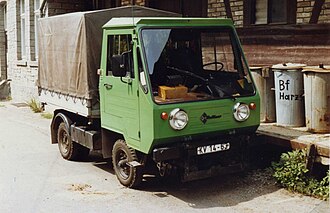
Multicar M25: The Small East German Truck That Became a Legend
The Multicar M25 is one of those commercial vehicles whose modest dimensions conceal just how important and versatile it was. Developed in the German Democratic Republic and manufactured at the VEB Fahrzeugwerk Waltershausen, the M25 became the best-known member of the Multicar family and one of the most recognizable compact utility trucks produced in Eastern Europe. Introduced in 1978 as the successor to the Multicar M24, it combined a small footprint with a useful payload, simple diesel mechanics, and an exceptionally adaptable chassis. More than 100,000 vehicles from the M25 family were produced, and large numbers were exported, making the little truck familiar not only in East Germany but throughout the wider Eastern Bloc and in Western markets as well.
What made the M25 unusual was its ability to occupy a space between a conventional light truck and a specialist municipal machine. It was small enough to operate in narrow streets, industrial compounds, farms, construction sites, and courtyards, yet it could carry around two tonnes or more depending on the version. The vehicle could also be fitted with a remarkable variety of bodies and attachments, transforming the same basic chassis into a flatbed, tipper, snowplough, sweeper, tanker, service vehicle, or other specialized machine. This modularity was not merely a convenient feature; it was the central idea behind the Multicar concept and one of the main reasons the M25 remained in production for so many years.
The History of the Multicar M25
From the M24 to a New Generation
The M25 was introduced in 1978, replacing the Multicar M24. The M24 had already established the basic formula of a compact, highly maneuverable work vehicle, but the M25 refined the concept and gave it a more mature appearance and greater development potential. The new truck retained the compact dimensions and practical construction of its predecessor while receiving a redesigned cab, improved driver visibility, and a chassis intended to support an expanding selection of specialized equipment. The German Patent and Trade Mark Office describes the M25 as the technically and visually improved successor to the M24 and notes that four-wheel drive became available from 1982.
The visual differences between the M24 and early M25 were not dramatic, but they were significant. The M25 received a more modern cab with an elongated windscreen and larger side-window areas that improved the driver’s view toward the front-mounted equipment. Inside, the driving position was also developed further, with improved seating and a more clearly arranged instrument panel. The cab could be tilted forward for maintenance, an especially useful feature on a vehicle whose engine was installed beneath the front section of the cab.
The M25 quickly became more than simply another small truck. Its standardized chassis and hydraulic systems allowed different bodies and implements to be fitted, giving municipalities and industrial operators a single vehicle platform that could perform numerous jobs. This was particularly valuable in East Germany, where public-sector organizations, factories, agricultural enterprises, and municipal services needed durable equipment that could be used intensively without the complexity of modern specialized machinery.
A Major Export Product
The M25 became an important export vehicle for the East German automotive industry. Sources differ somewhat in how they count the final production period and total output, particularly because the later Multicar 91 is sometimes included in overall M25-family figures, but the commonly cited total is more than 100,000 vehicles. A substantial proportion went abroad. One historical account notes that approximately 70 percent of production was exported, while other sources give somewhat different proportions depending on the period and definition used.
This export success was remarkable for such a specialized vehicle. The M25 found customers because its advantages were not tied exclusively to the East German economy. Small municipalities, factories, farms, construction companies, and utility organizations in other countries also needed vehicles that could carry loads while fitting into confined spaces. Its relatively simple mechanical design was another advantage in regions where advanced commercial-vehicle servicing was not always available.
The Design of the Multicar M25
Small Dimensions, Serious Utility
The most obvious characteristic of the M25 is its compactness. A standard short-wheelbase version was only around four metres long, while the vehicle’s narrow body made it much easier to maneuver than a conventional medium-sized truck. One documented M25 specification gives a wheelbase of approximately 1,970 mm, while later versions such as the M25.1A used a 2,100 mm wheelbase and long-wheelbase versions extended this to approximately 2,675 mm.
The compact layout was particularly valuable in urban work. A refuse vehicle, street-cleaning truck, maintenance vehicle, or construction transporter frequently has to stop beside buildings, turn in restricted spaces, negotiate narrow lanes, or work around parked cars and other obstacles. A full-size truck can perform these tasks, but it consumes considerably more road space and may be less maneuverable. The M25 was designed specifically to make this kind of work easier.
Despite its small size, the truck could carry a substantial payload. Depending on the configuration, published specifications give payload figures of around 2.2 to 2.3 tonnes, while some versions and sources list somewhat different capacities. This was one of the M25’s most impressive characteristics: its payload was large relative to its physical dimensions and curb weight.
The Characteristic Cab
The M25’s two-seat cab became one of the most recognizable shapes associated with the Multicar name. The broad windscreen, upright construction, compact doors, and distinctive proportions gave the vehicle a personality of its own. It was not styled for appearance in the modern passenger-car sense; virtually every element served a practical purpose.
Visibility was particularly important. Because many M25s were designed to carry front-mounted or specialized equipment, the driver needed to see the area immediately ahead of the vehicle. The redesigned windscreen and side windows therefore had a functional role. The compact nose and relatively upright cab also helped the driver judge the vehicle’s position when working close to buildings, machinery, curbs, or other obstacles.
The cab remained a utilitarian environment. Comfort levels were basic compared with modern commercial vehicles, but the interior was straightforward and durable. The driver was provided with the essential controls and instrumentation without the electronic complexity that would later become standard in commercial vehicles. This simplicity remains one of the attractions of surviving M25s for enthusiasts and owners who appreciate older mechanical machinery.
Engine and Mechanical Engineering
The Original 2.0-Litre Diesel
Early M25 vehicles used a four-cylinder diesel engine manufactured by VEB Motorenwerk Cunewalde. The commonly documented engine was the 4 VD 8.8/8.5-2 SRF, with a displacement of approximately 1,996 cc and an output of around 45 horsepower (33 kW). The engine was water-cooled and naturally aspirated, reflecting the straightforward mechanical philosophy of the vehicle.
Forty-five horsepower may seem extremely modest today, but the M25 was not intended to be a high-speed transport truck. Its job was to move heavy loads at relatively low speeds while providing reliable operation in urban, industrial, agricultural, and municipal environments. The engine’s torque characteristics were therefore more important than headline horsepower. A mechanically injected diesel was also familiar technology for workshops of the period and could be maintained without sophisticated electronic diagnostic equipment.
The original M25 generally had a four-speed manual gearbox and rear-wheel drive. Published specifications commonly give a maximum speed around 50 km/h for the early version. This again reflects the vehicle’s role. The M25 was primarily a working machine rather than a long-distance freight vehicle, and its performance was optimized around maneuverability, carrying capacity, and utility.
The Larger Engine and M25.1A
The M25 family evolved during production. From the mid-1980s, the M25.1A received the larger 2,238 cc 4 VD 8.8/9-1 SRF diesel engine. Output increased only slightly to approximately 46 horsepower (34 kW), but the larger engine produced more torque, which was more useful for a heavily loaded utility truck. Documented figures give approximately 124 Nm of torque.
The M25.1A was also associated with four-wheel drive. Although four-wheel drive became available on the M25 from 1982, the later M25.1A represented a more developed version of the concept. Mechanically selectable front-wheel drive made the vehicle considerably more capable on slippery surfaces, rough access roads, construction sites, fields, and snow-covered streets. The combination of compact dimensions and 4×4 traction gave the M25 a capability that could be disproportionately useful compared with its size.
The M25 as a 4×4 Utility Vehicle
Four-Wheel Drive Changes the Character
The arrival of four-wheel drive expanded the M25’s operating possibilities considerably. In ordinary road conditions, rear-wheel drive was sufficient for many applications, but when the vehicle encountered mud, snow, loose gravel, steep access roads, or construction terrain, the ability to mechanically engage the front axle provided additional traction.
This was particularly useful for municipal operators. Winter-maintenance vehicles, for example, could encounter snow and slippery surfaces precisely when traction was most important. Similarly, agricultural and construction operators could use a compact 4×4 M25 in places where a conventional two-wheel-drive truck might struggle. The vehicle’s small dimensions remained a major advantage because four-wheel-drive capability did not require turning it into a large off-road truck.
The M25.1A also used a reduction gear as available equipment, giving the truck a very low-speed operating capability for difficult conditions and specialized work. One documented specification lists a minimum speed of approximately 1 km/h with the appropriate creeper arrangement.
Long-Wheelbase and Specialized Versions
M25L and M25.1AL
The M25 was offered with more than one wheelbase, allowing customers to choose between maneuverability and greater body length. The long-wheelbase versions used a wheelbase of approximately 2,675 mm, compared with around 1,970 mm for the early short version. The extended chassis could accommodate longer bodies and was particularly useful when additional cargo space was more important than the absolute minimum turning circle.
The long versions could be configured as flatbeds and later with enclosed bodies, including insulated versions. Raised sideboards and tarpaulin-covered cargo areas also appeared. This demonstrates again that the M25 was not one rigid design but an adaptable vehicle family capable of meeting different transport requirements.
The choice between short and long wheelbases also illustrates one of the most important principles behind the Multicar concept. Instead of producing entirely different vehicles for different tasks, the manufacturer could alter the chassis and body configuration while preserving the underlying mechanical architecture. This reduced complexity for operators and created a broad range of applications from a relatively small industrial platform.
Municipal Equipment and Attachments
The M25 became especially famous for its wide selection of bodies and attachments. Depending on the version, it could be equipped as a three-way tipper, flatbed, enclosed transporter, refuse vehicle, sweeper, snow-removal machine, tanker, or specialist service vehicle. Contemporary descriptions list numerous body variants, while historical accounts emphasize that the M25 could accept a large number of different superstructures and attachments.
The three-way tipper was particularly useful for construction and municipal operations because material could be discharged to the rear or either side. This was a practical advantage in restricted work areas where there might not be enough space to position the truck directly behind a pile or excavation. Other equipment could use the vehicle’s hydraulic and power-take-off systems to operate specialist machinery.
The result was a truck that could change roles according to the season or job. The same basic chassis might be used for transporting materials in summer, clearing snow in winter, or performing municipal maintenance throughout the year. Such flexibility helps explain why Multicars remained in service long after many larger commercial vehicles from the same period had disappeared.
The Multicar M25 After German Reunification
The Transition to the Multicar 91
The political and economic transformation of Germany around 1990 presented an enormous challenge for East German vehicle manufacturers. The M25, however, had a significant advantage: it occupied a specialized market that was not easily served by conventional trucks. Rather than disappearing immediately, the vehicle was updated for the post-reunification market.
From 1991, the M25 evolved into the Multicar 91, which incorporated a Volkswagen diesel engine. Sources commonly identify the engine as a 1.9-litre four-cylinder diesel producing approximately 40 kW or 54 hp. The newer engine increased maximum speed to approximately 70 km/h in the updated vehicle.
The Multicar 91 represents an important transitional moment in the history of the company. The basic M25 architecture was retained, but components from Western suppliers were introduced to meet the requirements of the newly unified German market. Production of the M25/91 family ended as the more modern Multicar M26 took over, with sources placing the final transition around 1992–1993 depending on how the variants are counted.
Why the Multicar M25 Became a Legend
More Than Just a Small Truck
The enduring reputation of the M25 comes from the way it combined characteristics that rarely appeared together. It was compact but had a substantial payload. It was mechanically simple but could operate complex attachments. It was available with rear-wheel drive for ordinary work and four-wheel drive for more demanding conditions. It was slow compared with modern vehicles, yet its speed was adequate for the local and municipal work for which it was designed.
Its importance can also be measured by its production volume. More than 100,000 examples of the M25 family were built, making it vastly more widespread than many specialist commercial vehicles from the same era. Its presence in Central European towns and industrial facilities became so familiar that the word “Multicar” itself became closely associated with small municipal trucks.
Even today, surviving examples can still be found working on farms, private properties, construction sites, and in collections. Their continued usefulness says something important about the original design. A vehicle does not remain practical for decades simply because it is historically interesting; it survives because the basic engineering remains suited to real work.
Conclusion
The Multicar M25 was one of the most successful compact utility trucks produced in the former Eastern Bloc. Introduced in 1978 as the successor to the M24, it refined the concept of a small but highly adaptable working vehicle and ultimately became the defining model of the Multicar brand. Its compact dimensions, approximately two-tonne-plus payload capability, simple diesel engines, manual transmission, hydraulic equipment options, and later availability with four-wheel drive gave it an unusually broad operating range.
The M25 was never intended to replace a full-size lorry. Its strength was doing jobs for which a large truck was simply too cumbersome. It could squeeze through narrow streets, maneuver around industrial facilities, carry materials on construction sites, clear snow, transport equipment, and operate a variety of specialist bodies. The long-wheelbase versions extended its usefulness, while the M25.1A and four-wheel-drive derivatives added further capability.
Its story continued after the end of the GDR, with the Multicar 91 adapting the basic concept to a newly unified German market and introducing a Volkswagen diesel engine. Eventually, the M26 succeeded the M25 family, but the basic philosophy remained remarkably consistent: build a compact, robust carrier that can perform many different jobs.
That philosophy is ultimately what makes the Multicar M25 so interesting. It was small enough to be underestimated, but its versatility made it a serious piece of commercial equipment. More than four decades after its introduction, the distinctive little East German truck remains a symbol of practical engineering, municipal utility, and a period when straightforward mechanical design could turn a very small vehicle into an extraordinarily useful working machine.
Multicar M25 Technical Specifications
Because the M25 was produced in numerous configurations, there is no single specification sheet that accurately describes every example. The table below focuses on commonly documented versions and highlights the principal differences between the early M25, the later M25.1A 4×4, and the long-wheelbase derivatives.
| Technical specification | Multicar M25 | Multicar M25.1A / 4×4 |
|---|---|---|
| Manufacturer | VEB Fahrzeugwerk Waltershausen | VEB Fahrzeugwerk Waltershausen |
| Country of origin | GDR / East Germany | GDR / East Germany |
| Production period | 1978–1991 for core M25 production | 1985–1991 commonly documented |
| M25-family production | More than 100,000 | Included in overall M25 total |
| Vehicle type | Compact utility/light truck | Compact 4×4 utility truck |
| Engine | 4 VD 8.8/8.5-2 SRF | 4 VD 8.8/9-1 SRF |
| Engine layout | Inline 4-cylinder diesel | Inline 4-cylinder diesel |
| Cooling | Liquid/water | Liquid/water |
| Displacement | 1,996 cc | 2,238 cc |
| Power | Approx. 45 hp / 33 kW | Approx. 46 hp / 34 kW |
| Torque | Approx. 108–110 Nm | Approx. 124 Nm |
| Transmission | 4-speed manual | 4-speed manual |
| Reverse gears | 1 | 1 |
| Drive | 4×2 rear-wheel drive | Selectable 4×4 |
| Maximum speed | Approx. 50 km/h | Approx. 60 km/h |
| Typical short wheelbase | Approx. 1,970 mm | Approx. 2,100 mm |
| Long-wheelbase version | M25L, approx. 2,675 mm | M25.1AL, approx. 2,675 mm |
| Typical width | Approx. 1,810 mm | Approx. 1,870 mm |
| Typical height | Approx. 2,140 mm | Approx. 2,155 mm |
| Ground clearance | Around 200 mm, configuration dependent | Around 200 mm |
| Curb weight | Approx. 1,580–1,700 kg | Approx. 1,600–1,700 kg |
| Payload | Up to approx. 2,200 kg | Up to approx. 2,200–2,300 kg, configuration dependent |
| Gross vehicle weight | Up to around 3.9 tonnes | Up to around 3.95 tonnes |
| Brakes | Drum brakes | Drum brakes |
| Rear wheels | Often twin rear wheels | Twin rear wheels on documented versions |
| Special equipment | Hydraulic systems, tippers, flatbeds, enclosed bodies and municipal equipment | Same, plus enhanced off-road capability |
| Notable feature | Extremely compact multifunctional chassis | Selectable 4×4 and higher-torque engine |
Specifications vary by production year, body, wheelbase, drivetrain, and market. Historical sources also differ slightly in how they classify the M25, M25.1, M25.1A, M25L, M25.1AL, and later Multicar 91 variants, so individual vehicles should be identified by their exact type plate and factory documentation.
