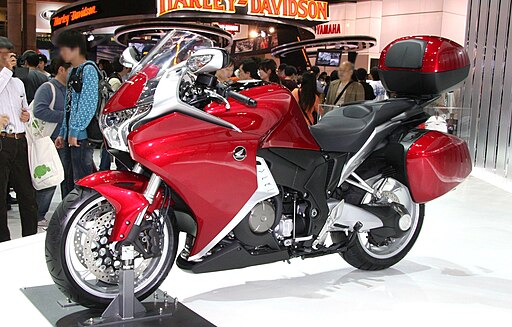
The Honda VFR1200F is one of Honda’s most ambitious and technologically advanced sport-touring motorcycles. Introduced in 2009 as a 2010 model, the VFR1200F represented a bold new direction for the legendary VFR lineage—a series celebrated for its balance of sport performance, refinement, and everyday usability.
Developed under the codename “Project 1200,” the VFR1200F was envisioned as a high-performance, long-distance machine that blended the excitement of a superbike with the comfort and practicality of a touring motorcycle. It introduced a powerful new V4 engine, an advanced Dual Clutch Transmission (DCT) option, and a radical design language that set it apart from both its predecessors and its competitors.
Design Philosophy
The VFR1200F’s design philosophy centered around three key themes: human fit, aerodynamic efficiency, and mechanical purity. Honda’s engineers aimed to create a motorcycle that felt natural to ride, looked futuristic, and performed effortlessly on any road.
Its bodywork was sculpted using mass centralization principles, with flowing, layered panels designed to optimize airflow and rider protection. The motorcycle’s “X-shaped” front fascia and integrated exhaust design gave it a distinctive identity—sleek, functional, and unmistakably Honda.
The VFR1200F’s engineering was rooted in Honda’s V4 heritage, drawing inspiration from legendary machines such as the VFR750F and the RC30. However, this model was a complete reinvention, introducing a larger displacement engine, ride-by-wire technology, and electronic integration that represented a leap forward in Honda’s design evolution.
Engine and Performance
At the heart of the VFR1200F is a 1,237 cc V4 engine, designed to deliver seamless torque, linear power delivery, and a distinctive V4 character. The engine uses a 76-degree V configuration, which balances compactness and smoothness, and employs Honda’s signature Unicam valve train system for reduced mass and height.
-
Engine Type: 4-stroke, 76° V4, liquid-cooled, SOHC, 16-valve
-
Displacement: 1,237 cc
-
Bore x Stroke: 81.0 mm × 60.0 mm
-
Compression Ratio: 12.0:1
-
Fuel System: PGM-FI (Programmed Fuel Injection)
-
Ignition: Digital transistorized ignition with 3D mapping
-
Maximum Power Output: Approximately 170 hp (127 kW) at 10,000 rpm
-
Maximum Torque: Around 129 Nm (95 lb-ft) at 8,750 rpm
This engine marked a technological milestone with its shaft-drive system and unique crankshaft configuration—each pair of cylinders shared offset crankpins, creating perfect primary balance and eliminating much of the vibration typical of V4 engines.
Power delivery was tuned for both smooth highway cruising and explosive acceleration. The broad torque curve provided strong pull even from low revs, making the VFR1200F equally adept at relaxed touring and high-speed sport riding.
Transmission and Drivetrain
One of the VFR1200F’s defining innovations was the introduction of Honda’s first-ever Dual Clutch Transmission (DCT) in a production motorcycle. Riders could choose between a 6-speed manual transmission or the 6-speed automatic DCT, which offered seamless gear shifts without the use of a clutch lever.
-
Transmission: 6-speed manual or 6-speed Dual Clutch Transmission
-
Clutch Type: Wet, multi-plate hydraulic
-
Final Drive: Shaft (enclosed)
The DCT system allowed two clutches—one for odd gears (1, 3, 5) and another for even gears (2, 4, 6)—to alternate seamlessly. This resulted in lightning-fast shifts with no interruption in power delivery. Riders could operate the gearbox in full automatic mode or switch to manual control using thumb-operated paddles on the handlebar.
The shaft drive was housed in a single-sided swingarm and featured an innovative offset pivot design to reduce torque reaction during acceleration and deceleration. The result was a remarkably smooth and direct drivetrain with minimal maintenance requirements.
Chassis and Frame Construction
The VFR1200F’s chassis was engineered to deliver stability, precision, and comfort. It featured a die-cast aluminum twin-spar frame, optimized for rigidity and balanced weight distribution.
-
Frame Type: Diamond-type aluminum twin-spar
-
Rake (Caster Angle): 25°30′
-
Trail: 101 mm
-
Wheelbase: 1,545 mm
The frame’s rigidity and geometry provided neutral steering and predictable handling, even under the heavy loads of long-distance touring. Combined with mass centralization around the engine and fuel tank, the VFR1200F achieved exceptional stability at high speeds while maintaining agility in tight corners.
Suspension System
The suspension setup was designed to handle both sporty cornering and long-distance comfort, featuring high-quality, fully adjustable components.
-
Front Suspension: 43 mm cartridge-type telescopic fork, preload and rebound adjustable
-
Rear Suspension: Pro-Link monoshock with gas-charged damper, preload and rebound adjustable
-
Front Wheel Travel: 120 mm
-
Rear Wheel Travel: 130 mm
This suspension system provided a balance between comfort and control, absorbing road imperfections while maintaining precise feedback through the chassis.
Braking and Safety Systems
The VFR1200F’s braking performance was on par with superbikes of its time, complemented by advanced electronic safety aids.
-
Front Brakes: Dual 320 mm floating discs with 6-piston calipers
-
Rear Brake: Single 276 mm disc with 2-piston caliper
-
Braking System: Combined ABS (Honda’s Combined Braking System with anti-lock functionality)
The Combined ABS system proportionally distributed braking force between the front and rear wheels, ensuring stability and control during emergency stops. The inclusion of standard ABS across all versions reinforced Honda’s commitment to safety.
Aerodynamics and Ergonomics
The VFR1200F’s aerodynamics were the result of extensive wind tunnel testing. The layered bodywork design channeled air smoothly around the rider, reducing turbulence and fatigue during long rides.
The fuel tank, sculpted for both aesthetics and knee grip, contributed to the bike’s aerodynamic efficiency. The seat and handlebar placement created a slightly forward-leaning but comfortable sport-touring riding position—ideal for long journeys without compromising control.
The windscreen and fairing were designed to provide superior wind protection, while the integrated side panels helped manage airflow and engine heat, keeping the rider comfortable in varied conditions.
Dimensions and Weight
-
Overall Length: 2,250 mm
-
Overall Width: 755 mm
-
Overall Height: 1,220 mm
-
Wheelbase: 1,545 mm
-
Seat Height: 815 mm
-
Ground Clearance: 125 mm
-
Curb Weight: 267 kg (manual) / 277 kg (DCT)
-
Fuel Tank Capacity: 18.5 liters
Despite its size and touring orientation, the VFR1200F’s weight distribution gave it a surprisingly agile feel, particularly at midrange speeds.
Electrical and Electronic Systems
The VFR1200F was packed with advanced electronics for its era. Its ride-by-wire throttle system ensured precise control, while the PGM-FI injection system optimized fuel efficiency and throttle response.
-
Electrical System: 12V DC
-
Battery Capacity: 12V, 11.2Ah
-
Lighting: Dual halogen headlights (later models offered LED upgrades)
-
Instrumentation: Multi-function digital display with analog tachometer, trip computer, fuel consumption meter, gear indicator, and ambient temperature sensor
Later models included refinements to the throttle response, traction control (on some markets), and DCT logic for smoother, more intuitive operation.
Performance and Riding Dynamics
The VFR1200F delivers an exhilarating yet refined riding experience. Its V4 engine provides a deep, muscular exhaust note and an abundance of torque that makes gear selection almost optional. Power delivery is smooth and predictable, with a surge of acceleration from the midrange that continues to redline without harshness.
High-speed stability is exceptional, thanks to the aerodynamic bodywork and balanced chassis. The bike’s advanced suspension and linked braking system inspire confidence in both spirited cornering and long-distance touring scenarios.
Despite its size, the VFR1200F handles like a much lighter motorcycle, aided by precise steering geometry and a low center of gravity.
Variants and Model Evolution
Throughout its production, Honda offered several versions and updates to the VFR1200F platform:
-
2010–2011: Launch of the standard VFR1200F (manual and DCT versions).
-
2012: Introduction of traction control and improved throttle mapping.
-
2013: Cosmetic updates and minor refinements to fuel range and seat comfort.
-
VFR1200X Crosstourer: Adventure-oriented derivative sharing the same V4 engine and DCT system, optimized for long-distance touring and light off-road use.
Production of the VFR1200F continued until the mid-2010s, with the platform evolving into the VFR1200X and later influencing the NT1100 and Africa Twin DCT systems.
Legacy and Impact
The Honda VFR1200F occupies a unique place in motorcycle history. It was both a technological pioneer and a bold design statement. The introduction of DCT technology revolutionized the concept of transmission systems in motorcycles, influencing future Honda models across multiple segments.
Although some riders viewed its futuristic styling and shaft drive as a departure from the traditional VFR ethos, the VFR1200F remains one of the most engineered and refined sport-touring motorcycles ever built. Its combination of power, comfort, and innovation solidified Honda’s reputation for pushing the boundaries of motorcycle design.
Conclusion
The Honda VFR1200F represents the pinnacle of Honda’s V4 engineering philosophy—a motorcycle that combines cutting-edge technology, superior craftsmanship, and long-distance comfort in a cohesive, high-performance package.
