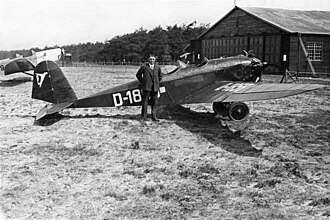
The BFW M.23 occupies a fascinating place in the history of European aviation. Although it never achieved the worldwide fame of iconic aircraft such as the Junkers Ju 52 or the de Havilland Tiger Moth, the M.23 represented an important milestone in the development of German civil aviation during the interwar period. Combining efficient aerodynamic design, lightweight construction, excellent handling qualities, and practical versatility, the aircraft became one of the most successful light touring airplanes produced by Bayerische Flugzeugwerke (BFW), the company that would later become internationally famous as Messerschmitt.
Developed during a period when aviation was evolving at an extraordinary pace, the M.23 reflected the optimism and technological ambition of the late 1920s. Air travel was steadily becoming more accessible, flying clubs were expanding across Europe, and governments increasingly recognized aviation as both an economic opportunity and a symbol of national technological progress. In this environment, there was growing demand for aircraft that could perform multiple roles—pilot training, touring, business transportation, aerial photography, mail delivery, and participation in competitive air races.
The M.23 answered these requirements remarkably well. It was not designed as a military aircraft or a heavy commercial transport. Instead, it represented an efficient, economical airplane intended for everyday flying. It possessed the flexibility to carry passengers, undertake long cross-country journeys, participate in international aviation competitions, and operate from relatively modest airfields. This versatility made it attractive not only within Germany but also in several export markets where light aircraft were becoming increasingly popular.
Perhaps even more importantly, the aircraft played a role in establishing the reputation of Bayerische Flugzeugwerke as a manufacturer capable of producing sophisticated, reliable aircraft. Many of the engineering principles explored during the M.23’s development would later influence aircraft designed by one of Germany’s most celebrated aviation engineers, Willy Messerschmitt. Although later military designs would overshadow these early civil aircraft, the M.23 deserves recognition as one of the foundations upon which Germany’s modern aircraft industry was built.
Germany’s Aviation Industry After the First World War
The story of the M.23 cannot be separated from the political and industrial circumstances that shaped German aviation following the First World War.
The Treaty of Versailles imposed severe restrictions on German military aviation, effectively eliminating the country’s air force and limiting aircraft production. While these restrictions created enormous challenges for manufacturers, they also encouraged many companies to focus their efforts on civil aviation.
During the 1920s, Germany experienced a remarkable resurgence in aircraft design despite these limitations. Manufacturers concentrated on producing touring aircraft, trainers, gliders, postal aircraft, and commercial transports. Flying clubs flourished, encouraged by public enthusiasm for aviation and by government policies that quietly supported the preservation of aeronautical expertise.
Bayerische Flugzeugwerke became one of several companies seeking opportunities within this expanding civilian market. Rather than competing solely in large commercial transports, the company recognized the growing demand for efficient light aircraft capable of serving private owners, flying schools, businesses, and aviation organizations.
The M.23 emerged directly from this environment of innovation, optimism, and practical necessity.
Bayerische Flugzeugwerke and a New Generation of Aircraft
The Bayerische Flugzeugwerke had already begun developing a reputation for modern engineering by the late 1920s. Engineers sought to move beyond the structural concepts inherited from the First World War and embrace lighter, more aerodynamic aircraft suited to civilian operations.
Among the most influential figures associated with the company was Willy Messerschmitt, whose design philosophy emphasized lightweight construction, structural efficiency, and aerodynamic refinement. Even before achieving international fame with later military aircraft, Messerschmitt advocated minimizing structural weight while maximizing performance through intelligent engineering rather than brute engine power.
The M.23 reflected these ideas.
Instead of relying upon oversized engines or unnecessarily robust structures, the aircraft sought efficiency through careful aerodynamic shaping, rational structural design, and attention to operational practicality.
This philosophy would become one of the defining characteristics of Messerschmitt’s later work.
Development of the M.23
Development of the M.23 began during the late 1920s as demand increased for versatile civil aircraft capable of performing numerous tasks without excessive operating costs.
Designers envisioned an airplane suitable for private ownership while remaining attractive to commercial operators and flying clubs.
Several factors influenced the design.
The aircraft needed sufficient range for cross-country touring.
It required comfortable accommodation for passengers.
Maintenance had to remain relatively simple.
Operating costs needed to be competitive.
Performance had to be respectable despite modest engine power.
Rather than specializing in one narrow role, the M.23 aimed to become an all-purpose light aircraft.
This flexibility proved central to its commercial appeal.
Aerodynamic Design
One of the most striking characteristics of the M.23 was its clean aerodynamic appearance.
The aircraft employed a high-wing monoplane configuration at a time when many manufacturers still relied upon biplane layouts.
Monoplanes offered significantly lower aerodynamic drag than comparable biplanes because they eliminated the complex system of interplane struts and bracing wires.
The high wing also provided excellent downward visibility, making the aircraft particularly suitable for navigation, sightseeing, aerial observation, and pilot instruction.
Wing struts remained necessary to support the structure, but careful engineering minimized their aerodynamic penalty.
The fuselage featured smooth contours that blended naturally into the engine cowling and cabin, reducing airflow separation while improving overall efficiency.
Although modest by modern standards, these refinements represented advanced thinking during the late 1920s.
Structural Engineering
The M.23 combined traditional aircraft construction techniques with increasingly modern engineering practices.
Its fuselage employed a welded steel tube framework providing excellent structural strength while remaining relatively lightweight.
Fabric covering reduced overall mass and simplified repairs.
The wings primarily utilized wooden construction, reflecting the widespread availability of high-quality aircraft timber and the manufacturing capabilities of the era.
Wood remained an excellent structural material when properly designed and maintained. It provided impressive strength-to-weight ratios while allowing relatively inexpensive production.
Control surfaces likewise employed lightweight frameworks covered with fabric.
This combination of steel, wood, and fabric became characteristic of many successful aircraft during the interwar years.
Engine Installations
The M.23 appeared with several different engine options throughout its production life.
Depending upon customer requirements and production variant, aircraft were equipped with engines from manufacturers including Siemens, Argus Motoren, and others.
Power outputs varied considerably, reflecting both technological progress and differing operational requirements.
Earlier radial engines offered simplicity, effective cooling, and mechanical reliability.
Inline engines later improved aerodynamic efficiency by presenting smaller frontal areas.
Despite relatively modest horsepower compared with later aircraft, the M.23 demonstrated impressive performance thanks to its lightweight construction and efficient aerodynamics.
This emphasis upon structural efficiency rather than overwhelming engine power became a recurring theme throughout Messerschmitt’s career.
Cockpit and Cabin
Unlike purely recreational aircraft, the M.23 was intended for practical transportation.
The enclosed cabin represented a considerable improvement over many open-cockpit aircraft still common during the period.
Passengers enjoyed greater comfort during longer flights, particularly under adverse weather conditions.
Large windows provided excellent visibility while allowing abundant natural light into the cabin.
Depending upon configuration, the aircraft accommodated the pilot together with several passengers.
Interior furnishings emphasized practicality rather than luxury, yet compared with many contemporary light aircraft, the M.23 offered a surprisingly civilized flying experience.
Noise levels remained relatively high by modern standards, but this reflected the technological limitations of piston-engine aircraft during the era rather than any specific shortcoming of the design.
Flight Characteristics
Pilots consistently praised the M.23 for its pleasant handling qualities.
The aircraft responded predictably to control inputs without becoming overly sensitive.
Longitudinal stability remained particularly strong, reducing pilot workload during extended cross-country flights.
Takeoff performance proved satisfactory from the grass airfields typical of the period.
Once airborne, the aircraft climbed steadily while maintaining comfortable visibility over the nose.
Cruise flight demonstrated excellent efficiency relative to installed engine power.
Landing characteristics likewise contributed to the aircraft’s popularity.
Moderate approach speeds, forgiving stall behavior, and stable handling made the aircraft suitable for pilots possessing varying levels of experience.
These qualities proved especially valuable within flying clubs and training organizations.
Touring Aircraft for a New Era
One of the M.23’s principal missions involved recreational and business touring.
During the late 1920s and early 1930s, aviation increasingly attracted wealthy enthusiasts interested in exploring Europe from the air.
Road infrastructure remained relatively underdeveloped in many regions, making aircraft attractive for rapid long-distance travel.
The M.23 offered an economical alternative to larger commercial transports.
Owners could undertake journeys between cities while enjoying the flexibility unavailable through scheduled airline services.
Flying clubs also organized group expeditions, encouraging private aviation throughout Germany and neighboring countries.
The aircraft’s respectable range and comfortable cabin made such adventures practical.
Flying Clubs and Pilot Training
Flying clubs played a central role in German aviation during the interwar years.
These organizations introduced countless individuals to flying while preserving aeronautical knowledge despite restrictions imposed after the First World War.
The M.23 became a valuable asset within many clubs because it combined forgiving handling with practical operating costs.
Student pilots benefited from stable flight characteristics.
Instructors appreciated the aircraft’s predictable behavior.
Club members valued its versatility for both local flights and longer excursions.
Many future military and commercial pilots gained valuable experience in aircraft such as the M.23 before progressing to more advanced machines.
Its contribution to pilot development therefore extended well beyond its commercial success.
Air Racing and Competitions
The interwar period witnessed enormous public enthusiasm for aviation competitions.
Cross-country races, endurance flights, navigation contests, and altitude attempts attracted widespread attention throughout Europe.
Manufacturers viewed these events as valuable opportunities to demonstrate aircraft performance and reliability.
The M.23 participated in numerous competitions where its combination of efficiency, handling, and dependable operation earned favorable recognition.
Although not designed specifically as a racing aircraft, it proved highly competitive within touring categories.
Success in these events enhanced the reputation of both the aircraft and its manufacturer.
Commercial Utility
Beyond recreational flying, the M.23 found employment in several commercial roles.
Small businesses utilized the aircraft for executive transportation.
Postal authorities explored its potential for mail delivery.
Photographers employed it for aerial survey work.
Government organizations occasionally used examples for inspection and liaison duties.
Its ability to adapt readily to differing missions contributed greatly to its market success.
Few aircraft of comparable size demonstrated such flexibility.
International Exports
Although primarily associated with Germany, the M.23 attracted international interest.
Several aircraft found customers abroad where operators appreciated German engineering quality and efficient performance.
Export success demonstrated the competitiveness of Germany’s recovering aviation industry despite continuing political and economic uncertainty.
International operations also exposed the aircraft to varying climates and operating conditions, further confirming its reliability.
Influence on Later Aircraft
Perhaps the greatest significance of the M.23 lies in its influence upon subsequent aircraft development.
Many structural concepts, aerodynamic ideas, and design philosophies explored during its creation reappeared in later Messerschmitt aircraft.
Lightweight construction became one of Willy Messerschmitt’s defining engineering principles.
Efficient aerodynamic layouts continued evolving throughout his career.
Attention to structural optimization rather than excessive engine power remained evident in many subsequent designs.
Although separated by mission and technology, there exists a clear intellectual connection between the modest touring aircraft of the late 1920s and the sophisticated fighters developed a decade later.
The M.23 therefore occupies an important place within this evolutionary process.
Legacy
Today, surviving M.23 aircraft are extremely rare, making preserved examples particularly valuable to aviation historians and museums.
They represent a formative period when civil aviation expanded rapidly despite significant political constraints.
The aircraft reminds us that aviation history extends far beyond famous military machines.
Touring aircraft, trainers, and utility airplanes often exert equally profound influence by developing engineering knowledge, training pilots, and expanding public enthusiasm for flight.
The M.23 also symbolizes the remarkable resilience of the German aviation industry during the interwar years. Despite economic instability and international restrictions, designers continued producing innovative aircraft that competed successfully within global civil aviation markets.
For enthusiasts of classic aviation, the BFW M.23 remains an elegant example of early monoplane development. Its graceful proportions, efficient structure, and practical versatility illustrate the transition from the fragile aircraft of the First World War toward the more refined civil airplanes that would define aviation during the 1930s.
Although overshadowed by later aircraft associated with the Messerschmitt name, the M.23 deserves recognition in its own right as one of the pioneering touring aircraft that helped establish Germany’s reputation for aerodynamic innovation and lightweight engineering. Its legacy survives not only through the few preserved examples that remain but also through the engineering philosophy it helped introduce—one that would shape aircraft design for decades to come.
Technical Specifications
| Parameter | Specification* |
|---|---|
| Aircraft | BFW M.23 |
| Role | Touring, light transport, trainer |
| Manufacturer | Bayerische Flugzeugwerke |
| Designer | Willy Messerschmitt |
| Country of origin | Germany |
| First flight | 1929 |
| Aircraft type | High-wing strut-braced monoplane |
| Crew | 1 |
| Passenger capacity | 2–3 (variant dependent) |
| Construction | Welded steel-tube fuselage, wooden wings, fabric covering |
| Landing gear | Fixed conventional (tailwheel) |
| Length | Approximately 7.6 m (24 ft 11 in) |
| Wingspan | Approximately 12.6 m (41 ft 4 in) |
| Height | Approximately 2.6 m (8 ft 6 in) |
| Wing area | Approximately 22 m² |
| Empty weight | Approximately 550–650 kg (variant dependent) |
| Maximum takeoff weight | Approximately 950–1,050 kg (variant dependent) |
| Engines | Various radial or inline piston engines depending on production version |
| Engine power | Approximately 95–150 hp |
| Propeller | Two-blade wooden fixed-pitch propeller |
| Maximum speed | Approximately 170–190 km/h (106–118 mph), depending on engine |
| Cruise speed | Approximately 150–165 km/h |
| Range | Approximately 700–900 km |
| Service ceiling | Approximately 4,500–5,500 m |
| Rate of climb | Approximately 3–5 m/s |
| Primary missions | Touring, pilot training, liaison, mail transport, aerial observation, sport flying |
