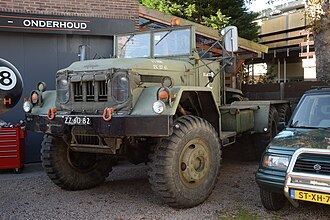
Among the countless military vehicles developed during the Cold War, only a few achieved legendary status because of their sheer size, strength, and ability to perform tasks that seemed almost impossible. One such vehicle was the Mack M123, a massive heavy-duty military truck designed to move some of the heaviest equipment in the United States Army inventory. Built during an era when military planners were preparing for large-scale armored warfare and global deployments, the M123 became one of the most important heavy transport vehicles of its generation.
Although it never achieved the widespread public recognition of vehicles such as the Jeep, the M35 “Deuce and a Half,” or the M151 MUTT, the Mack M123 occupied a crucial role behind the scenes. Tanks, artillery pieces, engineering equipment, missile systems, and other oversized military assets often depended on vehicles like the M123 for transportation. Without heavy haulers, modern armies cannot effectively move their largest weapons over long distances, and the M123 proved exceptionally capable in this demanding role.
The truck represented the peak of heavy military transport technology during the 1950s and 1960s. It combined enormous carrying capacity, rugged off-road capability, powerful engines, and military-grade durability into a single package. Decades after its retirement, the M123 remains a favorite among military vehicle collectors and historians who admire both its engineering and its role in Cold War logistics.
This article explores the history, development, engineering, operational use, and lasting legacy of the Mack M123, one of the most impressive military trucks ever produced by Mack Trucks.
Origins of the Mack M123
The Military Transportation Challenge
The years following the Second World War brought dramatic changes to military logistics. Armored vehicles were becoming larger, heavier, and more complex. Main battle tanks weighed significantly more than their wartime predecessors, while artillery systems and missile launchers also increased in size and weight.
The United States Army recognized that its existing transport fleet would eventually become insufficient for moving these increasingly heavy loads. New vehicles would be required to haul tanks, engineering equipment, and specialized military systems across both highways and rough terrain.
As Cold War tensions intensified during the 1950s, mobility became a strategic priority. Military planners understood that the ability to rapidly deploy heavy equipment could determine the outcome of future conflicts. This need created demand for an entirely new generation of heavy transport trucks.
Mack Wins the Contract
Mack Trucks had already established a reputation for producing durable and reliable heavy-duty vehicles. The company possessed extensive experience in building trucks capable of handling extreme workloads under difficult operating conditions.
When the U.S. military sought a new heavy transport tractor, Mack was well positioned to provide a solution. The result was the M123 series, a vehicle specifically designed to haul enormous military loads while maintaining operational flexibility across a variety of terrains.
Production began in the late 1950s, and the truck quickly became one of the Army’s primary heavy-haul platforms.
Design Philosophy
Built for Strength Above All Else
Unlike commercial trucks that often balanced payload capacity with fuel efficiency and driver comfort, the M123 was engineered primarily for strength. Every aspect of the design reflected the vehicle’s intended mission.
The frame was exceptionally robust, capable of withstanding enormous stresses generated by heavy trailers and oversized cargo. Suspension components were designed for durability rather than comfort, while drivetrain components were oversized to maximize reliability.
Military engineers prioritized survivability and dependability. The truck needed to function in extreme climates, operate on poor roads, and continue working even under harsh battlefield conditions.
Massive Dimensions
The M123 was an imposing vehicle. Its long hood, large cab, oversized tires, and towering profile immediately conveyed its purpose as a heavy transporter.
Even by modern standards, the truck appears enormous. When coupled to a heavy equipment trailer carrying a tank or engineering vehicle, the complete combination became one of the largest road-going military transport systems of its era.
The truck’s visual presence alone inspired confidence among operators tasked with moving valuable military equipment.
The Engine That Powered a Giant
Mack END 673 Diesel Engine
One of the most important components of the M123 was its engine. Early production vehicles were powered by the Mack END 673 diesel engine, a powerplant known for durability and substantial torque output.
This six-cylinder diesel engine was not designed to achieve high speeds. Instead, it delivered the low-end pulling power required to move extremely heavy loads.
Heavy hauling depends far more on torque than horsepower, and the END 673 excelled in this regard. Drivers frequently praised the engine’s ability to maintain steady pulling force under difficult conditions.
Reliability Under Pressure
Military operations place extraordinary demands on vehicles. Engines may operate continuously for long periods while exposed to dust, mud, extreme temperatures, and heavy workloads.
The END 673 earned a reputation for reliability because it could tolerate these harsh environments. Properly maintained examples often accumulated impressive service lives despite operating under conditions that would challenge many civilian trucks.
This durability became one of the defining characteristics of the M123 fleet.
Transmission and Drivetrain
Designed for Heavy Loads
The M123’s drivetrain was specifically engineered for moving massive cargo. Its transmission provided numerous gear ratios that allowed drivers to maximize engine torque under varying conditions.
Heavy-haul operations require careful control of vehicle speed and engine output. The transmission’s design allowed operators to keep the engine within its optimal operating range while climbing grades or maneuvering difficult terrain.
6×6 Configuration
One of the most important features of the M123 was its six-wheel-drive system. All three axles received power, significantly improving traction in off-road environments.
Military logistics frequently involve travel beyond paved highways. Construction sites, training grounds, deployment zones, and undeveloped terrain all present challenges that conventional highway tractors may struggle to overcome.
The M123’s 6×6 configuration allowed it to operate where many civilian vehicles would become immobilized.
Differential Systems
The truck incorporated sophisticated differential arrangements that enhanced traction under difficult conditions. These systems distributed power effectively across multiple axles and wheels, helping maintain mobility even when operating on mud, sand, snow, or uneven terrain.
This capability made the M123 an extremely versatile military transport platform.
Heavy Equipment Transport Missions
Moving Main Battle Tanks
One of the truck’s primary missions involved transporting tanks. Armored vehicles consume enormous amounts of fuel and experience significant track wear during long-distance travel.
Rather than driving tanks hundreds of miles, military planners often preferred transporting them on heavy equipment trailers. This approach reduced maintenance requirements and preserved vehicle readiness.
The M123 became a key component of this logistical strategy.
Transporting Engineering Equipment
Military engineering units operate bulldozers, excavators, bridge-laying equipment, and other specialized machinery. These assets are often too heavy for conventional transport vehicles.
The M123 provided a reliable means of moving engineering equipment between bases, construction sites, and deployment zones.
Its ability to handle oversized cargo made it indispensable for military engineering operations.
Missile and Artillery Support
The Cold War introduced a variety of missile systems that required transportation support. Some M123 variants and related heavy-haul platforms participated in moving missile launchers, support equipment, and large artillery systems.
The truck’s high payload capacity allowed it to support these increasingly sophisticated weapons programs.
Life in Military Service
Operating Conditions
Drivers assigned to M123 units often faced challenging conditions. Long-distance convoys, rough terrain, difficult weather, and oversized cargo demanded skill and concentration.
Operating a heavy-haul military tractor required specialized training. Drivers needed to understand weight distribution, trailer operation, braking systems, and off-road driving techniques.
Despite these challenges, many operators developed great respect for the vehicle’s capabilities.
Maintenance Requirements
Like all heavy military equipment, the M123 required regular maintenance. Its large engine, drivetrain, suspension, and braking systems demanded careful inspection and servicing.
Fortunately, the truck’s robust construction simplified many maintenance tasks. Components were designed with field serviceability in mind, allowing military mechanics to perform repairs under operational conditions.
The vehicle’s straightforward engineering contributed significantly to its reputation for reliability.
Variants of the M123 Family
M123 Tractor
The standard M123 tractor served as the primary heavy-haul version. It was designed to pull large trailers carrying tanks, engineering vehicles, and other heavy equipment.
This model became the most recognizable member of the M123 family.
M123A1
As military requirements evolved, improvements were introduced to enhance performance and reliability. The M123A1 represented one of the upgraded variants developed during the vehicle’s service life.
These improvements often reflected lessons learned through operational experience.
M125 Cargo Truck
Closely related to the M123 was the M125 cargo truck variant. While sharing many mechanical components, the M125 featured a cargo body rather than a fifth-wheel tractor arrangement.
This configuration expanded the family’s utility by providing a heavy off-road cargo transport capability.
Cold War Importance
Strategic Mobility
The Cold War emphasized rapid deployment and strategic flexibility. Heavy equipment had to be moved quickly between bases, ports, railheads, and operational areas.
Vehicles like the M123 played a critical role in achieving this mobility. Without reliable heavy-haul trucks, the deployment of armored formations would have been significantly more difficult.
NATO Operations
Many American military units stationed in Europe depended on heavy transport systems to support training exercises and contingency planning.
The M123 helped ensure that armored forces could reposition quickly if required.
Its contribution to Cold War readiness was substantial, even if it remained largely invisible to the general public.
Comparison With Other Military Heavy Haulers
M123 Versus Earlier Designs
Compared with older military transport vehicles, the M123 offered significantly improved payload capacity and off-road performance.
Its modern diesel engine, six-wheel-drive system, and robust frame construction represented a major advance in heavy military transportation.
Influence on Future Vehicles
The lessons learned from operating the M123 influenced later generations of military transport vehicles.
Modern heavy equipment transporters continue to prioritize many of the same characteristics: durability, traction, payload capacity, and maintainability.
The M123 helped establish design principles that remain relevant today.
Restoration and Preservation
Collector Interest
Military vehicle collectors regard the M123 as one of the most impressive Cold War trucks ever built. Its size, rarity, and historical significance make it highly desirable among enthusiasts.
Restoring an M123 is a major undertaking due to the truck’s complexity and enormous dimensions. Nevertheless, dedicated collectors continue to preserve surviving examples.
Museum Exhibits
Several military museums feature M123 trucks as examples of Cold War logistics technology.
Visitors are often surprised by the vehicle’s sheer scale. Seeing an M123 in person provides a greater appreciation for the challenges involved in transporting heavy military equipment.
Historical Events
Restored M123 trucks frequently appear at military vehicle rallies, historical reenactments, and transportation exhibitions.
Their presence helps educate new generations about the logistical backbone that supported military operations during the Cold War.
Legacy of the Mack M123
The Mack M123 occupies a unique place in military transportation history. While tanks and combat vehicles often receive the most attention, support vehicles like the M123 were equally essential to military effectiveness.
Without heavy-haul transporters, armored forces cannot move efficiently, engineering units cannot deploy rapidly, and large-scale military operations become significantly more difficult. The M123 solved these problems through a combination of power, durability, and engineering excellence.
Its service demonstrated the importance of logistics in modern warfare. The truck became a trusted workhorse that enabled the movement of some of the largest and heaviest military assets in the U.S. arsenal.
Today, surviving examples stand as reminders of an era when mechanical strength and rugged simplicity were considered the ultimate measures of military vehicle design. Although newer transporters have surpassed it in capability, the M123 remains one of the most respected heavy military trucks ever produced.
For historians, collectors, and military vehicle enthusiasts, the Mack M123 represents far more than a truck. It symbolizes the logistical power that underpinned Cold War military strategy and showcases Mack’s ability to build machines capable of accomplishing extraordinary tasks under demanding conditions.
Technical Specifications
| Parameter | Specification |
|---|---|
| Model | Mack M123 |
| Manufacturer | Mack Trucks |
| Vehicle Type | Heavy Equipment Transport Tractor |
| Service Entry | Late 1950s |
| Configuration | 6×6 |
| Wheel Formula | Three Driven Axles |
| Engine | Mack END 673 Diesel |
| Engine Type | Inline 6-Cylinder Diesel |
| Power Output | Approx. 255 hp |
| Transmission | Manual Multi-Speed |
| Drive System | Full-Time 6×6 |
| Fuel Type | Diesel |
| Trailer Capability | Heavy Equipment Transport Trailers |
| Primary Mission | Tank and Heavy Equipment Transport |
| Related Cargo Variant | M125 Cargo Truck |
| Cab Type | Conventional Military Cab |
| Suspension | Heavy-Duty Multi-Axle System |
| Brakes | Air Brakes |
| Operational Environment | Highway and Off-Road |
| Users | United States Army and Allied Forces |
| Era of Service | Cold War |
| Notable Strength | High Payload and Off-Road Mobility |
| Current Status | Military Collector and Museum Vehicle |
| Historical Significance | One of the U.S. Army’s principal heavy-haul transport tractors of the Cold War era |
