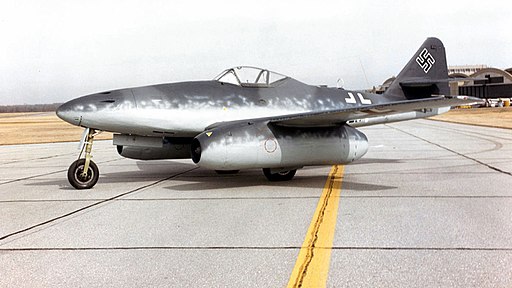
The Messerschmitt Me 262 was a revolutionary German jet fighter developed during World War II and remains one of the most significant aircraft in aviation history. As the first operational jet-powered fighter aircraft, it represented a dramatic leap in aeronautical engineering and propulsion technology. Known to the Allies as the “Stormbird” (Schwalbe in its fighter form and Sturmvogel in its fighter-bomber configuration), the Me 262 demonstrated speeds and performance far superior to any piston-engine aircraft of its time. Despite its late introduction and logistical difficulties, the Me 262 marked the dawn of the jet age and directly influenced postwar aircraft development worldwide.
Development History
The origin of the Me 262 dates back to 1938, when the German Air Ministry (RLM) issued requirements for a jet-powered fighter aircraft. Design work began under the leadership of Willy Messerschmitt and aerodynamicist Woldemar Voigt at Bayerische Flugzeugwerke (later Messerschmitt AG). The initial prototype, designated Projekt 1065, faced numerous challenges due to the experimental nature of turbojet engines at the time.
Early designs were intended to use the BMW P.3302 engines, but development delays and reliability issues forced the team to switch to the Junkers Jumo 004 turbojet. The first prototype, the Me 262 V1, made its maiden flight in April 1941 using a conventional Junkers Jumo 210 piston engine in the nose for safety, with two non-operational jet engines mounted under the wings. The first fully jet-powered flight occurred on July 18, 1942, with Jumo 004A engines, achieving promising results.
Despite technical success, political hesitation, engine shortages, and wartime disruption delayed large-scale production until mid-1944. Once operational, the Me 262 demonstrated an enormous advantage in speed and climb rate over Allied aircraft, though its limited numbers and fuel shortages prevented it from altering the course of the war.
Design and Construction
The Messerschmitt Me 262 was a twin-engine, mid-wing monoplane designed primarily from metal, featuring aerodynamic lines optimized for high-speed flight. The aircraft embodied forward-thinking design principles, including swept wings and tricycle landing gear—features that became standard in postwar jets.
Fuselage
The fuselage was a semi-monocoque structure built from duralumin alloy. It housed the cockpit, nose gear bay, fuel tanks, and armament. The cockpit canopy was a framed, clear-view bubble type, providing good visibility. The pilot’s seat was armored, and the cockpit layout was designed to be simple but functional. The nose section was modular, allowing rapid removal for servicing weapons or avionics.
Wings
The Me 262’s wings were slightly swept at 18.5 degrees to improve aerodynamic performance at high subsonic speeds. The wings were of all-metal construction with stressed skin and single main spars. Control surfaces included ailerons, flaps, and split air brakes mounted on the fuselage sides. The jet engines were mounted in streamlined nacelles below the wings, positioned to balance the aircraft’s center of gravity.
Landing Gear
One of the Me 262’s innovative design features was its tricycle landing gear, a first for a German combat aircraft. The nose wheel retracted rearward into the fuselage, while the main gear retracted inward into the wings. This arrangement improved ground handling, visibility during taxiing, and stability during takeoff and landing—key advantages over the taildragger configurations common at the time.
Powerplant and Performance
The Me 262 was powered by two Junkers Jumo 004B-1 or 004B-2 axial-flow turbojet engines, each producing around 8.8 kN (1,980 lbf) of thrust. The engines were groundbreaking but fragile, with an operational lifespan of only 25–50 flight hours due to materials shortages and early-stage metallurgy limitations. Throttle control was delicate; rapid power changes could lead to compressor stalls or engine fires.
Technical Parameters:
-
Type: Single-seat jet fighter
-
Manufacturer: Messerschmitt AG
-
Crew: 1
-
Engines: 2 × Junkers Jumo 004B-1 axial-flow turbojets
-
Thrust (each): 8.8 kN (1,980 lbf)
-
Maximum Speed: 870 km/h (540 mph) at 6,000 m (19,685 ft)
-
Cruising Speed: 750 km/h (466 mph)
-
Range: 1,050 km (652 mi)
-
Service Ceiling: 11,500 m (37,730 ft)
-
Rate of Climb: 1,200 m/min (3,937 ft/min)
-
Wingspan: 12.60 m (41 ft 4 in)
-
Length: 10.60 m (34 ft 9 in)
-
Height: 3.50 m (11 ft 6 in)
-
Wing Area: 21.7 m² (234 sq ft)
-
Empty Weight: 3,800 kg (8,378 lb)
-
Maximum Takeoff Weight: 7,130 kg (15,720 lb)
Armament and Equipment
The Me 262 was heavily armed to counter Allied bombers and fighters. The standard armament consisted of four 30 mm MK 108 autocannons mounted in the nose. Each gun carried 80 rounds of ammunition, sufficient for short but devastating bursts. The MK 108 had a relatively low muzzle velocity but delivered massive destructive power—one or two hits could down a bomber.
Some later versions also carried R4M rockets, 24 under each wing, which could be fired in salvos against bomber formations. These small, unguided rockets gave the Me 262 exceptional stand-off capability.
For the fighter-bomber variant (Me 262 A-2a Sturmvogel), two 250 kg (550 lb) or 500 kg (1,100 lb) bombs could be mounted under the nose or fuselage centerline, sacrificing some speed for ground-attack capacity.
Flight Characteristics
In flight, the Me 262 was exceptionally fast and stable. Its smooth jet thrust provided unmatched acceleration for the era. Pilots described it as easy to handle once airborne, though takeoff and landing required careful throttle management to avoid engine flameouts. Its roll rate and turning radius were inferior to propeller-driven fighters at low speeds, but at high speed, it was almost untouchable.
The aircraft’s tricycle gear and swept-wing layout contributed to aerodynamic efficiency, while the absence of propeller torque made it easier to aim and maintain directional control in combat. However, the fragile engines demanded careful handling, and inexperienced pilots often lost aircraft due to throttle mismanagement.
Variants
The Me 262 was produced in several variants, each adapted for specific roles:
-
Me 262 A-1a “Schwalbe” – Standard single-seat fighter configuration.
-
Me 262 A-2a “Sturmvogel” – Fighter-bomber variant capable of carrying bombs.
-
Me 262 B-1a – Two-seat trainer with extended fuselage and dual controls.
-
Me 262 B-1a/U1 – Two-seat night fighter equipped with FuG 218 Neptun radar and flame dampers.
-
Me 262 C-series – Experimental high-speed interceptors featuring rocket-assisted takeoff systems for improved climb performance.
Operational Service
The Me 262 entered operational service in July 1944 with Erprobungskommando 262, a test and evaluation unit. Full combat deployment began later that year with Jagdgeschwader 7 (JG 7) “Nowotny”, commanded by the celebrated pilot Walter Nowotny. In combat, the Me 262 proved devastating against Allied bombers and reconnaissance aircraft, capable of striking and disengaging before enemy fighters could react.
However, the aircraft suffered from limited availability due to fuel shortages, Allied bombing of production facilities, and a scarcity of trained pilots. Furthermore, Hitler’s insistence that it be used as a bomber delayed its deployment as a pure fighter, reducing its strategic impact.
Despite these challenges, Me 262 pilots achieved impressive kill ratios. Allied pilots often relied on ambush tactics during takeoff or landing, when the jet was most vulnerable. By war’s end, around 1,430 Me 262s had been built, though fewer than 300 saw active service.
Postwar Legacy
After World War II, the Me 262 became the foundation for jet development in both the United States and the Soviet Union. Captured examples were extensively studied and reverse-engineered. The U.S. produced several copies under the designation Bell X-1 and F-86 Sabre programs, while the Soviet Union incorporated its design lessons into early jets such as the Mikoyan-Gurevich MiG-9.
The Me 262 demonstrated the future of aerial warfare—speed, jet propulsion, and aerodynamic refinement. Its influence can be traced through nearly every jet fighter design of the late 1940s and 1950s.
Conclusion
The Messerschmitt Me 262 was far more than a weapon of war—it was a technological milestone that transformed aviation. Combining pioneering jet propulsion, advanced aerodynamics, and heavy armament, it symbolized both the brilliance and desperation of late-war German engineering. Although introduced too late to change the outcome of World War II, the Me 262 reshaped the trajectory of aircraft design worldwide and remains one of the most iconic and influential fighters ever built.
