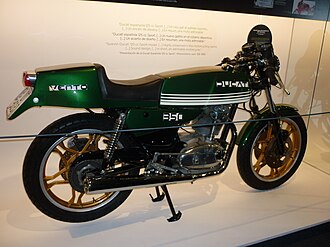
Ducati Vento: The Spanish-Built Café Racer That Kept the Ducati Bevel Single Alive
The Ducati Vento is one of the most distinctive and lesser-known motorcycles in Ducati’s history. Produced in Spain by MotoTrans under licence from Ducati, the Vento combined traditional Italian engineering with Spanish manufacturing expertise and the unmistakable styling of a classic café racer. Introduced during the 1970s, it was powered by a 340 cc bevel-drive single-cylinder engine, a design that had already become an important part of Ducati’s identity. While Ducati’s Italian factory was moving away from its traditional single-cylinder motorcycles, MotoTrans continued developing this engineering concept, allowing it to survive into the early 1980s. The result was a relatively rare motorcycle that combined an old-school mechanical character with sporting styling, impressive braking equipment and performance that made it a distinctive machine for its time.
The Ducati Vento is particularly interesting because it represents the final chapter of Ducati’s famous bevel-drive single-cylinder era. With its lightweight construction, high-revving engine, five-speed gearbox and café racer-inspired riding position, it offered an experience very different from that of the larger twin-cylinder motorcycles that would eventually define the Ducati brand. Today, the Vento attracts the attention of classic motorcycle collectors, Ducati enthusiasts and admirers of unusual European motorcycles. Its Spanish origins, limited production and distinctive engineering make it a fascinating example of how Ducati’s technical heritage continued to evolve beyond the company’s Italian factories.
The Origins of the Ducati Vento
MotoTrans and the Spanish Ducati Connection
To understand the Ducati Vento, it is essential to look at the history of MotoTrans. Based in Barcelona, Spain, MotoTrans was established in the late 1950s and developed a close relationship with Ducati, initially manufacturing motorcycles under licence and eventually producing a range of Ducati-derived models for the Spanish market. During the 1960s and 1970s, the company became an important part of Ducati’s international history, producing motorcycles that retained the Italian manufacturer’s engineering identity while incorporating local development and manufacturing decisions.
MotoTrans was particularly associated with Ducati’s single-cylinder motorcycles, which had developed a strong reputation for their overhead-camshaft engines and distinctive bevel-drive valve systems. When Ducati gradually discontinued its traditional bevel-drive singles in Italy, MotoTrans continued producing and improving related designs. This allowed the Spanish manufacturer to maintain a distinctive position in the European motorcycle industry and gave enthusiasts access to an engineering tradition that was disappearing elsewhere.
The Vento emerged from this background as a sporting motorcycle intended to succeed the earlier Ducati 24 Horas. Its development was presented during the 1970s, with prototypes appearing at the Barcelona Automobile Show in 1974. Although the model is commonly associated with production beginning in 1976, some historical accounts distinguish its initial development and presentation from its subsequent full production period. The Vento remained in production until 1983, becoming one of the final motorcycles to use Ducati’s celebrated bevel-drive single-cylinder engine.
A Motorcycle Designed for Sporting Riders
Unlike conventional touring motorcycles, the Ducati Vento was conceived with a clear sporting identity. Its café racer styling included a racing-inspired seat, low handlebars and rear-set foot controls, creating a riding position that emphasised control and an engaging connection with the motorcycle. The design was intended to appeal to riders who wanted a relatively lightweight road machine with the appearance and character of a competition-inspired motorcycle.
The Vento also benefited from the development work MotoTrans had carried out on its earlier Ducati-derived models. Rather than simply reproducing an existing motorcycle, the company refined the engine, chassis and braking systems to create a more focused package. The result was a machine that looked contemporary during the late 1970s while retaining the traditional mechanical architecture that had made Ducati singles distinctive.
Engine and Performance
The Famous 340 cc Bevel-Drive Single
At the heart of the Ducati Vento is a 340 cc, air-cooled, four-stroke, single-cylinder engine featuring a bevel-driven single overhead camshaft. The engine has a bore and stroke of 76 × 75 mm and a compression ratio of 10:1. Its construction includes an alloy cylinder head and barrel with a cast-iron liner, combining relatively low weight with the durability required for regular road use.
The bevel-drive system is one of the Vento’s most recognisable engineering features. Instead of using a conventional chain or belt to drive the overhead camshaft, the engine uses bevel gears to transmit power from the crankshaft to the valve train. This arrangement gives the motorcycle its distinctive mechanical identity and connects it directly to Ducati’s historic single-cylinder engineering tradition.
The Vento’s claimed maximum output was approximately 28 bhp at 8,000 rpm, an impressive figure for a relatively compact single-cylinder engine of its era. Fuel delivery was handled by a 32 mm Dell’Orto PHF carburettor, while the engine used wet-sump lubrication and battery-and-coil ignition. These components created a relatively straightforward mechanical package that nevertheless offered sophisticated engineering for a traditional road motorcycle.
Five-Speed Gearbox and Riding Character
The engine was connected to a five-speed gearbox through a multi-plate wet clutch, with primary drive by gears and final drive by chain. This arrangement allowed the rider to make effective use of the engine’s available power and maintain momentum across a variety of road conditions.
With a reported top speed of approximately 165–168 km/h, depending on the source, the Vento offered substantial performance for a lightweight single-cylinder motorcycle. Its relatively high-revving engine encouraged an active riding style, with the rider making frequent use of the gearbox to keep the engine operating within its effective power range. The absence of an electric starter, which helped reduce weight compared with the touring-oriented Forza, further emphasised the Vento’s sporting character.
The Vento was not designed to deliver the effortless low-speed torque of a large-capacity twin. Instead, its appeal came from the interaction between engine speed, gearing and the motorcycle’s relatively low weight. For enthusiasts who appreciate traditional mechanical motorcycles, this combination is an important part of the Vento’s enduring appeal.
Chassis, Suspension and Braking
Lightweight Frame and Responsive Handling
The Ducati Vento features a tubular steel single-cradle frame designed to provide a practical balance between rigidity, weight and road handling. Its wheelbase measures approximately 1,370 mm, while its dry weight is around 134 kg. These dimensions give the motorcycle compact proportions and contribute to its relatively agile character.
The front suspension consists of Telesco telescopic hydraulic forks, while the rear uses a conventional swinging arm with twin adjustable Telesco Hydrobag gas shock absorbers. This suspension arrangement was typical of sporting motorcycles from the period, providing a straightforward mechanical design that could be maintained and adjusted without complicated equipment.
The Vento’s sporting riding position and relatively narrow single-cylinder engine also helped create a distinctive riding experience. Its clip-on-style handlebars and rear-set footrests encouraged a forward-leaning posture, placing the rider in a position suited to spirited road riding. Although its chassis technology is relatively simple by modern standards, the motorcycle’s low weight and compact dimensions remain important elements of its character.
Brembo Disc Brakes and Cast Wheels
One of the Ducati Vento’s notable features was its braking system. The motorcycle was equipped with twin 260 mm Brembo disc brakes at the front and a single 260 mm disc at the rear. This arrangement gave it substantial braking equipment for a motorcycle of its size and reflected its sporting positioning.
The Vento also featured six-spoke cast alloy wheels, generally fitted with Michelin sports tyres measuring 3.25 × 18 inches at the front and 3.50 × 18 inches at the rear. These components contributed to the motorcycle’s distinctive appearance and separated it visually from many earlier Ducati singles equipped with conventional wire-spoked wheels.
The combination of three disc brakes, cast alloy wheels and sporting suspension made the Vento an interesting example of how MotoTrans modernised a traditional engine design with more contemporary cycle components.
Design and Styling of the Ducati Vento
The Classic Café Racer Appearance
The Ducati Vento’s styling is one of the reasons it remains so appealing to classic motorcycle enthusiasts. Its low handlebars, racing-inspired seat, exposed mechanical components and compact proportions give it the unmistakable appearance of a 1970s café racer. Unlike fully faired sport motorcycles that became increasingly popular in later decades, the Vento presented its engine and chassis openly, allowing the mechanical design to become an important part of its visual identity.
Most examples were finished in green, although some later motorcycles were produced in red. The colour schemes, together with the cast alloy wheels and sporting bodywork, helped distinguish the Vento from the more practical Ducati Forza. The fuel tank, seat and riding controls were designed to create a coherent sporting appearance without adding unnecessary bodywork.
The result was a motorcycle that looked purposeful without being excessively complicated. Every major element contributed to its sporting identity, from the compact engine to the rear-set foot controls.
Production History and the End of an Era
The Vento’s Final Years
The Ducati Vento remained in production into the early 1980s, although MotoTrans experienced serious financial difficulties during its final years. Production was suspended in late 1981 before resuming in the summer of 1982. Manufacturing finally ended in 1983, when MotoTrans entered receivership and its motorcycle production came to an end.
This ending gave the Vento a special place in Ducati history. Ducati’s Italian factory had already discontinued its bevel-drive singles in 1974, but MotoTrans had continued developing and manufacturing this engine family for several additional years. The Vento therefore became one of the last production motorcycles to preserve this particular form of Ducati engineering.
Its limited production, primarily Spanish-market distribution and relatively short availability outside Spain have also contributed to its rarity today. Compared with better-known Italian Ducati models, surviving Ventos are less frequently encountered, making original examples particularly interesting to collectors and historians.
Ducati Vento Technical Specifications
The following table summarises the commonly published technical specifications of the Ducati Vento 340, although individual details may vary according to production year and source.
| Technical specification | Ducati Vento |
|---|---|
| Manufacturer | Ducati / MotoTrans |
| Country of manufacture | Spain |
| Production period | 1976–1983 |
| Motorcycle category | Café racer |
| Engine type | Air-cooled, four-stroke, single-cylinder |
| Valve train | SOHC, bevel-drive |
| Displacement | 340.2 cc |
| Bore × stroke | 76 × 75 mm |
| Compression ratio | 10:1 |
| Maximum power | 28 bhp (21 kW) at 8,000 rpm |
| Maximum speed | Approximately 165–168 km/h |
| Carburettor | Dell’Orto PHF 32 AS |
| Lubrication | Wet sump |
| Ignition | Battery and coil |
| Cooling | Air |
| Clutch | Multi-plate wet clutch |
| Gearbox | 5-speed |
| Primary drive | Gear |
| Final drive | Chain |
| Frame | Tubular steel, single cradle |
| Front suspension | Telesco telescopic hydraulic forks |
| Rear suspension | Swinging arm, twin adjustable gas shocks |
| Front brakes | Twin 260 mm Brembo discs |
| Rear brake | Single 260 mm Brembo disc |
| Front tyre | 3.25 × 18 inches |
| Rear tyre | 3.50 × 18 inches |
| Wheels | Six-spoke cast alloy |
| Wheelbase | 1,370 mm |
| Dry weight | Approximately 134 kg |
| Fuel capacity | 16 litres |
| Electric starter | Not fitted |
Specifications compiled from published MotoTrans and Ducati Vento technical references. Published top-speed figures vary slightly by source.
The Legacy of the Ducati Vento
The Ducati Vento is much more than an unusual Spanish-built motorcycle carrying a famous Italian name. It represents the continuation of a distinctive engineering tradition at a time when Ducati itself was changing direction. Its bevel-drive single-cylinder engine, lightweight frame, sporting riding position and comprehensive disc-brake system demonstrate how MotoTrans developed a traditional mechanical design to meet the expectations of a new generation of riders.
For modern classic motorcycle enthusiasts, the Vento offers a combination of historical significance and mechanical individuality. It preserves the sound, feel and engineering character of Ducati’s traditional bevel-drive singles while presenting them in a distinctive café racer package. Its Spanish origins also provide a valuable reminder of MotoTrans’s contribution to European motorcycle history and to Ducati’s international development.
Although the Vento never achieved the worldwide recognition of Ducati’s most famous sporting motorcycles, its place in the company’s history is undeniable. As one of the final production motorcycles to use the classic Ducati bevel-drive single, it marks the end of an important engineering era. Today, the Ducati Vento remains a fascinating machine for collectors, restorers and enthusiasts who appreciate motorcycles with an unusual history, distinctive styling and a direct connection to the golden age of traditional European motorcycle engineering.
