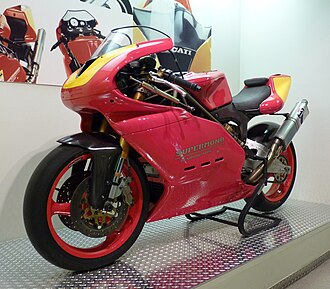
Ducati Supermono: The Extraordinary Racing Single That Redefined Motorcycle Engineering
The Ducati Supermono is one of the most remarkable motorcycles ever developed by the Italian manufacturer. Introduced in 1993, this exclusive racing machine combined an innovative single-cylinder engine, advanced desmodromic valve technology and an exceptionally lightweight chassis to create a motorcycle unlike anything else in Ducati’s history. Designed specifically for the rapidly developing Supermono racing category, it demonstrated that a single-cylinder motorcycle could deliver extraordinary performance without sacrificing the precision, sophistication and engineering character associated with Ducati. With an output of approximately 75 hp, a top speed exceeding 220 km/h and a dry weight of around 120 kg, the Supermono was an impressive technical achievement for its era.
What made the Ducati Supermono particularly special was not simply its performance, but the ingenious engineering solution behind its engine. Rather than developing a completely new single-cylinder powerplant, Ducati adapted technology from its successful 888 Superbike V-twin, replacing the conventional second cylinder’s combustion function with a sophisticated balancing mechanism. This allowed the motorcycle to retain much of the smoothness of a twin-cylinder engine while benefiting from the reduced weight, compact dimensions and agility of a single. Designed by Pierre Terblanche, with engineering development led by Massimo Bordi and Claudio Domenicali, the Supermono became a showcase for Ducati’s technical creativity. Built in extremely limited numbers, it remains one of the most sought-after and fascinating racing motorcycles of the 1990s.
The Origins of the Ducati Supermono
A New Challenge for Ducati
During the early 1990s, single-cylinder racing was experiencing renewed interest through the Supermono category, which encouraged manufacturers and independent racing specialists to develop lightweight, high-performance four-stroke motorcycles. Unlike traditional production-based racing classes, Supermono competition allowed considerable freedom in engine and chassis design, creating opportunities for innovative engineering solutions.
Ducati recognised the potential of this category as an opportunity to explore new technical ideas without the enormous development costs associated with an entirely new engine. The company already possessed considerable experience with its liquid-cooled, four-valve desmodromic V-twin engines, particularly those used in the 851 and 888 racing motorcycles. These engines provided an established foundation for developing a competitive single-cylinder powerplant.
The project was led by Massimo Bordi, whose engineering vision was supported by Claudio Domenicali and the Ducati technical team. Their objective was to create a motorcycle that combined exceptional power-to-weight performance with outstanding handling and reduced mechanical vibration. The Supermono would also provide an opportunity to investigate engineering solutions that could potentially benefit Ducati’s future production and racing motorcycles.
Pierre Terblanche’s Distinctive Design
The motorcycle’s appearance was entrusted to Pierre Terblanche, whose design work would later influence several important Ducati models. Terblanche developed a compact, aerodynamic body that reflected the Supermono’s lightweight engineering philosophy. The motorcycle’s low front profile, sculpted fuel tank, narrow seat and distinctive rear bodywork created a visually balanced design in which every major component appeared to serve a functional purpose.
Extensive use of carbon fibre and magnesium alloy helped reduce weight, while the compact engine allowed the designers to achieve a low and narrow overall profile. The rear section was particularly innovative, with the carbon-fibre seat structure contributing to the motorcycle’s lightweight construction. The resulting design was elegant without being unnecessarily decorative, combining the appearance of a prototype racing machine with the unmistakable identity of a Ducati.
The Revolutionary Supermono Engine
A Single Cylinder with Twin-Cylinder Technology
The most extraordinary feature of the Ducati Supermono was its engine. The original version had a displacement of 549 cc, with a 100 mm bore and 70 mm stroke. It was a liquid-cooled, four-stroke single-cylinder engine featuring double overhead camshafts and four desmodromically operated valves.
Rather than starting from an entirely new design, Ducati based the engine on the architecture of its 888 Superbike V-twin. The horizontal cylinder and cylinder head retained the essential combustion-engine configuration, while the space normally occupied by the second, vertical cylinder was adapted to accommodate an innovative balancing mechanism. This arrangement incorporated an articulated connecting-rod system, often described as a dummy connecting rod or double-connecting-rod balancer.
The purpose of this system was to counteract the substantial inertial forces generated by the large piston of a high-revving single-cylinder engine. Conventional large singles can suffer from considerable vibration, which affects rider comfort, chassis durability and the precision of handling. Ducati’s ingenious balancing system reduced these effects without the frictional losses associated with a conventional dummy piston. The result was an unusually smooth-running single-cylinder engine capable of operating at high engine speeds.
Desmodromic Valve Actuation and Fuel Injection
The Supermono used Ducati’s renowned desmodromic valve system, which mechanically controls both the opening and closing of the valves. This arrangement eliminates the reliance on conventional valve springs and allows precise valve movement at high engine speeds. Combined with its four-valve cylinder head and liquid cooling, the system gave the Supermono the technical characteristics of Ducati’s contemporary high-performance racing engines.
Fuel delivery was provided by Weber-Marelli electronic fuel injection, while electronic ignition ensured accurate combustion timing. The original 549 cc engine was capable of producing approximately 75 hp at 10,000 rpm, with maximum torque of around 50.8 Nm at 8,000 rpm. These figures were particularly impressive for a naturally aspirated single-cylinder racing engine.
In 1995, Ducati introduced a larger 572 cc version, using a 102 mm bore while retaining the 70 mm stroke. This development increased the engine’s potential output to approximately 80–81 hp, depending on the specification quoted. The larger engine helped the Supermono remain competitive as other manufacturers continued to develop increasingly powerful machines for the class.
Chassis, Suspension and Braking
A Lightweight Racing Chassis
The Ducati Supermono featured a tubular steel trellis frame, drawing on the structural philosophy used in Ducati’s contemporary superbikes. The frame was designed around the compact single-cylinder engine, allowing the engineers to create a narrow motorcycle with carefully controlled weight distribution.
The chassis had a wheelbase of approximately 1,360 mm, contributing to the Supermono’s compact proportions and agile handling. Depending on the production specification and source, its dry weight is quoted at approximately 118–125 kg. This remarkably low mass, combined with the engine’s high output, gave the motorcycle an exceptional power-to-weight ratio.
The front suspension consisted of fully adjustable Öhlins inverted telescopic forks, while the rear featured an Öhlins monoshock connected to a swinging arm. These high-quality components provided the adjustability required for circuit racing, allowing suspension settings to be adapted to different tracks, tyres and riding conditions.
Brembo Brakes and Magnesium Wheels
Braking performance was equally important to the Supermono’s engineering package. The motorcycle used twin 280 mm Brembo front discs with four-piston calipers and a rear disc brake. The braking equipment was designed to provide powerful, consistent deceleration while keeping unsprung weight under control.
Lightweight magnesium alloy wheels further reduced rotating mass, improving the motorcycle’s responsiveness during acceleration, braking and changes of direction. Combined with its narrow profile and low overall weight, these components helped make the Supermono particularly agile through tight corners and rapid direction changes.
The overall chassis package demonstrated how carefully Ducati had balanced engine performance, suspension quality, braking power and weight reduction to create a highly specialised competition motorcycle.
Racing Success and Competition History
The European Supermono Championship
The Ducati Supermono made an immediate impression in competition. In 1993, Mauro Lucchiari won the Riders’ title in the European Supermono Championship, while Ducati secured the Manufacturers’ title. This achievement demonstrated that the company’s innovative engine concept could deliver genuine racing success rather than simply serve as an engineering experiment.
The motorcycle also competed in Supermono races internationally, including events supporting major production-based racing championships. Its lightweight construction, high-revving engine and sophisticated chassis allowed it to challenge specialised single-cylinder machines from a variety of manufacturers.
The Supermono’s racing story was not defined exclusively by championship results. Its technical originality attracted considerable attention from engineers, journalists and enthusiasts, establishing the motorcycle as an important example of innovative racing design during the 1990s.
A Limited Production Racing Motorcycle
The Ducati Supermono was never intended to become a mass-produced road motorcycle. It was built specifically for competition, and its production remained extremely limited. Ducati’s official historical information records just 67 examples, making the Supermono one of the rarest modern racing motorcycles produced by the company. The machines were manufactured in small batches, with the original 549 cc version followed by the larger 572 cc development.
Because of its limited production, specialised components and competition-focused design, the Supermono became highly desirable among Ducati collectors. Original examples are particularly significant because many racing motorcycles have undergone modifications, rebuilds or changes in specification throughout their competitive lives.
Ducati Supermono Technical Specifications
The following table summarises the principal specifications of the Ducati Supermono, with differences between the original 549 cc and later 572 cc versions identified where relevant.
| Technical specification | Ducati Supermono |
|---|---|
| Manufacturer | Ducati |
| Country of manufacture | Italy |
| Production period | 1993–1997 |
| Total production | 67 units |
| Category | Racing motorcycle |
| Engine | Liquid-cooled, four-stroke single-cylinder |
| Valve train | DOHC, desmodromic |
| Valves | 4 |
| Displacement | 549 cc / 572 cc |
| Bore × stroke | 100 × 70 mm / 102 × 70 mm |
| Compression ratio | Approximately 11.8:1 |
| Maximum power | 75 hp at 10,000 rpm |
| Later-version power | Approximately 80–81 hp |
| Maximum torque | 50.8 Nm at 8,000 rpm |
| Fuel system | Weber-Marelli electronic injection |
| Ignition | Electronic |
| Cooling | Liquid |
| Lubrication | Wet sump |
| Clutch | Multi-plate dry clutch |
| Gearbox | 6-speed |
| Final drive | Chain |
| Frame | Tubular steel trellis |
| Front suspension | Öhlins inverted telescopic forks |
| Rear suspension | Öhlins monoshock |
| Front brakes | Twin 280 mm Brembo discs |
| Rear brake | Single Brembo disc |
| Wheels | Magnesium alloy |
| Front tyre | 120/60 VR17 |
| Rear tyre | 155/60 VR17 |
| Wheelbase | 1,360 mm |
| Dry weight | Approximately 118–125 kg |
| Fuel capacity | Approximately 15 litres |
| Maximum speed | Approximately 220–230 km/h |
Specifications vary by model year, engine version and reference source. Ducati’s historical overview gives 75 hp, 220 km/h and 100 kg, while detailed period tests and technical references report different weights and performance measurements.
The Legacy of the Ducati Supermono
The Ducati Supermono remains one of the clearest demonstrations of the company’s ability to combine unconventional engineering with competition-focused design. Its ingenious balancing mechanism, derived from the architecture of a successful V-twin, allowed Ducati to overcome one of the most significant limitations of high-performance single-cylinder engines. The result was a motorcycle that delivered remarkable power, exceptional agility and a distinctive mechanical character.
The Supermono also played an important role in the development of Ducati’s engineering expertise during the 1990s. Its advanced engine, lightweight materials, sophisticated suspension and aerodynamic design demonstrated the possibilities of a highly specialised racing motorcycle. The experience gained through the project formed part of the wider technical environment in which Ducati continued developing its celebrated superbikes.
Today, the Supermono is admired not only for its rarity but also for the originality of its engineering. It represents a moment when Ducati challenged conventional ideas about single-cylinder performance and produced a machine that remains distinctive decades after its introduction. With only 67 examples built, it is an exceptional part of Ducati’s history and a reminder that engineering innovation does not always require more cylinders, greater displacement or increasingly complex machinery.
Ultimately, the Ducati Supermono is a celebration of precision, creativity and purposeful design. Its extraordinary engine concept, lightweight chassis and racing pedigree established it as one of the most fascinating motorcycles of the 1990s. For Ducati enthusiasts and collectors, it remains a remarkable example of what can be achieved when technical imagination is combined with a clear competitive objective.
