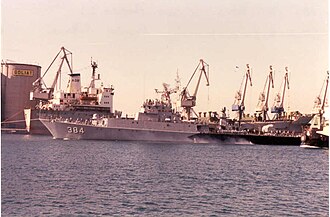
KRI Pati Unus (384) was a corvette operated by the Indonesian Navy, officially known as Tentara Nasional Indonesia Angkatan Laut (TNI AL). As a member of the Parchim-class family, also known in Indonesian naval service as the Kapitan Pattimura class, the vessel was designed primarily for anti-submarine warfare in coastal waters and relatively shallow maritime environments. Although it was not a large destroyer or frigate, KRI Pati Unus played a role in Indonesia’s maritime defense through its combination of naval guns, anti-submarine weapons, detection systems, and the ability to patrol important sea routes. The ship’s operational history also reflects a significant period in Indonesian naval modernization, when the country acquired a number of former East German naval vessels following the end of the Cold War.
The history of KRI Pati Unus is particularly interesting because it connects two different naval traditions: the former East German Volksmarine and the Indonesian Navy. Originally constructed for service in European waters, the vessel entered Indonesian service after the political changes that followed German reunification. It subsequently served for more than two decades under the Indonesian flag, participating in patrol duties, naval training, international engagement, and maritime security activities. However, age, maintenance requirements, and an accident involving damage to its hull eventually contributed to the end of its operational career. The vessel was formally decommissioned in April 2017, closing a chapter in the history of Indonesia’s Parchim-class corvettes.
Understanding KRI Pati Unus requires more than examining its dimensions or weapons. Its significance can also be understood through its original design philosophy, the circumstances of its acquisition, its operational responsibilities, and the practical challenges associated with maintaining older warships. Examining these aspects provides a broader picture of how a relatively compact corvette supported Indonesia’s maritime defense objectives during a period of changing regional security requirements and gradual fleet modernization.
What Was KRI Pati Unus (384)?
KRI Pati Unus was a conventional naval corvette designed around the requirements of coastal and anti-submarine operations. Its hull measured approximately 75.2 meters in length, with a beam of 9.78 meters and a draft of approximately 2.65 meters. These dimensions placed it in a category suitable for operations where maneuverability, a comparatively shallow draft, and the ability to carry specialized weapons were important considerations. The ship was equipped with three diesel engines driving three propellers, giving it a reported maximum speed of approximately 24.5 knots. Its propulsion arrangement provided the combination of endurance and speed required for patrol missions, interception tasks, and the movement of an anti-submarine warfare platform between operational areas.
The designation KRI stands for Kapal Republik Indonesia, or Ship of the Republic of Indonesia. The number 384 was the vessel’s Indonesian pennant number, used to identify it within the Indonesian naval fleet. The ship belonged to the Parchim-class design family, which originated in East Germany and was developed during the Cold War. In Indonesian service, the class became known as the Kapitan Pattimura class, named after the lead ship of the Indonesian group. KRI Pati Unus was therefore part of a broader collection of former East German vessels that helped Indonesia maintain and expand its naval capabilities without relying exclusively on newly constructed warships.
The vessel’s principal specialization was anti-submarine warfare, commonly abbreviated as ASW. This mission involves detecting, tracking, and engaging submarines that could threaten friendly naval units, maritime traffic, or important coastal areas. To perform this role, a warship needs more than weapons alone: it also requires sonar, appropriate fire-control equipment, trained personnel, and the ability to coordinate information gathered from different sensors. KRI Pati Unus combined several of these elements within a compact platform. Its original design reflected the Cold War concern that submarines operating near coastlines could threaten surface vessels and maritime approaches, making specialized coastal combatants valuable to navies with responsibility for defending nearby waters.
Historical Background and Origins
Construction in East Germany
KRI Pati Unus began its career as a vessel of the East German Navy, or Volksmarine, under the name Ludwigslust. It was built by Peene-Werft, a shipyard located in Wolgast, East Germany. The ship was launched on 1 October 1981 and entered East German service on 4 July 1983, according to commonly cited ship histories. Its original pennant number was 232. The vessel was part of the Parchim-class program, which provided East Germany with compact corvettes intended to counter underwater threats and support the defense of coastal approaches in the Baltic Sea.
The Parchim-class design emerged during a period when naval planners in both NATO and the Warsaw Pact regarded submarine warfare as a major component of a potential European conflict. Coastal submarines could operate in relatively restricted waters, exploit the geography of maritime approaches, and threaten surface vessels attempting to enter or leave important ports. In response, anti-submarine corvettes were equipped with a combination of sonar, naval guns, depth-oriented weapons, and anti-submarine rocket launchers. The ships were not intended to replace larger ocean-going combatants but instead to provide a specialized capability in environments where smaller vessels could be useful.
The construction of Ludwigslust also illustrates the industrial capabilities of East German naval shipbuilding. Peene-Werft produced vessels for domestic naval requirements and export-related programs, contributing to the maritime equipment needs of the former Eastern Bloc. The Parchim-class corvettes combined conventional diesel propulsion with weapon systems derived largely from Soviet or Eastern Bloc technology. This approach produced a vessel designed for a relatively focused tactical role rather than a broad, multirole mission comparable to that of a modern frigate.
The End of the Cold War and Transfer to Indonesia
The political changes of 1989 and 1990 transformed the circumstances surrounding the East German fleet. Following German reunification, the Volksmarine ceased to exist as an independent naval service, and many of its vessels became surplus to the requirements of the unified German state. Some ships were withdrawn, while others were considered for transfer or sale. Indonesia subsequently acquired a collection of former East German naval vessels as part of a wider effort to strengthen its fleet with available secondhand platforms.
This acquisition was significant because naval shipbuilding is expensive, and a country seeking to maintain a large maritime presence must balance operational requirements against procurement costs, delivery schedules, and the availability of domestic shipbuilding capacity. Purchasing used warships can offer a relatively rapid way to expand fleet numbers, particularly when the vessels already possess weapons, propulsion systems, and supporting equipment. However, secondhand acquisitions also bring challenges, including the age of machinery, differences between foreign and domestic maintenance systems, and the long-term availability of spare parts.
KRI Pati Unus was among the former East German vessels transferred to Indonesia during this period. The ship entered Indonesian service under its new name and received the pennant number 384. Although sources differ in how they describe the acquisition and commissioning timeline, ship histories generally identify 1993 as the year associated with Indonesia’s acquisition of the vessel and 21 July 1995 as its commissioning date under the Indonesian flag. These dates distinguish the broader transfer and procurement process from the vessel’s formal entry into operational naval service.
The Meaning Behind the Name Pati Unus
The name Pati Unus connects the warship with Indonesia’s historical heritage, particularly the history of the Demak Sultanate in Java. Pati Unus, also associated with the name Adipati Unus, is remembered as a ruler of Demak during the early sixteenth century. He is widely associated with the kingdom’s maritime ambitions and its efforts to challenge Portuguese influence around the strategically important trading center of Malacca. His reputation is closely linked to naval expeditions and the wider struggle for influence over maritime commerce in the region.
The choice of such a name reflects a tradition in which Indonesian naval vessels are named after historical figures, regional leaders, and individuals associated with national resistance or maritime achievements. Names drawn from Indonesian history give warships an identity that extends beyond their technical role. They also connect modern military institutions with narratives of sovereignty, historical continuity, and the importance of the sea to the Indonesian archipelago. For a country made up of thousands of islands, the maritime dimension of national history has particular importance.
Although a historical name does not determine a ship’s tactical capabilities, it contributes to the vessel’s symbolic role within the fleet. KRI Pati Unus represented a modern military platform that carried a name associated with an earlier period of maritime competition in Southeast Asia. This connection between historical identity and contemporary naval service helps explain why Indonesian warships are often discussed not only in terms of weapons and machinery but also in terms of the people and events commemorated by their names.
Design and Technical Characteristics of KRI Pati Unus
Hull Dimensions and Displacement
The hull design of KRI Pati Unus reflected the operational requirements of a compact anti-submarine corvette. At approximately 75.2 meters long and 9.78 meters wide, the vessel was large enough to accommodate its propulsion machinery, weapons, sensors, crew facilities, and operational equipment without becoming as costly or demanding to operate as a much larger surface combatant. Its reported draft of 2.65 meters was another important characteristic, allowing it to operate in a variety of coastal environments, subject to local depth, navigational restrictions, and weather conditions.
Displacement figures vary among published references, which is not unusual when different sources describe a ship’s standard, normal, or fully loaded condition. Commonly cited specifications list approximately 865 tonnes at standard displacement and 935 tonnes at full load, while other references provide lower figures. These differences should not automatically be interpreted as evidence of a major design change, because displacement depends on how fuel, ammunition, stores, crew equipment, and other onboard loads are accounted for. For a historical article, the most useful approach is to identify the source’s measurement basis rather than combine conflicting figures into a single supposedly definitive value.
The vessel’s dimensions also help explain its place in the wider hierarchy of naval combatants. A corvette is generally smaller than a frigate or destroyer, although the exact classification varies among navies and historical periods. KRI Pati Unus was not designed to provide the extensive air-defense coverage, long-range strike capability, or command facilities associated with larger modern warships. Instead, its design emphasized a more specialized combination of underwater-threat detection, short-range combat capability, and coastal operational flexibility.
Propulsion System and Performance
KRI Pati Unus was powered by three M-504A diesel engines, each commonly listed as producing approximately 4,750 horsepower. Together, these engines provided a reported total output of 14,250 horsepower and drove three fixed-pitch propellers. This arrangement gave the ship a maximum speed of around 24.5 knots, equivalent to approximately 45.4 kilometers per hour under the reported performance figures. Diesel propulsion was well suited to the vessel’s intended mission because it offered a practical combination of mechanical simplicity, fuel economy at cruising speeds, and the ability to produce the power needed for relatively rapid tactical movement.
The ship’s published endurance figures commonly indicate a range of approximately 2,100 nautical miles at a speed of 14 knots. That distance is equivalent to roughly 3,889 kilometers, although many general references round it to about 4,000 kilometers. Range should always be understood in relation to speed, fuel load, sea conditions, machinery condition, and the amount of power required by onboard systems. A vessel traveling at a sustained high speed normally consumes fuel more rapidly than it does when cruising economically, so its maximum speed and its maximum practical range describe different aspects of performance.
The three-engine arrangement was appropriate for a vessel whose responsibilities could involve routine patrols, transit between naval bases, training exercises, and rapid movement toward an operational area. Nevertheless, the performance of a diesel-powered warship depends on much more than its original engine specifications. Regular servicing, fuel quality, spare-parts availability, hull condition, propeller maintenance, and the state of auxiliary machinery all influence whether a ship can achieve its designed performance reliably. These considerations become increasingly important as a vessel ages, particularly when it was originally constructed overseas and uses equipment inherited from a different naval logistics system.
Electrical Generation and Onboard Systems
In addition to its main propulsion engines, published specifications list auxiliary diesel generators for the ship’s electrical requirements. Commonly cited figures include one 500-kilowatt generator and two 200-kilowatt generators. Electrical power is essential aboard a warship because navigation, communications, sensors, fire-control equipment, internal lighting, ventilation, pumps, and numerous other systems depend on reliable electricity. Even when a ship is not moving at high speed, its electrical systems must continue functioning to support the crew and maintain operational readiness.
The importance of auxiliary machinery is sometimes overlooked in discussions of warship specifications, which often concentrate on weapons and maximum speed. In reality, a ship’s effectiveness depends on the interaction of its mechanical, electrical, electronic, and human systems. A functioning propulsion plant cannot compensate for an unavailable radar, and powerful weapons cannot provide their intended benefits if the ship’s detection and fire-control equipment cannot operate reliably. Maintaining an older corvette therefore requires a broad approach that includes routine mechanical servicing, electrical inspections, equipment testing, and the replacement or repair of aging components.
Weapons and Combat Capabilities
AK-725 Twin 57 mm Naval Gun
One of the principal weapons associated with KRI Pati Unus was the AK-725 twin 57 mm naval gun. This Soviet-designed weapon system used two barrels within a single mounting and was intended to engage surface targets as well as certain aerial threats within its effective engagement envelope. Naval guns of this category can support several missions, including engagement of small surface craft, defensive fire against suitable targets, and other limited combat tasks. Their effectiveness depends on target characteristics, ammunition, detection equipment, fire-control quality, crew training, and environmental conditions.
The AK-725 was representative of the weapons technology available when the Parchim-class ships were designed. It offered a substantial gun capability for a relatively small warship, but it should not be confused with the advanced gun and missile systems carried by contemporary high-end combatants. A modern engagement environment can involve fast-moving targets, electronic countermeasures, long-range precision weapons, and complex sensor networks. Consequently, the effectiveness of an older naval gun is best assessed in the context of the missions for which it was intended rather than through a simple comparison of caliber alone.
AK-230 Twin 30 mm Gun
The vessel was also associated with the AK-230 twin 30 mm automatic naval gun system. Designed primarily for close-range defense, this weapon was intended to engage suitable aerial and surface targets using rapid automatic fire. Its presence complemented the larger 57 mm gun by providing a separate close-range weapon capability, although the actual performance of either system depended on the availability and condition of its associated equipment.
The AK-230 formed part of the original Soviet-influenced weapons arrangement found on Parchim-class vessels. However, equipment configurations could change during a ship’s operational life, particularly when a vessel moved between countries with different ammunition inventories, maintenance arrangements, and defense requirements. Published descriptions of the Indonesian ships also refer to additional 20 mm guns on some configurations, making it important to distinguish the class’s original design from the equipment fitted to an individual vessel at a particular point in time.
RBU-6000 Anti-Submarine Rocket Launchers
The RBU-6000 was among the most important systems associated with the Parchim-class anti-submarine mission. This Soviet-designed rocket launcher was developed to deliver anti-submarine projectiles into a designated area in the water, allowing a surface vessel to attack a submarine contact under appropriate tactical conditions. Unlike a conventional naval gun intended primarily for direct engagement of visible targets, an anti-submarine rocket system operates within a broader sequence involving underwater detection, contact classification, tracking, and the estimation of a submarine’s position.
The system’s practical value depended heavily on the ship’s sonar and its ability to maintain a usable underwater contact. Sonar equipment detects sound energy underwater and helps operators assess possible contacts, but underwater conditions can make detection challenging. Temperature layers, water depth, background noise, sea conditions, and the acoustic characteristics of a submarine can all influence the quality of information available to a ship. The RBU-6000 therefore represented one part of an integrated anti-submarine capability rather than an independent solution to the problem of submarine detection and engagement.
The Parchim-class design was intended to conduct anti-submarine operations in coastal and comparatively shallow waters, where specialized corvettes could contribute to the protection of maritime approaches. KRI Pati Unus inherited this basic mission when it entered Indonesian service. Its anti-submarine weapons and associated sensors gave it a specialized function within the fleet, although the usefulness of that function inevitably depended on equipment readiness, training, and the changing technological environment in which the ship operated.
Torpedo Tubes and Other Reported Weapons
Descriptions of the Parchim-class design frequently mention four 400 mm torpedo tubes in the original configuration. These tubes formed part of the class’s historical anti-submarine armament, but it is important not to assume that every weapon listed for the original East German vessel remained operational throughout its Indonesian career. Different references describe varying configurations for the Indonesian ships, and some report changes made to weapons or defensive equipment following transfer.
This distinction matters because naval equipment inventories can be more complicated than a simple list of everything ever installed on a ship. A launcher may remain physically present even when suitable ammunition is unavailable, while a weapon may be removed or replaced during a refit. A historical specification should therefore distinguish between the original class configuration, reported Indonesian-service equipment, and systems whose operational status at a particular date cannot be independently confirmed.
Some references also associate the class with short-range surface-to-air weapons and mine-carrying capability. These should be treated carefully when describing KRI Pati Unus specifically, because a class-wide specification does not automatically establish that every system was retained on the individual ship. The most reliable general conclusion is that the vessel’s primary design emphasis was anti-submarine warfare, supported by naval guns and additional defensive capabilities that could vary with configuration and service history.
Radar, Sonar, and Electronic Equipment
Radar and Fire-Control Systems
Radar is a fundamental element of surface-warship operations because it helps a vessel detect and track contacts beyond the range of unaided visual observation, depending on the target and prevailing conditions. Published descriptions of the Parchim-class design associate it with the MR-302 surface and air-search radar family and the MR-123 Vympel fire-control radar system. Such equipment supported the ship’s ability to build an operational picture and direct weapons toward appropriate targets.
Search radar and fire-control radar perform related but different functions. A search radar helps identify and track contacts over a broader area, while a fire-control system provides more specialized information for directing a weapon against a selected target. The performance of both systems depends on the quality of the equipment, the characteristics of the target, the ship’s own movement, atmospheric conditions, and the ability of operators to interpret and use the information effectively.
As technology advanced, older radar systems became increasingly different from the digital sensor networks and integrated combat-management systems used on many newer warships. Modern vessels may combine multiple radar types, electro-optical sensors, electronic support measures, and data links to create a more comprehensive tactical picture. KRI Pati Unus belonged to an earlier technological generation, and its systems should be understood within the historical context of the design rather than assumed to have capabilities equivalent to those of contemporary combatants.
MG-322T Sonar
Sonar was particularly important to KRI Pati Unus because the ship was developed for anti-submarine warfare. Published descriptions of the Parchim-class design associate it with the MG-322T sonar family. Sonar systems use sound to detect, locate, and track underwater objects, providing information that radar cannot supply because conventional radar does not penetrate seawater effectively enough to detect submerged submarines.
Active sonar works by transmitting a sound pulse and listening for the returning echo, while passive sonar listens for sound generated by other objects without transmitting an active signal. The precise capabilities of a particular installation depend on its design and configuration. For a coastal anti-submarine corvette, sonar information could provide the starting point for evaluating an underwater contact and deciding whether further tracking or engagement was warranted.
The underwater environment creates significant technical challenges for sonar operators. Sound propagation varies with water temperature, salinity, pressure, depth, and the seabed, while commercial traffic, machinery, and natural ocean noise can complicate detection. These factors make anti-submarine warfare a demanding discipline that relies on trained operators, appropriate procedures, and coordination between sensors and weapons. KRI Pati Unus’s sonar equipment was therefore central to its intended tactical role, but its presence alone does not establish a specific detection range or guarantee a successful engagement.
Electronic Countermeasures and Defensive Equipment
Some descriptions of the Parchim-class vessels mention PK-16 decoy-launching equipment. Such systems are intended to deploy countermeasures that can complicate an incoming weapon’s ability to identify or maintain its intended target. Decoys are part of a broader defensive approach that may include maneuvering, warning sensors, electronic countermeasures, and other procedures designed to improve a vessel’s chances of surviving an attack.
The effectiveness of any defensive system depends on the threat involved and the relationship between the weapon, the countermeasure, and the ship’s supporting equipment. Historical equipment lists do not always provide sufficient evidence to establish the precise configuration or operational status of a particular countermeasure installation on KRI Pati Unus at a given time. It is therefore more accurate to discuss such systems as part of the wider Parchim-class technological background unless a reliable source confirms the individual ship’s configuration.
Operational Service in the Indonesian Navy
Entry into Indonesian Service
After its transfer from East German ownership, KRI Pati Unus became part of Indonesia’s efforts to maintain a fleet capable of operating across a large and geographically dispersed maritime territory. Indonesia’s strategic environment differs considerably from the Baltic Sea environment for which the Parchim-class design was originally developed. The Indonesian archipelago contains numerous islands, narrow maritime passages, extensive coastal waters, and important commercial shipping routes, all of which create diverse requirements for naval patrol and surveillance.
The acquisition of used corvettes allowed Indonesia to field additional combatants more quickly than would have been possible through an equivalent program of entirely new construction. However, the decision also introduced practical challenges associated with operating vessels designed in another country, using older equipment, and built for a different set of climatic and logistical circumstances. These challenges included maintenance planning, crew training, the sourcing of spare parts, and the need to sustain systems whose original manufacturers and supply networks might no longer be readily accessible.
KRI Pati Unus was operated within the Indonesian Navy’s escort-ship structure and supported the service’s wider maritime responsibilities. Its role was not limited to the use of weapons in combat. Like other naval vessels, it also required routine navigation, communications, engineering, seamanship, maintenance, and training. The ship’s operational value depended on the collective work of its crew and supporting naval organizations, as well as the availability of shore-based facilities and logistics.
Patrols and Maritime Security
Patrol operations are an essential part of naval activity, especially for an archipelagic country whose maritime interests extend across many islands and sea routes. A warship on patrol may contribute to maritime surveillance, the presence of state authority, the observation of shipping activity, and the readiness to respond when an incident requires naval assistance. These duties do not always result in dramatic events, but they form an important part of the routine work through which a navy maintains awareness of its operating environment.
KRI Pati Unus’s relatively compact size and patrol-oriented characteristics made it suitable for a range of duties consistent with the capabilities of a coastal corvette. Its service should not, however, be interpreted as evidence that it performed every possible naval mission or that every deployment involved combat. Naval operations can include training, transit, port visits, exercises, security patrols, and other assignments intended to maintain readiness or support broader government objectives.
Indonesia’s maritime environment also requires cooperation among different types of vessels. Corvettes, frigates, patrol craft, amphibious ships, maritime surveillance aircraft, and shore-based organizations each contribute different capabilities. A vessel such as KRI Pati Unus provided a particular combination of weapons, sensors, and endurance within that wider system. Its contribution is best assessed as part of the overall fleet rather than as an isolated measure of national naval power.
Participation in the MILAN Naval Engagement in India
One documented highlight of KRI Pati Unus’s career was its participation in the MILAN naval engagement in Port Blair, India, in 2012. According to a report published by ANTARA News on 24 January 2012, the Indonesian Navy sent the corvette to take part in activities associated with MILAN 2012, a gathering intended to encourage cooperation among navies in the Indian Ocean region. The deployment included diplomatic engagement, professional discussions, and planned opportunities for interaction and joint activities with participating naval forces.
Such visits demonstrate that the role of a naval vessel extends beyond its armament and immediate combat mission. Port visits and multinational naval events provide opportunities to strengthen relationships, exchange professional experience, improve familiarity with other navies, and demonstrate a country’s ability to deploy ships abroad. They also give crews valuable experience in navigation, long-distance transit, communications, logistics, and the practical requirements of operating away from their home base.
The reported deployment also highlighted the importance of crew readiness. A ship preparing for an international visit must maintain its engineering systems, navigational equipment, communications, and safety arrangements throughout the voyage. The ability to undertake such an assignment is therefore a reflection of the work performed by the ship’s crew and the supporting organizations that prepare the vessel for sea. KRI Pati Unus’s participation in MILAN remains a useful example of the diplomatic and professional dimensions of Indonesian naval service.
The 2016 Hull-Damage Incident
What Happened in the Waters off Belawan?
One of the most significant incidents in the later history of KRI Pati Unus occurred on 13 May 2016, when the vessel suffered a hull leak while navigating the Belawan shipping channel in North Sumatra. Reporting by ANTARA News stated that the leak was discovered at approximately 18:15 local time and that the Indonesian Navy attributed the damage to the ship’s port-side forward hull striking an unidentified object beneath the water’s surface. The Navy also rejected claims that the vessel had been attacked by another country.
The circumstances described in the report illustrate the hazards that ships can face when navigating busy or restricted waterways. Submerged objects can present serious risks to a vessel’s hull, especially when visibility is limited and the nature or exact position of the obstacle is unknown. A hull breach can allow seawater to enter compartments, potentially affecting stability, machinery, and the safety of the ship if the damage is not contained. Even a vessel that remains afloat may require immediate assistance, damage-control measures, and a detailed inspection before it can safely resume operations.
The incident also demonstrates why naval readiness includes damage-control training and support from other vessels. When a warship experiences a leak, the crew must assess the affected area, control water ingress, protect essential systems, and coordinate assistance where necessary. The conditions surrounding the vessel, including waves and wind, can make external repairs more difficult. ANTARA reported that the response involved the ship’s crew, underwater-diving personnel, and the Belawan naval base, with other Indonesian naval vessels contributing to the response.
Response and Consequences
The response to the 2016 incident was an important episode in the ship’s later service history because it highlighted the practical risks associated with operating a naval vessel in restricted waters. Damage to a hull can require repairs beyond routine maintenance, depending on the location and severity of the breach, the condition of surrounding structures, and the consequences for internal compartments. Determining whether a ship can return to service requires an assessment of its structural condition and the reliability of the systems affected by the incident.
It is important to distinguish the documented hull leak from unsupported explanations about its cause. The contemporary ANTARA report stated that the Indonesian Navy described an impact with an unidentified underwater object and rejected claims of a foreign attack. The available report does not identify the object conclusively, so a responsible historical account should not claim certainty about what the vessel struck. Likewise, the incident should not be described as a combat engagement without evidence supporting that interpretation.
The ship’s eventual retirement followed in April 2017. Although the hull-damage incident was part of the final period of its career, the vessel was already an aging platform whose design dated to the early 1980s. It would be an oversimplification to attribute the entire decision to retire the ship to a single incident. The wider considerations surrounding an old warship can include structural condition, maintenance costs, machinery reliability, combat-system obsolescence, and the availability of newer vessels to assume its responsibilities.
Decommissioning of KRI Pati Unus
Retirement in April 2017
KRI Pati Unus was formally decommissioned on 19 April 2017, according to commonly cited ship histories. The retirement ended a period of Indonesian naval service that had lasted more than two decades following the vessel’s commissioning under the Indonesian flag in 1995. An Indonesian defense report published in April 2017 described the retirement as part of the gradual withdrawal of naval units whose functions had declined as the navy pursued its Minimum Essential Force program and introduced newer ships into the fleet.
The retirement of an older corvette is a normal part of long-term fleet management. A navy must continually evaluate whether its ships can meet operational requirements at an acceptable cost and with an appropriate level of safety and reliability. An older vessel may remain useful for years if it is properly maintained, but continued service can become increasingly difficult as machinery wears, spare parts become harder to obtain, and weapons or sensors fall behind contemporary requirements. A ship’s age alone does not determine whether it should be retired, but age often increases the importance of these other factors.
The departure of KRI Pati Unus from active service should therefore be understood within the broader process of fleet renewal. Retiring a ship can free personnel and resources for newer platforms, but it also requires the navy to ensure that the vessel’s former duties can be covered by other units. This is especially important for a maritime nation, where the need to maintain surveillance and a visible presence across extensive sea areas remains constant even as individual ships reach the end of their useful lives.
What Its Retirement Meant for the Indonesian Navy
KRI Pati Unus was one element of the Indonesian Navy’s Parchim-class inventory, a group of ships that had helped provide coastal anti-submarine and surface-combat capabilities for many years. The retirement of individual ships from this class reflected the challenges of maintaining aging platforms within a fleet facing evolving operational requirements. Newer vessels can offer improvements in sensors, communications, weapons integration, reliability, and the ability to cooperate with other units, although the scale of those improvements depends on the type and configuration of each replacement ship.
The retirement also illustrates the relationship between acquisition decisions and long-term maintenance. Buying used ships may expand a fleet quickly and provide immediate operational capacity, but the initial purchase price is only one part of a vessel’s lifetime cost. Fuel, personnel, spare parts, dockyard work, equipment upgrades, training, and eventual disposal all contribute to the total resources required to keep a ship operational. These considerations are particularly important when a navy acquires multiple vessels of a class built abroad several decades earlier.
For Indonesia, fleet modernization has involved balancing the requirement to cover extensive maritime territory with the need to introduce more capable platforms over time. Older corvettes such as KRI Pati Unus contributed to that mission during their operational lives, while their eventual retirement created opportunities for the navy to reorganize its resources. The ship’s history therefore provides a useful case study in the practical trade-offs involved in maintaining a maritime force over several decades.
The Importance of KRI Pati Unus in Indonesian Naval History
KRI Pati Unus was not the largest or most technologically advanced warship in the Indonesian Navy, but its history illustrates several important aspects of naval development. First, it demonstrates how geopolitical changes can reshape the availability of military equipment. The end of the Cold War created opportunities for Indonesia to acquire ships that had previously served another navy, allowing the country to expand its fleet using platforms that were already built and equipped. Second, it highlights the continued usefulness of specialized corvettes, which can provide surveillance, patrol, and anti-submarine capabilities without the scale and cost of a larger surface combatant.
The vessel’s career also reflects the importance of operational versatility within a defined mission. Although its design emphasized anti-submarine warfare, its existence within the fleet supported a wider set of naval activities, including training, international engagement, and routine maritime duties. The 2012 deployment to India demonstrates that a warship’s contribution can include diplomacy and professional cooperation in addition to combat readiness. These activities are an important part of modern naval service, particularly for countries whose maritime interests extend beyond their immediate territorial waters.
Finally, the ship’s retirement underscores the importance of sustainable fleet management. A warship’s operational life depends on the relationship between its original design, maintenance history, modernization opportunities, and the needs of the navy that operates it. The transition from East German service to Indonesian service, followed by decades of use and eventual retirement, makes KRI Pati Unus an example of how naval platforms can serve different national purposes across changing political and strategic environments.
Conclusion
KRI Pati Unus (384) was a Parchim-class corvette that served the Indonesian Navy after beginning its career as the East German vessel Ludwigslust. Built by Peene-Werft in Wolgast and launched in 1981, the ship entered East German service in 1983 before being transferred to Indonesia during the period of post-Cold War naval reorganization. Under the Indonesian flag, it served as a compact anti-submarine warfare platform equipped with diesel propulsion, naval guns, underwater detection equipment, and specialized anti-submarine systems. Its operational career included routine naval responsibilities and participation in international engagement, including the MILAN gathering in India in 2012.
The vessel’s later history was marked by the hull-damage incident off Belawan in May 2016 and its formal decommissioning in April 2017. These events brought its operational career to a close after more than two decades in Indonesian service. The ship’s story demonstrates how a warship’s significance is shaped not only by its specifications and armament but also by the circumstances of its acquisition, the work of its crew, its maintenance requirements, and the changing needs of the navy that operates it.
Today, KRI Pati Unus remains a noteworthy subject for readers interested in Indonesian naval history, Cold War warship design, and the development of Southeast Asian maritime defense. Its career connects the naval history of a divided Germany with Indonesia’s efforts to sustain a capable fleet across a vast archipelago. As a historical example of a secondhand warship that served under two different naval flags, KRI Pati Unus offers a valuable perspective on the relationship between naval technology, geopolitical change, and long-term maritime strategy.
Summary Table of KRI Pati Unus (384) Technical Specifications
The following table summarizes commonly reported characteristics of KRI Pati Unus. Figures may vary between references, especially where displacement and armament configurations are concerned. The table distinguishes broadly reported design characteristics from details that should be treated as historical or configuration-dependent rather than guaranteed to represent the ship at every point in its service life.
| Specification | Details |
|---|---|
| Ship name | KRI Pati Unus |
| Pennant number | 384 |
| Original name | Ludwigslust |
| Original pennant number | 232 |
| Country of original service | East Germany |
| Operator in later service | Indonesian Navy (TNI AL) |
| Ship type | Corvette |
| Class | Parchim class / Kapitan Pattimura class |
| Primary role | Anti-submarine warfare and coastal defense |
| Shipbuilder | Peene-Werft, Wolgast, East Germany |
| Launched | 1 October 1981 |
| Entered East German service | 4 July 1983 |
| Entered Indonesian service | Commonly reported as commissioned on 21 July 1995 |
| Decommissioned | 19 April 2017 |
| Length | 75.2 m |
| Beam | 9.78 m |
| Draft | 2.65 m |
| Standard displacement | Approximately 865 tonnes in commonly cited specifications; other references differ |
| Full-load displacement | Approximately 935 tonnes in commonly cited specifications; other references differ |
| Main propulsion | Three M-504A diesel engines |
| Reported engine output | Approximately 14,250 hp combined |
| Propellers | Three fixed-pitch propellers |
| Maximum speed | Approximately 24.5 knots |
| Reported range | Approximately 2,100 nautical miles at 14 knots |
| Crew complement | Commonly reported at approximately 62 personnel |
| Main gun | One twin 57 mm AK-725 mounting |
| Secondary gun | One twin 30 mm AK-230 mounting in commonly cited configurations |
| Additional weapons | Some references describe additional 20 mm guns in Indonesian-service configurations |
| Anti-submarine weapons | Two RBU-6000 launchers in commonly reported configurations |
| Torpedo armament | Four 400 mm tubes listed for the original class configuration; operational Indonesian-service fit requires qualification |
| Radar | MR-302 family reported for the class |
| Fire-control radar | MR-123 Vympel family reported for the class |
| Sonar | MG-322T family reported for the class |
| Operational status | Decommissioned |
