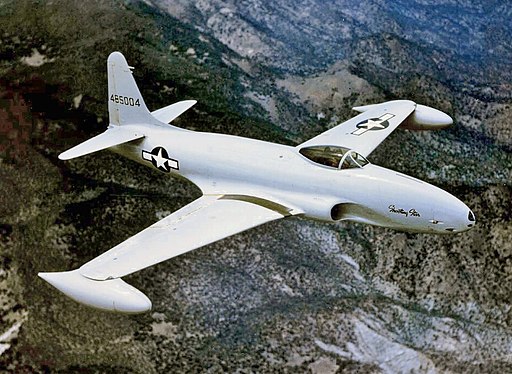
Lockheed P-80 Shooting Star
The Lockheed P-80 Shooting Star was the first operational jet-powered fighter aircraft used by the United States Army Air Forces (USAAF). Developed during World War II, the P-80 represented a significant leap forward in aviation technology, transitioning from propeller-driven planes to jet propulsion. Designed by the legendary Clarence “Kelly” Johnson and his team at Lockheed’s Skunk Works, the P-80 made its maiden flight on January 8, 1944, and entered service in 1945.
With a top speed of around 600 miles per hour, the P-80 was faster than contemporary propeller-driven fighters, providing a crucial advantage in air-to-air combat. It played a limited role in the final months of World War II but became a key asset during the Korean War, where it demonstrated its capabilities in air superiority missions. The Shooting Star’s success paved the way for the development of subsequent jet fighters and contributed to the evolution of modern aerial warfare. The P-80 remains a significant milestone in aviation history, marking the advent of jet-powered military aircraft for the United States.
parameters Lockheed P-80 Shooting Star
The Lockheed P-80 Shooting Star was a pioneering jet-powered fighter aircraft with various specifications and parameters. Here are some key parameters of the P-80:
- Crew: Single pilot
- Length: 34 feet 6 inches (10.52 meters)
- Wingspan: 38 feet 10 inches (11.84 meters)
- Height: 11 feet 3 inches (3.43 meters)
- Empty Weight: Approximately 8,420 pounds (3,819 kilograms)
- Loaded Weight: Approximately 13,415 pounds (6,088 kilograms)
- Maximum Takeoff Weight: 16,856 pounds (7,651 kilograms)
- Engine: One Allison J33-A-35 turbojet engine
- Maximum Speed: Approximately 600 miles per hour (965 kilometers per hour)
- Range: Approximately 1,200 miles (1,930 kilometers)
- Service Ceiling: 45,000 feet (13,716 meters)
- Rate of Climb: 4,800 feet per minute (24.4 meters per second)
- Armament: Typically equipped with six .50 caliber M2 Browning machine guns
- Hardpoints: Could carry bombs or rockets underwing for ground attack missions
- First Flight: January 8, 1944
- Entered Service: 1945
These parameters highlight the performance and characteristics of the Lockheed P-80 Shooting Star, showcasing its role as one of the early jet fighters in the history of military aviation.
Armament Lockheed P-80 Shooting Star
The Lockheed P-80 Shooting Star was armed with a formidable array of weaponry, making it a potent force in air-to-air combat. The primary armament of the P-80 consisted of six .50 caliber M2 Browning machine guns, three mounted in each wing. This provided the aircraft with a significant firepower advantage over its propeller-driven counterparts. The .50 caliber machine guns were known for their reliability and effectiveness, making them a staple in many World War II and early post-war American aircraft. The P-80’s machine guns were synchronized to fire through the propeller arc, ensuring accurate targeting during dogfights.
In addition to its machine guns, the P-80 had the capability to carry external stores such as bombs or rockets under its wings. This versatility allowed the aircraft to undertake ground attack missions, expanding its role beyond air superiority. The ability to carry ordnance made the P-80 a flexible platform that could adapt to different mission requirements. The combination of speed, firepower, and versatility in armament contributed to the Lockheed P-80 Shooting Star’s success and solidified its place in aviation history as a groundbreaking jet fighter.
.jpg)