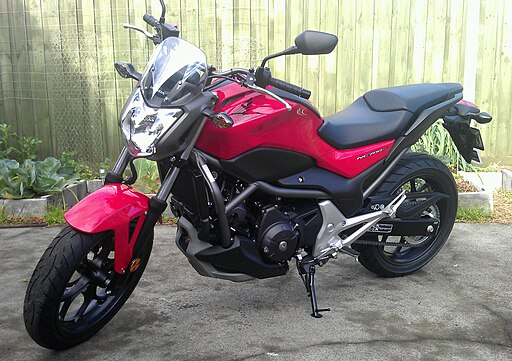
Honda NC700
The Honda NC700 is a family of purpose-built, commuter-friendly motorcycles introduced as a practical, efficient, and easy-to-ride platform blending elements of standard, crossover, and light-adventure designs. The model line emphasizes low-revving, torque-oriented performance, strong fuel economy, simplified maintenance, and user-focused packaging such as under-seat storage that replaces a conventional fuel tank to lower the center of gravity and increase everyday usability.
Engine and Powertrain
Engine architecture and displacement
The NC700 family uses a compact 670 cc parallel-twin engine with a single overhead camshaft and four valves per cylinder, designed for a low and usable powerband rather than high peak rpm performance. The engine layout and packaging prioritize a low center of gravity and efficient combustion for commuter and light-touring duties.
Bore, stroke and compression
Bore and stroke measure 73 mm by 80 mm, with a compression ratio around 10.7:1 on standard models, reflecting the engine’s tuning for midrange torque and fuel efficiency.
Induction, fueling and ignition
Fuel delivery is handled by PGM-FI electronic fuel injection with engine management optimized for predictable low-end torque, smooth throttle response, and economical consumption. Ignition is computer-controlled with transistorized advance for reliable starts and consistent combustion across varied conditions.
Transmission options
The NC700 series is offered with a six-speed manual transmission or an optional Dual Clutch Transmission (DCT) that provides fully automatic mode or manual shifting without a clutch lever. The DCT variants use a two-clutch arrangement to allow smooth, fast gear changes and commuter-friendly operation.
Performance and Fuel Economy
Power and torque characteristics
The NC700’s engine is tuned for usable torque in the low-to-mid rpm band. Published power figures vary by market and model tuning, with typical outputs focused on delivering strong torque around 4,750–6,250 rpm rather than high-rpm peak horsepower.
Consumption and real-world range
Fuel capacity is approximately 14.1 litres, and claimed consumption is extremely economical for a midweight twin; official figures and independent testing place combined fuel consumption in the low single-digit litres per 100 km, making the NC700 particularly attractive for commuting and long daily rides.
Chassis, Geometry and Handling
Frame and overall layout
The NC700 series employs a rigid-tube steel diamond frame designed to combine stability with a friendly handling balance suitable for urban traffic and open-road cruising. The engine’s compact packaging allows lower overall height and a lower center of gravity than many competitors in the class.
Dimensions and ergonomics
Wheelbase, rake and seat-height choices are targeted to create an upright, confidence-inspiring riding position. Typical wheelbase and dimension figures give the NC700 a compact footprint for city use while retaining highway composure and long-ride comfort.
Suspension and Brakes
Front and rear suspension
Front suspension is a 41 mm telescopic fork with around 120–153 mm of travel depending on the variant and market tuning. The rear uses a Pro-Link single-shock with progressive leverage, providing balanced compliance and support for solo riding, commuting loads, and light touring setups.
Braking system and safety features
Braking hardware typically includes a single 320 mm front disc with multi-piston caliper and a 240 mm rear disc with single-piston caliper, delivering confident stopping power with good modulation for mixed-surface and urban use. ABS and a combined braking system were available on certain models and trims to improve safety in varied road conditions.
Wheels, Tires and Ride Modes
Wheel and tyre configuration
Street-oriented 17-inch wheels front and rear with road-biased tires provide stable handling and predictable grip for commuting and occasional spirited riding. Tire choices reflect the range-oriented intent of the machine rather than off-road capability.
Ride modes and electronic aids
Some NC700 variants offer selectable rider modes and electronic management that tailor throttle response and shifting behaviour (on DCT models), enhancing adaptability between relaxed commuting and more responsive riding when desired.
Dimensions, Weight and Capacities
Key measurements
Typical NC700 dimensional values show compact overall length and a manageable seat height (often around 790 mm for standard trims), a wheelbase near 1,525–1,540 mm, and ground clearance tuned for urban obstacles and light touring duties.
Mass and carrying capacity
Wet weight varies by model and equipment, typically in the middleweight range; curb weights commonly fall in the neighborhood of low- to mid-200 kilograms depending on ABS, DCT and accessories. The under-seat storage area and pragmatic ergonomics make the NC700 family especially suited to everyday commuting with practical luggage solutions.
Electrical System and Instrumentation
Charging and electrics
The electrical system includes a stator/alternator sized to support lighting and the ignition with margin for accessories. The simplified wiring harness and proven components support reliability and straightforward troubleshooting for owners who prefer hands-on maintenance.
Instrument cluster and connectivity
Instrument clusters on the NC700 typically feature clear analog/digital layouts with speedometer, tachometer (on many trims), fuel level, odometer/trip meters and status indicators. Later models and higher trims may include additional readouts related to DCT status, gear position, and fuel consumption metrics.
Maintenance, Serviceability and Upgrades
Routine maintenance
The NC700’s engine architecture and accessory placement emphasize low-maintenance ownership: regular oil and filter changes, valve clearance checks at recommended intervals, fuel-injection diagnostics when necessary, and standard drivetrain upkeep such as chain maintenance on chain-driven units.
Aftermarket and owner upgrades
Common owner upgrades include luggage systems optimized to work with the under-seat storage layout, comfort seats, wind protection (screens and handguards), and suspension revalving for heavier riders or touring loads. DCT software updates and clutch pack services are part of lifecycle considerations for automatic variants.
Use Cases and Rider Profile
The NC700 is tailored for riders who prioritize fuel efficiency, daily usability, and approachable handling over outright sport performance. Ideal owners include commuters, urban couriers, and riders seeking a low-cost-per-kilometre medium-capacity motorcycle that can double as a relaxed weekend tourer or light-commuter with practical storage and excellent range.
Summary Technical Specification
- Engine type: 670 cc parallel-twin, SOHC, 4 valves per cylinder, liquid-cooled.
- Bore × stroke: 73 mm × 80 mm.
- Compression ratio: 10.7:1.
- Fuel system: PGM-FI electronic fuel injection.
- Ignition: Computer-controlled transistorized with electronic advance.
- Transmission: 6-speed manual or optional 6-speed Dual Clutch Transmission (DCT).
- Frame: Rigid tube steel diamond-type frame.
- Front suspension: 41 mm telescopic fork, travel ~120–153 mm depending on model.
- Rear suspension: Pro-Link single shock, progressive linkage, travel ~150 mm.
- Front brake: Single 320 mm disc with 3-piston caliper (varies by market).
- Rear brake: Single 240 mm disc with single-piston caliper.
- Wheels/tires: 17 in front and rear, street-biased tyres (typical sizes 120/70-ZR17 and 160/60-ZR17).
- Fuel capacity: ~14.1 litres.
- Seat height: Approximately 790 mm (market/trim dependent).
- Wheelbase: Approximately 1,525–1,540 mm.
- Wet/curb weight: Mid 200 kg range depending on equipment and model year.
Final thoughts
The Honda NC700 series represents a pragmatic approach to motorcycle design that balances everyday practicality, fuel efficiency, rider-friendly ergonomics, and modern drivetrain options such as DCT. For riders seeking a capable commuting machine with low operating costs and flexible use as a light tourer, the NC700 delivers a well-rounded, technically coherent package that remains compelling in the midweight segment.
