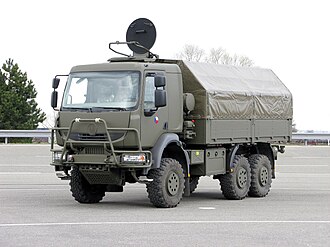
Tatra 810 – A Comprehensive Technical and Engineering Analysis of a Modern Czech Military Logistics Truck
The Tatra 810 is one of the most significant modern military logistics vehicles developed in Central Europe in the post–Cold War era. Designed primarily for the Army of the Czech Republic, it represents a crucial evolutionary step between older Cold War-era platforms such as the legendary Praga V3S and modern modular tactical trucks used by NATO forces. Unlike many traditional Tatra vehicles known for their unique backbone chassis and air-cooled engines, the Tatra 810 follows a more conventional truck architecture while still incorporating several robust off-road engineering solutions.
This article provides a deep technical breakdown of the Tatra 810, its development background, structural design, powertrain, mobility characteristics, off-road performance, military applications, and modernization trends. It also includes a detailed technical specification table at the end.
Historical Background and Development Context of the Tatra 810
The need for a replacement of the Praga V3S
The origins of the Tatra 810 are deeply connected to the long service life of the Praga V3S, a vehicle introduced in the 1950s. While the V3S was admired for its extreme durability and simplicity, by the 1990s and early 2000s it had become technologically outdated. The Czech military required a new medium-duty logistics truck that would:
- Offer higher road speed and mobility
- Improve crew comfort and ergonomics
- Provide better payload capacity
- Meet NATO interoperability standards
- Maintain high off-road reliability
The development process involved multiple industrial efforts, including earlier prototypes from various Czech and foreign collaborations. Eventually, Tatra Trucks took responsibility for delivering a production-ready platform.
Entry into service and production timeline
The Tatra 810 entered production in the late 2000s, with series deployment beginning around 2008. It was later introduced in civilian and modified variants, and even further modernized into the Tatra 810 M platform in the 2020s.
Its role is primarily logistics, troop transport, equipment towing, and support in both domestic and foreign military operations.
Design Philosophy and Structural Engineering
Departure from classic Tatra backbone architecture
One of the most important technical distinctions of the Tatra 810 is that it does not use the traditional Tatra backbone tube chassis with swinging half-axles. Instead, it uses a more conventional:
- Ladder-type frame chassis
- Standard rigid axle layout with portal reduction hubs
- Modular body mounting system
This decision was made to reduce production complexity, improve compatibility with NATO supply chains, and simplify maintenance.
Despite this, the vehicle still retains strong off-road DNA through its axle design and drivetrain configuration.
Chassis and frame construction
The chassis is built as a reinforced steel ladder frame optimized for torsional rigidity under heavy load conditions. It is designed to:
- Absorb extreme terrain deformation
- Carry heavy military payloads
- Support modular mission-specific bodies
- Maintain structural integrity under blast and vibration loads
The frame integrates mounting points for cargo beds, communication shelters, fuel tanks, and specialized military systems.
Powertrain and Engine Technology
Diesel engine configuration
The Tatra 810 is powered by a Renault DXi7 diesel engine (or equivalent Euro-standard variants depending on production batch). This is a key departure from traditional air-cooled Tatra engines.
Key engine characteristics include:
- Inline six-cylinder configuration
- Displacement: approximately 7.1 liters
- Water-cooled system
- Turbocharged diesel injection system
- Output: around 177 kW (≈240 hp)
- Torque: approximately 900 Nm
This engine was selected for its balance between:
- Fuel efficiency
- Emissions compliance (Euro standards)
- Global parts availability
- Reliability under military load conditions
Cooling and operational efficiency
The engine uses a modern liquid cooling system that ensures stable performance even in extreme climates. The vehicle is rated for operational use in temperatures ranging from approximately -32°C to +45°C, making it suitable for global deployment scenarios.
Transmission and Drivetrain System
Gearbox configuration
The transmission system is a critical element of the Tatra 810’s off-road capability. It typically uses:
- ZF 6-speed manual gearbox
- Auxiliary reduction gearbox (Steyr VG series)
This combination allows:
- High torque multiplication for off-road crawling
- Efficient highway cruising
- Flexibility in military convoy operations
4×4 and 6×6 drivetrain variants
The vehicle is produced in both 4×4 and 6×6 configurations, depending on mission requirements.
- 4×4: lighter logistics and patrol roles
- 6×6: heavy cargo and towing applications
Power is distributed through:
- Central transfer case
- Lockable differentials
- Portal axle reduction gears
This ensures traction even in mud, snow, sand, and uneven terrain.
Suspension System and Mobility Engineering
Axle and suspension design
The suspension system combines two different engineering approaches:
- Front axle: coil spring suspension with stabilizers
- Rear axles: leaf spring suspension in tandem configuration
This hybrid system is optimized for:
- Load-bearing capacity
- Shock absorption
- Maintenance simplicity
Portal axle and ground clearance
One of the defining features is the use of portal reduction axles, which significantly increase ground clearance without raising the vehicle’s center of gravity excessively.
Key benefits include:
- High obstacle clearance
- Improved underbody protection
- Reduced risk of drivetrain damage in rough terrain
Ground clearance reaches approximately 460 mm, enabling strong off-road performance.
Off-Road Capability and Terrain Performance
Terrain adaptability
The Tatra 810 is engineered for extreme terrain operations, including:
- Mountain paths
- Forest terrain
- Muddy and swampy conditions
- Snow-covered environments
- Sand and desert operations
Its performance is supported by:
- Differential locks
- Central tire inflation system
- High torque at low RPM
- Reinforced chassis structure
Central tire inflation system (CTIS)
The CTIS allows the driver to adjust tire pressure from inside the cabin. This enables:
- Lower pressure for soft terrain (sand, mud)
- Higher pressure for road driving
- Emergency mobility after partial tire damage
This system significantly enhances operational survivability in combat or remote logistics missions.
Cab Design and Crew Ergonomics
Cabin structure
The cabin is designed as a forward-control (cab-over-engine) configuration. This provides:
- Better visibility
- Shorter vehicle length for maneuverability
- Efficient space utilization
The cabin is reinforced for military conditions and can be fitted with optional armor kits.
Crew comfort and systems
Modern versions include:
- Heating and ventilation systems
- Optional air conditioning
- Ergonomic seating for long deployments
- Communication and navigation systems
- Military radio integration
Compared to older military trucks, this significantly improves crew endurance and operational efficiency.
Protection and Military Features
Ballistic and blast resistance
While not a full armored vehicle, the Tatra 810 can be fitted with protective elements such as:
- Fragment-resistant floor plating
- Armor panels for cabin protection
- Bullet resistance up to small arms calibers (with upgrades)
Electronic and tactical systems
Depending on configuration, the vehicle may include:
- Electronic countermeasure shielding
- Military communication systems
- Night operation lighting systems
- Convoy coordination modules
These features enhance survivability in modern battlefield environments.
Operational Roles and Military Applications
Logistics and transport duties
The primary function of the Tatra 810 is logistics support:
- Troop transport
- Ammunition supply
- Equipment relocation
- Medical evacuation support (in modified versions)
Towing and support roles
It can also be used for:
- Artillery towing
- Trailer transport
- Engineering equipment deployment
Its high torque and structural strength make it ideal for heavy-duty military logistics chains.
Modernization – Tatra 810 M Evolution
The newer Tatra 810 M introduces improvements such as:
- Increased payload capacity
- Modernized cab ergonomics
- Improved emissions compliance
- Enhanced modularity for mission systems
This ensures continued relevance in NATO-aligned forces.
Technical Performance in Real-World Conditions
The Tatra 810 is known for:
- High reliability in extreme climates
- Strong off-road capability compared to civilian trucks
- Moderate road comfort for its class
- Excellent maintenance accessibility
Its design prioritizes function over comfort, but modern upgrades have significantly improved usability for crews.
Conclusion
The Tatra 810 represents a balanced engineering compromise between traditional rugged military design and modern automotive standards. While it does not carry the iconic backbone chassis of older Tatra vehicles, it compensates with modularity, NATO compatibility, and modern diesel technology.
Its role as a successor to the Praga V3S makes it historically important, and its continued modernization ensures that it remains a relevant logistics platform in European military service.
Technical Specifications Table
| Parameter | Specification |
|---|---|
| Manufacturer | Tatra Trucks a.s. |
| Production period | 2008 – present |
| Vehicle class | Medium military logistics truck |
| Drive configuration | 4×4 / 6×6 |
| Engine | Renault DXi7 diesel (inline-6) |
| Displacement | ~7,145 cm³ |
| Power output | ~177 kW (≈240 hp) |
| Torque | ~900 Nm |
| Transmission | ZF 6-speed manual + auxiliary reduction gearbox |
| Top speed | ~90–105 km/h (depending on variant) |
| Payload capacity | ~2,850 – 5,000 kg |
| Gross vehicle weight | up to ~15,500 kg |
| Length | ~7,3 – 8,1 m |
| Width | 2,55 m |
| Height | 3,3 m |
| Wheelbase | 3,150 + 1,200 mm (or extended variants) |
| Ground clearance | ~460 mm |
| Fuel tank capacity | ~320 liters |
| Operational range | ~800 km |
| Suspension (front) | Coil springs with stabilizer |
| Suspension (rear) | Leaf springs (bogie setup) |
| Brake system | Air brake system |
| Tire system | Central tire inflation system |
| Operating temperature range | approx. -32°C to +45°C |
| Maximum fording depth | up to ~1.2 m (variant dependent) |
