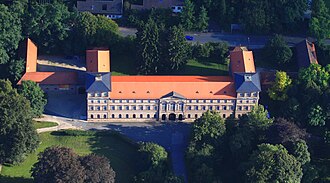
Schloss Burgfarrnbach: The Grand Classical Palace of Franconia
On the western edge of the Bavarian city of Fürth, in the quiet and historically rich district of Burgfarrnbach, stands one of the most impressive aristocratic residences in southern Germany: Schloss Burgfarrnbach. Often described as the largest classical palace complex in Bavaria, this architectural landmark is not only a striking example of 19th-century design but also a deeply layered historical site that reflects centuries of noble life, political change, and cultural transformation.
Built between 1830 and 1834 for the noble family of the Grafen von Pückler-Limpurg, the palace replaced an earlier medieval water castle that had existed on the site for hundreds of years. The result was a monumental classical residence that combined symmetry, grandeur, and rational architectural planning with the traditions of Franconian aristocratic life.
Today, Schloss Burgfarrnbach serves a completely different function: it houses the city archive, a scientific library, and parts of the cultural institutions of Fürth. In doing so, it bridges the gap between noble heritage and modern civic identity, transforming from a symbol of aristocratic power into a center of public knowledge and historical preservation.
This article explores the palace in depth—its origins, architectural design, historical evolution, interior structure, landscape park, and its continuing role in contemporary cultural life.
Historical Background of Schloss Burgfarrnbach
Medieval Origins and the First Settlement
The history of Schloss Burgfarrnbach stretches far back into the medieval period. As early as the 14th century, the site was already occupied by a noble residence belonging to local aristocratic families. Initially, this was not a palace in the modern sense but rather a fortified manor or water castle typical of the region.
By the 16th century, a more structured water castle had been constructed on the site, complete with defensive features and surrounding water channels. This early structure reflected the political instability of the time, when noble families needed both residential comfort and defensive capability.
During the Thirty Years’ War in the 17th century, the original structure suffered significant damage and was eventually destroyed. However, in 1658 it was rebuilt, once again serving as a noble residence for the ruling families of Burgfarrnbach.
The Pückler-Limpurg Family and Aristocratic Expansion
The most significant transformation of the estate began under the Grafen von Pückler-Limpurg, a noble family with roots in both Franconia and Silesia. Through marriage, inheritance, and political alliances, the family consolidated its position as one of the important aristocratic houses in the region.
Over time, the estate expanded beyond a simple residence. New agricultural buildings, administrative structures, and ornamental features were added. The baroque period in particular brought significant changes, including the construction of stables, gatehouses, and garden pavilions.
However, by the early 19th century, the old water castle had become outdated and structurally unsound. This set the stage for one of the most ambitious architectural projects in the region.
The Construction of the Classical Palace (1830–1834)
Decision to Build a New Residence
By the beginning of the 19th century, the old castle on the Farrnbach was no longer suitable for aristocratic living. Maintenance costs were rising, structural issues were becoming severe, and architectural tastes had shifted toward classical symmetry and elegance.
Instead of continuing to repair the old structure, the Pückler-Limpurg family decided to construct an entirely new palace. This decision marked a turning point in the history of the estate and reflected broader European trends toward neoclassical architecture.
The new palace was designed to be both a family residence and a symbol of status, reflecting Enlightenment ideals of order, rationality, and proportion.
Architectural Design by Leonhard Schmidtner
The palace was designed by the Königlich Bayerischer Bauinspektor Leonhard Schmidtner, a prominent architect of the period. His vision for Schloss Burgfarrnbach was rooted in classical principles: symmetry, geometric clarity, and restrained ornamentation.
Construction took place between 1830 and 1834, and the scale of the project was enormous. The palace extends roughly 70 meters in length and contains around 70 to 80 rooms distributed across multiple floors. It is structured as a long, symmetrical complex with a central axis and balanced wings on either side.
The building was intentionally designed to accommodate two branches of the Pückler family, each occupying a separate wing while sharing a central ceremonial hall. This dual-structure design is one of the most distinctive features of the palace.
A Monument of Classical Architecture
Unlike the ornate baroque castles of earlier centuries, Schloss Burgfarrnbach represents a shift toward neoclassicism. Its façade is characterized by simplicity and discipline rather than decorative excess.
The central entrance is emphasized by a slightly projecting section, while evenly spaced windows create a rhythm across the building’s surface. The overall impression is one of balance and stability, reflecting the ideals of early 19th-century aristocratic culture.
According to historical sources, the palace is considered the largest classical palace complex in southern Germany, making it a significant architectural landmark not only for Fürth but also for the entire Franconian region.
Interior Structure and Aristocratic Life
Symmetry and Dual Family Arrangement
One of the most fascinating aspects of Schloss Burgfarrnbach is its internal organization. The palace was designed to house two branches of the same noble family simultaneously. Each branch occupied one wing of the building, while the central section served as a shared ceremonial and social space.
This arrangement reflects both practical and political considerations. Aristocratic inheritance often led to complex family structures, and the palace’s architecture was adapted to accommodate shared ownership without conflict.
The Grand Festsaal
At the heart of the palace lies the Festsaal, or grand ceremonial hall. This space was used for receptions, celebrations, and official gatherings. Even today, it remains one of the most impressive interiors of the building.
The hall is notable for its balanced proportions and symbolic decoration. Initials and family emblems historically marked the division between the two family lines, emphasizing both unity and distinction within the same architectural space.
Residential and Administrative Rooms
Beyond the ceremonial areas, the palace contains a large number of residential rooms, private chambers, and administrative offices. These spaces were designed with functional elegance in mind rather than excessive ornamentation.
High ceilings, large windows, and simple classical detailing create a sense of lightness and order throughout the interior. This reflects the Enlightenment influence on architectural design, where clarity and reason were prioritized over baroque grandeur.
The Schlosspark and Landscape Design
From Baroque Garden to English Landscape Park
Surrounding the palace is a large park that has evolved over centuries. Originally designed as a baroque garden, it was later transformed into an English-style landscape park during the 19th century, in line with changing aesthetic preferences.
Unlike formal geometric gardens, English landscape parks emphasize naturalistic design. Winding paths, irregular tree groupings, and open lawns create a more relaxed and romantic atmosphere.
This transformation reflects broader European trends in landscape architecture, where nature was increasingly idealized as a space of freedom and reflection.
Historical Garden Structures
Within the park, several historical structures remain. Among them is a baroque garden pavilion known locally as the “Schneidershäuschen,” as well as smaller ornamental buildings such as the Karolinenruh pavilion.
These structures provide visual focal points within the landscape and serve as reminders of the estate’s long history. They also illustrate the layering of architectural styles across different periods.
The Decline of Aristocratic Ownership
End of the Pückler-Limpurg Line
The noble family continued to inhabit the palace well into the 20th century. However, over time, the aristocratic lifestyle became increasingly difficult to maintain. Economic pressures, social change, and the decline of noble privileges gradually reduced the family’s influence.
The final direct heirs of the Pückler-Limpurg line lived in the palace until the mid-20th century. With their passing, the aristocratic chapter of Schloss Burgfarrnbach came to an end.
Post-War Transformation
After the Second World War, the palace underwent a period of uncertain use. Like many large aristocratic estates in Germany, it was temporarily repurposed for housing displaced persons and administrative functions.
By the mid-20th century, it became clear that the building required preservation and a new long-term function to ensure its survival.
Transition into a Public Cultural Institution
Acquisition by the City of Fürth
In the 1960s, the city of Fürth acquired Schloss Burgfarrnbach. This marked a crucial turning point in its history. Rather than remaining a private estate or falling into decay, the palace was integrated into public ownership and repurposed for civic use.
Restoration work was carried out to stabilize the structure and adapt it for institutional functions while preserving its historical character.
Modern Use as Archive and Library
Today, Schloss Burgfarrnbach houses the city archive, a scientific library, and parts of the cultural documentation of Fürth. The archive preserves historical documents dating back centuries, while the library holds tens of thousands of volumes of scholarly importance.
This transformation has given the palace a new identity as a center of knowledge and historical research.
According to cultural records, the building now functions as one of the most important archival institutions in the region, supporting historical research and public education.
Architectural Significance in Bavaria
A Landmark of Neoclassical Design
Schloss Burgfarrnbach is widely regarded as a masterpiece of neoclassical architecture in Bavaria. Its disciplined geometry, restrained ornamentation, and monumental scale distinguish it from earlier baroque and rococo palaces.
The design reflects Enlightenment ideals that valued clarity, order, and rational structure. These principles are visible not only in the façade but also in the internal organization of the building.
Comparison with Regional Architecture
Within the Franconian region, Schloss Burgfarrnbach stands out due to its size and architectural coherence. While many aristocratic estates in Bavaria were smaller or more decorative, this palace combines scale with classical restraint, making it a unique example of early 19th-century design.
It represents a transitional moment in architectural history, bridging aristocratic tradition and modern civic architecture.
Cultural Importance Today
A Living Historical Monument
In contemporary Fürth, Schloss Burgfarrnbach is more than a preserved building—it is a living cultural institution. Its continued use ensures that history remains accessible and relevant to the public.
Visitors can explore the building, attend cultural events, or conduct research in its archives, making it an active part of civic life.
Educational and Research Role
The presence of the city archive and scientific library makes the palace a vital resource for historians, researchers, and students. Its collections provide insight into regional history, genealogy, urban development, and cultural heritage.
In this way, the palace continues to contribute to intellectual and cultural life long after the end of its aristocratic era.
Conclusion
Schloss Burgfarrnbach stands as one of the most important architectural and historical landmarks in Franconia. From its medieval origins as a water castle to its transformation into a grand neoclassical palace and finally into a modern cultural archive, it reflects the long and complex history of the region.
Its architecture embodies the ideals of symmetry, order, and classical beauty, while its interior structure tells the story of aristocratic life and family dynamics. Today, as part of the civic infrastructure of Fürth, it serves a completely new purpose—preserving history rather than representing power.
