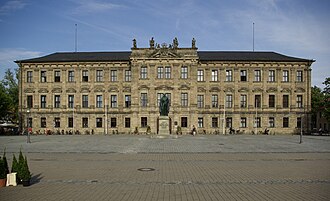
Schloss Erlangen: History, Architecture, and Cultural Legacy in the Heart of Franconia
In the center of the Bavarian city of Erlangen stands one of its most recognizable historical landmarks: Schloss Erlangen. Often referred to in English as Erlangen Castle or Erlangen Palace, this elegant structure is more than just an architectural relic of the past. It is a living symbol of the city’s evolution—from a small medieval settlement into a planned baroque residence city and later into a modern university hub.
Although Schloss Erlangen may not be as globally famous as Bavaria’s grand palaces such as Neuschwanstein, its significance lies in its cultural, academic, and urban role. It is deeply tied to the development of the city, the rise of Enlightenment-era urban planning, and the growth of one of Germany’s most respected universities, the Friedrich-Alexander-Universität Erlangen-Nürnberg.
This article explores the castle’s origins, architectural transformation, historical importance, and its role in contemporary Erlangen life.
Historical Origins of Schloss Erlangen
Early Settlement and the Need for a Residence
The origins of Schloss Erlangen are closely tied to the transformation of Erlangen itself. The earliest documented settlement in the area dates back to the medieval period, but it remained relatively modest until the 17th century. The region suffered heavily during the Thirty Years’ War, which left many towns in Franconia depopulated and economically weakened.
It was in this context that the Margraves of Brandenburg-Bayreuth saw an opportunity to rebuild and reorganize the region. Erlangen was selected as one of the locations for planned reconstruction and expansion. The idea was not simply to restore a town but to create a model baroque residence city that reflected order, rationality, and princely authority.
The Construction of the First Palace
The first version of Schloss Erlangen was constructed in the late 17th century under Margrave Christian Ernst. It was initially a relatively modest residence compared to larger European palaces, but it served an important administrative and symbolic function.
The palace marked the center of the newly designed urban layout. Streets were arranged geometrically, and the palace was positioned as the focal point of the city. This reflected baroque urban planning principles, which emphasized symmetry, hierarchy, and visual control.
Baroque Transformation and Urban Planning
Erlangen as a Planned Baroque City
Unlike many European cities that developed organically over centuries, Erlangen is often described as one of the earliest “planned cities” in Germany. After destruction during the war, the Margraves rebuilt it according to a strict geometric layout.
Schloss Erlangen was central to this design. The palace, the central square, and the main avenues were aligned to create a coherent visual and political axis. This planning reflected Enlightenment ideals of order and rational governance.
Expansion Under Margrave Christian Ernst
Under Margrave Christian Ernst, the palace underwent expansion and refinement. New wings were added, and the surrounding gardens were developed. The palace began to serve not only as a residence but also as a ceremonial and administrative center.
During this period, Erlangen also became a refuge for Huguenots fleeing religious persecution in France. Their arrival significantly influenced the city’s cultural and economic development, and the palace stood as a symbol of princely protection and integration.
Architectural Features of Schloss Erlangen
Exterior Design and Baroque Elegance
Schloss Erlangen reflects the restrained elegance of Franconian baroque architecture. Unlike the highly ornate palaces of southern Bavaria, it is more functional and balanced in appearance.
The façade is characterized by symmetrical windows, modest decorative elements, and a central emphasis on proportion rather than excessive ornamentation. This simplicity reflects both economic realities and the intellectual climate of the region during the Enlightenment.
The palace’s color palette—typically light tones with subtle contrasts—enhances its harmonious integration into the surrounding urban landscape.
Interior Layout and Functional Spaces
The interior of Schloss Erlangen originally included ceremonial halls, residential apartments, and administrative offices. While much of the original interior has been modified over time, historical records indicate that the layout followed typical baroque principles.
Key rooms were arranged along a central axis, emphasizing hierarchy and movement through space. Public reception rooms were designed to impress visitors and demonstrate princely authority, while private quarters were more modest and functional.
The Schlossgarten: A Green Extension of the Palace
Design and Purpose of the Gardens
One of the most important features associated with Schloss Erlangen is the adjacent Schlossgarten. This formal garden was designed as an extension of the palace’s symbolic power, blending nature with architectural order.
The gardens follow geometric patterns typical of baroque landscape design. Paths, hedges, fountains, and sculptures are arranged symmetrically, creating a controlled natural environment.
Transition to a Public Space
Over time, the Schlossgarten transitioned from a private princely garden into a public park. Today, it is one of the most popular recreational areas in Erlangen.
Students, families, and visitors use the space for walking, studying, and social gatherings. This transformation reflects broader changes in European society, where aristocratic spaces were gradually democratized and opened to the public.
Schloss Erlangen and the University Tradition
The Rise of Academic Influence
A defining chapter in the history of Schloss Erlangen began in the 18th century with the establishment of a university in the city. Today, this institution is known as the Friedrich-Alexander-Universität Erlangen-Nürnberg.
As the university grew, the palace and surrounding buildings increasingly became integrated into academic life. Parts of the castle were repurposed for administrative and ceremonial university functions.
The Palace as an Academic Symbol
Schloss Erlangen is now closely associated with academic identity. It represents the historical continuity between Enlightenment ideals and modern education. The palace’s transformation from ducal residence to academic building reflects the shift from aristocratic governance to intellectual and civic development.
Many university ceremonies, public lectures, and cultural events take place in or around the palace, reinforcing its role as a living institution rather than a static monument.
Cultural and Social Significance
A Center of Civic Identity
For residents of Erlangen, Schloss Erlangen is more than a historical building—it is a central part of civic identity. It appears in city branding, tourism materials, and local traditions.
The palace and its gardens serve as a meeting point for festivals, seasonal events, and public celebrations. Its presence reinforces a sense of continuity between past and present.
Festivals and Public Life
Throughout the year, the area around Schloss Erlangen hosts cultural events, including music performances, open-air gatherings, and university-related festivals. The integration of historical architecture with modern cultural life is one of the defining features of the city.
The palace thus functions not only as a monument but also as a dynamic space for social interaction.
Architectural Evolution Through Time
19th and 20th Century Changes
During the 19th century, Schloss Erlangen underwent several modifications to accommodate changing administrative and academic needs. While the original baroque structure remained intact in its core, interior renovations reflected more modern functional requirements.
In the 20th century, particularly after the Second World War, restoration efforts focused on preserving historical elements while ensuring usability for contemporary purposes.
Preservation and Restoration Efforts
Restoration of Schloss Erlangen has been guided by a commitment to preserving historical authenticity while adapting to modern use. Conservation experts have worked to maintain the structural integrity of the building, including its façade, roof structure, and key architectural features.
These efforts ensure that the palace remains a functioning part of the city rather than a purely decorative relic.
Schloss Erlangen in Modern Urban Life
Integration Into the City Landscape
Today, Schloss Erlangen is seamlessly integrated into the urban fabric of Erlangen. It is surrounded by university buildings, cafés, pedestrian areas, and cultural institutions.
Unlike isolated historical monuments, the palace exists within a living, evolving environment. This integration enhances its accessibility and relevance.
Tourism and Visitor Experience
Visitors to Erlangen often encounter the palace as part of a broader exploration of the city. Its proximity to the Schlossgarten makes it a natural destination for walking tours and cultural visits.
Tourists are drawn not only to its architectural beauty but also to the atmosphere created by the surrounding gardens and academic environment.
Symbolism and Historical Interpretation
A Reflection of Enlightenment Ideals
Schloss Erlangen embodies Enlightenment principles of order, rationality, and civic planning. Its symmetrical design and integration into a planned city reflect the intellectual currents of the 17th and 18th centuries.
The palace stands as a physical manifestation of the idea that urban space can be intentionally designed to reflect social and political ideals.
Continuity Between Past and Present
One of the most remarkable aspects of Schloss Erlangen is its continuity of use. Unlike many historical palaces that have become museums, it remains actively embedded in daily life.
Its connection to the Friedrich-Alexander-Universität Erlangen-Nürnberg ensures that it continues to serve educational and cultural purposes.
Conclusion
Schloss Erlangen is not just a baroque palace—it is a living symbol of transformation, continuity, and identity. From its origins as a margravial residence to its current role within a vibrant university city, it reflects the layered history of Erlangen.
Its architecture tells a story of Enlightenment ideals, its gardens reflect changing social values, and its ongoing use demonstrates the adaptability of historical spaces in modern society.
In many ways, Schloss Erlangen represents the essence of European cultural heritage: not frozen in time, but continuously evolving while preserving its historical soul.
