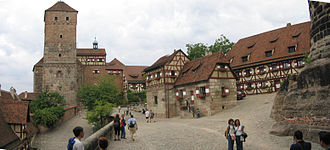
Nürnberger Burg: The Imperial Castle That Shaped the History of Nuremberg
High above the medieval old town of the Bavarian city of Nürnberg rises one of the most historically significant fortifications in Europe: the Nürnberger Burg, also known in English as the Imperial Castle of Nuremberg. This monumental complex is not a single building but rather a combination of castles, towers, courtyards, and defensive structures that together form one of the most powerful symbols of medieval imperial authority in the Holy Roman Empire.
For centuries, the castle was not only a military stronghold but also a political center where emperors resided, diets were held, and imperial power was visibly staged. Its silhouette dominates the skyline of Nuremberg, reminding visitors of a time when the city was one of the most important centers of trade, governance, and culture in Central Europe.
Today, the castle is both a major historical monument and a museum complex, attracting visitors from around the world. It stands as a rare example of a nearly intact imperial fortress, preserving layers of architectural development from the Romanesque period to the late Middle Ages and beyond.
This article explores the Nürnberger Burg in depth—its origins, political significance, architectural evolution, defensive systems, interior structures, wartime damage, and its role in modern cultural identity.
The Historical Importance of Nürnberger Burg
A Fortress at the Heart of the Holy Roman Empire
The Nürnberger Burg is inseparably linked to the history of the Holy Roman Empire. From the 11th century onward, the castle served as one of the most important imperial residences, strategically located in the center of the empire’s German territories.
The emperors of the Holy Roman Empire did not have a fixed capital. Instead, they traveled from one imperial palace to another, holding court and administering their territories. The castle in Nürnberg became one of the most important of these residences, symbolizing imperial authority in stone.
Its elevated position above the city was not accidental. It allowed for both defense and symbolic dominance, visually reinforcing the connection between imperial power and urban prosperity.
The Dual Structure: Imperial Castle and Burgrave Castle
One of the unique aspects of the Nürnberger Burg is its dual structure. It consists of two main components: the Imperial Castle (Kaiserburg) and the Burgrave’s Castle (Burggrafenburg).
The Imperial Castle served the Holy Roman Emperors and their administrative functions. The Burgrave’s Castle, on the other hand, was the residence of the burgraves—local nobles who acted as imperial representatives.
Over time, these two parts evolved both independently and together, creating a complex architectural and political landscape that reflects the layered nature of medieval governance.
Early Origins and Medieval Development
The First Fortifications
The earliest fortifications on the castle hill likely date back to the 11th century. These were simple defensive structures made of wood and earth, designed to control the surrounding region and protect trade routes.
As the political importance of Nuremberg grew, these early structures were replaced by stone buildings, marking the beginning of the castle’s transformation into an imperial residence.
Romanesque Foundations
By the 12th century, significant Romanesque construction had begun. This period saw the development of the most ancient surviving parts of the castle, including foundational walls and early towers.
One of the most important surviving structures from this era is the Double Chapel, a rare example of Romanesque sacred architecture integrated directly into a fortified complex.
Expansion Under the Hohenstaufen Emperors
The castle reached new levels of importance under the Hohenstaufen dynasty, particularly during the reign of Emperor Frederick II. During this time, Nuremberg became a favored imperial city, and the castle was expanded to accommodate courtly life, administration, and military defense.
New halls, residential quarters, and fortifications were added, transforming the complex into a fully functional imperial residence.
Architectural Structure of the Castle
The Imperial Castle Complex
The Nürnberger Burg is not a single building but a collection of structures built over several centuries. Its architecture reflects continuous adaptation to changing political, military, and residential needs.
Key components include:
- The Palas (main residential hall)
- The Sinwell Tower
- The Deep Well
- The Double Chapel
- Defensive walls and gates
- The Burgrave’s buildings
Each of these elements contributes to the castle’s layered identity.
The Palas: Heart of Imperial Life
The Palas is the main residential building of the Imperial Castle. It served as living quarters for emperors and their retinues during their stays in Nuremberg.
Inside, large halls were used for ceremonies, banquets, and administrative functions. The architecture reflects Gothic influences, particularly in its tall windows, vaulted ceilings, and emphasis on vertical space.
Although much of the interior has been restored, the Palas still conveys the grandeur of imperial life.
The Double Chapel: A Rare Medieval Structure
Unique Architectural Design
One of the most remarkable features of the Nürnberger Burg is the Double Chapel (Doppelkapelle). This two-level chapel dates back to the 12th century and is one of the most important Romanesque religious structures in Germany.
The chapel consists of two stacked levels connected by a central opening. The lower level was intended for servants and lower-ranking individuals, while the upper level was reserved for nobility and the imperial family.
This vertical separation reflects the rigid social hierarchy of medieval society.
Symbolism and Function
The Double Chapel is not only an architectural curiosity but also a symbol of medieval political theology. It reflects the idea that earthly hierarchy was mirrored in sacred space.
Its integration into a fortified structure highlights the close relationship between religion and imperial authority during the Middle Ages.
Defensive Structures and Military Architecture
Towers and Walls
The castle’s defensive system is one of its most impressive features. Thick stone walls, strategically placed towers, and fortified gates ensured that the castle could withstand sieges and attacks.
The design of these defenses evolved over time, incorporating new military technologies and architectural innovations.
The Sinwell Tower
One of the most iconic structures in the castle is the Sinwell Tower. Built in the 13th century, it served as both a defensive stronghold and a watchtower.
From its summit, guards could observe the surrounding countryside and the city below, ensuring early warning of approaching threats.
Today, the tower offers panoramic views of Nürnberg and remains one of the most popular visitor attractions in the castle.
The Deep Well
Another engineering marvel of the castle is the Deep Well (Tiefer Brunnen). Dug deep into the rock beneath the fortress, it provided a reliable water source during sieges.
The well reaches depths of over 50 meters and demonstrates the advanced engineering capabilities of medieval builders.
Guided demonstrations today allow visitors to witness how water was drawn from this impressive structure.
The Castle as an Imperial Residence
Royal and Imperial Visits
Throughout the Middle Ages, numerous Holy Roman Emperors resided in the Nürnberger Burg. It was not a permanent residence but a key stop in the imperial itinerary.
Emperors such as Frederick I Barbarossa and Charles IV used the castle during their travels, conducting state affairs, holding court sessions, and issuing decrees.
Imperial Diets and Political Functions
The nearby city of Nuremberg often hosted imperial diets—formal assemblies of princes and nobles. While these gatherings were held in the city rather than the castle itself, the fortress played a supporting role as a secure residence for the emperor.
This close connection between city and castle reinforced Nuremberg’s status as one of the most important political centers in the empire.
Decline of Imperial Power and Changing Roles
The End of the Medieval Empire
As the Holy Roman Empire gradually lost central authority in the early modern period, the political importance of the Nürnberger Burg declined.
By the 16th century, emperors no longer used it regularly as a residence. Instead, it became more of a symbolic structure than an active seat of power.
Transition to Administrative Use
Despite its reduced political role, the castle remained an important administrative and military site. It continued to serve as a fortress and was maintained by the city of Nuremberg.
Over time, however, its function shifted from imperial residence to historical monument.
Damage and Restoration in the Modern Era
Destruction During World War II
Like much of the old town of Nürnberg, the Nürnberger Burg suffered significant damage during the Second World War. Allied bombing raids caused extensive destruction to parts of the castle complex.
Although some structures survived relatively intact, others required substantial reconstruction.
Post-War Reconstruction Efforts
After the war, extensive restoration work was undertaken to rebuild and preserve the castle. Architects and historians carefully reconstructed damaged sections using historical documentation and surviving fragments.
The goal was not to modernize the structure but to restore its medieval and imperial character as accurately as possible.
Today, the castle stands as a carefully preserved historical monument that reflects both its original form and the resilience of post-war reconstruction efforts.
The Castle as a Museum and Cultural Site
Historical Exhibitions
Today, the Nürnberger Burg functions as a museum complex. Visitors can explore exhibitions that cover medieval life, imperial history, architecture, and the development of the Holy Roman Empire.
Artifacts, models, and reconstructed interiors help bring the castle’s history to life.
Educational Role
The castle plays an important educational role for schools, researchers, and tourists. It provides insight into medieval governance, military architecture, and urban development.
Its integration into the cultural life of Nuremberg ensures that it remains more than just a preserved ruin—it is an active center of historical learning.
The Castle in Urban Identity
Symbol of Nuremberg
The Nürnberger Burg is one of the defining symbols of Nürnberg. Its silhouette appears in countless images, postcards, and cultural representations of the city.
It represents continuity between past and present, linking modern urban life with medieval imperial history.
Tourism and Cultural Importance
As one of the most visited landmarks in Bavaria, the castle attracts millions of tourists each year. Its combination of architecture, history, and panoramic views makes it a central attraction in the region.
Visitors often begin their exploration of Nuremberg’s old town from the castle, descending into the medieval streets below.
Conclusion
The Nürnberger Burg is far more than a fortress. It is a living chronicle of European history, reflecting centuries of political power, architectural innovation, and cultural transformation.
From its origins as a medieval stronghold to its role as an imperial residence and finally its modern function as a museum, the castle has continuously evolved while retaining its historical essence.
Standing above the city of Nürnberg, it remains a powerful reminder of the Holy Roman Empire and the enduring legacy of medieval Europe.
