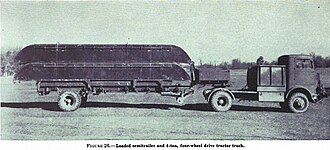
When discussing American military trucks of the Second World War, most enthusiasts immediately think of iconic vehicles such as the GMC CCKW, the Studebaker US6, or the Mack NO artillery tractor. These machines became legendary because of their widespread service and their direct association with some of the most important campaigns of the war. Yet hidden behind these famous names was a specialized vehicle that performed a mission every bit as important as transporting troops, ammunition, and supplies. This vehicle was the Mack NJU, a heavy-duty military tractor designed specifically to support one of the most critical engineering tasks in wartime operations: bridge construction.
Although relatively few were built compared with other military trucks, the Mack NJU played a unique and highly specialized role within Allied logistics. Designed to haul pontoon bridge equipment, engineering tools, and support trailers, the NJU was an essential component of military mobility. Armies can only advance as fast as they can cross rivers, canals, and other natural obstacles. Throughout military history, bridges have often determined the speed of offensives and the success of campaigns. During World War II, mobile bridge construction became a science, and vehicles such as the Mack NJU formed the backbone of that capability.
Produced in limited numbers between 1941 and 1942, the NJU represented an interesting combination of civilian truck technology and military engineering requirements. It was rugged, powerful for its era, and specifically designed to operate in environments where reliability was more important than comfort. While it never achieved the fame of combat vehicles or frontline transport trucks, its contribution to military engineering operations deserves recognition.
Today, surviving examples of the Mack NJU are rare and highly valued by military vehicle collectors. They serve as reminders of an era when victory often depended not only on tanks and aircraft, but also on the engineers and support vehicles that kept armies moving.
The Strategic Need for Specialized Engineering Vehicles
Rivers as Military Obstacles
One of the greatest challenges facing military planners throughout history has been the problem of crossing water obstacles. Rivers, streams, canals, and flooded terrain can halt even the most powerful armies if bridging equipment is unavailable. During World War II, mechanized forces depended upon rapid movement. Tanks, trucks, artillery pieces, and support vehicles required dependable crossing points if they were to maintain operational momentum.
Military engineers therefore became one of the most important branches of every major army. Their responsibility extended beyond constructing fortifications and clearing obstacles. They were also responsible for creating temporary bridges capable of supporting heavy military traffic.
The transportation of pontoon bridge sections required specialized vehicles. Bridge components were large, heavy, and awkwardly shaped. Standard cargo trucks were not always suitable for carrying them efficiently. This requirement led to the development of dedicated bridge transport tractors such as the Mack NJU.
The U.S. Army’s Requirements
In 1940, the United States Army recognized that expanding military operations would require improved engineering support capabilities. A contract was issued for a heavy-duty tractor capable of towing pontoon bridge trailers and associated engineering equipment. The result was the Mack NJU, officially designated as the G-639 military vehicle. Approximately 700 vehicles were ordered to meet anticipated wartime needs.
The truck was not intended to operate as a general-purpose transport. Instead, it was designed around a specific mission profile involving bridge construction and engineering support. This specialization made it one of the more unusual military vehicles produced during the war.
Development of the Mack NJU
From Civilian Origins to Military Service
Like many wartime vehicles, the NJU evolved from existing commercial truck designs. Military procurement agencies frequently adapted proven civilian platforms because doing so reduced development time and simplified production. Mack already possessed extensive experience manufacturing heavy commercial trucks, making the company a logical choice for the project.
The NJU was based on a cab-over-engine configuration, a design that offered several practical advantages. By positioning the cab above the engine, engineers reduced overall vehicle length while maximizing maneuverability. This arrangement proved particularly useful when towing large trailers carrying bridge equipment.
Although derived from civilian technology, the NJU underwent extensive modifications to meet military requirements. Four-wheel drive capability, heavy-duty axles, military-grade components, and reinforced chassis construction transformed the vehicle into a capable off-road tractor suitable for wartime service.
Limited Production Numbers
Unlike mass-produced cargo trucks, the NJU was manufactured in relatively small quantities. Approximately 700 examples were completed between 1941 and 1942, including 692 NJU-1 pontoon tractors and a small batch of NJU-2 variants.
The limited production run reflected the specialized nature of the vehicle. The Army required enough units to support engineering formations but did not need the massive numbers associated with general logistics trucks.
Today, these limited production numbers contribute significantly to the vehicle’s rarity and historical value.
Design and Engineering
Cab-Over-Engine Configuration
One of the most distinctive features of the NJU was its cab-over-engine design. At a time when many military trucks used conventional layouts with long engine hoods, the NJU adopted a more compact arrangement.
This design improved maneuverability while maintaining sufficient powertrain space. Engineers recognized that bridge construction sites often involved confined working areas where maneuvering large trailers could be difficult.
The cab itself resembled contemporary commercial truck cabs, though it incorporated military modifications and equipment. Compared with open-cab military vehicles, the enclosed cab offered improved protection from weather and environmental conditions.
Chassis Construction
The foundation of the NJU was a robust ladder-frame chassis designed to withstand heavy towing loads. Military engineering operations frequently involved rough terrain, temporary roads, and unimproved riverbanks. The frame therefore needed exceptional strength and durability.
Two live axles supported the vehicle, both suspended by heavy leaf springs. This suspension arrangement prioritized load-carrying capability and reliability over ride comfort. Such compromises were common in military vehicles, where durability was considered paramount.
The wheelbase measured approximately 155 inches, providing stability while towing heavy pontoon trailers.
Four-Wheel Drive Capability
A major advantage of the NJU was its four-wheel-drive system. Bridge construction frequently occurs in difficult terrain where conventional road vehicles may become stuck.
The four-wheel-drive arrangement significantly improved traction on mud, sand, loose soil, and riverbank surfaces. Military engineers could therefore deploy bridge equipment closer to intended crossing sites without relying on additional recovery vehicles.
This capability greatly enhanced operational flexibility.
Powertrain and Performance
Mack EN532 Engine
The heart of the NJU was the Mack EN532 gasoline engine. This large inline six-cylinder powerplant displaced approximately 532 cubic inches and produced around 136 horsepower. While this figure may appear modest by modern standards, it represented respectable performance for a military engineering vehicle of the early 1940s.
More important than peak horsepower was the engine’s torque output. Heavy towing operations depend upon sustained pulling power rather than outright speed, and the EN532 delivered the low-speed performance necessary for moving loaded pontoon trailers.
Transmission and Transfer Case
Power from the engine was transmitted through a five-speed manual gearbox connected to a two-speed transfer case. This arrangement effectively doubled the available gear ratios, providing drivers with flexibility when operating under varying load and terrain conditions.
Low-range gearing proved particularly valuable when towing heavy bridge components across soft ground or climbing steep inclines.
The drivetrain was engineered for durability rather than speed, reflecting the vehicle’s intended role.
Pontoon Bridge Operations
The Vehicle’s Primary Mission
The NJU’s principal purpose was transporting equipment associated with pontoon bridges. Pontoon bridges were temporary structures assembled from floating sections capable of supporting military traffic.
Bridge sections, support equipment, outboard motors, and engineering tools all needed transportation to crossing sites. The NJU provided this capability.
Unlike conventional semi-tractors, most NJUs featured a large equipment compartment behind the cab. This storage area carried specialized engineering tools and bridge-related equipment.
This unique feature immediately distinguished the vehicle from other military tractors.
Supporting Offensive Operations
During offensive campaigns, military engineers often worked under tremendous pressure. Delays in bridge construction could halt entire armored formations.
Vehicles such as the NJU helped ensure that engineering units possessed the equipment necessary to establish crossings rapidly.
The ability to transport bridge components efficiently often translated directly into operational success.
International Service
British Army Use
Although designed for American service, some NJUs were supplied to Allied forces. In late 1941, approximately 119 vehicles were delivered to British forces operating in Egypt. These trucks became part of the extensive logistical network supporting Allied operations in North Africa.
The harsh desert environment tested every military vehicle. The NJU’s robust design helped it withstand challenging conditions including extreme heat, dust, and rough terrain.
Post-War Service
Following the war, some NJUs continued serving with foreign military organizations. Surviving examples reportedly entered French military service during the post-war period.
This extended service life reflected the vehicle’s durable construction and continued usefulness.
The Rare NJU-2 Variant
Communications Support Role
While most production vehicles were NJU-1 bridge tractors, a small number were manufactured as NJU-2 variants.
These vehicles were designed to tow topographical and communications trailers rather than pontoon equipment. Unlike standard bridge tractors, they omitted the large engineering equipment compartment located behind the cab.
Only eight examples were reportedly produced, making the NJU-2 one of the rarest Mack military vehicles ever built.
Historical Significance
The NJU-2 demonstrates the adaptability of the platform. Although originally conceived as a bridge-support vehicle, its basic design proved suitable for other specialized military applications.
Why the Mack NJU Remains Important Today
A Specialized Solution
Many wartime vehicles were designed for broad utility. The NJU, however, represents a specialized engineering solution to a specific military problem.
Its existence highlights the complexity of modern warfare. Victory depends not only on combat units but also on the infrastructure and support systems that enable them to operate effectively.
Collector Interest
Because so few examples were built, surviving NJUs are highly sought after by military vehicle enthusiasts.
Restoration projects are challenging due to the rarity of components and documentation. Nevertheless, collectors recognize the vehicle’s historical significance and continue efforts to preserve remaining examples.
Historical Lessons
The NJU reminds historians that military logistics often determine operational success. Armies that can cross rivers rapidly possess a major strategic advantage.
Bridge-building vehicles may not receive the attention granted to tanks or fighter aircraft, but their contribution can be equally decisive.
Conclusion
The Mack NJU occupies a fascinating niche in military vehicle history. Produced in small numbers and assigned a highly specialized role, it was never intended to become a household name. Yet its importance to military engineering operations cannot be overstated.
By transporting pontoon bridge equipment and supporting river-crossing operations, the NJU helped ensure that Allied forces could maintain mobility across difficult terrain. Its rugged construction, four-wheel-drive capability, reliable powertrain, and specialized design made it an invaluable asset for combat engineers during World War II.
Today, the NJU stands as a reminder that successful military operations depend upon far more than frontline combat vehicles. Behind every advancing army are countless support vehicles performing critical tasks. The Mack NJU was one of those vehicles—a hardworking bridge-builder whose contribution helped armies keep moving when rivers stood in their way.
Technical Specifications Table
| Parameter | Specification |
|---|---|
| Model | Mack NJU-1 |
| Military Designation | G-639 |
| Manufacturer | Mack Trucks |
| Production Years | 1941–1942 |
| Vehicle Type | Pontoon Bridge Semi-Tractor |
| Configuration | 4×4 |
| Drive Type | Four-Wheel Drive |
| Production Quantity | 692 NJU-1 + 8 NJU-2 |
| Engine | Mack EN532 |
| Engine Type | Inline 6-Cylinder Gasoline |
| Displacement | 532 cu in (8.7 L) |
| Power Output | 136 hp |
| Transmission | 5-Speed Manual |
| Transfer Case | 2-Speed |
| Suspension | Live Axles on Leaf Springs |
| Wheelbase | 155 in (3.94 m) |
| Length | 19 ft 9 in (6.02 m) |
| Width | 8 ft (2.44 m) |
| Height | 9 ft 6 in (2.90 m) |
| Empty Weight | 16,580 lb (7,520 kg) |
| Brakes | Full Air Brakes |
| Tire Sizes | 9.75×20 or 12.00×20 |
| Primary Mission | Pontoon Bridge Transport |
| Secondary Variant | NJU-2 Communications Trailer Tractor |
| British Service | 119 Vehicles Delivered to Egypt |
| Post-War Users | United States and France |
| Historical Significance | Specialized WWII Engineering Support Vehicle |
