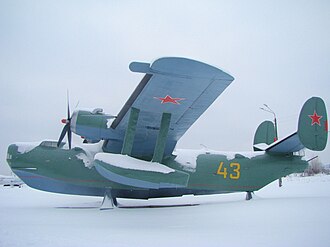
Beriev Be-6 – The Soviet Flying Boat That Patrolled Oceans and Defined an Era of Maritime Aviation
The Beriev Be-6 stands as one of the most distinctive and capable flying boats ever developed during the early Cold War period. Designed in the Soviet Union at a time when maritime patrol aviation was rapidly evolving, the Be-6 represented a sophisticated attempt to combine long-range endurance, multi-role versatility, and the ability to operate far from prepared runways. In an era dominated increasingly by land-based aircraft and the emerging dominance of helicopters for certain maritime tasks, the Be-6 preserved and refined the concept of large seaplanes as practical tools of military aviation.
At first glance, the Be-6 is striking. Its long, boat-like fuselage, high-mounted gull wing, twin engines positioned above the wing, and boat hull designed for open-water operations give it an unmistakable silhouette. It looks like an aircraft built for a world without airports, where vast oceans and remote coastlines demanded machines capable of launching from water and returning to it safely in unpredictable conditions.
But the Be-6 was not a relic of the past. It was a thoroughly modern aircraft for its time, incorporating metal construction, pressurized systems (in later variants of Soviet flying boats generally), and carefully engineered aerodynamics designed to improve range, endurance, and operational reliability. In Soviet naval aviation service, it played a critical role in reconnaissance, maritime patrol, anti-submarine warfare, and transport missions.
What makes the Be-6 especially fascinating is that it emerged during a transitional moment in aviation history. By the 1950s, many countries were abandoning large flying boats in favor of land-based maritime patrol aircraft such as the P-2 Neptune or later the P-3 Orion. Yet the Soviet Union, with its vast coastline spanning multiple oceans and seas, still saw strategic value in water-operable aircraft. The Be-6 became a cornerstone of that doctrine.
Even today, the aircraft remains an important subject of study for aviation historians because it represents both the culmination of flying boat design and the final era in which such aircraft played a significant military role.
The Beriev Design Bureau and Soviet Naval Aviation Needs
The story of the Be-6 begins with the Beriev Design Bureau, led by Georgy Mikhailovich Beriev, one of the Soviet Union’s foremost designers of amphibious and maritime aircraft. From its earliest days, the bureau specialized in aircraft capable of operating over water, including reconnaissance seaplanes and flying boats used for coastal defense and naval coordination.
The Soviet Union’s geographic reality strongly influenced this focus. With coastlines along the Arctic Ocean, Pacific Ocean, Baltic Sea, and Black Sea, the USSR required aircraft capable of long-range maritime surveillance and transport. Many remote regions lacked airfields, especially in the northern Arctic territories, making water-based aviation a practical necessity.
During World War II, Soviet maritime aviation relied heavily on earlier flying boats and amphibious aircraft, but these designs were increasingly outdated by the late 1940s. The post-war period brought new challenges: submarines became faster and more capable, naval warfare expanded into global theaters, and electronic reconnaissance systems began to reshape intelligence gathering.
The Soviet Navy needed a new generation of aircraft capable of long endurance patrols, anti-submarine warfare, and reconnaissance missions over vast maritime regions.
The Beriev Be-6 was the answer.
Development of the Be-6
Development of the Be-6 began in the late 1940s, with the aircraft making its first flight in 1949. It was designed as a replacement for earlier piston-engine flying boats and was intended to operate in a wide range of maritime conditions, including rough seas and Arctic environments.
Unlike earlier wooden or mixed-construction seaplanes, the Be-6 was built entirely of metal, reflecting the global transition toward more durable and corrosion-resistant aircraft structures. This was especially important for maritime aircraft, which were constantly exposed to saltwater environments that could rapidly degrade less robust materials.
The aircraft was designed with a high-mounted gull wing, which allowed engines to be positioned well above the waterline, reducing the risk of spray ingestion during takeoff and landing. The hull was carefully shaped to provide stable water handling characteristics, including the ability to operate in moderate sea states.
From the beginning, the Be-6 was intended to be a multi-role platform. It could perform reconnaissance missions, transport personnel and cargo, conduct maritime patrol operations, and later be adapted for anti-submarine warfare roles.
Airframe Design and Flying Boat Architecture
The Be-6 is a classic example of a hull-based flying boat design. Unlike amphibious aircraft equipped with retractable landing gear, the Be-6 was primarily intended for water operations, although it could be supported by beaching gear for land-based handling.
The fuselage is shaped like a deep boat hull, with a pronounced keel and carefully designed steps that help reduce water resistance during takeoff. This “planing step” is critical in flying boat design, allowing the aircraft to break free from water drag as speed increases.
The high-mounted wing is one of the most visually distinctive features of the Be-6. It is mounted above the fuselage in a gull-wing configuration, meaning the wing roots angle upward before leveling out. This design serves multiple purposes: it provides clearance between the engines and water spray, improves structural efficiency, and allows for better lift distribution.
Two engines are mounted in nacelles above the wing, keeping them safely away from water spray during takeoff and landing. This configuration also simplifies maintenance in maritime environments.
The tail assembly is conventional but robust, designed to provide stability during low-speed water operations where aerodynamic forces interact with hydrodynamic behavior.
Engines and Propulsion System
The Beriev Be-6 was powered by two Shvetsov ASh-73 radial piston engines, each producing approximately 2,300 horsepower. These engines were among the most powerful Soviet piston engines of their era and were also used in large aircraft such as the Tu-4 bomber.
The use of radial engines was particularly appropriate for maritime operations. Radial engines tend to be more resistant to battle damage and easier to cool in varied operating conditions, making them suitable for long-range patrol aircraft.
Each engine drove a large multi-blade propeller, providing the thrust necessary for heavy takeoff loads from water surfaces. Water takeoff requires significantly more power than runway operations due to drag forces, and the Be-6’s engines provided sufficient thrust to lift the aircraft even when fully loaded with fuel, crew, and mission equipment.
The placement of engines above the wing also minimized corrosion risks, as exhaust and water spray interaction was reduced.
Operational Roles and Maritime Missions
The Be-6 served in a wide variety of roles within Soviet Naval Aviation, reflecting its adaptable design.
Maritime Patrol and Reconnaissance
One of the primary roles of the Be-6 was long-range maritime patrol. The aircraft could fly extended missions over oceans and seas, monitoring naval activity, identifying surface vessels, and gathering intelligence.
Its long endurance allowed it to remain airborne for many hours, covering vast distances across the Arctic and Pacific regions.
Anti-Submarine Warfare (ASW)
As submarine technology advanced during the Cold War, the Be-6 was adapted for anti-submarine warfare missions. Equipped with sonar buoys, radar systems, and sometimes depth charges or torpedoes, the aircraft played a role in detecting and engaging enemy submarines.
Although later replaced by more advanced jet-powered patrol aircraft, the Be-6 represented an important step in Soviet ASW capability.
Transport and Logistics
The Be-6 was also used for transport missions, especially in remote coastal or island regions where airfields were unavailable. It could carry personnel, cargo, and supplies, landing directly on water near remote installations.
Search and Rescue
In maritime environments, the ability to land on water made the Be-6 valuable for search and rescue operations. It could retrieve survivors from sea or deliver emergency supplies to isolated locations.
Flight Characteristics and Water Handling
Operating a large flying boat like the Be-6 required specialized piloting skills. Water takeoff and landing are fundamentally different from runway operations, as pilots must consider wave height, wind direction, water currents, and hull hydrodynamics.
The Be-6 was designed to be stable on water, with a hull shape that provided predictable behavior during taxiing and takeoff runs. The aircraft would accelerate along the water surface until reaching planing speed, at which point the hull would rise partially out of the water to reduce drag.
Once airborne, the Be-6 exhibited stable flight characteristics typical of large twin-engine piston aircraft of its era. Its high wing contributed to stability, while its size provided smooth handling in turbulence.
Landing required careful control to avoid excessive impact forces on the hull. Pilots needed to judge wave conditions accurately to ensure safe water contact.
Cold War Service and Strategic Importance
During the Cold War, the Be-6 played an important but often understated role in Soviet maritime strategy. While it was not as technologically advanced as later jet-powered patrol aircraft, it provided essential coverage of vast maritime regions at a time when surveillance infrastructure was still developing.
The Soviet Union’s emphasis on naval expansion, particularly submarine fleets, made maritime patrol aircraft critical. The Be-6 contributed to early Cold War naval reconnaissance and helped establish operational doctrines that would later evolve into more advanced systems.
Its ability to operate from remote coastal bases and water surfaces gave it flexibility that land-based aircraft could not match in certain regions.
Comparison with Western Flying Boats
By the time the Be-6 entered service, Western nations were also transitioning away from large flying boats. Aircraft such as the American PBY Catalina had proven extremely successful during World War II, but newer designs like the P-5 Marlin and land-based P-2 Neptune were gradually replacing them.
Compared to Western counterparts, the Be-6 was larger and more powerful than many World War II-era flying boats, but it entered service at a time when global doctrine was shifting toward runway-based maritime patrol aircraft.
Nevertheless, it remained competitive in endurance and payload capacity, particularly in regions where infrastructure limitations made seaplanes advantageous.
Decline and Replacement
As jet propulsion and advanced radar systems became standard in maritime patrol aviation, aircraft like the Be-6 gradually became obsolete. Newer Soviet aircraft such as the Il-38 and Tu-142 offered significantly greater speed, range, and sensor capability.
However, the Be-6 continued to serve for several years in secondary roles, including transport and training duties.
Its retirement marked the end of an era in Soviet naval aviation—the final chapter of large piston-engine flying boats in frontline service.
Legacy of the Beriev Be-6
The Be-6 remains an important aircraft in aviation history because it represents the peak of flying boat development in the Soviet Union. It demonstrated that even in the early jet age, piston-engine maritime aircraft still had a valuable role to play.
Its design reflects a deep understanding of both aerodynamic and hydrodynamic principles, and its operational history illustrates the unique demands of Soviet geography and naval strategy.
Today, the Be-6 is remembered as one of the most capable post-war flying boats ever built, and a symbol of a time when aircraft routinely took off from the surface of the sea to patrol the world’s oceans.
Conclusion
The Beriev Be-6 is more than just a Cold War aircraft. It is a representation of an entire era of aviation in which flying boats played a crucial role in global maritime operations. With its powerful radial engines, elegant gull-wing design, and robust hull structure, it embodied the final evolution of a concept that once dominated naval aviation.
Although eventually replaced by faster and more advanced land-based aircraft, the Be-6 remains a remarkable example of engineering adapted to unique operational requirements. Its legacy continues in modern amphibious aircraft and maritime patrol doctrines that still rely on the principles established during its development.
In the history of aviation, the Be-6 stands as a reminder that sometimes the ocean is not an obstacle to flight—but a runway.
Technical Specifications
| Parameter | Value |
|---|---|
| Manufacturer | Beriev Design Bureau |
| Designation | Beriev Be-6 |
| Type | Maritime patrol flying boat |
| Crew | 8–10 (typical mission crew) |
| Configuration | Twin-engine gull-wing flying boat |
| Length | 23.4 m |
| Wingspan | 33.0 m |
| Height | 7.4 m |
| Wing Area | 120 m² (approx.) |
| Empty Weight | ~18,000 kg |
| Maximum Takeoff Weight | ~27,000 kg |
| Engines | 2 × Shvetsov ASh-73 radial piston engines |
| Engine Power | ~2,300 hp each |
| Propellers | 4-blade constant-speed propellers |
| Maximum Speed | ~415 km/h |
| Cruise Speed | ~320 km/h |
| Range | ~4,800 km |
| Service Ceiling | ~6,100 m |
| Endurance | Up to 12–14 hours |
| Takeoff Surface | Water only (flying boat hull) |
| Armament | Torpedoes, bombs, depth charges (ASW variants) |
| First Flight | 1949 |
| Service Entry | Early 1950s |
| Primary Roles | Maritime patrol, ASW, reconnaissance, transport, SAR |
| Distinctive Feature | Gull-wing twin-engine flying boat with long-range patrol capability |
