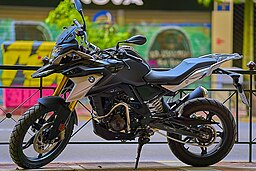
The BMW G 310 GS stands as a compact adventure motorcycle engineered to deliver the versatility and rugged stance typical of BMW’s GS lineup while remaining accessible and manageable for a broad range of riders. With its relatively small 313 cc displacement and lightweight construction, the G 310 GS bridges the gap between urban commuting and light off-road touring, offering practicality without sacrificing the core capabilities expected of an adventure bike. It embodies BMW Motorrad’s philosophy of combining performance, everyday usability, and reliability in a modern package that’s technically competent and globally appealing.
Engine Architecture and Performance
At the heart of the G 310 GS is a single-cylinder, water-cooled, four-stroke engine with a double overhead camshaft (DOHC) and four valves. This engine configuration yields a displacement of 313 cc and employs a bore and stroke dimension of 80 mm x 62.1 mm, reflecting a design that favors rev-happy responsiveness and balanced torque delivery. The compression ratio is set at 10.9:1, which supports efficient combustion and performance across a broad rpm range. Fuel delivery is managed by electronic fuel injection, and emissions control complies with modern standards via a closed-loop three-way catalytic converter. Peak power output is approximately 34 hp at 9,250 rpm with maximum torque of around 28 Nm at 7,500 rpm, producing performance suitable for both city riding and light touring scenarios.
The engine assembly incorporates a wet sump lubrication system and is paired with a 6-speed constant-mesh manual gearbox, enabling riders to optimize engine performance across diverse terrain. Power is delivered to the rear wheel through an X-ring chain final drive, chosen for its durability and ease of maintenance. Clutch engagement is facilitated via a multiplate wet clutch in oil bath, which contributes to smoother gear shifts and enhanced rider control under various load conditions.
Chassis, Suspension, and Handling Dynamics
The chassis of the G 310 GS is built around a tubular space frame that balances strength with lightweight design, reinforcing the bike’s agility and stability both on pavement and light trails. Suspension duties at the front are handled by an inverted telescopic fork with 41 mm stanchions and approximately 180 mm of travel, providing a capable response to uneven surfaces and absorbing the irregularities encountered on adventure routes. The rear suspension consists of a monoshock with preload adjustment, offering flexibility to tune the ride quality depending on luggage load or riding style. Together, the suspension system delivers a compliant yet controlled ride that suits both daily road use and exploratory off-road excursions.
Braking performance incorporates a 300 mm single disc with a radially mounted four-piston caliper at the front and a 240 mm single disc with a floating single-piston caliper at the rear. These are paired with BMW Motorrad ABS, enhancing safety by reducing the risk of wheel lock-up during abrupt braking maneuvers on varied surfaces. Wheels are cast aluminum alloys fitted with a 19-inch front tire and a 17-inch rear tire, with sizes of 110/80 R19 and 150/70 R17 respectively, selected to optimize both road grip and light off-road traction.
Dimensions, Ergonomics, and Weight
The BMW G 310 GS exhibits dimensions that underscore its agility without compromising stability. The overall wheelbase measures 1,420 mm, contributing to a balanced footprint that enhances both highway composure and nimbleness in urban environments. The motorcycle’s length, width, and height are typically reported as 2075 mm, 880 mm, and 1230 mm respectively, creating a commanding yet accessible presence. Seat height is around 835 mm, which provides a tall riding position typical for adventure motorcycles, offering excellent visibility and control. Ground clearance is designed to handle occasional off-road conditions without hesitation.
In terms of mass, the bike’s kerb (wet) weight sits around 169.5 kg, allowing it to remain light enough for confident handling yet substantial enough to provide road stability at higher speeds. Fuel capacity is approximately 11 litres, with a roughly 1 litre reserve, striking a practical balance between range and weight for mixed riding scenarios. (ZigWheels.com)
Electrical and Auxiliary Systems
The G 310 GS features a modern electrical suite that includes a three-phase alternator rated around 308 W and a 12 V/8 Ah maintenance-free battery, supporting reliable starting performance and stable power delivery for electrical systems. Lighting is fully LED, encompassing headlight, taillight, and turn indicators, ensuring effective illumination and safety. Instrumentation typically includes a monochrome LCD panel providing essential readouts such as speed, engine rpm, fuel level, gear position, and time, giving the rider clear and concise information at a glance.
Performance Characteristics
The G 310 GS delivers a top speed in the ballpark of 140–143 km/h (approximately 88 mph), which aligns with its displacement and tuning priorities. Its acceleration and fuel consumption figures further support its dual-purpose nature, with fuel economy often estimated around 28–32 km/l, translating to practical efficiency for long rides or commuting duties. This balance of performance and efficiency underscores the motorcycle’s adaptability as a versatile all-rounder.
