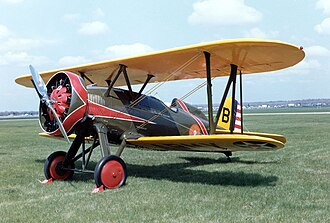
Boeing P-12 – The Classic Pursuit Fighter of the United States Army Air Corps
The Boeing P-12 occupies an important position in the history of American military aviation as one of the most successful fighter aircraft of the interwar period. Developed during a time when aviation technology was rapidly changing, the P-12 represented the peak of the traditional biplane fighter design before the arrival of more advanced all-metal monoplanes. It combined excellent maneuverability, reliable construction, and strong performance, making it a favorite among pilots and a key aircraft of the United States Army Air Corps during the late 1920s and early 1930s.
Although the P-12 never fought in a major conflict, its influence on American fighter development was considerable. It introduced important design concepts, helped establish Boeing as a major military aircraft manufacturer, and served as a training platform for a generation of pilots who would later fly more advanced aircraft during the Second World War. The aircraft also demonstrated the effectiveness of carefully refined conventional designs at a moment when aviation was transitioning from the wooden aircraft of the First World War era toward the modern metal aircraft of the 1930s and 1940s.
Known for its distinctive appearance, with a compact fuselage, radial engine, and traditional biplane wings, the Boeing P-12 became one of the most recognizable American fighters of its era. It represented a period when fighter aircraft emphasized agility, close-range combat, and pilot skill rather than speed, heavy armament, or advanced electronics. Its story reflects the technological evolution of aviation and the changing priorities of military air forces between the world wars.
The Development of American Fighters After the First World War
The years following the First World War were a period of uncertainty and experimentation for military aviation. During the conflict, aircraft had developed from simple reconnaissance machines into specialized fighters, bombers, and observation platforms. However, once peace returned in 1918, military budgets declined and aircraft development slowed. Many nations struggled to determine what role air power would play in future conflicts.
In the United States, the Army Air Service, which later became the United States Army Air Corps, continued exploring fighter designs despite limited funding. American military planners recognized that a capable fighter force would be necessary to protect air superiority and defend military operations. However, the rapid technological advances seen during the First World War had created a challenge: aircraft became obsolete quickly, and designers had to balance innovation with practical affordability.
During the 1920s, American fighters generally followed the proven formula of the First World War. Biplane configurations remained popular because they provided excellent maneuverability and structural strength. Wooden wings, fabric coverings, and open cockpits were still common. Although these designs lacked the speed and range of later aircraft, they were reliable, lightweight, and relatively inexpensive to produce.
Boeing recognized an opportunity in this market. The company had already gained experience producing military aircraft and wanted to establish itself as a leading supplier of fighters and other combat aircraft. The P-12 became one of Boeing’s most important early military successes.
The Origins of the Boeing P-12
From Boeing Model 83 to Military Fighter
The Boeing P-12 originated from a private company project developed by the Boeing Aircraft Company in the late 1920s. Boeing engineers designed the aircraft as a successor to earlier Boeing fighters, particularly the PW-9 series. The goal was to create a modern pursuit aircraft that combined excellent handling with improved performance.
The first prototype, known as the Boeing Model 83, flew in 1928. The aircraft immediately demonstrated impressive characteristics, including strong maneuverability and a favorable power-to-weight ratio. The design was refined further, resulting in the Model 89 prototype and eventually the production aircraft known as the P-12 for the Army and the F4B for the Navy.
The close relationship between Army and Navy requirements was significant. Rather than creating entirely separate aircraft, Boeing developed related versions for both services. This approach reduced development costs and allowed the company to achieve larger production numbers.
The Army Designation
The United States Army Air Corps adopted the aircraft under the designation P-12, with the letter “P” standing for “Pursuit.” During this period, American military terminology used the term pursuit aircraft instead of fighter. The aircraft entered service in 1929 and quickly became one of the primary fighters of the Army Air Corps.
Design Philosophy and Engineering Features
A Traditional Biplane Fighter
The Boeing P-12 represented a highly refined version of the classic biplane fighter concept. Its design was conservative compared with later aircraft, but it incorporated numerous improvements that made it one of the most capable fighters of its generation.
The aircraft used a single-engine, single-seat configuration with unequal-span wings. The upper wing was larger than the lower wing, a common arrangement among biplanes because it improved visibility and aerodynamic efficiency. The compact design reduced drag and allowed the aircraft to respond quickly to pilot inputs.
Although biplanes were eventually replaced by monoplanes, they offered several advantages during this era. Their structural design allowed strong lightweight wings without requiring advanced manufacturing techniques. They also provided excellent low-speed handling, which was important for air combat tactics of the period.
Construction Methods
The P-12 used a mixed construction approach typical of late 1920s aircraft. The fuselage consisted of a welded steel-tube framework covered with fabric. The wings used wooden structures with fabric coverings. This combination provided sufficient strength while keeping production costs manageable.
The aircraft’s structure was designed for the stresses of military flying, including sharp turns, aerobatic maneuvers, and combat training exercises. Pilots appreciated its strength and predictable handling, especially when compared with older fighters.
Powerplant and Performance
The Boeing P-12 was powered by air-cooled radial engines, primarily variants of the Pratt & Whitney Wasp engine family. Radial engines were becoming increasingly popular during the late 1920s because they offered excellent reliability and simpler maintenance compared with liquid-cooled engines.
The radial engine was particularly suitable for fighter aircraft because it provided a favorable balance between power, weight, and durability. Unlike liquid-cooled engines, radial engines were less vulnerable to damage from combat because they lacked exposed coolant systems that could fail if hit.
Performance was impressive for the period. The P-12 offered excellent climb capability, strong maneuverability, and sufficient speed to compete with contemporary fighters. While it could not match the speeds of later monoplanes, it was highly effective within the tactical environment of the early 1930s.
Operational Service with the United States Army Air Corps
The Mainstay Fighter of the Early 1930s
The Boeing P-12 became one of the most important fighters operated by the United States Army Air Corps during the early 1930s. It equipped several pursuit squadrons and served as the primary front-line fighter during a period of rapid aviation development.
Pilots valued the aircraft because it was responsive, reliable, and enjoyable to fly. The P-12 rewarded skilled pilots and allowed them to perform advanced maneuvers. Its handling characteristics made it an excellent aircraft for training fighter pilots in aerial combat techniques.
The aircraft also served an important symbolic role. During the interwar period, military aviation was still establishing its identity, and fighters such as the P-12 represented the professionalism and technological progress of the growing air services.
Training and Transition Aircraft
As newer aircraft entered service, the P-12 gradually moved from front-line combat duties into training roles. However, this did not reduce its importance. Many pilots who later flew advanced fighters during the Second World War gained early experience flying aircraft like the P-12.
The aircraft helped teach fundamental fighter skills, including formation flying, aerial maneuvers, gunnery practice, and tactical coordination. Its demanding but predictable flight characteristics made it a valuable educational tool.
The Navy Version: Boeing F4B
The Boeing P-12 had a closely related naval counterpart known as the F4B. The United States Navy adopted the aircraft for carrier operations, requiring modifications suitable for naval aviation.
Carrier aircraft faced unique challenges, including stronger landing gear requirements, arresting gear compatibility, and resistance to the harsh maritime environment. Boeing adapted the design successfully, creating one of the most important Navy fighters of the early 1930s.
The shared design between Army and Navy versions demonstrated Boeing’s ability to create versatile aircraft platforms. The F4B served alongside the P-12 and contributed to Boeing’s reputation as a major supplier of military aircraft.
Variants of the Boeing P-12
P-12A
The P-12A was the first major production version of the aircraft. It featured improvements over the prototype designs and introduced the basic configuration that would define later variants.
P-12B and P-12C
These versions included refinements to the structure, engine installation, and equipment. Improvements focused on reliability and operational suitability rather than major changes to the basic design.
P-12E
The P-12E represented one of the most advanced Army versions. It incorporated a metal fuselage structure, providing increased durability and reflecting the industry’s transition toward more modern aircraft construction.
P-12F and Later Models
Later variants received improved engines and equipment upgrades. These aircraft remained in service throughout the 1930s until replaced by more advanced monoplane fighters.
The Transition From Biplanes to Monoplanes
The Boeing P-12 represented the final stage of traditional biplane fighter development. During the early 1930s, aviation technology changed rapidly. Engineers began experimenting with all-metal construction, enclosed cockpits, retractable landing gear, and streamlined monoplane designs.
Aircraft such as the Boeing P-26 demonstrated the next generation of fighter development. Monoplanes offered greater speed and improved aerodynamic efficiency, making them increasingly attractive to military planners. The P-12 gradually became outdated as these new designs entered service.
However, the P-12 should not be considered obsolete because of its eventual replacement. It represented the best possible solution within the technological limitations of its time and successfully fulfilled its intended mission.
Combat Potential and Limitations
The Boeing P-12 never participated in major combat operations, but it was designed according to the combat concepts of the interwar period. Air combat doctrine emphasized maneuverability, close-range engagements, and pilot skill. The aircraft’s agility made it well suited to this style of warfare.
However, the P-12 also revealed the limitations of the biplane fighter concept. Its speed and range were limited compared with later aircraft, and its open cockpit provided little protection from weather or enemy fire. These limitations encouraged the development of more advanced fighters during the 1930s.
Legacy of the Boeing P-12
The Boeing P-12 occupies an important place in American aviation history because it represented the peak of one generation of fighter aircraft. It helped establish Boeing as a major military aircraft manufacturer and contributed to the company’s long-term success.
The aircraft also influenced future Boeing designs by providing valuable experience in fighter development, manufacturing, and military requirements. The lessons learned from the P-12 program contributed to Boeing’s later aircraft projects.
For aviation historians, the P-12 symbolizes the transition between the First World War era and the modern age of military aviation. It was among the last great American biplane fighters and one of the first aircraft to demonstrate Boeing’s ability to produce world-class combat aircraft.
Preserved Aircraft and Historical Recognition
Several Boeing P-12 aircraft survive today in museums and private collections. These preserved examples allow visitors to experience an important chapter of aviation history and appreciate the craftsmanship involved in early military aircraft production.
Because relatively few examples remain, surviving P-12 aircraft are highly valued by aviation historians. They serve as reminders of the pilots, engineers, and manufacturers who shaped military aviation during the interwar period.
Technical Specifications
| Specification | Boeing P-12E |
|---|---|
| Manufacturer | Boeing Aircraft Company |
| Country of Origin | United States |
| First Flight | 1928 |
| Role | Pursuit fighter aircraft |
| Crew | 1 pilot |
| Length | 20 ft 9 in (6.32 m) |
| Wingspan | 30 ft 0 in (9.14 m) |
| Height | 9 ft 6 in (2.90 m) |
| Wing Area | 220 sq ft (20.4 m²) |
| Empty Weight | Approximately 1,935 lb (878 kg) |
| Maximum Takeoff Weight | Approximately 2,600 lb (1,179 kg) |
| Powerplant | 1 × Pratt & Whitney R-1340 Wasp radial engine |
| Engine Power | Approximately 450 hp (336 kW) |
| Maximum Speed | Approximately 189 mph (304 km/h) |
| Cruising Speed | Approximately 160 mph (257 km/h) |
| Range | Approximately 570 miles (917 km) |
| Service Ceiling | Approximately 27,000 ft (8,230 m) |
| Armament | 2 × .30 caliber machine guns |
| Construction | Fabric-covered steel tube fuselage and wooden wings |
| Landing Gear | Fixed conventional landing gear |
| Primary Operators | United States Army Air Corps and United States Navy |
| Production | Approximately 360 aircraft including related variants |
| Status | Retired |
