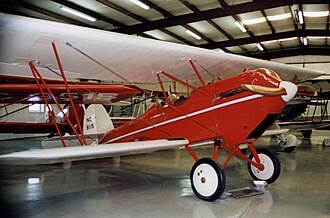
The Brunner-Winkle Bird occupies a unique and often overlooked place in the history of American aviation. Produced during the closing years of the 1920s, the Bird represented an ambitious attempt to redefine what a light civilian aircraft could be. At a time when many private airplanes still featured open cockpits, externally braced biplane wings, and relatively modest performance, the Bird introduced a clean high-wing monoplane layout, an enclosed cabin, excellent visibility, and comfortable accommodations for both pilot and passengers. Although its production run proved relatively short, the aircraft demonstrated ideas that would become common in general aviation during the following decades.
The late 1920s marked a period of extraordinary optimism in aviation. Charles Lindbergh’s famous transatlantic flight had inspired widespread public enthusiasm, manufacturers were introducing increasingly sophisticated designs, and private flying was beginning to evolve from an adventurous pastime into a practical means of transportation. Companies throughout the United States sought to capitalize on this expanding market by developing aircraft that appealed to businessmen, private owners, flying clubs, and charter operators. The Brunner-Winkle Bird emerged directly from this environment of innovation and optimism.
What distinguished the Bird from many of its contemporaries was not overwhelming speed or spectacular aerobatic capability. Instead, it focused on qualities that modern pilots continue to value: safety, visibility, comfort, reliability, and ease of operation. These priorities reflected a forward-thinking understanding of what private aviation would eventually become. While some manufacturers pursued increasingly powerful engines and military contracts, Brunner-Winkle concentrated on producing a practical traveling aircraft that ordinary pilots could enjoy.
Today, surviving Birds are exceptionally rare, making them prized exhibits at aviation museums and treasured possessions among vintage aircraft enthusiasts. Their graceful lines, elegant cabin, and historical significance remind us of a fascinating transitional period when aircraft design was rapidly evolving from the fragile biplanes of the First World War toward the refined touring airplanes that would dominate civil aviation during the 1930s.
The Golden Age of American Civil Aviation
To appreciate the significance of the Brunner-Winkle Bird, it is essential to understand the remarkable transformation taking place within American aviation during the late 1920s. The decade following the First World War witnessed dramatic technological progress. Military surplus aircraft introduced thousands of former service pilots to civilian flying, while improvements in engines, materials, navigation, and manufacturing techniques steadily increased aircraft reliability.
Perhaps no event accelerated public interest more dramatically than Charles Lindbergh’s Transatlantic Flight. Lindbergh’s achievement transformed aviation from a specialized technical pursuit into a subject of worldwide fascination. Investors poured money into aviation companies, municipalities constructed airports, airlines expanded routes, and private citizens increasingly dreamed of owning personal aircraft.
Initially, many manufacturers simply adapted military biplanes for civilian use. While practical, these aircraft often retained open cockpits, extensive external bracing, and relatively limited passenger comfort. As private aviation matured, customers demanded something different. Business travelers wanted enclosed cabins that protected occupants from weather. Families sought aircraft capable of comfortable sightseeing flights. Flying clubs desired machines that combined safety with economical operation.
The Bird answered these evolving expectations remarkably well.
The Brunner-Winkle Aircraft Company
The Brunner-Winkle Aircraft Corporation was established during one of the most competitive periods in American aviation. Numerous companies competed for a rapidly expanding market, introducing increasingly innovative aircraft in hopes of establishing lasting commercial success.
Unlike larger manufacturers with military contracts or extensive industrial resources, Brunner-Winkle focused primarily on civilian aircraft. The company’s engineers recognized that future growth depended upon attracting private owners rather than government customers.
This strategy encouraged innovation in areas sometimes overlooked by manufacturers concentrating upon military specifications. Passenger comfort, visibility, ease of maintenance, and operational economy became central design priorities.
Although the company remained relatively small, its engineering ambitions were anything but modest.
The Origins of the Bird
Development of the Bird began during a period when monoplane designs were gradually demonstrating clear aerodynamic advantages over traditional biplanes. Engineers increasingly understood that eliminating one wing reduced drag considerably while improving efficiency.
The design team envisioned an aircraft suitable for personal transportation, business travel, aerial observation, and flight training. Rather than specializing in one mission, the Bird would become a versatile all-purpose cabin aircraft.
Several objectives guided development.
The airplane needed excellent visibility.
Passengers required genuine comfort.
Handling characteristics had to inspire confidence among relatively inexperienced pilots.
Maintenance should remain straightforward.
Operating costs needed to compete favorably with existing light aircraft.
These practical requirements ultimately shaped every aspect of the Bird’s design.
High-Wing Monoplane Configuration
Perhaps the Bird’s most recognizable feature was its graceful high-wing monoplane arrangement.
During the late 1920s, this configuration remained comparatively uncommon, yet it offered numerous practical advantages that later became widely appreciated.
The high wing provided outstanding downward visibility, making the aircraft ideal for sightseeing, aerial photography, agricultural observation, and navigation.
Passengers could enter the cabin without climbing over wing structures.
The elevated wing also improved ground clearance for the propeller and reduced the likelihood of damage from uneven airfields.
From an aerodynamic perspective, the monoplane configuration substantially reduced drag compared with similarly sized biplanes. Fewer lifting surfaces meant fewer interference effects between wings, fewer bracing wires, and improved overall efficiency.
These benefits allowed respectable performance despite relatively modest engine power.
Structural Design
The Bird employed construction methods representative of its era while incorporating several progressive ideas.
Its fuselage utilized a welded steel-tube framework, providing impressive structural strength with relatively low weight. Fabric covering reduced mass while simplifying repairs.
The wings were primarily wooden structures, carefully engineered to balance stiffness with lightweight construction. High-quality aircraft-grade timber remained one of aviation’s most effective structural materials during this period, offering excellent strength-to-weight characteristics when properly maintained.
Wing struts supported the structure efficiently while minimizing additional weight.
Control surfaces followed similar construction techniques, employing lightweight frameworks covered in fabric.
This combination of steel, wood, and fabric represented mature engineering that had proven reliable throughout the 1920s.
Cabin Comfort
One of the Bird’s greatest selling points was its enclosed cabin.
While open-cockpit flying possessed undeniable romantic appeal, prolonged exposure to wind, rain, cold temperatures, and engine noise significantly reduced passenger comfort.
The Bird addressed these shortcomings through a spacious enclosed cabin designed for practical transportation rather than mere recreation.
Large windows admitted abundant natural light while providing panoramic visibility.
Passengers enjoyed protection from weather, making longer journeys considerably more pleasant.
Communication between occupants also improved because the enclosed environment reduced wind noise.
Although modest by modern standards, these comforts represented significant progress for private aviation.
Engine Choices
Throughout production, the Bird appeared with several different radial engine options depending upon customer requirements and evolving manufacturing decisions.
Radial engines were particularly popular during the era because of their mechanical simplicity, effective air cooling, and proven reliability.
Various powerplants from manufacturers including Warner Aircraft Corporation and Wright Aeronautical found installation in different Bird variants.
Engine outputs generally ranged from approximately 110 to 165 horsepower.
Although these figures appear modest today, the aircraft’s efficient aerodynamics and lightweight structure enabled highly respectable performance.
Fuel consumption remained comparatively economical, an important consideration for private owners.
Flight Characteristics
Pilots frequently praised the Bird for its stable, confidence-inspiring handling.
The high wing contributed significantly to lateral stability, naturally encouraging the aircraft to return toward level flight after disturbances.
Control forces remained moderate throughout the normal flight envelope.
Takeoff performance proved satisfactory from the grass airfields typical of the late 1920s.
Once airborne, the Bird climbed steadily while maintaining excellent forward visibility.
Cruise flight emphasized smoothness and efficiency rather than outright speed.
Landing characteristics likewise reflected the aircraft’s practical mission. Predictable approaches and forgiving handling reduced pilot workload, making the aircraft attractive for relatively inexperienced aviators.
These qualities enhanced both operational safety and passenger confidence.
Touring and Personal Transportation
The Bird excelled as a touring aircraft.
Private owners could undertake journeys between cities with a degree of comfort unavailable in many earlier designs.
Business travelers appreciated the enclosed cabin and respectable cruise performance.
Families enjoyed sightseeing flights over landscapes that remained inaccessible by road.
Flying clubs organized cross-country excursions, introducing members to practical navigation while promoting recreational aviation.
Because the aircraft balanced economy with comfort, it occupied an attractive position within the rapidly expanding civilian market.
Flight Training Applications
Training represented another important mission.
Student pilots benefited from stable handling characteristics.
The enclosed cockpit allowed instructors and students to communicate more effectively.
Good visibility improved traffic awareness during takeoff, landing, and navigation exercises.
Straightforward systems reduced cockpit complexity.
Maintenance requirements remained manageable for flying schools operating multiple aircraft.
These characteristics made the Bird an appealing instructional platform during a period when civilian pilot training expanded rapidly.
Commercial Roles
Beyond private ownership, several commercial applications emerged.
Charter operators employed the Bird for executive transportation over relatively short distances.
Newspapers occasionally utilized aircraft for aerial photography.
Survey organizations found the excellent downward visibility advantageous.
Mail transport represented another possible role where modest payloads and economical operation proved beneficial.
Although larger transports dominated scheduled airline routes, the Bird successfully filled numerous specialized niches requiring flexibility rather than capacity.
Competition Within a Growing Market
The Bird entered an increasingly competitive marketplace populated by innovative manufacturers such as Travel Air Manufacturing Company, Waco Aircraft Company, Curtiss-Wright, and Stinson Aircraft Company.
Each company pursued different strategies.
Some emphasized rugged utility.
Others focused upon luxury.
Still others competed primarily on price.
The Bird distinguished itself through balanced capability rather than specialization.
Its enclosed cabin, modern appearance, and pleasant flying qualities appealed strongly to pilots seeking a practical traveling aircraft.
The Great Depression and Changing Markets
Unfortunately, the Bird’s commercial career coincided with one of the most difficult economic periods in modern history.
The Great Depression devastated industries worldwide, and aviation proved particularly vulnerable.
Private aircraft purchases declined dramatically as businesses and individuals postponed discretionary spending.
Many promising manufacturers disappeared despite producing technically excellent airplanes.
Brunner-Winkle struggled within this harsh economic environment.
The company’s difficulties reflected broader market conditions rather than shortcomings in the Bird itself.
Had economic circumstances been more favorable, production might have continued substantially longer.
Surviving Aircraft
Today, remarkably few Birds survive.
Those that remain represent invaluable historical artifacts illustrating the rapid evolution of civil aviation during the late 1920s.
Restoration presents unique challenges because original components are scarce and documentation limited.
Nevertheless, dedicated owners and museum professionals have preserved several examples, allowing modern audiences to appreciate their elegant design firsthand.
At vintage aircraft gatherings, surviving Birds invariably attract considerable attention due to their rarity and distinctive appearance.
Their graceful proportions continue demonstrating why the aircraft impressed pilots nearly a century ago.
Legacy
The Brunner-Winkle Bird occupies an important, if sometimes overlooked, position in aviation history.
It demonstrated that private aircraft could successfully combine enclosed comfort, efficient aerodynamics, practical performance, and attractive styling long before these qualities became standard.
Many design concepts pioneered or refined by aircraft such as the Bird later appeared throughout general aviation.
High-wing cabin monoplanes eventually became among the world’s most popular civilian aircraft configurations.
Passenger comfort evolved from luxury to expectation.
Efficient aerodynamic design increasingly replaced brute engine power as the preferred path toward improved performance.
Although its manufacturer ultimately disappeared, the Bird’s influence endured through the broader evolution of aircraft design.
Today, the Brunner-Winkle Bird serves as a reminder that aviation history is shaped not only by famous military aircraft and record-breaking racers but also by thoughtful civilian designs that quietly advanced engineering and expanded the practical possibilities of personal flight. Elegant, innovative, and remarkably modern for its time, the Bird remains one of the finest examples of America’s vibrant Golden Age of Aviation—a period when imagination, craftsmanship, and optimism combined to produce aircraft whose influence far exceeded their production numbers.
Technical Specifications
| Parameter | Specification* |
|---|---|
| Aircraft | Brunner-Winkle Bird |
| Role | Cabin touring, utility and training aircraft |
| Manufacturer | Brunner-Winkle Aircraft Corporation |
| Country of origin | United States |
| First flight | 1928 |
| Aircraft type | High-wing strut-braced cabin monoplane |
| Crew | 1 |
| Passenger capacity | 2–3 (variant dependent) |
| Construction | Welded steel-tube fuselage, wooden wings, fabric covering |
| Landing gear | Fixed conventional (tailwheel) |
| Length | Approximately 7.3 m (24 ft) |
| Wingspan | Approximately 10.7 m (35 ft) |
| Height | Approximately 2.5 m (8 ft 2 in) |
| Wing area | Approximately 19.5 m² (210 sq ft) |
| Empty weight | Approximately 600 kg (1,320 lb), depending on version |
| Maximum takeoff weight | Approximately 1,000 kg (2,200 lb) |
| Engines | Various air-cooled radial piston engines |
| Typical engine power | 110–165 hp (82–123 kW) |
| Propeller | Two-blade fixed-pitch wooden propeller |
| Maximum speed | Approximately 175–195 km/h (109–121 mph), depending on engine |
| Cruise speed | Approximately 155–170 km/h (96–106 mph) |
| Range | Approximately 650–800 km (400–500 mi) |
| Service ceiling | Approximately 4,500–5,500 m (14,800–18,000 ft) |
| Rate of climb | Approximately 3.5–5.0 m/s (700–1,000 ft/min), depending on engine |
| Primary missions | Touring, private transport, pilot training, aerial observation, charter, photography |
