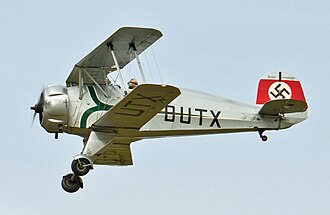
Bücker Bü 133 Jungmeister: The Elegant Aerobatic Biplane That Became a Legend
Few aircraft from the golden age of aviation combine compact proportions, elegant design and aerobatic capability as convincingly as the Bücker Bü 133 Jungmeister. Developed in Germany during the mid-1930s, the Jungmeister was a single-seat biplane created primarily for advanced flight training and aerobatics. Although it shared much of its ancestry with the successful two-seat Bücker Bü 131 Jungmann, the Bü 133 was smaller, lighter and more powerful for its size, giving it a character that was distinctly different from that of an ordinary trainer. Its responsive controls and impressive power-to-weight ratio made it particularly well suited to aerobatics, and the aircraft quickly established a reputation in competition flying that extended well beyond its original military training role.
The Jungmeister also occupies an interesting place in aviation history because its career did not end with the Second World War. Aircraft were produced under license in Switzerland and Spain, while surviving examples continued to appear at air shows and aerobatic competitions for decades. The type’s combination of relatively simple construction, excellent handling and a powerful radial engine allowed it to remain relevant even as newer monoplane aerobatic aircraft began to appear. Although precise production totals vary among historical sources, the commonly cited figure is around 250–280 aircraft, including license-built examples.
Origins and Development of the Jungmeister
From the Bücker Bü 131 Jungmann to the Bü 133
The story of the Jungmeister begins with the Bücker Bü 131 Jungmann, a two-seat biplane that had already established Bücker Flugzeugbau as an important manufacturer of training aircraft. The new Bü 133 was essentially a more specialized development of that design. It retained a number of components and design principles from the Jungmann, with the Bücker Museum noting that approximately 40 percent of the Jungmann’s parts were used in the Jungmeister, including elements of the landing gear, wings and tail.
The new aircraft was nevertheless substantially more focused. Instead of accommodating an instructor and student, the Jungmeister carried only one pilot. This reduction in size and weight, combined with a more powerful engine, produced an aircraft with the qualities needed for advanced aerobatic instruction. Rather than being simply a smaller Jungmann, the Bü 133 was intended for pilots who had progressed beyond basic training and wanted to develop precision and advanced aerobatic skills.
The design was associated with Swedish engineer Anders Johan Andersson, Bücker’s chief designer at the time. The prototype, designated Bü 133 V1, made its first flight on 21 August 1935, flown by Bücker’s test pilot Luise Hoffmann. The prototype initially used a Hirth inline engine, but subsequent development led to the Siemens-Halske radial engine that became characteristic of the main production versions.
A Small Airframe With Serious Aerobatic Potential
The Jungmeister’s physical proportions reveal much about its intended purpose. At roughly 6.6 metres in wingspan and just over six metres long, it was a compact aircraft. Its biplane configuration provided a substantial amount of lifting surface without requiring a large wingspan, while the relatively low weight kept the aircraft highly responsive.
The airframe combined a steel-tube fuselage with wooden wings and fabric covering, reflecting construction methods common among European light aircraft of the period. The design was comparatively conventional, but its effectiveness came from the way its components were balanced rather than from any radical technological innovation. Light controls, a compact airframe and a powerful engine produced an aircraft that pilots could maneuver rapidly and accurately.
The Engine and Performance of the Bü 133
The Siemens-Halske Sh 14A-4
The principal production Jungmeister is closely associated with the 160 hp Siemens-Halske Sh 14A-4, a seven-cylinder, air-cooled radial engine. This engine gave the lightweight Bü 133 an unusually strong power-to-weight ratio for an aircraft of its era. The Military Aviation Museum likewise identifies the Sh 14A as the engine of its Bü 133C and lists 160 horsepower as its output.
The radial engine also contributed to the Jungmeister’s distinctive appearance. Its compact nose, exposed cylinders and short fuselage gave the aircraft a purposeful look that contrasted with the longer, more streamlined profiles of inline-engined aircraft. The engine was not merely a visual feature, however: its combination of relatively modest weight and useful power was central to the aircraft’s aerobatic abilities.
The Bü 133C is commonly listed with a maximum speed of approximately 220 km/h and a cruising speed around 200 km/h, although exact figures can vary depending on the source, configuration and weight used for the calculation. Published specifications generally place the range at about 500 km and the service ceiling somewhere between 4,500 and 5,600 metres, with the difference reflecting variations in specifications for particular configurations.
Why Its Performance Mattered
Raw speed was not the primary reason the Jungmeister became famous. Its real strength was maneuverability. The aircraft’s low weight and powerful engine meant that it could accelerate and climb effectively, while its biplane layout and responsive controls made it particularly suitable for aerobatic maneuvers.
The Bücker Museum records a climb to 1,000 metres in approximately 2.8 minutes for its listed Bü 133C specification. The same source gives a maximum speed of 220 km/h, a cruising speed of 200 km/h and a range of approximately 500 km. These figures help explain why the aircraft was much more than a conventional trainer: it provided a compact platform capable of demanding maneuvers while remaining practical enough for training and demonstration work.
The Jungmeister and Aerobatic Flying
A Reputation Built in Competition
Aerobatics became the defining chapter of the Jungmeister’s identity. Before the Second World War, the aircraft was used extensively in aerobatic competitions and demonstrations, where its handling characteristics allowed experienced pilots to exploit its capabilities to the fullest. The Bücker Museum describes the type as having achieved numerous victories at national and international aerobatic competitions before the war.
The aircraft’s reputation was reinforced by the fact that it remained competitive long after its original introduction. According to the Military Aviation Museum, the Jungmeister design continued to participate in international aerobatic competition into the 1960s. This longevity is particularly significant because aerobatic aircraft are heavily influenced by improvements in power, airframe design and control systems. For a 1930s biplane to remain relevant for several decades demonstrates how well its basic configuration suited precision aerobatic flying.
The Jungmeister’s reputation was therefore based not simply on its historical importance but on genuine flying qualities. Its light controls, compact size and balanced handling made it attractive to skilled pilots who valued responsiveness and predictability.
A Specialized Advanced Trainer
The aircraft’s single-seat arrangement also tells an important part of its story. Unlike a conventional two-seat trainer, the Jungmeister did not allow an instructor to sit alongside or behind the student. It was therefore not intended to replace a basic training aircraft such as the Jungmann. Instead, it occupied a more advanced stage of pilot development.
The Military Aviation Museum describes it as an advanced trainer used by the Luftwaffe, while also emphasizing its effectiveness as an aerobatic aircraft. In practical terms, the Jungmeister was the kind of machine intended for pilots who already possessed fundamental flying skills and were ready to develop more demanding maneuvering techniques.
Military Service and International Use
The Luftwaffe Era
During the 1930s, Germany’s military aviation system expanded rapidly, creating demand for aircraft suitable for different stages of pilot training. The Jungmeister became associated with advanced training and aerobatic instruction. Its qualities made it useful for teaching pilots the precise aircraft control required before moving on to more complex military aircraft.
The aircraft was also exported internationally. The Bücker Museum states that exports had reached 13 countries before the outbreak of war, while other sources document use or production connections involving Switzerland, Spain, Hungary and several other air forces.
Its international distribution is an important part of the aircraft’s history because it demonstrates that the Jungmeister was not simply a German military trainer. It became an internationally recognized aerobatic design whose qualities were appreciated in both military and civilian aviation.
License Production in Switzerland and Spain
One of the most notable aspects of the Bü 133 story was its license production. Switzerland produced Jungmeisters through Dornier Flugzeugwerke at Altenrhein, while Spain produced the CASA 1.133. The exact number built outside Germany varies among sources, but Swiss production alone is often given as approximately 50 aircraft, with the AIRPOWER organization citing 52 Swiss-built examples.
The Spanish aircraft also developed a notable postwar career. The Fundación Infante de Orleans describes a Spanish Jungmeister restored to flying condition and returned to the air with its original type of Siemens engine, demonstrating how individual aircraft have continued to preserve the type’s aerobatic heritage.
Construction and Flying Characteristics
Steel, Wood and Fabric
The Jungmeister’s construction represents the mature form of a traditional light-aircraft technique. The fuselage used a welded steel-tube structure, while the wings incorporated wooden components and fabric covering. This approach allowed the designers to produce a strong but relatively lightweight airframe without relying on the all-metal construction that would increasingly dominate military aircraft design.
The fabric-covered structure also contributed to the aircraft’s distinctive appearance. Even today, a restored Jungmeister looks unmistakably like a product of the 1930s: delicate in appearance but purposeful in proportions, with its radial engine, narrow fuselage, braced biplane wings and fixed landing gear.
Responsive Controls
The aircraft’s aerobatic reputation depended heavily on its control response. Sources describing surviving Jungmeisters emphasize the lightness and precision of the controls, as well as the aircraft’s agility. The design incorporated ailerons on both the upper and lower wings, a feature that helped provide effective roll control and contributed to the aircraft’s aerobatic character.
For a pilot, this meant that the aircraft could respond quickly to relatively small control inputs. Such responsiveness is valuable in aerobatics, where the accuracy of a maneuver can depend on the pilot’s ability to establish and maintain exact attitudes rather than simply produce large control movements.
The Jungmeister After the Second World War
The end of the war did not mark the end of the Jungmeister’s career. Surviving aircraft entered civilian ownership, and the type continued to appear in aerobatic flying. The Bücker Museum records that Swiss Jungmeisters remained in military training service until 1968, after which some were sold to civilian owners.
The aircraft’s postwar competition career is particularly remarkable. The Bücker Museum notes that the first five aerobatic championships in the young Federal Republic of Germany were won using Jungmeisters, while the design remained competitive until newer aircraft such as the Zlin types began to make the older biplane less dominant.
This transition illustrates the broader development of aerobatic aviation. As purpose-built aerobatic monoplanes and other specialized designs emerged, the advantages of the traditional biplane configuration became less decisive. Nevertheless, the Jungmeister had already secured a lasting reputation.
Survivors and the Jungmeister Legacy
Today, surviving Bü 133s are valued as historic aircraft as well as functioning examples of classic aerobatic design. Their rarity, historical significance and demanding maintenance requirements make them very different from modern general-aviation aircraft. Some have been carefully restored and continue to fly at air shows and historic aviation events.
The survival of these aircraft is particularly valuable because the Jungmeister provides a direct connection to the prewar era of aerobatic aviation. Its design demonstrates how much performance could be extracted from a relatively small piston-powered biplane through careful attention to weight, balance, control response and power.
The aircraft has also influenced later generations of aerobatic enthusiasts. Modern replicas and new-build projects have kept the basic Jungmeister concept alive, while original aircraft continue to attract attention wherever classic aircraft are displayed. Sources differ over precise production totals, but the broad historical picture is consistent: only a few hundred original Jungmeisters were constructed, making surviving examples comparatively scarce.
Why the Bücker Bü 133 Jungmeister Still Matters
The enduring appeal of the Bücker Bü 133 Jungmeister lies in the balance of simplicity and capability. It was not a large aircraft, it did not possess an enormous engine, and it did not depend on advanced technology to achieve its reputation. Instead, the Jungmeister succeeded because its designers created a lightweight airframe in which the engine, wing arrangement and controls worked together exceptionally well.
Its development from the Bü 131 Jungmann gave Bücker a proven starting point, but the decision to create a smaller, single-seat aircraft transformed the concept into something much more specialized. The 160 hp radial engine gave the aircraft enough performance to serve as an advanced trainer, while its handling characteristics made it exceptionally attractive to aerobatic pilots. The resulting combination helped the Jungmeister become one of the best-known aerobatic biplanes of the 1930s and a machine that remained relevant for decades afterward.
The Jungmeister is therefore more than an attractive vintage aircraft. It represents an important moment in the evolution of aerobatic flying, when relatively simple wooden, steel and fabric aircraft could achieve extraordinary results in the hands of skilled pilots. Its legacy can be seen in surviving historic aircraft, restorations, replicas and the continued interest of enthusiasts who appreciate the character of classic aviation.
Bücker Bü 133 Jungmeister Technical Specifications
The following figures summarize commonly published specifications for the Bü 133C, the principal production configuration. Some historical sources give slightly different figures for weight, ceiling, wing area and other parameters, so specifications should be treated as representative rather than universal for every surviving or license-built Jungmeister.
| Specification | Bücker Bü 133C Jungmeister |
|---|---|
| Aircraft type | Single-seat aerobatic trainer / sport biplane |
| Manufacturer | Bücker Flugzeugbau |
| First flight | 21 August 1935 |
| Crew | 1 |
| Engine | Siemens-Halske Sh 14A-4 |
| Engine type | 7-cylinder, air-cooled radial |
| Power | 160 hp |
| Wingspan | 6.60 m |
| Length | 6.02 m |
| Height | 2.20 m |
| Wing area | Approximately 12.0 m² |
| Empty / equipped weight | Approximately 420–425 kg |
| Maximum take-off weight | Approximately 585–615 kg, depending on specification |
| Maximum speed | Approximately 220 km/h |
| Cruising speed | Approximately 200 km/h |
| Range | Approximately 500 km |
| Service ceiling | Approximately 4,500–5,600 m, depending on source/configuration |
| Climb to 1,000 m | Approximately 2.8 minutes |
| Landing gear | Fixed conventional landing gear |
| Armament | None |
| Primary role | Advanced training and aerobatics |
| Production | Approximately 250–280 aircraft, including license-built examples |
The differences in published figures are worth noting because surviving Jungmeisters represent several production batches, license-built aircraft and later restorations. The Bücker Museum, for example, lists a 615 kg flight weight and 4,500 m service ceiling for its Bü 133C specification, while other technical references give approximately 585 kg maximum take-off weight and a higher ceiling.
Conclusion
The Bücker Bü 133 Jungmeister remains one of the defining aircraft of classic aerobatic aviation. Born from the successful Bü 131 Jungmann, it transformed a practical training-aircraft concept into a compact, single-seat machine with remarkable agility. Its 160 hp radial engine, lightweight construction and responsive controls gave it the performance necessary to compete at the highest levels of aerobatic flying during an era when aviation technology was changing at extraordinary speed.
Its career also demonstrates that a successful aircraft can remain important long after its original military purpose has disappeared. The Jungmeister continued into civilian ownership, competition flying, air displays and restoration, while license-built versions helped spread the design beyond Germany. Even as newer aerobatic aircraft eventually surpassed it, the Jungmeister retained something that specifications alone cannot capture: a distinctive combination of elegance, mechanical simplicity and pilot-focused handling.
For historians, the Bü 133 offers a window into 1930s aviation. For restorers, it is a challenging and rewarding classic aircraft. And for aviation enthusiasts, it remains a striking reminder of what skilled designers and pilots could accomplish with a lightweight biplane, a 160 hp radial engine and an uncompromising focus on aerobatic performance.
.jpg)