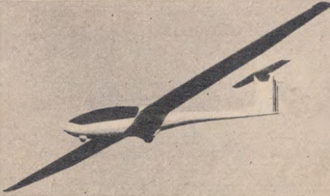
Manufactured by Centrair, the 201 Marianne was developed with support from several important organisations within the French aerospace industry, including Dassault Aviation and ONERA, the French national aerospace research organisation. The project was also supported by the French government and the Fédération Française de Vol à Voile, which recognised the importance of maintaining a modern domestic glider manufacturing capability. The result was an aircraft that combined practical training characteristics with aerodynamic performance suitable for more advanced recreational flying.
The Marianne was designed primarily as a two-seat training glider, with the instructor and student seated one behind the other. This arrangement allows an instructor to supervise the student while providing access to the aircraft’s controls and instruments. Its relatively large wings and carefully developed aerodynamic surfaces make it suitable for a variety of gliding activities, including introductory training, conversion training, thermal soaring, and certain approved aerobatic manoeuvres.
One of the aircraft’s most interesting characteristics is its combination of a relatively high glide ratio and robust training-oriented construction. Published technical information identifies a maximum glide ratio of approximately 40:1, while its minimum sink rate is approximately 0.64–0.65 metres per second, depending on the reference configuration and operating weight. These characteristics make the Marianne more than simply a basic training aircraft; it is also a capable sailplane for recreational operations and club flying.
Although production was relatively limited, the Centrair 201 Marianne remains an important aircraft for understanding the evolution of French glider design. Its development history, engineering characteristics, and operational experience provide a useful example of how manufacturers attempted to combine training requirements, aerodynamic efficiency, structural strength, and affordable production during the 1980s.
History and Development of the Centrair 201 Marianne
The Need for a New French Training Glider
During the early 1980s, French gliding clubs faced an increasingly important challenge: many of their two-seat training aircraft were becoming outdated. One of the most widely used models was the Wassmer Bijave, which had served numerous clubs and training organisations for years. Although the Bijave had established a strong reputation, the ageing fleet created a growing need for a modern replacement with improved aerodynamic characteristics, updated construction methods, and more contemporary cockpit arrangements.
The Fédération Française de Vol à Voile, which played a central role in organising French gliding activities, recognised that replacing such a large number of aircraft would require a coordinated development programme. The objective was not simply to introduce another two-seat glider, but to create a practical and economically viable aircraft that could serve the needs of flying clubs for many years.
A design competition was therefore organised, attracting attention from the French aerospace industry. Centrair was eventually selected to develop the new aircraft, which received the name Marianne. The project benefited from financial support from the French Ministry of Transport and technical cooperation with major aerospace organisations.
This initiative reflected a broader ambition to preserve the French glider manufacturing industry and provide domestic flying clubs with a modern aircraft designed specifically for their operational requirements.
Cooperation with Dassault Aviation and ONERA
An important feature of the Marianne project was the involvement of several organisations with extensive aerospace engineering experience. Centrair worked with Dassault Aviation, ONERA, and other technical partners to develop the aircraft’s aerodynamic and structural characteristics.
The preliminary design work also involved ENSICA, while SUPAERO contributed to the broader technical development programme. This cooperation allowed the project to benefit from expertise in aerodynamic research, structural engineering, and aircraft design.
ONERA’s involvement was particularly significant because the aerodynamic performance of a sailplane depends heavily on the efficiency of its wing profiles, the distribution of lift, and the management of drag. The Marianne’s wing was designed to provide a balance between efficient soaring performance and the handling qualities required for training operations.
The collaboration between an independent glider manufacturer and major aerospace research organisations demonstrates the importance attached to the project. Rather than treating the Marianne as a simple club aircraft, the developers approached it as a serious engineering programme intended to produce a competitive modern training glider.
Centrair’s own historical account describes the Marianne as a major development project resulting from this collaboration.
Centrair+1
First Flight and Certification
The Centrair 201 Marianne prototype completed its maiden flight on 19 September 1985. This marked an important milestone for the manufacturer and the French gliding industry, as the aircraft represented the practical result of several years of engineering and development work.
Following the initial flight programme, the aircraft underwent testing and evaluation to establish its flight characteristics, structural behaviour, and operational limitations. Certification was achieved on 29 January 1987, allowing the Marianne to enter regular production and operational service.
The development period was relatively short considering the complexity of producing a new two-seat composite sailplane. Nevertheless, the aircraft represented a substantial investment in design, manufacturing, and testing.
The Marianne entered the market with expectations of becoming a widely adopted replacement for older training gliders. However, its commercial success was more limited than originally anticipated. Centrair ceased trading in 1988, after approximately 80 Marianne aircraft had been produced according to commonly cited historical records. Other historical references report slightly different totals, reflecting differences in the way completed and delivered aircraft are counted.
Wikipedia+2
Exterior Design and Aerodynamic Construction
High-Wing Configuration
The Centrair 201 Marianne features a high-wing configuration, with the main wing mounted above the fuselage. This arrangement is particularly appropriate for a training sailplane because it provides a relatively unobstructed cockpit environment and contributes to the aircraft’s overall aerodynamic layout.
The wing has a span of approximately 18.55 metres, making it considerably larger than the wings fitted to many basic training aircraft. Its relatively slender proportions are designed to generate sufficient lift while maintaining favourable aerodynamic efficiency during gliding flight.
The wing also incorporates approximately three degrees of dihedral, meaning that the outer sections rise slightly relative to the horizontal plane. This geometry contributes to lateral stability and helps the aircraft maintain predictable behaviour during normal flight.
The high-wing arrangement also provides a useful structural and visual distinction from many contemporary two-seat sailplanes, which often use shoulder-wing or lower-mounted wing configurations.
Wing Structure and Composite Materials
The wing is constructed using a single main spar formed from glass-fibre rovings, with the surrounding aerodynamic structure incorporating polyvinyl chloride foam and glass-reinforced plastic sandwich construction.
This combination of materials provides an effective balance between structural strength, stiffness, and relatively low weight. Composite sandwich construction is particularly useful in sailplane design because it allows manufacturers to create smooth aerodynamic surfaces while maintaining the structural characteristics required to withstand flight loads.
The wing incorporates a laminar-flow aerodynamic profile, designed to reduce drag under suitable operating conditions. The ailerons are integrated into the wing structure, allowing the pilot to control roll through conventional aerodynamic control surfaces.
Unlike some more advanced sailplanes, the Marianne does not use conventional flaps. Instead, its wing design focuses on providing suitable performance across the intended training and recreational flight envelope.
Airbrakes and Descent Control
The Marianne is equipped with large double-plate airbrakes that extend from the upper surfaces of the wings. These devices allow the pilot to increase aerodynamic drag and control the aircraft’s descent rate.
Airbrakes are particularly important in training gliders because they help pilots manage their approach paths and landing patterns. A sailplane can travel considerable horizontal distances while losing altitude gradually, so an effective drag-control system is necessary when approaching a relatively short runway.
The Marianne’s airbrakes are designed to provide strong and predictable drag when deployed. Their relatively large surface area allows the pilot to control the descent without relying on excessive changes in aircraft attitude.
The effectiveness of these airbrakes has been positively noted in operational reviews, making them one of the aircraft’s practical strengths.
Fuselage and Structural Design
The fuselage uses a monocoque pod-and-boom configuration constructed primarily from composite sandwich materials, with carbon fibre incorporated into parts of the structure.
The forward pod accommodates the cockpit and the two occupants, while the rear boom connects the main fuselage structure to the tail assembly.
This arrangement provides a streamlined external shape while maintaining the structural strength necessary for a two-seat training aircraft. The use of composite materials also allows the manufacturer to control the aircraft’s overall weight and aerodynamic profile.
The fuselage measures approximately nine metres in length, giving the Marianne a relatively substantial appearance compared with smaller single-seat sailplanes.
The cockpit canopy arrangement is another distinctive feature. Rather than using one large shared canopy, the aircraft has two separate single-piece canopies, one for each occupant. The forward canopy opens forward, while the rear canopy opens to the right.
This configuration provides separate access to the front and rear cockpits, which is useful for training operations and ground handling.
Tail Assembly
The Centrair 201 Marianne uses a T-tail configuration, with the horizontal stabilizer mounted on top of the vertical fin.
This arrangement places the horizontal tailplane relatively high above the fuselage, helping keep it away from some of the disturbed airflow that can occur around the main fuselage and wing.
The tail assembly is constructed from glass-reinforced plastic and includes a horizontal stabilizer with an elevator. The vertical fin provides directional stability and carries the rudder.
The T-tail configuration gives the Marianne a distinctive appearance and contributes to its overall aerodynamic design. Its structural attachment points and control linkages are important maintenance considerations, particularly because the tail assembly experiences aerodynamic loads throughout normal operation.
Cockpit Design and Pilot Comfort
Tandem Seating Arrangement
One of the defining characteristics of the Centrair 201 Marianne is its tandem seating configuration. Unlike side-by-side training aircraft, the Marianne places the instructor and student one behind the other along the aircraft’s longitudinal axis.
This arrangement provides several advantages for glider training. The instructor can sit behind the student and observe the student’s control inputs, flight decisions, and handling techniques while maintaining access to the aircraft’s controls. It also allows the aircraft to retain a relatively narrow fuselage, which is beneficial from an aerodynamic perspective.
The front cockpit is intended primarily for the student or pilot receiving instruction, while the rear cockpit accommodates the instructor. Both positions have access to the relevant flight controls and cockpit equipment, allowing the aircraft to be used for dual instruction and supervised flying.
However, the tandem arrangement also creates some differences in comfort and visibility between the two seats. The rear cockpit has been criticised for offering a more restricted external view and less comfortable seating than the front position. This is an important consideration for clubs that operate the aircraft during extended training sessions.
Separate Cockpit Canopies
The Marianne has an unusual canopy arrangement for a two-seat sailplane because each occupant has a separate canopy. The forward canopy is hinged at the front, while the rear canopy opens to the right.
This arrangement provides independent access to the two cockpit positions and avoids the need for a single large canopy covering the entire seating area.
The separate canopies also contribute to the aircraft’s distinctive appearance. Their transparent construction provides the occupants with visibility of the surrounding environment, although the viewing experience differs between the front and rear positions.
Canopy locking mechanisms and release systems are particularly important safety components. They must be inspected regularly and maintained according to the applicable technical documentation.
Instrumentation and Flight Controls
The cockpit contains the flight instruments and controls required for normal sailplane operation. These include equipment for monitoring airspeed, altitude, vertical speed, and aircraft coordination.
The rear cockpit provides the instructor with the necessary controls and instruments to supervise and intervene during training flights.
Depending on the aircraft’s age and subsequent modifications, the instrumentation may include conventional analogue equipment or modern electronic devices installed by later owners.
The variometer is particularly important because it allows the pilot to identify vertical air movement. In thermal soaring, this information helps the pilot determine whether the aircraft is gaining or losing altitude and whether it is positioned correctly within a rising air mass.
Modern examples may also have GPS navigation systems, electronic flight computers, and digital variometers. Such equipment should always be checked against the aircraft’s approved installation and maintenance documentation.
Flight Performance and Aerodynamic Characteristics
Maximum Glide Ratio
The Centrair 201 Marianne offers respectable aerodynamic performance for a two-seat training sailplane. Its maximum glide ratio is generally quoted at approximately 40:1, although some technical and operational references report figures close to 41:1.
A glide ratio of 40:1 means that the aircraft can theoretically travel 40 kilometres horizontally while losing one kilometre of altitude in still air under the specified optimum conditions.
This is an important characteristic because it allows the Marianne to cover substantial distances without engine power. The aircraft can use naturally occurring rising air to regain altitude and then glide toward the next suitable source of lift.
For a training glider, this level of aerodynamic efficiency is particularly useful because students can learn the principles of energy management, speed control, and cross-country navigation while flying an aircraft with performance characteristics that extend beyond basic training requirements.
The maximum glide ratio is achieved only within a particular speed and weight range. Wind, atmospheric turbulence, aircraft condition, and pilot technique all influence real-world performance.
Minimum Sink Rate
Minimum sink rate describes the lowest rate at which an aircraft loses altitude during normal gliding flight.
For the Marianne, published figures indicate a minimum sink rate of approximately 0.64–0.65 metres per second, depending on the reference configuration and operating conditions.
This characteristic is particularly important when flying in thermals. Rising air can vary significantly in strength, and a glider with a low sink rate has a better opportunity to remain airborne in relatively weak thermals.
The Marianne’s minimum sink performance makes it suitable for teaching thermal-soaring techniques, allowing students to learn how to locate rising air, establish coordinated turns, and maintain an efficient flight path.
The aircraft’s relatively large wing also contributes to its ability to generate lift at comparatively low speeds, although the exact performance depends on loading and atmospheric conditions.
Cruising Speed and Maximum Speed
The Marianne is designed to operate across a range of speeds, depending on the type of flight being performed.
During thermal soaring, pilots generally use relatively low speeds to maximise the time spent within rising air. During longer cross-country transitions, higher speeds may be appropriate depending on the strength of the expected lift, wind conditions, and the aircraft’s performance characteristics.
Published technical references identify a maximum speed of approximately 250 km/h in smooth air at maximum permitted take-off weight for the relevant configuration.
This figure represents a structural operating limit rather than a recommended everyday cruising speed. In rough air, the maximum permitted speed is substantially lower, with approximately 170 km/h commonly quoted for the applicable configuration.
The approved flight manual also specifies separate limitations for aero-tow and winch launching. These restrictions are particularly important because the aircraft experiences different aerodynamic and structural loading during launch operations.
Thermal Soaring Performance
Thermal soaring is one of the principal activities for which the Marianne was designed.
A thermal is a rising column of air produced when the ground heats the atmosphere above it. Glider pilots use these rising air currents to gain altitude, allowing them to remain airborne for extended periods and travel significant distances.
The Marianne’s relatively efficient wing and low sink rate make it suitable for this type of flying. Its two-seat arrangement also provides a valuable opportunity for instructors to demonstrate thermal-centering techniques directly to students.
During training, instructors can explain how to recognise suitable thermal conditions, enter rising air safely, establish coordinated circling flight, and maintain an efficient position within the thermal.
The aircraft’s predictable handling and substantial wing area provide a useful platform for developing these skills.
Cross-Country Flying
Although the Marianne was primarily designed as a training aircraft, its aerodynamic characteristics also make it suitable for recreational cross-country flying.
Cross-country gliding requires pilots to travel between areas of rising air while managing altitude, airspeed, weather conditions, and available landing locations.
The Marianne’s approximate 40:1 glide ratio provides useful range when transitioning between thermals. Its relatively low sink rate also helps pilots exploit favourable atmospheric conditions.
For flying clubs, this creates an opportunity to use the same aircraft for both instructional flights and more advanced recreational activities.
However, its performance should not be compared directly with modern high-performance two-seat sailplanes without considering differences in wing loading, aerodynamic design, and technology.
Aerobatic Capabilities and Flight Envelope
Approved Aerobatic Manoeuvres
An interesting feature of the Centrair 201 Marianne is that certain versions are approved for a limited selection of aerobatic manoeuvres.
This makes it more versatile than some conventional training gliders that are restricted to ordinary soaring and instructional operations.
The approved manoeuvres commonly associated with the aircraft include loops, stall turns, and chandelles, subject to the specific aircraft’s approved flight manual and operating limitations.
These manoeuvres can provide valuable training opportunities for pilots who want to develop a better understanding of aircraft energy management, attitude control, and coordination.
However, the Marianne is not an unlimited aerobatic sailplane. Inverted flight is not permitted under the commonly published operating limitations, and the approved manoeuvres must be performed within the aircraft’s specified speed, weight, and loading restrictions.
Structural Load Limits
Published specifications for the relevant configuration identify positive and negative load-factor limits of approximately +4.3 g and -1.5 g.
These limits establish the structural operating envelope for the aircraft under the applicable conditions.
The load factor is particularly important during manoeuvres that involve changes in pitch, bank angle, or airspeed. Exceeding the permitted limits can place excessive stress on the wings, fuselage, tail assembly, and other structural components.
Pilots must therefore understand the distinction between normal manoeuvres, approved aerobatic manoeuvres, and prohibited operations.
The aircraft’s exact flight manual remains the authoritative reference for all operational limitations.
Launching Methods and Ground Operations
Aero-Tow Launching
Aero-tow is a widely used launching method for the Centrair 201 Marianne. During this procedure, a powered aircraft pulls the glider into the air using a suitable tow cable.
The Marianne’s two-seat configuration makes it particularly useful for teaching aero-tow procedures because an instructor can supervise the student’s handling throughout the launch.
The pilot must maintain the correct position behind the towing aircraft while monitoring speed, alignment, and surrounding traffic.
The aircraft’s operating documentation specifies the maximum permitted aero-tow speed, commonly listed at approximately 170 km/h for the relevant configuration.
Aero-tow provides flexibility because the glider can be released at a suitable altitude and location for the intended flight.
Winch Launching
Winch launching is another important method used by gliding clubs.
A ground-based winch accelerates the aircraft along the runway using a cable. As the aircraft gains speed, it climbs steeply until the pilot reaches the appropriate release point and disconnects the cable.
The Marianne’s flight limitations include a maximum winch-launch speed commonly quoted at approximately 130 km/h for the relevant configuration.
Winch launching can be particularly economical for clubs because one ground-based system can launch multiple aircraft without requiring a powered towing aircraft.
However, the procedure requires suitable ground equipment, trained operators, appropriate runway conditions, and careful coordination between the pilot and ground crew.
Rigging and De-Rigging
One of the less favourable aspects of the Marianne is the complexity of its rigging and de-rigging procedures.
Although many sailplanes are designed to have their wings removed for transport and storage, the Marianne has been criticised for being relatively difficult to assemble and dismantle.
This is an important practical consideration for flying clubs because aircraft that require more time and personnel to prepare may be less convenient during busy operating periods.
Proper rigging is essential for flight safety. The wings, control linkages, attachment points, locking mechanisms, and other structural components must be correctly connected and secured before the aircraft can be operated.
The manufacturer’s approved instructions must always be followed, and the aircraft should never be flown if any part of the assembly process is uncertain.
Maintenance and Ownership Considerations
Composite Structure Inspection
The Marianne’s composite construction offers important advantages in terms of aerodynamic quality and structural efficiency, but it also requires appropriate inspection techniques.
The fuselage and wing structures should be checked for impact damage, cracks, delamination, moisture ingress, and evidence of previous repairs.
Composite damage is not always immediately visible, particularly when it occurs beneath the exterior surface. A professional inspection may therefore be necessary to assess suspected damage and determine whether repairs are required.
The wing spar deserves particular attention because it is a primary structural component responsible for carrying substantial aerodynamic loads.
Tail and Control System Maintenance
The T-tail and associated control linkages must be maintained according to the applicable technical documentation.
Inspection should include the vertical fin, horizontal stabilizer, elevator, rudder, hinges, attachment points, and control connections.
The rudder pedals and associated mechanisms are also important maintenance items. Historical airworthiness documentation includes a mandatory inspection concerning possible cracking in rudder-pedal components on specified Centrair aircraft, including certain Marianne serial numbers.
This illustrates why owners should verify the status of applicable airworthiness directives and service bulletins rather than relying exclusively on routine visual inspections.
Pilot & Club Info+1
Airbrake Inspection
The large double-plate airbrakes are essential for controlling descent and approach paths.
Their condition should be checked regularly, including the hinges, operating linkages, locking arrangements, and mechanical connections.
The rear-seat airbrake control system also deserves attention because historical Centrair service documentation includes a mandatory inspection concerning the rear airbrake handle on specified aircraft.
Correct operation of the airbrakes is important during both training and normal recreational flights.
Buying a Used Centrair 201 Marianne
Because production ended in the late 1980s, most Marianne aircraft available today are used examples with individual maintenance histories.
A prospective buyer should therefore evaluate the condition of the specific aircraft rather than relying solely on the model’s published performance figures.
Important points to inspect include:
-
Composite structure: Examine the fuselage, wing skins, spar, tail assembly, and previous repairs.
-
Canopies: Check transparency, hinges, locking systems, and emergency-release arrangements.
-
Flight controls: Inspect the ailerons, elevator, rudder, control linkages, and rudder pedals.
-
Airbrakes: Verify the condition and operation of both systems, including the rear cockpit control.
-
Landing gear: Check the main wheel, nosewheel, hydraulic brake, tyres, and attachment points.
-
Documentation: Review the aircraft logbook, maintenance records, modifications, and certification documents.
-
Airworthiness directives: Confirm that all applicable mandatory inspections and modifications have been completed.
-
Weight and balance: Verify the current empty weight, centre-of-gravity limits, and permitted occupant loading.
A specialist pre-purchase inspection is strongly recommended, particularly for aircraft that have been stored for extended periods or have incomplete maintenance documentation.
Variants of the Centrair 201 Marianne
Although the Marianne was produced in relatively limited numbers, several versions and designations are associated with the aircraft. Understanding these differences is useful when researching individual examples or considering a purchase.
Centrair 201 Prototype
The original 201 designation refers to the first two prototype aircraft. These examples were used during the development and testing programme to evaluate the aerodynamic design, structural characteristics, and handling qualities.
The prototypes provided valuable information that helped Centrair refine the aircraft before introducing the production version.
Centrair 201A
The 201A was an early production-related configuration, although it was manufactured or registered in very limited numbers. Historical aircraft-register information identifies only a small number of examples.
The designation is also relevant because historical service documentation records a modification programme involving certain 201A aircraft exported to other markets.
Centrair 201B
The 201B is the principal production version and the most widely encountered Marianne configuration.
It incorporates the main characteristics of the original design, including the 18.55-metre wing, tandem seating, composite fuselage, fixed landing gear, and T-tail.
This version is particularly associated with flying-club training and recreational soaring. Its established operating history makes it the most relevant variant for pilots researching the Marianne today.
Centrair 201B1
The 201B1 designation appears in aviation authority type records as an approved model designation within the Marianne family.
When researching an individual aircraft, the precise model identification should be confirmed using its certification documents, aircraft data plate, and applicable technical records rather than assuming that all 201B-designated aircraft have identical specifications.
Centrair 201C
The 201C is another rarely encountered designation within the family. Historical register information identifies very few examples, making it considerably less common than the 201B.
The limited production and availability of documentation mean that individual aircraft should be evaluated using their specific approved technical records.
The different designations and certification references are reflected in aviation authority records and historical aircraft registers.
caa.co.uk+1
Advantages and Disadvantages of the Centrair 201 Marianne
Main Advantages
The Marianne offers several characteristics that make it interesting as a training and recreational sailplane.
Two-seat training configuration: Its tandem cockpit provides a practical environment for instructor-led training, conversion flights, and supervised soaring.
Good aerodynamic efficiency: A maximum glide ratio of approximately 40:1 makes the aircraft capable of covering substantial distances under favourable atmospheric conditions.
Composite construction: The use of glass-fibre-reinforced materials and composite sandwich structures provides an effective combination of strength, stiffness, and aerodynamic surface quality.
Effective airbrakes: The large double-plate airbrakes provide strong drag when required, making descent control and landing approaches more manageable.
Versatile operation: The aircraft can be used for basic and advanced glider training, recreational flying, thermal soaring, and certain approved aerobatic manoeuvres.
Established operational history: The Marianne has been operated by gliding clubs in several countries, providing a useful body of practical experience with the aircraft.
Potential Disadvantages
Despite its strengths, the Marianne has several limitations.
The first is its relatively limited commercial success. Only approximately 80 examples were produced, meaning that it is considerably less common than some competing two-seat sailplanes.
The second is cockpit comfort. The rear cockpit has received criticism for its restricted visibility and less comfortable seating arrangement. This can be a disadvantage during long instructional flights.
Another concern is the complexity of rigging and de-rigging. Compared with some competing gliders, assembling and dismantling the Marianne can be relatively time-consuming.
Its age is also an important factor. Most surviving examples are several decades old, and their structural condition and maintenance histories can vary considerably.
Finally, the aircraft does not offer the aerodynamic performance of many modern high-performance two-seat sailplanes. Although its approximately 40:1 glide ratio remains respectable, newer designs benefit from advances in aerodynamic optimisation and composite manufacturing.
Centrair 201 Marianne Compared With Other Two-Seat Gliders
The Marianne was developed during a period when European sailplane manufacturers were competing to produce increasingly efficient two-seat aircraft for training and recreational operations.
Two particularly relevant contemporary competitors were the Grob G 103 Twin Astir and the Schempp-Hirth Janus.
Both aircraft established strong positions in the European gliding market and offered different approaches to training and performance flying.
The Marianne was designed to compete in this environment by combining a large wing, composite construction, practical tandem seating, and a relatively straightforward aerodynamic configuration.
Its performance was generally considered competitive with contemporary two-seat sailplanes, although operational feedback was mixed. Some pilots appreciated its handling and airbrake effectiveness, while others preferred the cockpit comfort and practical ground-handling characteristics of competing aircraft.
The Marianne therefore represents an interesting alternative in the history of European training gliders. Its design was ambitious, but its relatively short production period prevented it from achieving the same commercial recognition as some of its competitors.
The Centrair 201 Marianne Today
Although Centrair ceased trading in 1988, the Marianne has continued to appear in the fleets of gliding clubs and private owners.
Its continued operation demonstrates that an aircraft does not necessarily become obsolete simply because production has ended. A well-maintained sailplane can remain useful for many years, particularly when its basic design is robust and its performance remains suitable for the intended activities.
The Marianne is particularly interesting for clubs looking for a two-seat sailplane with both instructional and recreational capabilities. Its performance allows pilots to progress beyond basic training and explore thermal soaring and longer-distance flying.
However, maintaining an older composite sailplane requires attention to technical documentation, approved modifications, and the availability of qualified maintenance specialists.
The aircraft’s limited production also makes historical information and the sharing of maintenance experience between owners particularly valuable.
For aviation enthusiasts, the Marianne represents an important example of French aerospace engineering during the 1980s and an interesting chapter in the evolution of modern composite gliders.
Conclusion
The Centrair 201 Marianne is a distinctive French two-seat training sailplane developed to modernise the aircraft fleets of French gliding clubs during the 1980s. Its development involved several important aerospace organisations, including Dassault Aviation and ONERA, and demonstrated Centrair’s ambition to establish itself as a manufacturer of advanced composite gliders.
The aircraft combines a high-wing configuration, tandem seating, composite sandwich construction, and an efficient 18.55-metre wing. Its approximately 40:1 glide ratio and low minimum sink rate make it suitable for instructional flights, thermal soaring, and recreational cross-country operations.
Its large airbrakes, conventional flight controls, and approved aerobatic capabilities also provide additional versatility compared with simpler training sailplanes.
Although production was limited to approximately 80 aircraft, the Marianne remains an interesting example of European glider development. Its mixed operational reputation, particularly regarding rear-seat comfort and rigging complexity, illustrates the challenges involved in developing an aircraft that must satisfy both instructors and recreational pilots.
Overall, the Centrair 201 Marianne deserves recognition as an ambitious French training glider that combined contemporary aerospace research with practical club-flying requirements. Its history, engineering, and operational characteristics make it a worthwhile subject for anyone interested in aviation, sailplane technology, and the evolution of European gliding.
Centrair 201 Marianne: Technical Specifications Summary
The following table summarises the principal technical characteristics of the Centrair 201 Marianne, primarily the standard 201B configuration. Figures may differ between individual aircraft and approved configurations.
| Technical specification | Published value |
|---|---|
| Manufacturer | Centrair, France |
| Aircraft designation | Centrair 201 Marianne |
| Aircraft category | Sailplane / Glider |
| Aircraft type | Two-seat training glider |
| First flight | 19 September 1985 |
| Certification date | 29 January 1987 |
| Production period | 1985–1988 |
| Number manufactured | Approximately 80 |
| Crew | 2 |
| Seating arrangement | Tandem |
| Overall length | 9.00 m |
| Wingspan | 18.55 m |
| Overall height | 1.55 m |
| Wing area | 17.18 m² |
| Aspect ratio | Approximately 19.9 |
| Wing configuration | High wing |
| Wing dihedral | Approximately 3° |
| Wing structure | Glass-fibre spar and composite sandwich |
| Fuselage construction | Composite monocoque pod and boom |
| Tail configuration | T-tail |
| Landing gear | Fixed |
| Main wheel | Single central wheel |
| Nosewheel | Yes |
| Airbrakes | Double-plate upper-surface airbrakes |
| Flaps | None |
| Propulsion | None |
| Empty weight | Approximately 430–450 kg |
| Maximum take-off weight | Approximately 650–655 kg, depending on approved data |
| Maximum glide ratio | Approximately 40:1–41:1 |
| Speed for best glide | Approximately 105 km/h |
| Minimum sink rate | Approximately 0.64–0.65 m/s |
| Speed for minimum sink | Approximately 73–85 km/h, depending on reference |
| Stall speed | Approximately 67 km/h |
| Maximum speed (smooth air) | 250 km/h |
| Maximum speed (rough air) | Approximately 170 km/h |
| Maximum aero-tow speed | Approximately 170 km/h |
| Maximum winch-launch speed | Approximately 130 km/h |
| Maximum positive load factor | +4.3 g |
| Maximum negative load factor | -1.5 g |
| Water ballast | No provision |
| Approved aerobatics | Limited manoeuvres, including loops and stall turns |
| Main production version | 201B |
| Other designations | 201, 201A, 201B1, 201C |
Technical specifications are compiled from historical aircraft references, manufacturer-related documentation, and gliding organisation records. Weight, speed, and aerobatic limitations must be verified against the approved flight manual and certification documents for the individual aircraft.
