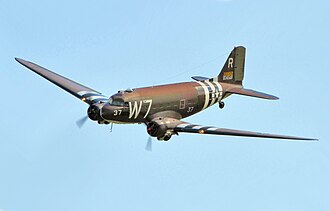
Douglas C-47 Skytrain: The Legendary Workhorse of World War II
The Douglas C-47 Skytrain is one of the most important transport aircraft ever built, and its reputation rests on something more fundamental than speed or technological sophistication: reliability. Developed from the highly successful Douglas DC-3 airliner, the C-47 transformed a proven civilian passenger aircraft into a rugged military transport capable of carrying troops, cargo, paratroopers and wounded personnel across enormous distances. It became an essential part of Allied logistics during the Second World War, serving in Europe, Africa, Asia and the Pacific, and its contribution continued long after 1945 through the Berlin Airlift, the Korean War and conflicts in Southeast Asia. The U.S. Army Air Forces ultimately procured 9,348 C-47s, while total production of the broader military DC-3 family exceeded 10,000 aircraft. The type was so durable that examples continued flying in military and civilian roles for decades, with some aircraft still operating today.
From the DC-3 to the C-47
The Airliner That Became a Military Legend
The story of the C-47 begins with the Douglas DC-3, one of the most influential airliners in aviation history. Introduced into airline service in 1936, the DC-3 helped make scheduled passenger aviation commercially viable and dependable. Its all-metal construction, low-wing configuration, twin-engine layout and strong performance gave airlines a combination of reliability and operating economics that was exceptionally valuable during the 1930s. By the end of that decade, DC-3s represented more than 80 percent of airliners operating in the United States, according to the National Air and Space Museum.
The U.S. Army Air Corps recognized that the same qualities that made the DC-3 successful as an airliner could make it highly effective as a military transport. The first U.S. order for the military version was placed in September 1940, and the aircraft received the designation C-47. The basic airframe remained recognizable as a DC-3, but Douglas modified it extensively for military requirements. These modifications included a reinforced cabin floor, large cargo doors on the port side, fittings for cargo and troop transportation, more powerful engines and an astrodome above the cockpit for navigation and observation. The result was not merely a DC-3 painted in military colors; it was a specialized transport optimized for the demanding conditions of wartime logistics.
The first C-47 entered service on December 23, 1941, only a few weeks after the Japanese attack on Pearl Harbor. From that point onward, the aircraft became increasingly central to the rapid expansion of American military air transport. Production was initially concentrated at Douglas facilities in California and was later expanded to Oklahoma City, allowing thousands of aircraft to be manufactured as the war intensified.
C-47 Design and Construction
A Strong and Practical Airframe
The C-47’s design was remarkably conventional by modern standards, but its conventionality was part of its strength. It was a twin-engine, low-wing monoplane with an all-metal alloy airframe and fabric-covered control surfaces. The aircraft’s structure was sufficiently strong to withstand the stresses of carrying heavy cargo, transporting troops and operating from relatively rough airfields. The National WWII Museum notes that the military version incorporated a strengthened rear fuselage and reinforced floor specifically to accommodate the demands of military transport operations.
The aircraft’s dimensions were substantial for its era. The C-47 had a wingspan of roughly 95 feet 6 inches, a length of approximately 63 feet 9 inches and a height of about 17 feet. These dimensions provided enough internal volume to accommodate significant quantities of cargo or large numbers of troops without making the aircraft excessively large for wartime airfields.
One of the most important modifications was the large cargo door on the port side. Civilian airliners were designed around passengers and baggage, whereas the C-47 had to accommodate everything from ammunition and food to vehicles and medical supplies. The wide door simplified loading and unloading and allowed ground crews to move equipment into the aircraft far more efficiently.
The reinforced floor was equally important. A transport aircraft could not be expected to carry heavy military equipment on a floor designed solely for airline passengers. The C-47’s strengthened structure made it possible to carry loads of approximately 6,000 pounds, giving commanders a flexible platform that could be used for everything from routine supply missions to emergency battlefield logistics.
The Engines of the Skytrain
Pratt & Whitney Twin Wasp Power
The standard C-47 was powered by two Pratt & Whitney R-1830 Twin Wasp radial engines, each producing approximately 1,200 horsepower. These 14-cylinder, air-cooled engines were widely used in American military aviation and had a reputation for providing dependable power under demanding conditions. The combination of two large radial engines and a strong airframe gave the C-47 the ability to carry substantial loads while maintaining useful range and altitude performance.
The use of air-cooled radial engines was particularly appropriate for a transport aircraft intended to operate around the world. Compared with a liquid-cooled system, the radial engine did not require a large liquid-cooling radiator and associated plumbing, while its relatively straightforward mechanical arrangement made it well suited to field maintenance. A transport aircraft operating thousands of miles from major maintenance facilities needed precisely this sort of mechanical robustness.
The C-47 was not a fast aircraft compared with contemporary fighters or later transports, but speed was not its principal purpose. Its value came from the combination of adequate performance, substantial payload, long range and exceptional reliability. The National Museum of the U.S. Air Force gives the C-47D a maximum speed of 232 mph and a range of approximately 1,513 miles, while the Air Mobility Command Museum lists a C-47A at approximately 224 mph maximum speed, 160 mph cruise speed and 1,600 miles of range. Differences reflect model, weight and operating configuration.
The C-47 as a Troop Transport
Carrying Soldiers to the Battlefield
The C-47 became particularly famous as an airborne assault aircraft. Its large cabin allowed it to carry substantial numbers of soldiers, while its robust construction made it suitable for the repeated operations required during major campaigns. A typical C-47 could carry up to 28 paratroopers, depending on configuration and mission requirements. The National Museum of the U.S. Air Force also notes that the aircraft could carry 18 to 22 fully equipped paratroopers in certain configurations.
The aircraft’s role in airborne warfare became particularly important from 1943 onward. C-47s participated in the invasion of Sicily, the landings at Salerno, the Normandy invasion, Operation Dragoon in southern France, Operation Market Garden in the Netherlands and Operation Varsity during the crossing of the Rhine. Their contribution was not limited to simply delivering soldiers to the battlefield: C-47s also transported supplies, evacuated casualties and towed gliders carrying troops and heavy equipment.
The scale of the Normandy operation illustrates the importance of the aircraft. On June 6, 1944, more than 1,000 C-47s transported American paratroopers toward Normandy. These aircraft formed part of an enormous airborne force whose mission was to disrupt German defenses, seize bridges and secure key positions ahead of the amphibious invasion.
The C-47’s contribution continued during Operation Market Garden. More than 1,400 C-47s participated in the massive Allied airborne operation, demonstrating how the aircraft had become an indispensable component of large-scale air mobility by the later stages of the war.
Glider Towing and Battlefield Logistics
More Than a Paratroop Aircraft
Although photographs of paratroopers jumping from C-47s are among the aircraft’s most famous images, airborne troops represented only one part of its wartime mission. The Skytrain was also extensively used as a glider tug. Aircraft such as the Waco CG-4A could be loaded with troops, jeeps, artillery pieces and other equipment and then towed behind C-47s toward combat zones.
The ability to tow gliders greatly expanded the aircraft’s usefulness. A glider could carry heavy equipment that could not conveniently be dropped by parachute, allowing airborne formations to receive vehicles, artillery and other essential equipment shortly after landing. The National Museum of the U.S. Air Force records that C-47s continued this role through D-Day and later operations, including the recovery of gliders after their missions.
The C-47 also became an aerial ambulance. Its spacious interior could be configured to carry stretchers and medical personnel, allowing wounded soldiers to be transported away from combat areas. The National Air and Space Museum notes that the aircraft could accommodate up to 14 wounded soldiers in evacuation configurations, while other configurations used approximately 18 stretchers with medical personnel.
This flexibility was one of the aircraft’s greatest strengths. A single C-47 could perform very different missions simply by changing its interior arrangement. The same basic aircraft could carry cargo on one flight, paratroopers on another and wounded personnel on a third.
The Dangerous “Hump” Route
Supplying China Across the Himalayas
The C-47 also played an important role in one of the most hazardous airlift operations of the Second World War: supplying China across the Himalayas, a route commonly known as “the Hump.”
With traditional land routes severely restricted, Allied aircraft transported supplies from India toward China over some of the world’s most difficult terrain. C-47s operated alongside larger Curtiss C-46 Commandos, flying through mountainous areas where severe weather, turbulence, icing and high altitude created major hazards. Some missions required aircraft to reach altitudes approaching 17,000 feet.
The Hump demonstrated another important quality of the C-47: adaptability. An aircraft originally developed from a commercial passenger design had become a strategic military transport capable of operating in environments vastly different from those for which its civilian predecessor had been created. The missions were dangerous, but maintaining the supply route was vital to Allied operations in China and Southeast Asia.
The C-47 on D-Day
An Aircraft at the Center of Operation Overlord
The C-47’s association with D-Day has become one of the defining elements of its historical legacy. During the airborne phase of the Normandy invasion, C-47s carried American paratroopers toward their designated drop zones. The aircraft also towed gliders carrying equipment and reinforcements.
Individual aircraft have remarkably well-documented wartime histories. The C-47 displayed by the National WWII Museum, serial number 42-93096, was built at Douglas’s Oklahoma City plant and delivered to the U.S. Army in April 1944. After arriving in England, it participated in the Normandy invasion by carrying pathfinders from the 82nd Airborne Division. It subsequently participated in Operation Market Garden, flew supply missions to Bastogne during the Battle of the Bulge and finally dropped paratroopers during Operation Varsity in March 1945.
This particular aircraft illustrates how intensely the C-47 could be used. Within less than a year, one transport could participate in multiple major airborne operations, supply missions and combat-related flights. The ability to repair damaged aircraft quickly and return them to service was another reason the type became so valuable.
The C-47 After World War II
The Berlin Airlift
The end of the Second World War did not mean the end of the C-47’s military usefulness. Thousands of aircraft remained available, and their durability allowed them to serve in the postwar period. One of their most famous later missions came during the Berlin Airlift of 1948–49.
When land access to West Berlin was blocked, Allied aircraft created an enormous air bridge to supply the isolated city. C-47s were among the aircraft used during the operation, helping transport food, fuel and other essential supplies. The type’s relatively modest capacity compared with larger transports was offset by its availability and reliability. The C-47 could continue operating while larger aircraft handled heavier loads, making it a useful component of a diverse airlift fleet.
The Berlin Airlift also demonstrated that the C-47’s usefulness extended beyond conventional warfare. The aircraft had been designed as a military transport, but its fundamental purpose—moving people and material reliably—was equally valuable during a humanitarian and strategic airlift.
Korea, Vietnam and the Gunship Era
An Aircraft That Refused to Become Obsolete
The C-47 remained active during the Korean War, where it transported supplies, evacuated wounded personnel, dropped paratroopers and performed other support missions. By this point, newer and larger aircraft were beginning to enter military service, but the Skytrain remained useful because of its simplicity and versatility.
Its career became even more unconventional during the Vietnam War. C-47s were adapted for missions including reconnaissance, psychological warfare and ground attack. The development of the AC-47 gunship transformed the basic transport into an aircraft capable of providing sustained fire support against ground targets. The National Museum of the U.S. Air Force notes that C-47 variants in Southeast Asia performed ground-attack missions as gunships as well as reconnaissance and psychological-warfare duties.
This evolution is perhaps the strongest evidence of the C-47’s underlying versatility. The same fundamental airframe that had carried paratroopers over Normandy could later serve in roles completely unrelated to its original transport mission.
The Dakota and the Global C-47 Family
The C-47 was not exclusively an American aircraft. In British and Commonwealth service, the type was generally known as the Dakota, a name that became almost as famous as Skytrain. The aircraft served extensively with the Royal Air Force and other Allied air forces.
The basic DC-3 design also became an international aircraft through licensed production. The Soviet Union built approximately 6,000 aircraft as the Lisunov Li-2, while Japan produced roughly 400 examples under license before and during the war. This worldwide production and operation helped make the DC-3 family one of the most influential aircraft designs of the twentieth century.
Why the C-47 Was So Durable
The Skytrain’s longevity cannot be explained by one feature alone. Its success came from a combination of structural strength, straightforward systems, dependable engines, useful payload capacity and the enormous experience accumulated by thousands of crews and maintenance personnel.
The aircraft was also forgiving in the sense that its basic design left considerable room for adaptation. Cargo fittings, troop seats, medical equipment, glider-towing equipment and specialized mission systems could be installed without fundamentally redesigning the aircraft. That adaptability helped the C-47 remain useful even as military aviation evolved around it.
Its longevity is extraordinary. The National Air and Space Museum notes that DC-3 and military derivatives continued operating around the world decades after their introduction, while individual C-47s accumulated remarkably long service careers.
Surviving C-47 Skytrains Today
A Living Piece of Aviation History
Unlike many wartime aircraft that survive only as static museum exhibits, a number of C-47s and DC-3s remain airworthy. Their continued operation allows modern audiences to experience the distinctive sound and appearance of the aircraft in a way that a museum display cannot completely reproduce.
Museums have preserved individual aircraft with especially important histories. The National WWII Museum’s C-47 “096”, for example, survived D-Day, Market Garden, the Battle of the Bulge and Operation Varsity before later serving in the Berlin Airlift and Finnish Air Force. It ultimately became part of the museum’s collection in 2006.
The National Museum of the U.S. Air Force also preserves a C-47D that represents the aircraft’s D-Day and glider-recovery missions. The museum identifies it as the last C-47 to remain in routine USAF service and notes that it flew to the museum in 1975.
Douglas C-47 Skytrain Technical Specifications
The following figures are representative of the wartime C-47A/C-47D family. Exact specifications varied according to model, equipment, fuel load and mission configuration, so individual aircraft can differ. The dimensions and performance figures below are based primarily on U.S. military museum references.
| Technical specification | Douglas C-47 Skytrain |
|---|---|
| Aircraft type | Military transport aircraft |
| Civilian predecessor | Douglas DC-3 |
| Manufacturer | Douglas Aircraft Company |
| Country of origin | United States |
| First C-47 flight/service | 1941 |
| Configuration | Twin-engine, low-wing monoplane |
| Crew | Typically 3 |
| Passenger capacity | Up to 28 troops/passengers |
| Paratroop capacity | Up to 28 paratroopers |
| Cargo capacity | Approximately 6,000 lb (2,722 kg) |
| Engines | 2 × Pratt & Whitney R-1830 Twin Wasp |
| Engine type | 14-cylinder air-cooled radial |
| Power | 1,200 hp (895 kW) each |
| Total engine power | 2,400 hp (1,790 kW) |
| Length | 63 ft 9 in (19.43 m) |
| Wingspan | 95 ft 6 in (29.11 m) |
| Height | Approximately 17 ft (5.18 m) |
| Empty weight | Approximately 18,135 lb (8,225 kg) |
| Loaded weight | Approximately 26,000 lb (11,794 kg) |
| Maximum takeoff weight | Varies by version/configuration |
| Maximum speed | Approximately 224–232 mph (360–373 km/h) |
| Cruise speed | Approximately 160 mph (257 km/h) |
| Range | Approximately 1,500–1,600 miles (2,414–2,575 km) |
| Service ceiling | Approximately 24,000–26,400 ft (7,315–8,047 m) |
| Rate of climb | Approximately 1,130 ft/min (5.7 m/s) |
| Primary wartime roles | Troop transport, cargo, paratroop drops, medical evacuation, glider towing |
| U.S. Army procurement | 9,348 C-47s |
| Common British/Commonwealth name | Dakota |
| Common U.S. nickname | Gooney Bird |
Specifications vary between C-47 variants and individual aircraft. Payload, range and performance were particularly dependent on fuel, altitude, temperature and mission equipment.
Final Thoughts
The Douglas C-47 Skytrain earned its legendary status not through one spectacular technological innovation but through an extraordinary combination of reliability, adaptability and usefulness. Derived from the civilian DC-3, it became the backbone of Allied military air transport during the Second World War and participated in virtually every major airborne campaign in which American forces were involved. It carried paratroopers into Normandy, towed gliders loaded with equipment, transported supplies across the Himalayas, evacuated wounded soldiers and maintained the enormous logistical network required to sustain armies operating far from their home bases.
Its story did not end with World War II. The Skytrain remained active during the Berlin Airlift and Korean War and subsequently found new roles in Southeast Asia, where modified aircraft became gunships, reconnaissance platforms and psychological-warfare aircraft. The fact that the same fundamental airframe could serve such radically different missions is perhaps the clearest demonstration of the design’s quality.
More than eighty years after the first C-47s entered military service, the aircraft remains one of the most recognizable symbols of wartime air transport. Surviving examples preserve not only the appearance and sound of a classic Douglas aircraft but also the history of the crews, soldiers, mechanics and communities that depended upon it. The C-47 was, in the simplest sense, a transport aircraft—but its ability to move people, equipment and supplies when and where they were needed made it one of the most consequential aircraft of the twentieth century.
.jpg)