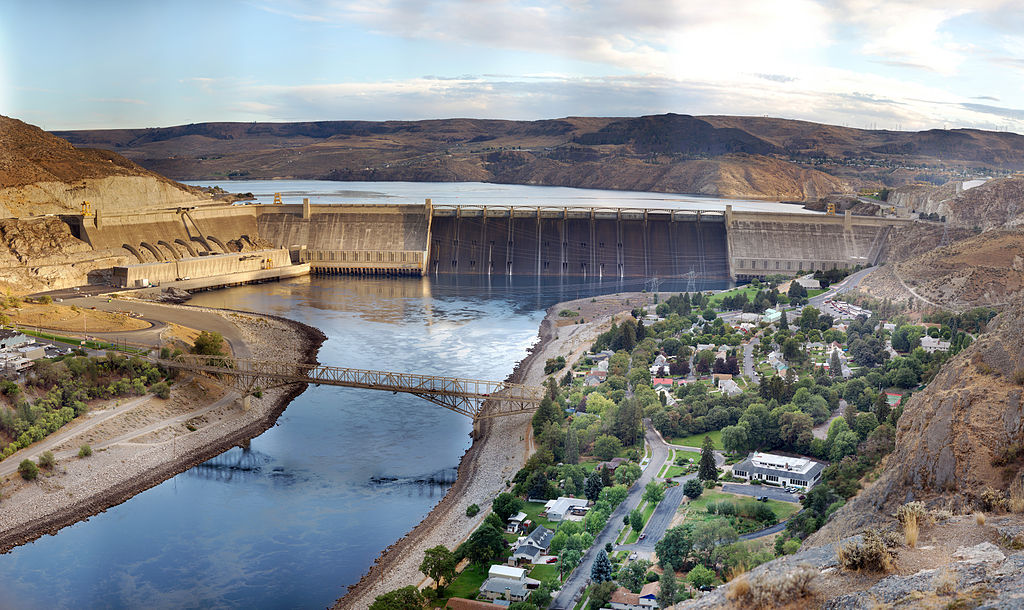
Grand Coulee Dam
Grand Coulee Dam is a waterworks located on the Columbia River in the United States, specifically in the state of Washington. Like other similar dams, it has several tasks. First of all, it concerns the production of electricity, but of course also the regulation of the watercourse and also water storage tank for irrigation.
The construction of the entire waterworks took place between 1933 and 1942. Two power plants were put into operation. Later, in 1974, a third power plant was put into operation to cover the increased electricity needs.
technical parameters Grand Coulee Dam
| Location | Grant / Okanogan counties |
| Country | United States |
| Construction began | July 16, 1933 |
| Opening date | June 1, 1942 |
| Construction cost |
|
| Purpose | Power, regulation, irrigation |
| Operator | Bureau of Reclamation |
| Type of dam | Concrete gravity |
| Height | 550 ft (168 m) |
| Length | 5,223 feet (1,592 m) |
| Impounds | Columbia River |
| Width (base) | 500 ft (152 m) |
| Width (crest) | 30 ft (9 m) |
| Spillway capacity | 1,000,000 cu ft/s (28,317 m3/s) |
| Spillway type | Service, drum gate |
| Dam volume | 11,975,520 cu yd (9,155,942 m3) |
| Total capacity reservoir | 9,562,000 acre⋅ft (12 km3) |
| Active capacity reservoir | 5,185,400 acre⋅ft (6 km3) |
| Catchment area | 74,100 sq mi (191,918 km2) |
| Surface area | 125 sq mi (324 km2) |
| Type power station | Conventional, pumped-storage |
| Commission date power station |
|
| Turbines |
|
| Hydraulic head | 380 ft (116 m) |
| Capacity factor | 36 % |
| Installed capacity |
|
| Annual generation | 20.24 TWh |
Grand Coulee Dam
