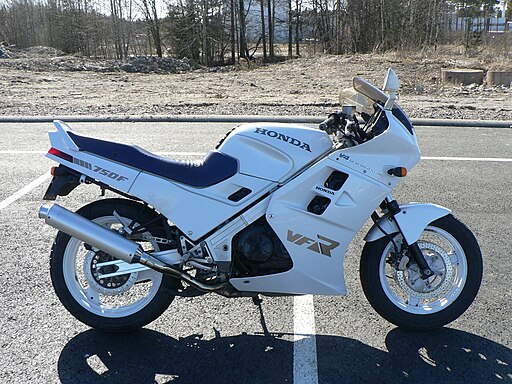
The Honda VFR750F debuted in 1986 as a pioneering sport-tourer that fused cutting-edge V4 power with everyday versatility. Its combination of a compact 90° V-4 engine, robust chassis, and sophisticated suspension set new benchmarks for handling precision and high-speed stability. This article unpacks the VFR750F’s engineering DNA, performance figures, maintenance essentials, and enduring appeal, offering technical granularity for riders, restorers, and engineers alike.
Development and Design Philosophy
Honda’s engineers targeted a package that could attack winding backroads yet remain comfortable on extended tours. Key development goals included:
- Maximizing mid-range torque for tractable on-throttle performance
- Minimizing engine vibration through natural V-4 balance and counter-balancers
- Achieving compact weight distribution with a narrow powerplant
- Integrating adjustable suspension to suit both sporty and touring riding
This dual-nature mandate led to innovations still admired today, from the Pro-Link rear swingarm geometry to the distinctive single-sided swingarm introduced on later VFR models.
Powerplant Architecture
Engine Configuration
- Type: Liquid-cooled, 90° V-4 four-stroke
- Displacement: 747 cc
- Bore × Stroke: 70.0 mm × 48.6 mm
- Compression Ratio: 10.0 : 1
The 90° V-4 layout delivers inherent primary balance. Coupled with a gear-driven cam system and hydraulic tensioners, the engine revs smoothly to an 11 000 rpm redline.
Cylinder Head and Valvetrain
- Valvetrain: Dual overhead camshafts (DOHC) per bank
- Valves: 4 per cylinder (16 total)
- Cam Drive: Duplex toothed steel gears
- Valve Timing: 320° intake, 280° exhaust
Gear-driven cams eliminate belt servicing intervals. A high-lift cam profile and short valve lash paths support crisp throttle response at high rpm.
Fueling and Induction
- Carbs: 4 × Keihin CV 32 mm constant-velocity
- Airbox: Tuned plenum with dual resonators
- Intake Tracts: Variable-length trumpets for broad torque delivery
CV carbs with progressive slide curves maintain fuel atomization from idle to redline, while the tuned airbox smooths transient throttle transitions.
Cooling and Lubrication
- Radiator: 3-row aluminum with thermostatic electric fan
- Coolant Capacity: 2.75 L
- Oil System: Wet sump, capacity 4.0 L
- Oil Cooler: Integrated front-mounted unit
Optimized coolant flow channels through each cylinder head bank, preventing hot spots during extended high-load operation. An under-pressure crankcase vent reduces oil foaming at rev limits.
Drivetrain Details
- Transmission: 6-speed constant-mesh
- Clutch: Wet multi-plate, cable-actuated
- Shift Mechanism: Ratchet-plate indexing
- Final Drive: Continuous O-ring chain; 16 T front, 42 T rear
Close-ratio gears keep the engine in its strong mid-range, while a tall sixth gear reduces engine speed on the highway for relaxed cruising and fuel economy.
Chassis, Suspension, and Braking
Frame Geometry
- Frame Type: Steel perimeter twin-spar
- Wheelbase: 1 470 mm
- Rake/Trail: 26° / 110 mm
- Seat Height: 785 mm
- Ground Clearance: 150 mm
- Dry Weight: 217 kg
A perimeter frame carries loads directly between headstock and swingarm pivot. This minimizes flex under heavy cornering and enhances front-end precision.
Front Suspension
- Forks: 41 mm telescopic, adjustable preload & rebound
- Travel: 130 mm
Rear Suspension
- Swingarm: Pro-Link single shock with rising rate
- Shock: Piggyback reservoir, preload and rebound adjustable
- Travel: 120 mm
Progressive linkage ratios deliver supple response over small bumps and rising stiffness under heavy cornering loads.
Wheels and Tires
- Wheels: Cast aluminum, 17 × 3.50 in front; 17 × 4.50 in rear
- Tires: 120/70 ZR17 front; 150/70 ZR17 rear
Brakes
- Front: Dual 296 mm discs, Nissin four-piston calipers
- Rear: Single 256 mm disc, two-piston caliper
- Brake Lines: Steel-braided aftermarket conversions readily available
High-stiffness calipers and large rotors ensure fade-free performance under sustained sport rides.
Electrical System and Cockpit
- Battery: 12 V 10 Ah sealed lead-acid
- Alternator: 370 W at 5 500 rpm
- Ignition: Digital CDI with automatic advance mapping
- Lighting: 55 W halogen headlight; LED conversion options popular
- Instruments: Twin analog tachometer and speedometer; digital odometer; coolant-temperature gauge; fuel reserve warning light
A dedicated grounding rail simplifies fault tracing. The under-seat fuse block separates high-current circuits from the main harness.
Performance Figures
- Peak Power: 100 hp (75 kW) @ 10 500 rpm
- Peak Torque: 68 Nm @ 9 500 rpm
- Top Speed: 240 km/h
- 0–100 km/h: 4.5 s
- Fuel Economy: 6.0 L/100 km at 90 km/h cruise
- Fuel Capacity: 21 L (including 3 L reserve)
Broad torque above 5 000 rpm makes the VFR750F both rapid in sprints and composed on long straights.
Maintenance Best Practices
- Valve Clearance: Inspect every 16 000 km; shim-under-bucket design requires special tappet blocks for adjustment.
- Carburetor Sync: Balance every 8 000 km for stable idle and even throttle response.
- Coolant Change: Replace every two years; use corrosion-inhibited coolant.
- Chain Care: Adjust tension and lubricate every 1 000 km; replace sprockets when chain stretch reaches 1 %.
- Brake Fluid: Flush annually with DOT 4 fluid to prevent moisture buildup.
- Fork Seals and Shock Bushings: Inspect annually for leaks and stiction; upgrade seals to modern low-friction units.
Proactive monitoring of rubber hoses, ignition wires, and electrical connectors extends reliability in high-mileage examples.
Technical Specification Summary
| Parameter | Specification |
|---|---|
| Engine Type | Liquid-cooled 90° V-4 |
| Displacement | 747 cc |
| Bore × Stroke | 70 mm × 48.6 mm |
| Compression Ratio | 10.0 : 1 |
| Valvetrain | DOHC per bank; 4 valves/cylinder |
| Fuel System | 4 × Keihin CV 32 mm |
| Transmission | 6-speed constant-mesh |
| Final Drive | O-ring chain (16 T/42 T) |
| Frame | Steel perimeter twin-spar |
| Front Suspension | 41 mm adjustable telescopic |
| Rear Suspension | Pro-Link single shock, preload/rebound |
| Wheelbase | 1 470 mm |
| Dry Weight | 217 kg |
| Fuel Capacity | 21 L (3 L reserve) |
| Peak Power | 100 hp @ 10 500 rpm |
| Peak Torque | 68 Nm @ 9 500 rpm |
| Top Speed | 240 km/h |
Legacy and Aftermarket Ecosystem
More than three decades on, the VFR750F remains highly prized. Key factors fueling its resurgence include:
- Availability of OEM rebuild kits: pistons, bearings, and camchain components
- Electronic upgrades: ignition mapping modules and LED lighting conversions
- Suspension enhancements: fully adjustable cartridge fork kits and Ohlins rear shocks
- Community resources: detailed factory workshop manuals, wiring diagrams, and dyno-map archives
Riders seeking modern handling refinement often retrofit radial-mount calipers and braided lines without compromising the bike’s classic silhouette.
Conclusion
The Honda VFR750F set a high bar for sport-touring motorcycles by blending a potent, rev-happy V-4 with a chassis tuned for razor-sharp cornering and enduring comfort on motorways. Its technical innovations—gear-driven cams, Pro-Link suspension, and a naturally balanced engine—still resonate with enthusiasts. With diligent maintenance and targeted upgrades, the VFR750F continues to flourish as an engaging ride and a testament to Honda’s engineering vision.
