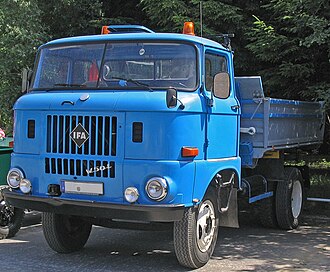
IFA W50: The East German Truck That Refused to Disappear
The IFA W50 is one of those trucks that seems to belong to another era, yet it has a remarkable ability to remain relevant decades after its production ended. Built in East Germany from 1965 until 1990, the W50 became one of the most recognizable commercial vehicles produced by the former German Democratic Republic. It was designed as a practical medium-duty truck rather than a luxurious or technically extravagant machine, and that straightforward philosophy became one of its greatest strengths. Over its long production run, approximately 572,000 examples were built at the Ludwigsfelde plant, with the truck becoming a familiar sight not only throughout Eastern Europe but also in many export markets.
The W50’s story is particularly interesting because it combines industrial history, engineering pragmatism and an extraordinary variety of applications. It could be found as a conventional cargo truck, tipper, military vehicle, fire engine, tanker, workshop vehicle and in numerous other specialized configurations. Some sources identify dozens of factory-supported versions, while the number becomes considerably larger when special bodies and export adaptations are included. This flexibility helped make the W50 one of the most important commercial vehicles of its generation in East Germany.
The Origins of the IFA W50
The name W50 has its roots in the vehicle’s development history. The “W” refers to Werdau, the East German location associated with the truck’s development, while “50” relates to its intended payload class of approximately five tonnes. Interestingly, the earliest prototypes were associated with the W45 designation because their planned payload was lower, but the production vehicle ultimately exceeded the five-tonne target. Later versions could carry around 5.3 tonnes depending on specification and configuration.
The W50 was developed as the successor to the IFA S4000-1, and production began in July 1965 at the Ludwigsfelde factory. Its development reflected the requirements of a centrally planned economy in which a single basic vehicle often had to fulfill a remarkably wide range of transportation duties. Instead of producing completely different trucks for every application, IFA created a robust basic platform that could accept different bodies and driveline configurations.
This approach was highly practical. A truck operating in agriculture had different requirements from one serving a municipal authority, military unit or construction company, but all of them could be based around the same fundamental chassis. The result was a vehicle that was not particularly glamorous, but was exceptionally adaptable.
A Simple but Capable Diesel Engine
One of the defining characteristics of the IFA W50 was its four-cylinder diesel engine. Early vehicles used a 6.56-liter, water-cooled four-cylinder diesel producing approximately 110 PS at 2,200 rpm. In 1967, IFA introduced the more powerful 4 VD 14.5/12-1 SRW engine, which retained the same 6.56-liter displacement but increased output to 125 PS at 2,300 rpm.
The later engine used the M-system direct-injection principle, developed through cooperation involving the Motorenwerke Nordhausen and MAN. The change brought more power while retaining the relatively simple four-cylinder architecture. According to historical technical information, early examples of the newer engine suffered from durability and production-quality problems, but manufacturing quality improved considerably during the following years.
For modern drivers, a 6.56-liter four-cylinder producing 125 PS may sound unusual. Today’s medium-duty trucks frequently use smaller turbocharged engines with substantially more power, but the W50 was built around a very different philosophy. Its engine was intended to provide steady torque, straightforward servicing and acceptable performance under demanding working conditions rather than rapid acceleration.
That character is part of what makes the truck interesting today. The engine is large, relatively slow-revving and mechanically straightforward by modern standards. There are no modern electronic control systems to complicate the basic operating concept. For owners restoring an old W50, this mechanical simplicity can be both an advantage and a major part of the vehicle’s appeal.
Rear-Wheel Drive or Four-Wheel Drive?
The W50 was produced in both rear-wheel-drive and four-wheel-drive configurations, with 4×4 versions becoming particularly important. The four-wheel-drive models gave the truck significantly greater versatility on rough roads, construction sites, fields and other surfaces where a conventional road truck could struggle.
This capability was especially valuable because the W50 was exported extensively. It was reportedly supplied to more than 40 countries, and export vehicles could be adapted to local requirements. In some years, exports represented a very substantial proportion of production.
The four-wheel-drive configuration also contributed to the truck’s reputation for being surprisingly useful away from paved roads. A relatively compact wheelbase, high ground clearance and rugged chassis made it suitable for conditions that would have been uncomfortable for many ordinary road-going trucks.
Built for Work, Not Luxury
The W50’s cab-over-engine layout gave it a practical combination of visibility and compact overall dimensions. The standard configuration had a 3,200 mm wheelbase, while other versions used a longer wheelbase. The commonly quoted W50 L dimensions are approximately 6,530 mm long, 2,500 mm wide and 2,600 mm high, although specialized configurations could differ considerably.
Inside the cab, the philosophy was unmistakably functional. The W50 was designed to be driven and maintained by working people rather than presented as a premium vehicle. Materials and equipment were selected for durability and practicality. There was little need for the kind of comfort technology that has become normal in modern trucks.
Yet this basic approach has a certain charm today. The W50 provides a very direct connection between driver and machine. Operating an old example involves considerably more mechanical involvement than driving a modern commercial vehicle, and that is precisely what attracts collectors, enthusiasts and historic-vehicle owners.
The Many Faces of the W50
Perhaps the most impressive aspect of the IFA W50 is not its engine or top speed but the enormous variety of roles it performed.
Cargo bodies were among the most common configurations, but the W50 could also be equipped as a three-way tipper, tanker, fire engine, military vehicle, workshop truck and numerous other specialist machines. Specialized manufacturers created additional bodies, meaning that the visual appearance of two W50s could be completely different even though they shared the same basic mechanical platform.
Military versions are particularly recognizable among surviving examples. The W50’s 4×4 capability, relatively compact dimensions and payload made it suitable for military logistics and support duties. Fire-service versions are another important part of its legacy, while agricultural and municipal vehicles helped make the W50 a familiar sight across East Germany and other countries.
The enormous range of configurations also explains why discussing “the” W50 can be misleading. A basic W50 L cargo truck and a specialized all-wheel-drive version might share the same fundamental heritage while having substantially different dimensions, payloads and operating characteristics.
Performance by 1970s Standards
The W50 was never intended to be a high-speed truck. Depending on the version and production period, published specifications give maximum speeds of approximately 83 to 90 km/h. Later standard W50 L versions with the 125-PS engine are commonly listed at around 90 km/h.
That figure sounds modest today, but it was entirely appropriate for the vehicle’s intended purpose. The W50 prioritized carrying capacity, durability and versatility over outright speed. Its relatively short wheelbase also helped give it useful maneuverability for a truck of its class.
The basic W50 L specification could have a payload around 5,200 kg with the early engine and approximately 5,300 kg with the later version, while permissible gross mass increased from roughly 9,800 kg to 10,200 kg.
These figures demonstrate why the truck earned its reputation as a serious working vehicle. It was not merely a medium-sized vehicle visually; it offered a substantial payload relative to its own size and mechanical configuration.
Why the IFA W50 Became So Durable
There is an important distinction between being technologically advanced and being useful. The W50 was not a technological revolution, but its straightforward engineering helped it survive in environments where sophisticated vehicles could be difficult to maintain.
Its mechanical layout was relatively accessible, and the truck’s components were designed around serviceability rather than extreme complexity. A contemporary account of the W50 highlights how an example could sometimes be returned to service after sitting unused for months with remarkably basic preparation.
That reputation for toughness is one reason surviving W50s continue to attract attention. More than three decades after production ended, examples can still be found working or being restored. Spare parts and components also continue to appear on the enthusiast and used-parts market, demonstrating that the truck has not completely disappeared from practical use.
The End of Production
The W50 eventually faced a successor in the form of the IFA L60. The newer truck was intended to offer improvements in areas such as engine performance, fuel consumption, payload, reliability and driver comfort. Nevertheless, the W50 remained in production alongside the newer design and ultimately outlived it in production terms.
Production of the W50 finally ended in December 1990, shortly after German reunification and during the enormous economic changes that followed the collapse of the East German industrial system. IFA’s truck production at Ludwigsfelde came to an end on 17 December 1990.
By then, the W50 had already established an extraordinary production record. Hundreds of thousands had been built, and its influence extended well beyond East Germany.
Why the IFA W50 Still Matters
The appeal of the IFA W50 today is about much more than nostalgia. It represents a particular approach to vehicle engineering: build one strong platform, make it adaptable, keep the mechanics understandable and design it to perform useful work for many years.
That philosophy is increasingly interesting in an era of highly computerized vehicles. Modern trucks are safer, faster, cleaner and vastly more comfortable, but the W50 illustrates what can be achieved with relatively uncomplicated engineering and a clear understanding of the job a truck is supposed to perform.
Its survival is therefore not simply a historical curiosity. Restored W50s appear at classic-vehicle gatherings, working examples remain in some regions, and the truck continues to fascinate enthusiasts who appreciate its distinctive appearance and mechanical character.
The IFA W50 may have been born in a very different political and industrial world, but its basic qualities remain easy to understand. It was strong, adaptable, relatively compact for its carrying capacity and designed to keep working. Those qualities explain why the W50 became one of the most important trucks of East German automotive history—and why, more than 30 years after the last one left the factory, its distinctive silhouette is still instantly recognizable.
IFA W50 Technical Specifications
The following figures represent the commonly documented IFA W50 L specification. Exact figures can vary according to production year, body style, wheelbase, drivetrain and specialist configuration.
| Specification | IFA W50 L |
|---|---|
| Manufacturer | IFA / IFA-Automobilwerk Ludwigsfelde |
| Production | 1965–1990 |
| Vehicle type | Medium-duty cab-over truck |
| Engine | 4-cylinder, water-cooled diesel |
| Early engine | 4 KVD 14.5/12 SRW |
| Later engine | 4 VD 14.5/12-1 SRW |
| Displacement | 6.56 liters |
| Bore × stroke | 120 × 145 mm |
| Early power | 110 PS at 2,200 rpm |
| Later power | 125 PS at 2,300 rpm |
| Early maximum torque | 40 kpm at 1,400 rpm |
| Later maximum torque | 43 kpm at 1,350 rpm |
| Transmission | 5-speed manual |
| Drive configurations | 4×2 and 4×4, depending on version |
| Wheelbase | 3,200 mm / 3,700 mm depending on version |
| Track width | Approximately 1,700 / 1,778 mm |
| Length | Approximately 6,530 mm for W50 L |
| Width | Approximately 2,500 mm |
| Height | Approximately 2,600 mm |
| Ground clearance | Approximately 300 mm |
| Early kerb mass | Approximately 4,600 kg |
| Later kerb mass | Approximately 4,400 kg |
| Payload | Approximately 5,200–5,300 kg |
| Maximum permissible mass | Approximately 9,800–10,200 kg |
| Tyres | 8.25–20 |
| Top speed | Approximately 83–90 km/h |
| Electrical system | 12 V |
| Fuel tank | 100 L initially; later versions up to 150 L |
| Factory location | Ludwigsfelde, East Germany |
| Approximate production | 572,000 examples |
Final Thoughts
The IFA W50 was never about showing off. Its purpose was to carry, tow, haul, climb and work, often under conditions in which simplicity was more valuable than sophistication. That mission explains almost everything about its design, from the large four-cylinder diesel to the cab-over layout and the wide variety of available body configurations.
Its historical importance is equally significant. The W50 became a symbol of East German commercial vehicle production and one of the most widely produced trucks in the country’s history. Its long production period, enormous export footprint and multitude of specialized variants gave it a reach far beyond its original market.
For enthusiasts today, the W50 offers something increasingly rare: a truck whose character is immediately understandable. Turn the key, hear the diesel, engage the gearbox and the purpose of the machine becomes obvious. It was built to work—and that simple idea is perhaps the most enduring reason the IFA W50 remains memorable.
