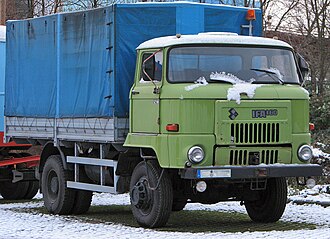
IFA L60: The Last Great East German Truck
The IFA L60 occupies a fascinating place in European truck history. Developed in the German Democratic Republic as the successor to the enormously successful IFA W50, the L60 was intended to take East German medium-duty trucks into a more modern era. It brought a larger six-cylinder diesel engine, greater payload capacity, a more sophisticated transmission, new axles and, in many versions, four-wheel drive. Yet its story is also one of unfortunate timing. The L60 finally entered series production in 1987, after years of development, only to find itself introduced during the final years of the GDR. Production ended in August 1990, meaning that this ambitious truck had only a few years to establish itself before the political and economic transformation of Germany brought the East German commercial-vehicle industry to an abrupt end. Approximately 20,000 L60 trucks were produced, making it considerably rarer today than the W50.
Although the L60 retained a visual resemblance to its predecessor, it was considerably more than a larger-engine W50. Engineers at VEB Automobilwerke Ludwigsfelde developed a new six-cylinder diesel engine, redesigned the drivetrain and introduced new axles with planetary gearing. The truck was aimed at a payload class of approximately six tonnes and was intended to provide better performance, economy and versatility than the aging W50. The designation itself reflected this concept: the “L” connected the truck to Ludwigsfelde, while “60” referred to its approximately six-tonne payload class. In the familiar 1218 designation, the numbers could also indicate the approximately 12-tonne gross vehicle weight and 180 PS engine output.
From the W50 to the L60
The IFA W50 had been a remarkable success for East German industry. Introduced in 1965, it became the country’s standard medium-duty truck and was exported to numerous countries. But by the 1970s, the basic design was becoming increasingly dated. Its four-cylinder diesel engine was reliable and simple, but its power and payload were increasingly restrictive as transportation requirements evolved.
The L60 project therefore represented a much more substantial development program. Work on the concept had been underway for many years, and the truck’s development was repeatedly affected by the economic limitations of the GDR and by attempts to cooperate with Western manufacturers. At various stages, East German engineers investigated foreign cab designs, including proposed cooperation with Volvo and later Steyr. Neither project ultimately produced the planned production solution. The final L60 therefore used a cab derived from the W50 design but modified into a tilting configuration to provide better access to the engine.
This history helps explain one of the L60’s most interesting characteristics. Underneath its familiar exterior was a significantly newer truck, but externally it could appear surprisingly conservative. The L60 was therefore a mixture of old and new: a modernized chassis and engine hidden beneath a cab that still visually connected it to a truck from the previous generation.
A New Six-Cylinder Diesel
The 6 VD 13.5/12 SRF Engine
The heart of the L60 was its newly developed six-cylinder diesel engine, designated 6 VD 13.5/12 SRF. It displaced 9.16 liters and produced approximately 132 kW, or 180 PS, at 2,300 rpm. Maximum torque was around 634 Nm, giving the truck substantially more power than the 92-kW engine commonly associated with the later W50.
The engine was a liquid-cooled, naturally aspirated diesel with direct injection. Its six-cylinder configuration made the L60 noticeably more capable when carrying heavy loads or operating off-road. The engine was also designed as part of a broader modular family, with the underlying architecture intended to accommodate later developments such as turbocharging and charge-air cooling. The IFA Museum in Nordhausen notes that the engine concept was designed with future technical development in mind, illustrating that the L60 powertrain was not simply an enlarged version of the older W50 engine.
In practical terms, the engine gave the L60 the sort of torque and pulling ability that operators expected from a serious six-tonne truck. It was not a high-speed engine by modern standards, but its low-revving diesel character was well suited to transporting heavy loads and working in difficult terrain.
Performance and Economy
The L60’s performance varied according to its configuration, gearing, tyres and intended application. Commonly documented versions had top speeds in the region of 82–90 km/h, while different gear ratios could provide alternative performance characteristics. Historical technical information also describes versions with different maximum speeds, demonstrating how extensively the basic truck could be adapted.
Fuel consumption was not particularly low by modern standards, and real-world figures could exceed 20 liters per 100 kilometers. However, judging the L60 purely by fuel consumption misses the point of its development. Compared with the W50, the L60 was designed to transport a greater payload, and its increased capacity meant that fuel consumption per tonne of transported cargo could be considerably more favorable.
The Eight-Speed Transmission
One of the most important mechanical improvements in the L60 was its transmission. Depending on configuration, the truck used an eight-speed manual gearbox with an additional crawler gear. This provided a much wider selection of ratios than the simpler transmission arrangements associated with the W50.
The gearbox was operated using a double-H shift pattern, allowing the driver to select the appropriate ratio for road speed, load and terrain. A crawler gear was particularly valuable for heavy-duty work, where extremely low speeds and controlled torque were more important than acceleration.
However, the greater sophistication also introduced additional complexity. Contemporary owners and later enthusiasts have noted that L60 gearboxes could suffer damage, particularly when operated incorrectly. The transmission therefore illustrates the general character of the L60: it was technologically more advanced than the W50, but that advancement demanded more knowledge and careful maintenance from its operators.
Four-Wheel Drive and Serious Off-Road Ability
Built for Difficult Terrain
Four-wheel drive was one of the L60’s defining characteristics, particularly because a large proportion of production vehicles were configured for all-terrain use. The 4×4 drivetrain, high ground clearance and planetary axles made the truck well suited to military, agricultural, construction and forestry applications.
The all-wheel-drive system could be combined with locking differentials, allowing the L60 to maintain traction when one or more wheels encountered slippery or uneven ground. Historical descriptions indicate that four-wheel-drive versions were designed to cope with very steep gradients, with unloaded vehicles capable of climbing grades of up to approximately 60 percent under suitable conditions.
The L60’s chassis was based around a ladder frame, while both axles used leaf springs. This was conventional heavy-truck engineering, but it provided the durability and articulation needed for demanding work. The use of planetary gearing in the axles was another significant departure from the older W50 design and helped combine suitable ground clearance with the required torque multiplication.
A Natural Military and Expedition Truck
These characteristics made the L60 particularly attractive for military and specialist applications. Its combination of payload, four-wheel drive and mechanical simplicity gave it the ability to operate far away from paved roads and established infrastructure.
Today, that same combination has made surviving L60s interesting to expedition and overland enthusiasts. The truck’s large chassis provides a substantial platform for a camper or expedition body, while its four-wheel-drive system and robust axles make it capable of reaching remote areas. Its age and fuel consumption obviously introduce compromises, but the underlying mechanical design remains attractive to people who value ruggedness over modern convenience.
The L60 in East German Industry
The L60 was designed for a wide range of civilian applications. Flatbed trucks, box bodies, tankers, specialist vehicles and other configurations could be produced using the basic platform. Military versions represented another important area of use, while municipal and industrial operators could select bodies appropriate to their particular requirements.
The truck’s six-tonne payload class gave it a useful position between lighter commercial vehicles and much larger heavy trucks. The gross vehicle weight of a commonly documented 4×4 configuration was approximately 12.4 tonnes, with a payload of around six tonnes.
Despite these improvements, the W50 remained in production alongside the L60. The reason was partly economic: the newer truck was significantly more expensive, reportedly costing almost twice as much as the W50 for domestic customers. This meant that the L60 could not immediately replace its predecessor, even though that had been the long-term intention.
Why the L60 Had Such a Short Career
The L60 made its public debut at the Leipzig Trade Fair in September 1986, and series production began in June 1987. Unfortunately, the timing could hardly have been worse. The GDR was approaching the political upheaval of 1989, and within a few years its economic system and established export markets would disappear.
Production numbers demonstrate the short lifespan of the model. Around 1,700 L60s were built in 1987, production increased substantially in 1988 and reached more than 8,000 units in 1989, but the collapse of the East German economy and the subsequent reunification of Germany brought production to an end. The final L60s left production in August 1990, after only about three years of series manufacture.
The L60 therefore became something of a “what if?” in European truck history. Had it appeared a decade earlier, it might have had many more years to mature and establish itself. Had the GDR survived longer, further development of the engine and chassis might have produced turbocharged and more powerful versions. Instead, the L60 arrived just as the industrial environment that created it was disappearing.
The Planned Next Generation
The story becomes even more intriguing when considering what came after the L60. In 1990, Ludwigsfelde engineers explored cooperation with Mercedes-Benz. A prototype known as the IFA 1318 was produced using a Mercedes-Benz LN2 cab mounted on an L60-related chassis. The prototype demonstrated how East German engineering could potentially have been combined with Western components to create a competitive post-reunification truck.
The project never developed into the large-scale production successor that might otherwise have followed. The rapid political and economic transformation of 1990 effectively ended the independent development path of the East German truck industry.
This makes the L60 particularly significant. It was not simply the final truck produced by an old manufacturer; it was one of the last products of a complete industrial system that was about to disappear.
IFA L60 Compared With the W50
The differences between the two trucks become clearer when they are considered together. The W50 was simpler, lighter and produced in enormous numbers, which explains why it remains relatively common among classic East German commercial vehicles. The L60 was more powerful and carried a larger payload, but its additional mechanical complexity and short production period made it less common.
The L60’s 9.16-liter six-cylinder engine represented a major step forward from the W50’s four-cylinder diesel. Its eight-speed transmission offered greater flexibility, while planetary axles and improved four-wheel-drive equipment made it better suited to demanding applications. In return, the L60 was heavier, more expensive and mechanically more complicated.
The two trucks therefore represent different stages in East German truck development. The W50 embodied simplicity and mass production; the L60 represented an attempt to modernize that formula and compete in a rapidly changing commercial-vehicle market.
Why the IFA L60 Is Still Interesting Today
The L60’s modern appeal comes from its combination of rarity, historical importance and mechanical ability. It is much less common than the W50, yet it offers considerably more performance and payload than the older truck. Its 180-PS six-cylinder diesel, eight-speed transmission and four-wheel-drive configuration give it genuine capability rather than merely collector appeal.
For restorers, the challenge is also part of the attraction. Because only around 20,000 vehicles were produced, surviving examples are less numerous, and obtaining certain components can be more difficult than for the W50. At the same time, the L60 has developed a dedicated enthusiast community, and restored examples demonstrate how advanced the basic concept was for its time. The IFA Museum Nordhausen records 20,289 L60 vehicles with the 180-PS engine, illustrating just how short the production run was compared with the W50.
IFA L60 Technical Specifications
The following table summarizes commonly documented specifications for the IFA L60 1218 4×4. Exact dimensions, weights, fuel capacity and performance can vary between body styles and individual versions, so these figures should be regarded as representative rather than universal.
| Specification | IFA L60 1218 4×4 |
|---|---|
| Manufacturer | VEB Automobilwerke Ludwigsfelde / IFA |
| Production | 1987–1990 |
| Vehicle class | Medium-duty truck |
| Configuration | Cab-over-engine, 4×4 |
| Engine | 6 VD 13.5/12 SRF |
| Engine type | Six-cylinder, four-stroke diesel |
| Cooling | Liquid-cooled |
| Fuel system | Direct injection |
| Displacement | 9.16 liters |
| Bore × stroke | 120 × 135 mm |
| Maximum power | 132 kW / 180 PS |
| Maximum power speed | 2,300 rpm |
| Maximum torque | Approximately 634 Nm |
| Transmission | 8-speed manual |
| Additional gearing | Crawler gear |
| Drive | Four-wheel drive |
| Axles | Planetary-drive axles |
| Suspension | Leaf springs front and rear |
| Frame | Ladder frame |
| Brakes | Pneumatic-assisted hydraulic system, drum brakes |
| Steering | Hydraulically assisted |
| Wheelbase | Approximately 3,240 mm |
| Length | Approximately 6,690–6,955 mm, depending on version |
| Width | Approximately 2,500 mm |
| Height | Approximately 3,130 mm or more depending on equipment |
| Ground clearance | Approximately 340–450 mm on certain 4×4 versions |
| Payload | Approximately 6,000–6,200 kg |
| Gross vehicle weight | Approximately 12,300–12,400 kg |
| Towing capacity | Up to approximately 9,000 kg on documented configurations |
| Fuel tank | Approximately 180–250 liters, depending on version |
| Top speed | Approximately 82–90 km/h, depending on gearing/version |
| Electrical system | 24 V |
| Typical tyre specification | 9.00 R20 / 18/70 R20, depending on version |
| Production volume | Approximately 20,000 vehicles |
Final Thoughts
The IFA L60 was a truck caught between two worlds. Technically, it was a significant advance over the W50, bringing a modern six-cylinder diesel, substantially greater payload capacity, an eight-speed gearbox and improved axles and driveline technology. Industrially, however, it arrived too late. After years of development, the L60 entered production just as the political and economic foundations of the East German automotive industry were beginning to collapse.
That unfortunate timing is precisely what makes the L60 so fascinating today. It represents what East German truck engineering was capable of producing at the end of the country’s industrial history. The L60 was stronger, more capable and more sophisticated than its predecessor, yet it never received the decades of development and production that might have transformed it into a major European truck.
Instead, it became a rare final chapter. The surviving examples are reminders of Ludwigsfelde’s ambitious attempt to create a new generation of medium-duty trucks and of an automotive industry that disappeared almost overnight. For collectors, historians and off-road enthusiasts, the IFA L60 remains much more than an old East German truck: it is a snapshot of engineering ambition at the very end of an era.
