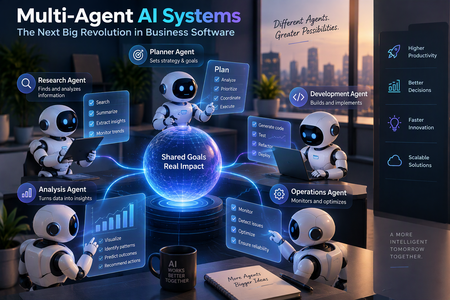
Artificial intelligence is transforming the way businesses operate, make decisions, and interact with customers. From automating repetitive tasks to analyzing massive amounts of data, AI has already become an essential part of modern business technology. However, the next major step in this evolution goes beyond individual AI tools and chatbots. It involves something much more powerful: Multi-Agent AI Systems.
Multi-agent AI systems are emerging as one of the most promising developments in business software. Instead of relying on a single AI model to handle every task, these systems use multiple specialized AI agents that collaborate, communicate, and coordinate their actions to accomplish complex business objectives.
This shift could fundamentally change how companies manage workflows, serve customers, develop products, and make strategic decisions.
Let’s explore what multi-agent AI systems are, how they work, and why they could become the next big revolution in business software.
What Are Multi-Agent AI Systems?
A multi-agent AI system is a network of independent or semi-independent AI agents designed to work together toward a shared goal.
Each agent typically has a specific responsibility, set of capabilities, and access to particular tools or information. Rather than expecting one AI system to perform every operation, businesses can assign different tasks to specialized agents.
For example, an AI-powered business management system might include:
- Research Agent: Collects information, analyzes market trends, and identifies opportunities.
- Sales Agent: Qualifies leads, prepares proposals, and manages customer interactions.
- Marketing Agent: Develops campaigns, analyzes engagement, and recommends content strategies.
- Finance Agent: Reviews expenses, prepares financial reports, and identifies unusual transactions.
- Customer Support Agent: Answers customer questions, resolves common problems, and escalates complex cases.
- Operations Agent: Coordinates workflows, tracks projects, and manages business processes.
These agents can exchange information, delegate tasks, review each other’s work, and coordinate decisions.
The result is an intelligent digital workforce capable of handling workflows that would traditionally require multiple employees and software applications.
How Do Multi-Agent AI Systems Work?
Multi-agent systems operate through collaboration and coordination.
A typical workflow begins when a user or business system provides an objective. A coordinating agent, sometimes called an orchestrator, breaks that objective into smaller tasks and assigns them to the appropriate agents.
Each specialized agent completes its assigned work and shares the results with the others. The orchestrator then combines the outputs, checks whether the objective has been achieved, and determines whether additional actions are necessary.
Consider a company planning to launch a new product.
A multi-agent AI system could coordinate the entire preparation process:
- The research agent analyzes competitors, customer demand, and market opportunities.
- The marketing agent develops a campaign strategy based on the research.
- The finance agent estimates the launch budget and potential profitability.
- The product agent reviews customer requirements and suggests product improvements.
- The sales agent prepares lead lists, outreach materials, and sales recommendations.
- The coordinating agent combines the findings into a comprehensive launch plan for management approval.
Instead of manually switching between several applications and departments, employees can supervise a coordinated AI-powered workflow.
Importantly, these systems do not necessarily operate without human involvement. Businesses can establish approval checkpoints, access restrictions, and oversight mechanisms for sensitive decisions.
Why Multi-Agent AI Systems Are Different From Traditional AI Tools
Traditional AI applications are often designed to perform specific tasks. A chatbot answers questions, a recommendation engine suggests products, and an automation tool executes predefined instructions.
Although useful, these tools can struggle with complex workflows involving multiple departments, applications, and decision-making stages.
Multi-agent AI systems introduce a more collaborative approach.
Here are some of their most important differences:
1. Specialized Intelligence
Rather than relying on one general-purpose AI model, businesses can use multiple agents with specialized instructions, tools, and responsibilities.
2. Collaborative Problem-Solving
Agents can share information, evaluate different approaches, and work together to solve problems that require several types of expertise.
3. Greater Workflow Flexibility
Multi-agent systems can adapt their workflows depending on the task, available information, and results produced by individual agents.
4. Cross-Department Coordination
Different agents can connect business functions such as marketing, finance, sales, customer support, and operations.
5. Scalable Automation
Companies can introduce additional agents as their requirements grow, allowing automation capabilities to expand without redesigning every process from scratch.
7 Ways Multi-Agent AI Systems Could Transform Businesses
The real value of multi-agent AI systems becomes clear when we examine their potential business applications.
1. Intelligent Customer Support
Customer support is one of the areas where multi-agent AI can make a significant difference.
A customer service system could use specialized agents to identify customer needs, retrieve relevant account information, troubleshoot technical problems, and process routine requests.
For example, when a customer reports a billing issue, one agent could examine the invoice, another could review payment history, and a third could prepare an appropriate response.
If the issue requires human intervention, the system can escalate it with the relevant information already collected.
This can reduce response times, improve service consistency, and allow human support teams to focus on more complicated customer problems.
2. Smarter Sales and Lead Generation
Sales teams spend considerable time researching prospects, qualifying leads, preparing proposals, and following up with potential customers.
Multi-agent AI systems can automate many of these activities.
A prospect research agent can gather relevant business information, a qualification agent can evaluate potential opportunities, and a sales assistant can prepare personalized outreach materials.
Another agent can monitor customer interactions and recommend the next best action.
By coordinating these activities, businesses can improve sales productivity and reduce the administrative workload placed on sales representatives.
3. Automated Marketing Campaigns
Marketing requires coordination between research, content creation, advertising, analytics, and customer engagement.
A multi-agent system can connect these activities into a unified workflow.
For example, one agent can identify trending topics, another can generate content ideas, and a third can prepare campaign materials. An analytics agent can evaluate campaign performance and recommend adjustments.
Human marketers remain responsible for brand direction, creative judgment, and final approvals, while AI agents help accelerate execution.
4. Financial Analysis and Reporting
Financial departments work with large volumes of information that require accuracy, consistency, and careful analysis.
Specialized AI agents can assist with expense categorization, financial reporting, budget monitoring, and anomaly detection.
One agent might analyze transaction data while another compares spending against approved budgets. A reporting agent can then prepare a summary for the finance team.
However, sensitive financial operations should include strict access controls, audit trails, and human approval requirements.
5. Smarter Project Management
Managing projects involves tracking deadlines, allocating resources, monitoring progress, and coordinating communication.
Multi-agent AI systems can help project managers oversee these activities.
A scheduling agent can monitor deadlines, a resource agent can identify workload imbalances, and a reporting agent can summarize project progress.
If a potential delay is detected, the system can notify the responsible team and suggest possible solutions.
This creates a more proactive approach to project management.
6. Business Research and Competitive Intelligence
Businesses need accurate information to understand competitors, identify market opportunities, and make strategic decisions.
A multi-agent research system can divide these responsibilities among specialized agents.
One agent can monitor industry developments, another can analyze competitor strategies, and a third can identify emerging customer trends.
The system can combine these findings into structured research reports that help management make better-informed decisions.
7. Human Resources and Employee Management
Human resources departments handle recruitment, onboarding, employee communication, training, and administrative processes.
Multi-agent AI systems can assist with many of these responsibilities.
For example, recruitment agents can help organize applications, scheduling agents can coordinate interviews, and onboarding agents can provide new employees with relevant documentation and information.
Human oversight remains particularly important in recruitment and employment decisions to prevent discrimination and ensure fair treatment.
Key Business Benefits of Multi-Agent AI Systems
Adopting multi-agent AI technology can provide several important advantages.
Increased Productivity: Multiple agents can work on different parts of a workflow simultaneously, reducing the time required to complete complex tasks.
Lower Operational Costs: Automating repetitive administrative processes can reduce manual workloads and help businesses use resources more efficiently.
Better Decision-Making: Specialized agents can analyze information from different perspectives and provide decision-makers with more comprehensive insights.
Improved Customer Experience: Faster responses, personalized interactions, and coordinated support can improve customer satisfaction.
Greater Business Agility: Organizations can adjust workflows and introduce specialized agents as business requirements change.
24/7 Operational Support: AI agents can handle eligible tasks outside normal working hours, subject to system availability and appropriate safeguards.
These benefits make multi-agent AI particularly attractive to companies looking to modernize their operations and build more intelligent business processes.
Challenges and Risks Businesses Must Consider
Despite their potential, multi-agent AI systems are not a perfect solution.
Their effectiveness depends on thoughtful design, reliable infrastructure, and responsible implementation.
Some important challenges include:
System Complexity
Managing multiple agents introduces additional complexity. Businesses must ensure that agents communicate effectively, follow consistent instructions, and understand their responsibilities.
Data Security and Privacy
Agents may need access to sensitive business information. Organizations must establish appropriate permissions, authentication mechanisms, and data protection policies.
Unreliable AI Outputs
AI agents can misunderstand instructions, generate inaccurate information, or make incorrect assumptions. Their outputs should be validated, especially when they affect important business decisions.
Coordination Problems
Agents can sometimes produce conflicting recommendations, repeat tasks, or enter inefficient communication loops. Effective orchestration and clearly defined responsibilities are essential.
Integration With Existing Software
Businesses often rely on established systems such as CRM platforms, ERP software, accounting applications, and project management tools. Connecting AI agents to these systems requires careful integration and testing.
Governance and Human Oversight
Organizations need clear policies defining which actions agents can perform independently and which require human approval.
The most successful implementations will not simply give AI agents unlimited authority. They will establish controlled environments in which agents can operate efficiently while remaining accountable.
Multi-Agent AI and the Future of Business Software
The development of multi-agent AI systems could reshape the traditional business software model.
Historically, organizations have relied on separate applications for different functions. Employees move between CRM systems, spreadsheets, communication platforms, financial tools, and project management software to complete everyday activities.
Multi-agent AI introduces the possibility of a more unified experience.
Instead of manually navigating multiple applications, employees could describe a business objective in natural language and allow an AI-powered system to coordinate the necessary actions across connected tools.
Imagine telling your business software:
“Prepare a sales performance report, identify underperforming regions, analyze the reasons behind the decline, and recommend three actions to improve results.”
A multi-agent system could divide this request into research, data analysis, reporting, and recommendation tasks. Each agent would contribute its specialized capabilities, while a coordinating agent would assemble the final result.
This does not mean traditional business applications will disappear. Instead, AI agents may become an intelligent coordination layer that connects existing software and makes it easier to use.
Emerging agent frameworks and orchestration technologies are helping developers build these systems, while improvements in language models, tool integration, and AI infrastructure continue to expand what they can accomplish.
How Businesses Can Start Adopting Multi-Agent AI
Companies do not need to transform their entire technology infrastructure overnight.
A gradual implementation strategy is usually more practical.
Step 1: Identify Repetitive Business Processes
Start by identifying workflows that involve repetitive tasks, multiple applications, or frequent information exchange.
Step 2: Choose a Suitable Use Case
Select a clearly defined business problem, such as customer support automation, lead qualification, or report generation.
Step 3: Start With a Small Number of Agents
Introduce a few specialized agents with clearly defined responsibilities rather than building an unnecessarily complicated system.
Step 4: Connect Existing Business Tools
Integrate the system with relevant applications and data sources using secure APIs and appropriate permissions.
Step 5: Establish Human Approval Mechanisms
Define which activities agents can perform independently and which require employee authorization.
Step 6: Measure Performance
Track measurable outcomes such as task completion time, operational costs, error rates, customer satisfaction, and employee productivity.
Step 7: Expand Gradually
Once the initial implementation demonstrates reliable results, introduce additional agents and connect more business processes.
This approach allows organizations to learn from real-world usage while minimizing implementation risks.
Final Thoughts: Are Multi-Agent AI Systems the Next Big Revolution?
Multi-agent AI systems represent an important evolution in the way businesses use artificial intelligence.
While traditional AI tools focus primarily on individual tasks, multi-agent systems introduce a collaborative model in which specialized AI agents can coordinate complex workflows and support multiple business functions.
Their potential applications extend across customer service, marketing, finance, sales, project management, human resources, and strategic planning.
However, successful adoption will depend on more than simply deploying advanced AI models. Businesses will need reliable integrations, effective orchestration, strong security, clear governance, and meaningful human oversight.
The biggest opportunity is not necessarily replacing employees or eliminating traditional business software. It is creating a more intelligent working environment in which people and AI agents collaborate to accomplish more with less friction.
As the technology matures, multi-agent AI systems could become a foundational component of next-generation business software.
The future of business software may not be a collection of disconnected applications. It may be a coordinated ecosystem of intelligent AI agents working together to help businesses operate smarter, faster, and more efficiently.