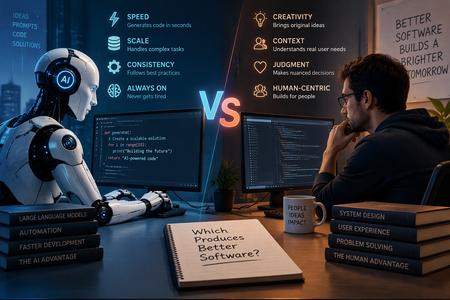
Artificial intelligence is transforming the way software is designed, developed, tested, and maintained. Tools powered by AI can now generate code, identify bugs, suggest improvements, and even build functional applications from simple text instructions. As a result, a major question is emerging in the technology industry: Does AI-generated code produce better software than code written by human developers?
The debate is becoming increasingly important for businesses, software engineers, startups, and technology enthusiasts. While AI promises faster development and reduced costs, human developers bring creativity, experience, critical thinking, and a deeper understanding of business requirements.
So, which approach produces better software? The answer depends on several factors, including project complexity, code quality, security, scalability, and long-term maintenance.
Let’s explore the differences between AI-generated code and human-developed software to understand where each approach performs best.
1. Understanding AI-Generated Code
AI-generated code refers to software code created with the assistance of artificial intelligence tools. These tools use machine learning models trained on large collections of programming languages, code examples, technical documentation, and development patterns.
Popular AI coding assistants can generate entire functions, explain unfamiliar code, suggest fixes, and help developers complete repetitive programming tasks.
Some widely used AI coding tools include:
- GitHub Copilot: An AI-powered coding assistant that suggests code and helps developers write programs faster.
- ChatGPT: Can generate code, explain programming concepts, troubleshoot errors, and assist with software architecture.
- Cursor: An AI-focused code editor designed to help developers understand and modify codebases.
- Amazon Q Developer: Provides AI-powered coding assistance, debugging support, and development recommendations.
- Google Gemini: Helps generate code, explain technical concepts, and solve programming problems.
These tools can significantly reduce the time required to complete routine programming tasks. However, their output still requires human review, testing, and validation.
2. Understanding Human-Developed Code
Human-developed code is software written by professional developers using their technical knowledge, experience, and problem-solving abilities.
Human developers do more than translate requirements into programming instructions. They understand user needs, evaluate different solutions, make architectural decisions, and consider how software will behave in real-world situations.
Experienced developers also understand that good software is not simply code that works. It must be secure, reliable, maintainable, scalable, and easy for other developers to understand.
Human programmers bring several important qualities to software development:
- Creativity: They can develop original solutions to unusual or complicated problems.
- Critical thinking: They can evaluate trade-offs and recognize problems that automated tools might overlook.
- Business understanding: They can connect technical decisions with organizational goals.
- Contextual judgment: They can interpret incomplete requirements and ask important questions.
- Accountability: They can take responsibility for technical decisions and development outcomes.
These qualities remain essential, particularly when developing complex software systems.
3. AI-Generated Code vs Human Developers: Key Differences
Both AI and human developers can produce functional software, but they approach programming differently.
Here are the most important areas of comparison.
Development Speed
One of the biggest advantages of AI-generated code is speed.
AI coding assistants can generate boilerplate code, create simple functions, write database queries, and suggest solutions within seconds. Tasks that might take a developer several minutes or hours can sometimes be completed much faster with AI assistance.
Human developers generally require more time to write code manually, especially when handling repetitive tasks.
However, development speed is not the same as overall productivity. AI-generated code may require additional time for debugging, testing, and correcting mistakes.
Winner: AI for repetitive and well-defined coding tasks.
Code Quality
Code quality depends on more than whether a program runs successfully.
Well-written software should be readable, efficient, reusable, secure, and maintainable.
AI tools can generate clean, consistent code and follow established programming conventions. They are particularly useful for implementing common patterns and standard functionality.
However, AI-generated code can also contain unnecessary complexity, outdated approaches, inefficient algorithms, or subtle logical errors.
Human developers can evaluate the broader context of a project and make decisions based on experience. They can also recognize when a seemingly correct solution creates problems elsewhere in the system.
Winner: Human developers for complex projects requiring architectural judgment, although AI can produce excellent code for well-defined tasks.
Debugging and Problem-Solving
Debugging is an essential part of software development.
AI tools can analyze error messages, suggest potential fixes, explain unfamiliar code, and identify common programming mistakes. This makes them valuable debugging assistants.
Nevertheless, AI may misunderstand the underlying cause of an error or suggest a fix that solves one problem while introducing another.
Human developers can investigate complex interactions between components, examine system behavior, and consider problems from multiple perspectives.
Winner: A combination of AI assistance and human expertise.
Security and Reliability
Security is one of the most important considerations when comparing AI-generated and human-written code.
AI models can generate code containing security vulnerabilities, insecure authentication methods, improper input validation, or unsafe database queries.
Human developers can apply security principles and review potential risks. However, human-written code is not automatically secure either. Experienced developers can also make mistakes.
The most reliable approach involves combining human security expertise with automated testing, code analysis, dependency scanning, and security reviews.
Winner: Neither has an automatic advantage. A rigorous security process matters more than who or what writes the code.
Creativity and Innovation
AI systems are excellent at recognizing patterns and generating solutions based on learned examples.
They can combine existing programming approaches, suggest alternative implementations, and help developers explore different ideas.
However, genuinely innovative software often requires understanding problems that do not have obvious solutions.
Human developers can challenge assumptions, interpret user behavior, and design unconventional solutions based on real-world experience.
Winner: Human developers, particularly when projects require original thinking and unconventional problem-solving.
Scalability and Long-Term Maintenance
Building software is only the beginning. Successful applications must continue working as user numbers grow, requirements change, and technologies evolve.
AI can generate scalable code patterns and help developers optimize existing systems. It can also explain unfamiliar sections of large codebases.
However, AI-generated changes can introduce inconsistencies if the tool does not understand the entire architecture.
Human developers are better positioned to consider long-term architectural decisions, technical debt, system dependencies, and future business requirements.
Winner: Human developers supported by AI tools.
4. Advantages of AI-Generated Code
AI coding tools offer several benefits that make them increasingly valuable in modern software development.
1. Faster development
AI can generate repetitive code, automate routine programming tasks, and accelerate prototyping. This allows developers to spend more time on important technical challenges.
2. Reduced development costs
By improving productivity, AI tools can reduce the time required for certain development activities. This can be especially useful for startups and small development teams.
3. Improved accessibility
People learning programming can use AI to understand concepts, generate examples, and receive explanations of complicated code.
4. Faster prototyping
Developers can describe an idea in natural language and quickly generate an initial implementation. This makes experimenting with new products and features easier.
5. Assistance across programming languages
Many AI coding assistants support multiple programming languages and frameworks, making it easier to explore unfamiliar technologies.
5. Disadvantages of AI-Generated Code
Despite its advantages, AI-generated code has limitations that businesses and developers should understand.
1. Potentially incorrect output
AI-generated code may look convincing while containing logical errors, incorrect assumptions, or incomplete functionality.
2. Security vulnerabilities
Generated code can introduce security weaknesses if it is not carefully reviewed and tested.
3. Limited project understanding
AI tools may not fully understand the business logic, architectural requirements, or dependencies of a complex application.
4. Maintenance challenges
Poorly reviewed AI-generated code can increase technical debt and make future maintenance more difficult.
5. Overdependence on AI
Developers who rely too heavily on AI may fail to develop essential programming, debugging, and problem-solving skills.
AI should therefore be treated as an assistant rather than an unquestionable source of technical truth.
6. Advantages of Human Developers
Human developers continue to play a critical role in creating high-quality software.
Their biggest strengths include:
- Deep technical understanding: Experienced programmers can understand complex systems and evaluate architectural trade-offs.
- Better requirement interpretation: Humans can communicate with stakeholders, clarify unclear requirements, and identify hidden problems.
- Original problem-solving: Developers can create solutions for situations that do not follow familiar programming patterns.
- Greater contextual awareness: Human developers can consider legal, ethical, operational, and business implications.
- Long-term responsibility: They can oversee software maintenance, collaborate with teams, and make informed decisions throughout a product’s lifecycle.
These capabilities are particularly important in industries where software failures can have serious financial, operational, or safety consequences.
7. Disadvantages of Human-Developed Code
Although human developers have significant strengths, traditional software development also has limitations.
1. Slower development: Writing code manually can take considerable time, especially for repetitive tasks.
2. Higher development costs: Hiring experienced developers and maintaining large development teams can be expensive.
3. Human errors: Developers can introduce bugs, security vulnerabilities, and inefficient implementations.
4. Knowledge limitations: No individual developer can know every programming language, framework, or development technique.
5. Repetitive work: Developers often spend time writing boilerplate code and performing routine tasks that could be automated.
AI tools can help reduce many of these limitations.
8. Can AI Replace Human Software Developers?
This is perhaps the most controversial question in the software industry.
AI is becoming increasingly capable of handling programming tasks that once required substantial human effort. It can generate application components, write tests, explain code, and assist with debugging.
However, software development involves much more than writing code.
Developers must understand business objectives, communicate with stakeholders, select appropriate technologies, manage technical risks, and make architectural decisions.
AI can assist with these activities, but it does not automatically possess the complete context or judgment required to make every decision independently.
Instead of completely replacing software developers, AI is more likely to change their responsibilities.
Future developers may spend less time writing repetitive code and more time on:
- Software architecture and system design.
- Reviewing and validating AI-generated code.
- Security and performance optimization.
- Complex debugging and problem-solving.
- Product strategy and user experience.
- Managing AI-assisted development workflows.
The developers who learn to use AI effectively may gain a significant advantage in the evolving technology industry.
9. Why Combining AI and Human Developers Produces Better Results
Rather than treating AI and human developers as competitors, businesses should consider combining their strengths.
AI can handle repetitive programming activities, while human developers focus on decisions that require experience, creativity, and contextual understanding.
For example, consider the development of an e-commerce application.
AI can help generate product listing components, create database queries, write basic API endpoints, and produce initial test cases.
Human developers can define the system architecture, design secure payment workflows, evaluate customer requirements, and review the generated code.
Together, they can create a more efficient development process.
A practical AI-assisted software development workflow might look like this:
- Requirement analysis: Human developers define project objectives and functional requirements.
- Architecture planning: Developers select suitable technologies and design the system structure.
- AI-assisted coding: AI tools generate repetitive code and assist with implementation.
- Code review: Human developers inspect the generated code for correctness, readability, and security.
- Automated testing: Testing tools check functionality, performance, and potential vulnerabilities.
- Deployment: Developers approve and deploy the software after appropriate validation.
- Continuous maintenance: AI assists with troubleshooting and improvements while humans oversee important decisions.
This approach combines the speed of AI with the judgment and accountability of experienced developers.
10. The Future of Software Development
The future of software development will likely involve deeper collaboration between humans and artificial intelligence.
As AI models become more capable, coding assistants will handle increasingly complex tasks. Development environments will become more intelligent, automated testing will improve, and software prototyping will become faster.
However, the importance of strong programming fundamentals will not disappear.
Developers will still need to understand algorithms, databases, system architecture, cybersecurity, and software engineering principles. Without this knowledge, they may struggle to recognize incorrect AI suggestions or evaluate the quality of generated software.
Businesses will also need to establish clear processes for reviewing AI-generated code, protecting sensitive information, managing intellectual property risks, and maintaining software quality.
Ultimately, the future will not necessarily belong to AI or human developers alone. It will favor teams that know how to use both effectively.
Conclusion: AI-Generated Code vs Human Developers – Which Is Better?
So, which produces better software: AI-generated code or human developers?
The answer is that neither approach is universally superior.
AI-generated code offers speed, convenience, automation, and productivity improvements. It works particularly well for repetitive programming tasks, standard implementations, prototyping, and development assistance.
Human developers offer creativity, critical thinking, architectural judgment, contextual understanding, and the ability to make complex decisions.
For simple and well-defined tasks, AI can sometimes produce excellent results with minimal human intervention. For complex, security-sensitive, or business-critical applications, experienced human oversight remains essential.
The best software development approach is not AI versus human developers. It is AI working alongside human developers.
By combining artificial intelligence with human expertise, organizations can accelerate development, improve productivity, reduce repetitive work, and build more reliable software.
The real competitive advantage will belong to developers and businesses that understand how to use AI responsibly without sacrificing the engineering principles that make software successful.
Frequently Asked Questions (FAQs)
1. Is AI-generated code better than human-written code?
Not necessarily. AI-generated code can be faster to produce and effective for routine tasks, while human-written code often benefits from deeper contextual understanding and architectural judgment. Quality depends on the requirements, implementation, and testing process.
2. Can AI write an entire software application?
AI can generate substantial parts of an application and sometimes produce working prototypes or simple applications. However, complex production software usually requires human involvement in architecture, security, testing, integration, and maintenance.
3. Is AI-generated code safe to use?
AI-generated code can be safe when properly reviewed, tested, and validated. Developers should check for security vulnerabilities, incorrect logic, outdated dependencies, and compliance issues before using it in production.
4. Will AI replace software developers?
AI will automate some programming activities, but human developers will remain important for architecture, problem-solving, business understanding, security, and technical decision-making. Their roles are more likely to evolve than disappear completely.
5. What are the best AI tools for coding?
Popular options include GitHub Copilot, ChatGPT, Cursor, Amazon Q Developer, and Google Gemini. The best tool depends on the programming language, development environment, project requirements, and budget.
6. Should beginners use AI to learn programming?
Yes. AI can explain programming concepts, provide examples, and help identify errors. However, beginners should practice writing and understanding code independently instead of simply copying AI-generated solutions.
7. What is the future of AI in software development?
AI will likely become more integrated into coding, testing, debugging, documentation, and deployment workflows. Human developers will increasingly focus on system design, complex problem-solving, quality assurance, and responsible technology development.