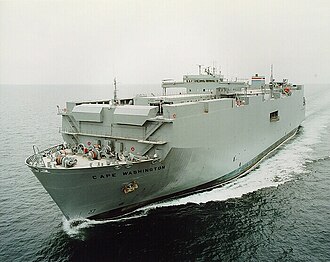
The MV Cape Washington (T-AKR-9961) is one of the most powerful yet least publicly visible assets in the United States’ strategic sealift system. As part of the Maritime Administration’s Ready Reserve Force (RRF), she is not a combat vessel and does not carry weapons, aircraft, or sailors in a traditional naval sense. Instead, she performs something arguably just as critical: she moves war.
Modern military power is not defined solely by ships that fight battles, but also by ships that make battles possible. Tanks, armored vehicles, engineering equipment, helicopters, ammunition, and sustainment supplies must all be transported across oceans in massive quantities before a single shot is fired. That responsibility falls on roll-on/roll-off (RO/RO) ships like Cape Washington.
At nearly 700 feet long and displacing more than 50,000 tons, she is a floating industrial transport platform designed to rapidly deploy entire military formations anywhere in the world. Built originally in Poland during the early 1980s as a commercial RO/RO vessel, she was later acquired by the United States in the 1990s and transformed into a strategic military sealift asset.
Her story is a combination of Cold War-era European shipbuilding, post–Cold War American logistics strategy, and modern global military readiness doctrine.
Origins and Construction: Built Behind the Iron Curtain, Designed for Global Trade
Polish Shipbuilding at Gdynia: A Cold War Industrial Powerhouse
The MV Cape Washington began her life far from American strategic planning tables. She was built in 1982 at the Stocznia im. Komuny Paryskiej shipyard in Gdynia, Poland, then part of the Eastern Bloc. Despite geopolitical divisions of the Cold War, Polish shipyards were internationally competitive and produced large, sophisticated commercial vessels for global trade.
Originally delivered as MV Hual Transporter, the ship was constructed for Grace Marine Co. S.A., a commercial operator engaged in global RO/RO shipping. At the time, the maritime industry was rapidly shifting toward efficient vehicle transport systems, and RO/RO vessels represented one of the most important innovations in global logistics.
Unlike container ships that require cranes and port infrastructure, RO/RO vessels allow vehicles and wheeled cargo to be driven directly on and off the ship via internal ramps. This dramatically reduces port time and increases operational flexibility, especially for heavy industrial cargo.
The ship’s design reflected this philosophy: large internal decks, stern ramps, and reinforced cargo spaces capable of handling heavy rolling equipment.
Early Commercial Career: A Global Cargo Traveler
From Hual Transporter to International Merchant Service
Before entering U.S. military service, the vessel operated for more than a decade in commercial shipping under the name Hual Transporter. During this period, she was used in global trade routes transporting vehicles, heavy machinery, and industrial cargo between Europe, North America, and other global ports.
Her role in commercial shipping was typical for large RO/RO vessels of the era, but her size and structural strength made her particularly attractive for later military use. Ships like this often changed ownership and operational roles depending on global market demand, and Hual Transporter was no exception.
By the early 1990s, the vessel had become part of a growing pool of surplus RO/RO ships that caught the attention of U.S. defense planners.
Acquisition by the United States: Strategic Sealift Expansion
Post–Gulf War Lessons and the Need for Surge Capacity
The Gulf War of 1990–1991 fundamentally changed how the United States viewed military logistics. While the war demonstrated overwhelming combat superiority, it also exposed a logistical limitation: the U.S. required enormous sealift capacity to move armored divisions and sustain overseas operations.
As a result, the Maritime Administration (MARAD) and Department of Defense began aggressively expanding the Ready Reserve Force (RRF). The strategy was simple but powerful: acquire commercially viable RO/RO vessels and maintain them in a reduced operating status so they could be activated quickly in crisis.
On 7 April 1993, the United States purchased Hual Transporter. She was soon renamed MV Cape Washington and integrated into the National Defense Reserve Fleet. By April 1994, she was assigned to the Ready Reserve Force and placed in ROS-5 status, meaning she could be fully activated within approximately five days.
This transformation marked a complete change in purpose: from commercial cargo carrier to strategic military logistics platform.
Engineering and Design: A Floating Heavy Equipment Highway
Massive Hull Built for Volume and Stability
The MV Cape Washington is one of the largest RO/RO vessels in the U.S. Ready Reserve Force. Her design prioritizes cargo capacity, structural strength, and stability under heavy loads rather than speed or maneuverability.
Key physical characteristics include:
- Length: 697 feet (212.6 meters)
- Beam: 105 feet 11 inches (32.3 meters)
- Draft: 38 feet (11.6 meters)
- Full load displacement: approximately 53,652 long tons
Her enormous hull allows her to carry a wide range of military equipment simultaneously, including armored vehicles, trucks, helicopters, and support systems.
Internally, the ship originally featured seven vehicle decks. However, these were later deemed insufficiently strong for heavy modern military vehicles such as main battle tanks. As a result, a major structural modernization was carried out beginning in 1999, replacing the older decks with three reinforced cargo decks.
This upgrade added approximately 156,000 square feet of additional usable cargo space and significantly increased her ability to carry modern military loads.
Propulsion System: A Single Massive Diesel Engine
Powering this enormous vessel is a single Cegielski-Sulzer 6RND 90/155 low-speed diesel engine. This type of engine is designed for endurance and fuel efficiency rather than speed.
Her propulsion system includes:
- One massive diesel engine
- Single propeller shaft
- Slow-speed, high-torque operation
Performance characteristics:
- Maximum speed: ~14.9 knots
- Long-range endurance suitable for transoceanic voyages
- Optimized fuel consumption for extended deployments
While not fast by naval standards, the ship’s speed is sufficient for convoy operations and planned military logistics schedules.
Ready Reserve Force Role: A Ship in Strategic Hibernation
What the RRF Means in Practice
The Ready Reserve Force is a fleet of government-owned vessels kept in a reduced operating condition. These ships are not active daily but are maintained so they can be activated rapidly in emergencies.
Cape Washington is part of this system and is typically moored in Baltimore, Maryland, in ROS-5 status. A small maintenance crew ensures that all systems remain functional, including:
- Propulsion systems
- Electrical distribution
- Cargo ramps and internal lifts
- Navigation and safety systems
When activated, civilian mariners board the ship, systems are brought online, and the vessel transitions into full operational status within days.
Operational History: From Exercises to Global Conflicts
Early Deployments and NATO Support Operations
In the mid-1990s, Cape Washington participated in a range of exercises and logistics operations supporting U.S. and NATO readiness. These early activations were essential for validating the Ready Reserve Force concept in real-world conditions.
Her role was consistent: transporting large volumes of military cargo and supporting deployment exercises across Europe and other regions.
Operation Iraqi Freedom (2003): A Defining Mission
The most significant operational deployment of Cape Washington occurred in 2003 during Operation Iraqi Freedom.
Activated in early 2003, the ship was loaded at the Port of Beaumont, Texas, with military vehicles, helicopters, and large-scale equipment belonging to U.S. Army units. One of her documented cargo loads included more than a dozen helicopters and approximately 1,350 pieces of military equipment.
She transported this cargo across the Atlantic and delivered it to Vlissingen, Netherlands, as part of the European staging process for coalition forces heading to the Middle East.
This operation demonstrated the critical importance of sealift capacity: without ships like Cape Washington, large-scale armored deployments would have been impossible at operational tempo.
Operation Atlantic Resolve (2022): Modern Strategic Relevance
In March 2022, following Russia’s full-scale invasion of Ukraine, Cape Washington was activated again to support Operation Atlantic Resolve.
She was loaded with U.S. Army equipment at Beaumont, Texas, and transported to Europe in support of NATO reinforcement efforts. Her cargo included armored vehicles, support systems, and aviation assets destined for forward deployment across Europe.
This activation demonstrated that even in the 21st century, RO/RO sealift remains essential for rapid global military response.
Strategic Importance: Why Cape Washington Still Matters
The Reality of Modern Military Logistics
Despite advances in airlift technology and container shipping, heavy military equipment cannot be moved efficiently by air. A single tank weighs tens of tons, and entire brigades require thousands of tons of equipment.
Ships like Cape Washington solve this problem by providing:
- Massive cargo capacity
- Direct vehicle loading capability
- Global range without refueling constraints
- Ability to deploy entire combat formations
They are the foundation of U.S. expeditionary warfare capability.
NATO and Allied Force Mobility
RO/RO vessels in the RRF are also critical to NATO operations. They allow the rapid reinforcement of European allies and enable joint exercises that test multinational readiness.
In crisis scenarios, these ships are among the first assets activated to move heavy equipment into theater.
Legacy: A Vessel That Moves Armies Without Firing a Shot
The MV Cape Washington represents the invisible side of military power. She does not engage in combat, carry missiles, or patrol seas. Instead, she ensures that when conflict or crisis arises, entire armies can be deployed quickly and effectively.
Her long service life—spanning more than four decades—demonstrates both the durability of Cold War-era shipbuilding and the enduring relevance of maritime logistics.
Even today, she remains part of the United States’ strategic backbone, quietly waiting in reserve, ready to move the equipment of modern warfare wherever it is needed.
Technical Specifications Table
| Parameter | Specification |
|---|---|
| Name | MV Cape Washington (T-AKR-9961) |
| Type | Roll-on/Roll-off (RO/RO) cargo vessel |
| Operator | U.S. Maritime Administration (MARAD) |
| Fleet | Ready Reserve Force (RRF) |
| Original Name | MV Hual Transporter |
| Builder | Stocznia im. Komuny Paryskiej, Gdynia, Poland |
| Completed | 1982 |
| Acquired by U.S. | 7 April 1993 |
| Entered RRF | 5 April 1994 |
| Length | 697 ft (212.6 m) |
| Beam | 105 ft 11 in (32.3 m) |
| Draft | 38 ft (11.6 m) |
| Displacement | ~53,652 long tons |
| Propulsion | 1 × Cegielski-Sulzer 6RND 90/155 diesel engine |
| Propeller | Single screw |
| Speed | ~14.9 knots |
| Cargo Capacity | ~156,000+ sq ft (post-upgrade) |
| Crew | ~27 civilian mariners when activated |
| Readiness Status | ROS-5 (5-day activation) |
| Homeport | Baltimore, Maryland, USA |
| Role | Strategic sealift / military RO/RO transport |
.jpg)