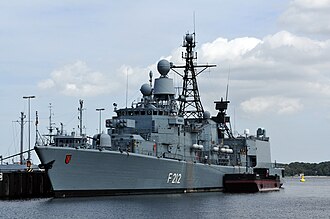
F122 Bremen-Class Frigates: History, Design, Weapons, Capabilities, and Technical Specifications
The F122 Bremen-class frigates represent an important chapter in the development of the modern German Navy, known as the Deutsche Marine. Designed during the Cold War and introduced into service during the 1980s, these warships were developed to strengthen West Germany’s maritime defense capabilities and contribute to the collective security of the North Atlantic Treaty Organization (NATO). Built around the requirements of anti-submarine warfare, escort operations, and maritime protection, the Bremen class became one of the most recognizable frigate families in the history of the postwar German Navy.
Officially designated Type 122, the Bremen-class frigates consisted of eight ships constructed for the Federal Republic of Germany. Their development was influenced by the changing strategic environment of the late Cold War, particularly the importance of protecting NATO naval formations, merchant shipping, and maritime supply routes against potential threats from Soviet submarines and surface combatants. The North Atlantic, North Sea, and Baltic Sea represented strategically important maritime regions, and Germany required warships capable of operating effectively alongside the naval forces of its NATO partners.
The Bremen class was particularly notable for combining several important naval capabilities within a single platform. Although anti-submarine warfare was its principal specialization, the ships also carried anti-ship missiles, surface-to-air missiles, naval artillery, lightweight torpedoes, electronic warfare equipment, and embarked helicopters. This combination allowed them to perform a variety of missions, from protecting other warships against submarine threats to conducting maritime patrols, escorting international naval formations, and participating in overseas security operations.
Another important characteristic was their propulsion arrangement. The Bremen-class frigates introduced combined diesel or gas turbine propulsion, commonly abbreviated as CODOG, to the German Navy’s frigate fleet. This arrangement allowed the ships to use diesel engines for economical cruising and gas turbines when higher speeds were required. The propulsion configuration provided an effective balance between operational endurance and tactical mobility.
Although the Bremen-class frigates have now been completely retired, their historical contribution remains significant. For approximately four decades, they formed an important part of Germany’s maritime capabilities and participated in numerous NATO exercises and international naval operations. Their retirement also marked the transition toward newer frigate designs that reflected the changing requirements of modern naval warfare.
Development and Historical Background of the Bremen Class
The Cold War Naval Environment
The origins of the Bremen-class frigates can be understood through the strategic circumstances of the Cold War. During this period, the North Atlantic was one of the most important areas of potential military confrontation between NATO and the Soviet-led Warsaw Pact. Naval forces on both sides invested heavily in submarines, surface combatants, maritime patrol aircraft, and anti-submarine warfare technologies.
For West Germany, maritime defense was especially important because of its geographical position and economic dependence on international trade. German ports, industrial centers, and commercial shipping routes were closely connected to the North Sea and Baltic Sea. In the event of a major conflict, maintaining access to maritime supply routes would have been essential to NATO’s broader military strategy.
The German Navy therefore required frigates capable of operating within multinational naval formations while providing specialized protection against underwater threats. Submarines represented a particularly serious challenge because they could threaten aircraft carriers, transport vessels, replenishment ships, and merchant shipping without necessarily exposing themselves to direct detection.
The Bremen-class program was developed to address these requirements. Instead of designing a vessel focused exclusively on surface combat or air defense, German naval planners selected a frigate configuration that prioritized anti-submarine warfare while retaining enough additional capabilities to operate effectively in a modern naval environment.
Origins of the Type 122 Design
The Type 122 design was strongly influenced by the Dutch Kortenaer-class frigates. The Netherlands and West Germany maintained close naval cooperation within NATO, and the use of a related design offered practical advantages in development, construction, and interoperability.
The Bremen class, however, was not simply an identical copy of the Dutch design. German requirements resulted in several important differences, particularly in propulsion arrangements, aviation facilities, and the overall configuration of certain systems.
One of the most significant differences was the adoption of the CODOG propulsion system. The German ships used a combination of diesel engines and gas turbines, providing an effective solution for both economical cruising and high-speed naval operations.
The ships were constructed primarily by German shipbuilding companies, including Bremer Vulkan and other participating yards. Construction began with the lead vessel, FGS Bremen, whose keel was laid in 1979. The first ship entered service in 1982, establishing the beginning of a frigate class that would remain an important part of the German Navy for several decades.
Construction and Commissioning
The eight Bremen-class frigates entered service between 1982 and 1990. Their introduction represented a substantial improvement over earlier German frigate designs, particularly in terms of missile armament, aviation capabilities, propulsion technology, and integrated combat systems.
The ships were designed to operate in demanding maritime conditions and to support NATO naval formations over extended deployments. Their equipment reflected the military requirements of the period, combining radar surveillance, sonar detection, anti-submarine weapons, and guided missiles.
The construction of eight vessels also allowed the German Navy to establish a consistent operational capability rather than relying on a small number of specialized warships. Having several ships of the same general design simplified training, logistical support, and the maintenance of operational standards across the fleet.
The Eight Ships of the Bremen Class
The class consisted of eight frigates, each identified by its individual name and pennant number. Their names were selected from German cities and geographical regions, following a longstanding tradition within the German Navy.
The eight ships were:
| Pennant number | Ship name | Commissioned |
|---|---|---|
| F207 | FGS Bremen | 1982 |
| F208 | FGS Niedersachsen | 1982 |
| F209 | FGS Rheinland-Pfalz | 1983 |
| F210 | FGS Emden | 1983 |
| F211 | FGS Köln | 1984 |
| F212 | FGS Karlsruhe | 1984 |
| F213 | FGS Augsburg | 1989 |
| F214 | FGS Lübeck | 1990 |
The vessels were initially assigned to the German Navy’s frigate formations and became important components of its maritime defense structure. Their operational responsibilities included anti-submarine warfare, naval escort missions, maritime surveillance, and participation in NATO exercises.
The final two ships, Augsburg and Lübeck, entered service later than the first six vessels. Their arrival extended the operational availability of the class and provided the German Navy with additional capacity during a period of continuing Cold War tensions.
General Design and Physical Characteristics
Hull Design and Dimensions
The Bremen-class frigates were designed as relatively large, ocean-going frigates capable of operating in the North Atlantic and other demanding maritime environments. Their hull dimensions provided sufficient internal volume for propulsion machinery, weapons systems, radar equipment, crew accommodation, aviation facilities, and mission-related equipment.
The overall length was approximately 130.5 meters, while the beam measured around 14.6 meters. Their full-load displacement was approximately 3,680 to 3,700 tonnes, depending on the reference and measurement convention used.
These dimensions placed the Bremen class within the category of conventional medium-sized frigates of its generation. The hull was designed to provide a balance between speed, maneuverability, stability, and endurance.
The relatively substantial displacement was necessary because the ships carried a considerable quantity of specialized equipment. Anti-submarine warfare required not only torpedo launchers and sonar equipment but also helicopter facilities, aviation fuel storage, maintenance spaces, and accommodation for additional aviation personnel.
Superstructure and Internal Arrangement
The superstructure incorporated the bridge, navigation facilities, communications equipment, radar systems, and combat information spaces. These areas were organized to allow the crew to maintain situational awareness and coordinate the ship’s different combat capabilities.
The weapons were distributed across the vessel to support multiple defensive and offensive functions. The main 76 mm naval gun was positioned forward, while missile systems and torpedo equipment were integrated into other sections of the ship.
The aft section was particularly important because it contained the helicopter landing deck and hangar facilities. These aviation installations were among the defining characteristics of the Bremen class and significantly expanded its anti-submarine warfare capabilities.
The design also incorporated facilities for replenishment at sea, allowing the frigates to receive fuel and supplies from support vessels while operating away from their home ports. This was essential for sustained NATO deployments and long-distance maritime operations.
Propulsion System and Performance
CODOG Propulsion Technology
One of the most distinctive features of the Bremen-class frigates was their CODOG propulsion system. CODOG stands for Combined Diesel Or Gas, describing a propulsion arrangement in which diesel engines and gas turbines can drive the propeller shafts through reduction gearboxes, but are not normally combined to provide propulsion simultaneously.
The system consisted of two MTU 20V 956 TB92 diesel engines and two General Electric LM2500 gas turbines.
The diesel engines were intended primarily for economical cruising. They allowed the frigates to maintain moderate speeds while consuming less fuel than would be required when operating their gas turbines.
When higher speeds were necessary, the gas turbines could be engaged to provide significantly greater propulsion power. This arrangement was particularly useful during naval exercises, tactical maneuvers, and operations requiring rapid movement between operational areas.
The use of two propulsion types provided operational flexibility. Rather than relying exclusively on powerful gas turbines, which consume substantial quantities of fuel at many operating conditions, the ships could use their diesel engines during routine transit.
Maximum Speed and Operational Range
The Bremen-class frigates had a published maximum speed of approximately 30 knots, equivalent to around 56 kilometers per hour. This performance allowed them to operate effectively alongside faster naval formations and respond to changing operational requirements.
Their cruising speed was approximately 18 knots, which provided a more economical operating condition for longer voyages.
Published reference specifications commonly list a range of approximately 4,000 nautical miles at 18 knots. This gave the frigates the ability to undertake extended deployments without requiring constant refueling.
The combination of diesel cruising and gas turbine acceleration made the Bremen class particularly suitable for NATO escort missions. A frigate might spend considerable time traveling with a naval formation before needing to increase speed to investigate a contact, reposition, or respond to a potential threat.
Propulsion System Reliability
The CODOG arrangement also introduced important maintenance considerations. Diesel engines and gas turbines have different mechanical characteristics and require specialized maintenance procedures.
The gas turbines offered excellent power-to-weight performance but required appropriate inspection and maintenance throughout their service lives. The diesel engines provided economical propulsion but also required regular servicing to maintain reliability.
The reduction gearboxes were another important part of the system because they transferred mechanical power from the selected engines to the propeller shafts. Their proper operation was essential for maintaining propulsion performance and controlling the ship’s speed.
Despite these maintenance requirements, the CODOG system became an important element of German naval engineering and was subsequently associated with other German frigate designs.
Weapons Systems and Combat Capabilities
OTO Melara 76 mm Naval Gun
The principal artillery weapon of the Bremen-class frigates was the OTO Melara 76/62 Compact naval gun. This Italian-designed weapon became widely used by navies around the world because of its relatively compact dimensions, versatility, and ability to engage different categories of targets.
The 76 mm gun was installed in the forward section of the frigate and could be used against surface targets, selected aerial threats, and other appropriate targets within its engagement envelope.
Its firing rate was approximately 85 rounds per minute, depending on ammunition type and operating conditions. The weapon offered a useful combination of firing speed, accuracy, and effective range.
The gun was particularly valuable because it provided the ship with a flexible weapon that could be employed without relying on expensive guided missiles for every engagement.
Harpoon Anti-Ship Missiles
The Bremen class was also equipped with the RGM-84 Harpoon anti-ship missile system. Harpoon was developed in the United States and became one of the most widely recognized Western naval anti-ship weapons.
The missiles were carried in dedicated launchers installed on the frigate’s superstructure. The original configuration included two quadruple launchers, providing a total of eight missile positions.
Harpoon missiles use an active radar seeker during the terminal stage of an engagement. Their intended purpose is to attack enemy surface vessels at distances considerably greater than those normally associated with naval artillery.
The missile’s range depends on the specific variant and configuration. Historical references for the original Harpoon versions commonly describe ranges around 120 to 130 kilometers, although later variants have significantly different performance characteristics.
For the Bremen class, Harpoon provided an important anti-surface warfare capability. It allowed the frigates to threaten hostile warships while remaining at considerable distances from their intended targets.
Sea Sparrow Surface-to-Air Missiles
For air defense, the Bremen-class frigates carried the NATO Sea Sparrow missile system, designated RIM-7.
The Sea Sparrow was designed to provide protection against aircraft and certain incoming threats. Its installation gave the frigates a defensive capability against aerial attacks, although it was primarily intended for local and point defense rather than long-range area air defense.
The original installation used an eight-cell Mk 29 launcher, providing eight ready-to-fire missiles. The system relied on shipboard radar and fire-control equipment to support target engagement.
The Sea Sparrow was particularly important in the Cold War environment, when naval formations had to consider threats from aircraft and anti-ship missiles.
Although the system provided a useful defensive capability, the Bremen class was not designed to replace dedicated air-defense destroyers or later frigates equipped with advanced long-range missile systems.
Rolling Airframe Missile (RAM)
During their operational lives, the frigates received Rolling Airframe Missile (RAM) systems as part of their modernization programs.
The RIM-116 RAM was developed to provide short-range protection against incoming anti-ship missiles and other threats. It was designed as a rapid-response defensive weapon and became an important component of naval close-in defense systems.
The system was installed toward the rear of the ships, above the helicopter deck area. The later configuration included two launchers, each associated with a 21-cell missile arrangement.
RAM complemented the Sea Sparrow system by providing another defensive layer against threats approaching the ship at relatively short distances.
This layered approach was important because naval vessels require several defensive mechanisms to improve their chances of surviving an attack. Longer-range detection, medium-range interception, and close-in defensive systems serve different purposes within the overall defensive structure.
27 mm Marineleichtgeschütz
The Bremen-class frigates also received two 27 mm Marineleichtgeschütz (MLG) automatic cannons during their later service lives.
These weapons improved the ships’ ability to respond to smaller surface threats and close-range situations. They were especially relevant to the changing operational environment after the Cold War, when naval vessels increasingly encountered asymmetric threats involving small boats and irregular maritime actors.
The introduction of additional lightweight weapons reflected a broader change in German naval requirements. The frigates were no longer operating exclusively in the context of a potential large-scale NATO-Warsaw Pact confrontation. They increasingly participated in maritime security missions where smaller vessels and unconventional threats could present serious challenges.
Torpedo Armament
Anti-submarine warfare was the principal specialization of the Bremen class, and torpedoes formed a central part of its offensive capability.
The frigates were equipped with two twin 324 mm torpedo tube installations, associated with the Mk 32 torpedo launching system.
These tubes could launch lightweight torpedoes such as the American Mk 46, which were designed specifically to attack submarines.
Lightweight torpedoes are particularly suitable for frigates because they can be carried in relatively compact launchers while providing a dedicated anti-submarine weapon.
The ship’s torpedo armament worked together with its sonar equipment and embarked helicopters. Detection, classification, tracking, and engagement were all important stages of an anti-submarine operation.
Anti-Submarine Warfare Capabilities
The Primary Mission of the Bremen Class
Anti-submarine warfare, commonly abbreviated as ASW, was the main operational purpose of the F122 Bremen-class frigates.
During the Cold War, NATO placed considerable importance on protecting its maritime supply routes against Soviet submarines. Submarines could threaten naval formations and commercial shipping, making their detection and neutralization an essential responsibility for escort vessels.
The Bremen class was designed to perform this mission through a combination of sonar equipment, lightweight torpedoes, and embarked anti-submarine helicopters.
This combination allowed the ships to search for underwater contacts and respond using weapons deployed directly from the frigate or delivered by aircraft.
Hull-Mounted Sonar
The frigates were equipped with hull-mounted sonar systems designed to detect underwater objects.
Historical technical references identify the Atlas Elektronik DSQS-21 sonar family, with variations and later upgrades documented across different sources.
Hull-mounted sonar works by transmitting or receiving acoustic signals through the surrounding water. These signals can provide information about underwater contacts, including possible submarines.
The effectiveness of sonar depends on several environmental factors, including water temperature, depth, background noise, salinity, and underwater acoustic conditions.
For a frigate operating in the North Atlantic, the ability to detect and classify submarines was essential to protecting the ships it was assigned to escort.
Mk 46 Lightweight Torpedoes
The Mk 46 lightweight torpedo provided the Bremen class with a direct means of attacking underwater targets.
The weapon was designed for anti-submarine warfare and could be deployed from the ship’s torpedo tubes or carried by compatible helicopters.
Lightweight torpedoes are particularly valuable because they can be launched from multiple platforms, allowing naval forces to attack submarines from different directions and distances.
The combination of sonar detection and torpedo armament gave the Bremen-class frigates an important independent ASW capability.
Sea Lynx Mk 88A Helicopters
One of the most significant characteristics of the Bremen-class design was its ability to operate two Westland Sea Lynx Mk 88A helicopters.
The introduction of embarked helicopters represented a major improvement in German frigate capabilities. Instead of relying exclusively on the ship’s hull-mounted sonar, the frigate could deploy aircraft to search a much larger area around its position.
The Sea Lynx was particularly suitable for naval operations because it could operate from relatively small flight decks and carry specialized anti-submarine equipment.
The helicopters could be equipped with dipping sonar, sonobuoys where supported by the mission configuration, and lightweight torpedoes.
This arrangement allowed them to perform several tasks:
- Search for submarines beyond the immediate detection range of the frigate.
- Investigate underwater contacts identified by the ship.
- Support the classification and tracking of potential submarine threats.
- Deliver lightweight torpedoes against designated underwater targets.
- Assist with maritime surveillance and other naval missions.
The use of two helicopters also provided operational flexibility. Depending on the mission, one aircraft could conduct an active search while another remained available for additional operations or maintenance.
The aviation facilities included a hangar and flight deck, together with equipment for handling and maintaining embarked helicopters.
Radar, Sensors, and Electronic Warfare
Three-Dimensional Surveillance Radar
The Bremen-class frigates underwent radar modernization during their service lives.
Later configurations included the TRS-3D multifunction radar, which provided three-dimensional surveillance and improved the ship’s ability to monitor air and surface contacts.
Unlike older systems that provided more limited tracking information, three-dimensional radar can determine the range, bearing, and altitude of detected aerial targets.
This capability is particularly important for naval air defense because the ship must identify and track potential threats while maintaining awareness of other vessels and aircraft in its operating area.
The TRS-3D represented an important modernization of the frigates’ surveillance capabilities, although the exact equipment configuration changed during the ships’ operational lives.
Fire-Control Radar
The frigates also used dedicated fire-control radar equipment to support their weapons systems.
Historical references identify systems such as WM 25 and STIR as part of the class’s radar and fire-control architecture.
Fire-control radar provides more precise target information than general surveillance radar. It helps weapons systems track designated targets and calculate the information necessary for engagement.
These systems were particularly important for the Sea Sparrow missile system and naval artillery.
Sonar and Underwater Detection
In addition to radar, sonar was one of the most important sensor categories aboard the Bremen-class frigates.
The hull-mounted sonar system provided underwater detection capabilities and supported the ship’s main anti-submarine warfare mission.
The combination of radar and sonar allowed the frigates to maintain awareness across different operational environments.
Radar was primarily concerned with air and surface contacts, while sonar provided information about underwater activity. Together, these systems formed an essential part of the ship’s combat information and situational awareness architecture.
Electronic Support and Countermeasures
The Bremen class also carried electronic warfare equipment designed to detect, identify, and respond to electromagnetic threats.
The FL 1800 S electronic warfare system provided electronic support and countermeasure capabilities.
Electronic support measures help naval forces identify radar emissions and understand the electromagnetic activity in their surrounding environment.
The ships also carried chaff and decoy launchers, including Mk 36 SRBOC equipment in later or documented configurations. These systems could deploy decoys intended to confuse or distract certain incoming guided weapons.
Some technical references additionally identify the SLQ-25 Nixie towed torpedo decoy system.
The presence of these systems demonstrated that the frigates were designed to operate in environments where threats could originate from the air, surface, and underwater domains.
Modernization and Upgrades
Adapting to the Post-Cold War Environment
The end of the Cold War transformed the operational requirements of the German Navy.
The primary concern was no longer exclusively the protection of NATO naval formations against large Soviet submarine forces. German warships increasingly participated in international security operations, maritime surveillance, embargo enforcement, and missions intended to stabilize regions experiencing conflict.
These changes created new requirements for older frigates.
The Bremen class therefore underwent various modernization programs designed to improve its operational capabilities and extend its service life.
Among the most important changes were improvements to radar systems, electronic equipment, combat management systems, communications, and defensive weapons.
Combat System Modernization
The modernization of combat information and management systems was especially important.
A modern warship must process large quantities of information from radar, sonar, communications equipment, and other sensors. These data must be evaluated and presented to the crew in a manner that supports timely operational decisions.
The Bremen-class frigates received improvements to their combat system architecture, including modernization programs involving Thales and other defense technology suppliers.
The upgrades also improved communications and interoperability with NATO forces.
The introduction of Link 16 capabilities was particularly relevant because it allowed participating units to exchange tactical information through a standardized digital data link.
This improved the ability of the frigates to operate as part of multinational naval formations.
Improvements to Defensive Weapons
The addition of RAM launchers and 27 mm automatic cannons also reflected the changing requirements of naval operations.
RAM provided a dedicated close-in missile defense capability, while the additional automatic cannons improved the frigates’ ability to respond to smaller surface threats.
These upgrades helped keep the ships relevant in a maritime environment that had become more complex than the one for which they were originally designed.
However, modernization could not completely eliminate the limitations associated with an older hull and original ship design. As newer frigates entered service, the technological and operational differences between generations became increasingly significant.
Operational History and International Deployments
NATO Exercises and Maritime Cooperation
Throughout their operational lives, the Bremen-class frigates participated in numerous NATO exercises and multinational maritime activities.
These exercises were intended to improve cooperation between allied navies and maintain the ability of different warships to operate together.
For the German Navy, the Bremen class was particularly useful because it could perform anti-submarine warfare and escort duties while maintaining compatibility with NATO communications and operational procedures.
The frigates operated alongside vessels from countries including the United States, the United Kingdom, the Netherlands, and other NATO members.
Such activities helped maintain Germany’s contribution to collective maritime security.
Mediterranean Operations
Following the end of the Cold War, German naval deployments increasingly expanded beyond the traditional North Atlantic and Baltic operating environments.
The Mediterranean became an important region for maritime security operations, particularly during international efforts to enforce embargoes and monitor shipping.
The Bremen-class frigates participated in missions involving maritime surveillance and the inspection of commercial vessels.
Their combination of helicopters, radar equipment, communications systems, and defensive weapons made them useful platforms for these operations.
Indian Ocean and Anti-Piracy Missions
The ships also contributed to German naval deployments in the Indian Ocean and surrounding maritime regions.
Piracy became a major international security concern, particularly in the waters surrounding the Horn of Africa and the Gulf of Aden.
German frigates participated in operations intended to protect commercial shipping and support international maritime security initiatives.
The Bremen-class vessels were suitable for these missions because they had the endurance, sensors, aviation facilities, and weapons necessary to operate far from their home bases.
Their helicopters could support maritime surveillance, while their onboard crews could assist with monitoring shipping routes and coordinating activities with other naval units.
Escorting Aircraft Carriers
The class also demonstrated its usefulness in multinational carrier operations.
For example, the German frigate Augsburg provided escort support to the French aircraft carrier Charles de Gaulle during Operation Counter Daesh in 2015 and 2016.
This type of deployment demonstrated the ability of the Bremen-class frigates to operate as part of larger naval formations.
Although the ships were not specialized air-defense vessels, they could contribute through their anti-submarine warfare capabilities, surveillance systems, and general escort functions.
Retirement of the Bremen-Class Frigates
The Beginning of the End
After several decades of service, the Bremen-class frigates gradually reached the end of their operational lives.
Maintaining older warships becomes increasingly expensive as propulsion systems, electronic equipment, structural components, and weapons installations age.
Although modernization can improve performance, there are limits to how much a vessel can be upgraded without undertaking extensive reconstruction.
The German Navy therefore began withdrawing the Type 122 frigates from active service as newer vessels became available.
Decommissioning Timeline
The retirement process took place over several years.
The individual ships were decommissioned as follows:
| Ship | Pennant | Decommissioning date |
|---|---|---|
| FGS Köln | F211 | July 31, 2012 |
| FGS Rheinland-Pfalz | F209 | March 22, 2013 |
| FGS Emden | F210 | November 29, 2013 |
| FGS Bremen | F207 | March 28, 2014 |
| FGS Niedersachsen | F208 | June 26, 2015 |
| FGS Karlsruhe | F212 | June 16, 2017 |
| FGS Augsburg | F213 | December 18, 2019 |
| FGS Lübeck | F214 | December 15, 2022 |
The decommissioning of FGS Lübeck in December 2022 officially ended the Bremen-class era in the German Navy.
Its retirement was particularly significant because it had been the final active representative of a frigate family that began entering service four decades earlier.
Replacement by Newer Frigate Classes
The Bremen-class frigates were replaced within the German Navy’s evolving fleet structure by newer generations of warships.
The Brandenburg-class frigates, designated Type 123, continued the German Navy’s emphasis on anti-submarine warfare while introducing more advanced systems and improved capabilities.
The Sachsen-class frigates, designated Type 124, were developed primarily for advanced air defense and fleet protection.
The Baden-Württemberg class, designated Type 125, introduced a different operational philosophy focused on extended deployments, stabilization missions, and sustained presence in distant maritime regions.
These newer ships reflect the changing requirements of modern naval operations and the increasing importance of integrated sensors, digital combat systems, advanced missile technology, and multinational interoperability.
Historical Importance and Naval Legacy
A Major Step in German Naval Development
The Bremen-class frigates represented a major improvement in the capabilities of the German Navy during the 1980s.
Their introduction brought together modern propulsion technology, guided missiles, anti-submarine sensors, naval aviation, and integrated combat systems in a single platform.
The ships also represented an important stage in the development of German naval engineering and procurement. Their relationship with the Dutch Kortenaer design demonstrated the value of international cooperation in developing effective naval platforms.
The Importance of Naval Aviation
One of the most enduring contributions of the Bremen class was its use of embarked helicopters as an integral part of frigate operations.
The Sea Lynx Mk 88A allowed the ships to extend their anti-submarine detection and engagement capabilities beyond the immediate area surrounding the hull.
This concept became a standard feature of modern frigate design and demonstrated how aviation could significantly increase the effectiveness of relatively compact surface combatants.
Lessons for Modern Frigate Design
The operational history of the Bremen class also provides several lessons for modern naval development.
First, specialized capabilities remain important even when warships are designed to perform multiple missions. The Bremen class was particularly effective because its anti-submarine warfare systems were supported by suitable aviation facilities and dedicated weapons.
Second, propulsion flexibility can contribute significantly to operational performance. The CODOG system provided an effective compromise between fuel-efficient cruising and high-speed movement.
Third, modernization is essential for extending the useful life of naval platforms. The upgrades received by the Bremen-class frigates helped them remain operational well beyond their original Cold War requirements.
Finally, the history of the class demonstrates the importance of interoperability. The ability to operate alongside allied warships, exchange tactical information, and participate in multinational missions became increasingly valuable after the Cold War.
Technical Specifications of the F122 Bremen-Class Frigates
The following table summarizes the principal technical characteristics of the Bremen-class frigates. Figures represent commonly published class specifications, with some differences between sources and between original and later modernized configurations.
| Specification | Details |
|---|---|
| Class name | Bremen class |
| German designation | F122 |
| Ship type | Guided-missile frigate |
| Country of origin | West Germany |
| Primary operator | German Navy (Deutsche Marine) |
| Number built | 8 |
| Design influence | Dutch Kortenaer class |
| Construction period | 1979–1990 |
| First ship | FGS Bremen (F207) |
| First commissioning | 1982 |
| Final commissioning | 1990 |
| Final retirement | December 15, 2022 |
| Full-load displacement | Approximately 3,680–3,700 tonnes |
| Overall length | 130.5 meters |
| Beam | 14.6 meters |
| Draught | Approximately 6.0–6.5 meters |
| Propulsion system | CODOG |
| Main gas turbines | 2 × General Electric LM2500 |
| Diesel engines | 2 × MTU 20V 956 TB92 |
| Total installed power | Approximately 38,000 kW |
| Propeller arrangement | 2 shafts |
| Maximum speed | Approximately 30 knots |
| Cruising speed | Approximately 18 knots |
| Published operational range | Approximately 4,000 nautical miles at 18 knots |
| Main gun | 1 × OTO Melara 76/62 Compact |
| Additional guns | 2 × 27 mm Marineleichtgeschütz (later fit) |
| Anti-ship missiles | 2 × quadruple Harpoon launchers |
| Air-defense missiles | 1 × Mk 29 Sea Sparrow launcher |
| Close-in missile defense | 2 × RAM launchers (later fit) |
| Torpedo systems | 2 × twin 324 mm Mk 32 launchers |
| Torpedo type | Mk 46 lightweight torpedo |
| Main radar (later fit) | TRS-3D multifunction radar |
| Fire-control radar | WM 25 / STIR systems |
| Sonar | DSQS-21 family hull-mounted sonar |
| Electronic warfare | FL 1800 S |
| Decoy systems | Mk 36 SRBOC; other documented defensive systems |
| Helicopter capacity | 2 × Westland Sea Lynx Mk 88A |
| Standard crew | Approximately 200–220 personnel, depending on configuration |
| Main operational specialization | Anti-submarine warfare |
| Additional missions | Escort, anti-surface warfare, local air defense, maritime security |
Technical note: Weapon installations, radar systems, crew figures, and other equipment changed during the class’s service life. The table combines principal design characteristics with documented later configurations; it should not be interpreted as a single identical equipment fit for every ship throughout its entire career.
Conclusion
The F122 Bremen-class frigates occupy an important place in the history of the German Navy. Developed during the Cold War and introduced into service between 1982 and 1990, these eight ships were designed primarily to protect NATO naval formations and maritime supply routes against submarine threats.
Their design combined a substantial hull, CODOG propulsion, anti-submarine sonar, lightweight torpedoes, Harpoon anti-ship missiles, Sea Sparrow air-defense weapons, and facilities for two Sea Lynx helicopters. This combination gave them the flexibility to undertake a wide variety of maritime missions while retaining a strong specialization in anti-submarine warfare.
The class also demonstrated the value of modernization and international naval cooperation. Improvements to radar, combat management systems, communications, and defensive weapons allowed the ships to remain relevant as Germany’s operational requirements changed following the end of the Cold War.
After approximately four decades of service, the retirement of FGS Lübeck in December 2022 brought the Bremen-class era to a close. Nevertheless, its contribution to German maritime defense remains significant. The Type 122 frigates helped establish the technological and operational foundations upon which later German frigate generations would build.
Ultimately, the Bremen class should be remembered not simply as a group of aging Cold War warships, but as an important generation of naval platforms that helped Germany maintain its maritime responsibilities within NATO and adapt to the changing demands of international naval operations.
