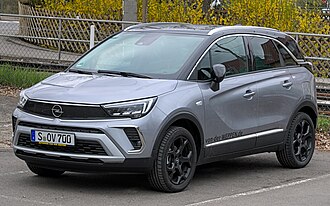
The Opel Crossland is an interesting option on the used-car market for drivers who want the practicality of a small SUV without the size, weight and running costs of a larger family vehicle. Introduced as the Crossland X in 2017, it was designed to combine the compact dimensions of a city car with a higher driving position, a spacious cabin and a practical boot. Unlike some crossovers that concentrate primarily on sporty styling, the Crossland puts everyday usability first. Its relatively upright body, comfortable seating position and flexible rear seats make it particularly attractive to families, older drivers and anyone who regularly carries passengers or luggage.
The model also represents an important period in Opel’s history. It was developed after Opel became part of the PSA Group, which later became part of Stellantis, and therefore shares much of its technology with vehicles from Peugeot and Citroën. This brought modern engines, platforms and equipment into the Opel range, but it also means that some of the Crossland’s mechanical characteristics and potential weaknesses are shared with other cars from the same automotive group. The most important examples are the 1.2-litre petrol engine with its oil-immersed timing belt and the 1.5-litre diesel, which has been associated with camshaft-chain concerns and recall activity on certain versions.
Buying a used Opel Crossland can make good financial sense, particularly if you need a comfortable and economical vehicle for everyday journeys. However, it is not a model that should be purchased without checking its engine, maintenance records and recall history. A well-maintained example can be a pleasant and practical companion, while a neglected one may require expensive work involving the engine, emissions equipment or suspension. Understanding the differences between the engines and production years is therefore essential before choosing a particular car.
Opel Crossland generations and development
Opel Crossland X: the first generation, introduced in 2017
The Opel Crossland X arrived in 2017 as a compact crossover positioned below the larger Grandland X. It effectively replaced the Meriva in Opel’s passenger-car range, although its design and character were quite different from those of a traditional small MPV. Instead of emphasising a van-like appearance, Opel gave the Crossland X a more fashionable crossover shape, raised ground clearance and protective-looking body trim. Despite the SUV-inspired styling, the vehicle remained primarily a front-wheel-drive family car rather than an off-road vehicle.
The Crossland X was developed on the PSA PF1 platform and shared important components with models such as the Peugeot 2008 and Citroën C3 Aircross. This partnership allowed Opel to introduce a modern compact crossover relatively quickly, using engines and technology already developed within the wider group. Petrol versions included naturally aspirated and turbocharged 1.2-litre three-cylinder engines, while diesel models initially used 1.6-litre units before the introduction of the 1.5-litre diesel. Power outputs and transmission combinations varied depending on the production year and market.
One of the Crossland X’s most attractive features was its interior flexibility. The rear bench could slide on selected versions, allowing owners to choose between additional passenger legroom and a larger luggage compartment. This is particularly useful for families who regularly change how they use the car. The vehicle also offered a relatively high roofline, wide-opening rear doors and a boot that was more practical than its compact exterior dimensions might suggest. These characteristics helped the Crossland X appeal to buyers who wanted the convenience of an MPV but preferred the appearance of a crossover.
Opel Crossland facelift: from 2021 onwards
In 2020, Opel introduced a significant facelift, with the updated model reaching customers around 2021. The most obvious change was the redesigned front end, which adopted the brand’s Vizor styling treatment. The grille and headlights were visually integrated into a darker front panel, giving the car a more modern and distinctive appearance. Opel also simplified the model name by removing the X, so the facelifted vehicle became known simply as the Crossland.
The facelift was not limited to cosmetic changes. Opel revised elements of the suspension and steering, updated the equipment range and introduced additional technology depending on the trim level and market. The interior remained broadly familiar, but equipment availability improved, with features such as updated infotainment, driver-assistance systems and more convenience options appearing across the range. Engine choices continued to include 1.2-litre petrol and 1.5-litre diesel units, although the precise combinations changed over time.
For used-car buyers, the facelift is worth considering because it gives the Crossland a more contemporary appearance and can provide a better equipment package. However, the newer styling does not automatically mean that the car is mechanically safer or more reliable. The important engine-related concerns still need to be investigated, especially the timing-belt condition on petrol versions and the recall status of relevant diesel models. A well-maintained pre-facelift Crossland X can be a better purchase than a newer facelifted car with an incomplete service history.
The end of the Crossland and the arrival of the Frontera
The Crossland remained in Opel’s range until 2024, when the new Frontera took over its position as the brand’s compact family SUV. This means that the used-car market contains a relatively straightforward range of Crossland models produced between 2017 and 2024, with differences mainly involving the facelift, engine specifications and equipment levels. Buyers should not confuse the Crossland with the later Frontera, which represents a separate model with different technical specifications and equipment.
Exterior design and everyday practicality
The Opel Crossland has a conventional crossover appearance, with a raised body, short overhangs and protective-looking plastic trim around the lower edges. Its styling is not particularly aggressive, and the overall shape is more focused on visibility and interior space than on creating a sporty impression. This approach has practical benefits, especially in urban environments where a compact vehicle with a high seating position can be easier to use than a larger SUV. The relatively short body also makes parking more manageable, while the upright windows provide a good view of the surroundings.
The front end differs noticeably between the original Crossland X and the facelifted model. Early cars have a more traditional grille and headlight arrangement, whereas later versions feature the distinctive Vizor front design. Buyers choosing between the two should consider more than appearance, however. Check the condition of the headlights, bumpers, wheel arches and lower body panels, as these areas can show signs of parking damage and minor collisions. A crossover may have been driven on rough roads or over high kerbs, so it is also sensible to inspect the underside and suspension components for impacts.
The Crossland is not designed for serious off-road use. Its ground clearance is useful on poor urban roads, gravel tracks and uneven access roads, but the vehicle is primarily a front-wheel-drive road car. It does not have the low-range gearing, advanced four-wheel-drive system or specialised underbody protection associated with genuine off-road vehicles. Buyers should therefore regard its raised stance as a convenience feature rather than evidence of substantial off-road ability.
Interior, comfort and equipment
Dashboard and driving position
The Crossland offers a relatively high driving position, which is one of the reasons many buyers find it comfortable in everyday use. Getting into the vehicle is easier than climbing down into a low hatchback, and the elevated seat gives the driver a good view over surrounding traffic. The dashboard layout is conventional, with physical controls for many important functions and an infotainment screen positioned within easy reach. Depending on the year and trim, the car may include navigation, smartphone connectivity, automatic climate control, heated seats, parking sensors and a reversing camera.
The quality of the interior is practical rather than luxurious. Most surfaces are made from hard-wearing plastics, and the overall design focuses on ease of use instead of premium materials. This is not necessarily a disadvantage in a used vehicle, because durable materials can cope well with family use. Nevertheless, buyers should inspect the steering wheel, gear lever, seat upholstery and door trims for signs of excessive wear. A car with a heavily polished steering wheel, damaged seat bolsters and worn pedals may have covered more kilometres than its displayed mileage suggests.
The front seats are generally comfortable for ordinary journeys, although individual comfort depends on the trim and available seat adjustments. If you regularly drive long distances, spend time in the driver’s seat during the inspection rather than judging comfort from a short test drive. Check the lumbar support, seat-height adjustment and steering-wheel position, and make sure that the driving position feels natural. Also test the air conditioning and heating thoroughly, because faults in these systems can be inconvenient and expensive to diagnose.
Rear passenger space and family usability
The Crossland is a compact vehicle, but its relatively tall body helps create a spacious-feeling cabin. Rear passengers benefit from a higher seating position and useful headroom, while the rear doors open wide enough to make access reasonably convenient. The sliding rear bench available on selected versions is especially valuable because it allows owners to adjust the balance between legroom and boot capacity. Families can move the bench rearwards when carrying adults or larger children, or forwards when additional luggage space is required.
The vehicle can be a practical choice for parents who regularly use child seats. The raised seating position can make lifting children into the rear seats easier than in a low hatchback, and the rear door openings are reasonably accommodating. However, buyers should physically test their own child seats before purchasing. Check the position of the ISOFIX anchor points, the space between the front and rear seats and whether the front passenger seat can still be adjusted comfortably when a rear-facing child seat is installed.
Boot capacity and luggage space
The Crossland has a useful boot for a vehicle in its class. Depending on the exact version and rear-seat position, published luggage capacity is generally around 410 litres, with some specifications offering more when the rear bench is moved forward. Folding the rear seats creates a substantially larger load area, making the car suitable for shopping, pushchairs, suitcases and many everyday household items. The shape of the boot is relatively practical, and the rear opening makes it easier to load larger objects than in some small hatchbacks.
The sliding rear bench is an important detail when comparing used examples. A car with this feature offers greater flexibility, but the amount of luggage space available will depend on where the bench is positioned. If you regularly travel with several passengers and a full load of luggage, test the configuration before buying. Check the boot floor, parcel shelf, rear seatbacks and loading-area trim for damage, and make sure that the rear seats fold and lock correctly.
Engines: which Opel Crossland is the best choice?
The Crossland’s engine range includes petrol and diesel options, with the majority of used examples featuring a 1.2-litre petrol or a 1.5-litre diesel. Older cars may also have a 1.6-litre diesel, particularly those produced during the early years of the model. Engine choice should reflect the type of driving you do. A petrol engine is often more appropriate for low annual mileage and frequent short journeys, while a diesel can make sense for regular longer-distance driving. However, the maintenance history of the individual engine is more important than the theoretical fuel savings.
1.2 naturally aspirated petrol
The entry-level 1.2-litre petrol engine is a three-cylinder unit without a turbocharger. Depending on the model year and market, it produces approximately 81–83 horsepower. It is designed primarily for drivers who want straightforward transport and do not need strong acceleration. In urban traffic, the engine can be perfectly adequate, and its simpler naturally aspirated design may appeal to buyers who want to avoid some of the additional components associated with turbocharged engines.
The main disadvantage is performance. The Crossland is taller and heavier than a small city car, so the naturally aspirated engine can feel slow when accelerating onto a motorway, overtaking or climbing steep hills. With several passengers and luggage on board, the driver may need to use lower gears more frequently. It is therefore best suited to people who drive calmly, spend most of their time in town and do not regularly carry heavy loads.
Even though this engine is relatively simple, it still requires correct maintenance. The timing belt is an important inspection point, and the correct oil specification must be used. Buyers should request service invoices and verify the belt replacement requirements for the exact engine code and production date. Do not assume that the absence of turbocharging makes the engine immune to maintenance-related problems.
1.2 Turbo petrol: 110 and 130 horsepower
The turbocharged 1.2-litre petrol engine is one of the most attractive choices in terms of everyday performance. It was offered in different power outputs, commonly around 110 and 130 horsepower, with torque figures that make the car more flexible than the naturally aspirated version. The turbocharger provides stronger low- and mid-range pulling power, making the Crossland more comfortable when accelerating, overtaking or travelling with passengers.
The 110-horsepower version is generally sufficient for normal family use. It offers a reasonable balance between performance and fuel consumption, and it does not feel as strained as the naturally aspirated engine when the car is fully occupied. The 130-horsepower version provides stronger acceleration and can be more relaxing for drivers who regularly use motorways or travel through hilly areas. However, a more powerful engine does not necessarily make a used car a better purchase if its maintenance history is incomplete.
The biggest concern with these petrol engines is the timing belt that runs in engine oil, commonly described as a wet timing belt. Over time, an unsuitable oil specification, extended oil-change intervals and other operating conditions can contribute to belt deterioration. Material from a deteriorating belt can contaminate the lubrication system and potentially restrict oil flow, creating the risk of serious engine damage. This issue has affected versions of the wider PSA/Stellantis 1.2 PureTech engine family, and it is one of the most important checks when buying a used Crossland.
A buyer should insist on documented oil changes using the correct manufacturer-approved specification and should verify the timing-belt inspection and replacement requirements for the particular engine. Do not rely on a seller’s statement that the belt is fine simply because the engine runs quietly. If the belt has been replaced, ask for an invoice showing the parts and work completed. If there is no convincing evidence of correct maintenance, the vehicle should be inspected by a specialist before purchase. A low purchase price is not enough compensation for the possibility of expensive engine repairs.
1.6 diesel
Some early Crossland X models were equipped with 1.6-litre diesel engines, typically producing approximately 99 or 120 horsepower depending on the version. These engines provide useful torque and can be economical on longer journeys. The stronger version is more comfortable when carrying passengers or driving on motorways, while the lower-powered variant can be suitable for drivers who prioritise fuel consumption over acceleration.
The diesel is best suited to vehicles that cover regular longer distances. It is less attractive for drivers who mainly make short urban journeys, because the diesel particulate filter needs suitable conditions to regenerate. Repeated short trips can interrupt this process and eventually contribute to a blocked filter or warning lights. Buyers should check the DPF, EGR valve, turbocharger, injectors and service history, particularly on examples with high mileage.
The 1.6 diesel is no longer the newest engine in the range, so the age and condition of the vehicle are important considerations. Check for oil leaks, coolant loss, rough cold starts, unusual noises and hesitation under acceleration. A well-maintained diesel with a clear motorway-use history can still be a sensible choice, but a neglected example with emissions-system faults can quickly become expensive.
1.5 diesel
The 1.5-litre diesel replaced the older 1.6-litre unit in the Crossland range. It was offered in different power outputs, commonly around 102 and 120 horsepower depending on the year and market. It provides good torque for a small crossover and can be economical when driven on longer routes. For drivers who regularly travel between towns, commute on motorways or cover high annual mileage, it can be an appealing alternative to the petrol engines.
However, the 1.5 BlueHDi diesel has an important known area of concern involving the camshaft chain on certain versions. The chain’s condition and the applicable manufacturer campaigns should be checked using the vehicle identification number. Buyers should not assume that every 1.5 diesel is affected in the same way, or that every vehicle has the same recall requirements. Ask an Opel dealer or authorised repairer to confirm whether the specific vehicle is included in a campaign and whether the required work has been completed. Obtain written confirmation rather than relying only on verbal assurances.
As with other modern diesels, the emissions equipment also needs attention. Depending on the version, the car may have a DPF and AdBlue/SCR system. Warning lights, emissions faults, a countdown to starting restrictions or a history of repeated regeneration problems should be treated seriously. The 1.5 diesel can be a good long-distance engine when maintained correctly, but it is not the ideal choice for a driver who mainly covers a few kilometres at a time.
Fuel consumption and running costs
The Opel Crossland was designed to be relatively economical, and its compact size helps keep fuel consumption lower than that of larger SUVs. Real-world results depend on the engine, transmission, route, load, tyre condition and driving style. The naturally aspirated 1.2 petrol can be reasonable in town, but it may need to work hard at higher speeds. The turbocharged petrol versions offer better flexibility, although frequent acceleration and motorway driving can increase consumption. Diesel versions are usually more economical on longer journeys, especially when driven at a steady speed.
Running costs should not be judged by fuel consumption alone. A used Crossland also requires regular servicing, tyres, brakes, suspension maintenance and occasional repairs to age-related components. A petrol model with a wet-belt engine may need particularly careful maintenance, while diesel versions can incur additional costs if the DPF, EGR or AdBlue system develops a fault. Before buying, compare the service history and condition of several examples rather than choosing the one with the lowest advertised consumption figure.
Insurance, road tax and registration costs depend on the country, engine, emissions rating and vehicle age. Buyers should also check the cost and availability of replacement parts in their local market. Since the Crossland shares many components with other vehicles from the PSA/Stellantis group, some mechanical parts are widely available, but exact compatibility should always be confirmed using the vehicle identification number.
Reliability and common problems
The Crossland is not a model that can be judged by one simple reliability label. It has several useful qualities, including relatively straightforward road manners and a practical interior, but its reliability record depends heavily on engine choice and maintenance. The most significant mechanical concerns relate to the 1.2 petrol engine’s wet timing belt and the 1.5 diesel’s camshaft-chain issue on certain versions. Other areas worth inspecting include oil leaks, suspension components, electrical equipment, emissions systems and the automatic transmission where fitted.
Wet timing belt on the 1.2 petrol engine
The wet timing belt is arguably the most important issue to investigate on a petrol Crossland. Unlike a conventional dry timing belt, it operates inside the engine and is exposed to engine oil. If the belt deteriorates, fragments can enter the lubrication system and potentially block the oil pickup or other oil passages. This can reduce lubrication and lead to severe engine damage.
The condition of the belt is influenced by the correct oil specification, service intervals, operating conditions and the exact engine version. Buyers should ask for a complete service history and evidence of regular oil changes. The belt should be inspected according to the manufacturer’s procedures, and its replacement interval should be verified for the exact vehicle rather than taken from a generic online recommendation. Some guidance and maintenance intervals have changed over time, so it is particularly important to use information that matches the engine code and production date.
If the engine has already suffered lubrication problems, simply replacing the belt may not be enough. A specialist may need to inspect the lubrication system and confirm that oil pressure is correct. For this reason, a pre-purchase inspection is especially valuable on any 1.2 petrol Crossland without a fully documented history.
Camshaft-chain concerns on the 1.5 diesel
The 1.5 BlueHDi diesel has been associated with a camshaft-chain issue affecting certain versions. The concern is related to the chain connecting components in the camshaft system, and the manufacturer has issued campaigns for relevant vehicles. The exact scope depends on the vehicle’s production details and identification number, so it is essential to check the individual car rather than assume that all 1.5 diesels are affected.
Listen carefully for unusual metallic noises, particularly during cold starting, but do not treat a quiet engine as proof that the vehicle is unaffected. Ask an authorised Opel repairer to check the VIN and provide confirmation of any outstanding or completed campaign work. A vehicle with documented remedial work is a more reassuring purchase than one whose recall status cannot be established.
Diesel particulate filter and EGR system
The DPF and EGR system can cause problems when a diesel Crossland is used mainly for short journeys. The particulate filter collects soot from the exhaust and periodically needs to regenerate. If the car is repeatedly switched off before regeneration is completed, soot can accumulate and eventually cause a warning light or reduced engine performance. The EGR system can also become contaminated over time, affecting engine operation and emissions.
During a test drive, check for warning lights, hesitation, unusual smoke and a lack of power. Ask whether the car has had DPF or EGR repairs, and have a diagnostic scan carried out before purchase. A vehicle that has been used regularly on motorways is often a more suitable diesel purchase than one that has spent most of its life in congested city traffic.
AdBlue and emissions-system faults
Some diesel versions use AdBlue and selective catalytic reduction equipment to reduce nitrogen oxide emissions. Problems can involve the tank, pump, dosing system, sensors or associated wiring. Symptoms may include an emissions warning, an AdBlue fault message or a countdown indicating that the vehicle may eventually refuse to restart if the issue is not corrected. These faults should never be dismissed as minor dashboard annoyances.
Check whether the AdBlue system has been repaired previously and whether the vehicle has any stored fault codes. A seller may claim that a warning is caused by a sensor or simply needs resetting, but a proper diagnosis is required. If the car displays an emissions warning during the inspection, it is safer to postpone the purchase until the cause has been identified and the repair documented.
Oil leaks and engine-related wear
Oil leaks are another area worth inspecting. Look around the engine, sump, seals and surrounding components for signs of fresh oil or accumulated dirt mixed with oil. A small leak may not be immediately serious, but it can indicate neglected maintenance or a developing seal problem. Check the engine oil level and condition, and look for evidence of regular servicing.
A used car should start reliably when cold and idle smoothly once the engine has settled. Misfires, rattling, knocking, excessive smoke or an uneven idle should be investigated. On turbocharged petrol and diesel versions, pay attention to unusual turbocharger noises and hesitation under acceleration. A professional inspection can help distinguish between minor age-related issues and problems that could require expensive repairs.
Suspension, steering and brakes
The Crossland’s suspension is designed for everyday comfort, but worn components can produce knocking noises and vague handling. Inspection data and used-car reports have highlighted suspension and axle-related areas as worth checking, including springs, dampers and components around the suspension mountings. During a test drive, listen for knocking over potholes and speed bumps, and check whether the vehicle feels stable on uneven roads.
Inspect the tyres for uneven wear, because this can indicate incorrect alignment or worn suspension parts. The steering should feel consistent and should not pull strongly to one side. Brakes should operate smoothly without vibration, grinding or excessive pedal travel. A professional inspection on a lift can reveal worn bushes, damaged springs, leaking shock absorbers and other problems that may not be obvious during a short drive.
Electrical systems and infotainment
The Crossland can be equipped with a range of electrical features, and all of them should be tested before buying. Check the central locking, electric windows, mirrors, lights, wipers, climate control, infotainment screen, parking sensors and reversing camera if fitted. On some versions, driver-assistance equipment may include lane-departure warnings, traffic-sign recognition or automatic emergency braking. Confirm that these systems do not display warnings and that their sensors are not damaged or incorrectly calibrated.
Infotainment and electrical problems are not necessarily unique to the Crossland, but they can be frustrating and time-consuming to diagnose. Check that the touchscreen responds correctly and that Bluetooth or smartphone connectivity works as expected. If the vehicle has had a windscreen replacement or front-end repair, ask whether any cameras or sensors required recalibration.
Driving experience: what is the Crossland like on the road?
The Opel Crossland is designed for comfort and ease of use rather than sporty driving. Its elevated seating position, light controls and compact exterior dimensions make it particularly suitable for urban traffic. The driver has a good view of the road, and the vehicle is relatively easy to manoeuvre in car parks and narrow streets. The suspension is generally tuned to provide a comfortable ride over ordinary road surfaces, although the experience can vary with wheel size, tyre condition and trim level.
On country roads, the Crossland behaves predictably but does not encourage particularly enthusiastic driving. Its body is taller than that of a conventional hatchback, and the steering is more focused on convenience than precision. This is perfectly acceptable for the type of buyer the vehicle is intended for, but drivers who want sharp handling and a sporty feel may prefer a different model. The Crossland is most comfortable when driven smoothly and at a relaxed pace.
The choice of engine has a noticeable effect on the driving experience. The naturally aspirated 1.2 petrol is adequate for urban use but can feel underpowered on faster roads. The turbocharged petrol versions are more flexible, while the diesel engines provide useful low-speed torque. If you regularly travel with several passengers or luggage, test the car with this in mind rather than evaluating its performance while driving alone on a flat road.
Opel Crossland as a family car
The Crossland can be a sensible family car for households that need a compact vehicle with a practical interior. Its high seating position makes entry and exit easier, while the rear doors and cabin layout are useful for transporting children. The boot can accommodate everyday shopping, pushchairs and luggage, and the sliding rear bench on selected models provides extra flexibility. These qualities make the Crossland particularly appealing to families who do not need the size of a larger SUV but want more interior space than a conventional supermini can offer.
There are limitations. Although the cabin is practical, the Crossland is not as spacious as a larger family SUV or MPV, especially when several adults are travelling together. The rear bench and boot need to be assessed in the configuration you expect to use most often. Families with bulky child seats, sports equipment or large pushchairs should take those items along when inspecting the car. It is better to confirm that everything fits comfortably than to rely on advertised boot capacity alone.
For everyday family transport, a turbocharged petrol model can be a good compromise if its timing-belt maintenance is fully documented. A diesel may be more suitable for a family that regularly travels long distances, but it is less attractive if most journeys are short school runs and local shopping trips. In either case, a complete service history and a professional inspection are more important than choosing a particular trim level.
Opel Crossland as a city car and commuter vehicle
The Crossland’s compact dimensions make it a useful vehicle for city driving. It is easier to park than many larger SUVs, the high seating position gives the driver a good view in traffic and the cabin is spacious enough to carry passengers comfortably. The raised body can also be helpful when dealing with uneven roads, speed bumps and poorly maintained urban surfaces.
For commuters, the choice between petrol and diesel depends largely on the distance travelled each day. A petrol Crossland is usually the more logical option for shorter journeys and mixed urban driving, provided the wet-belt engine has been maintained correctly. A diesel may offer lower consumption for regular longer commutes, but it should be driven enough to allow the emissions system to operate properly. Buying a diesel for occasional short trips simply because it appears economical in an advertisement can be a false economy.
Which Opel Crossland trim level should you choose?
Equipment levels differ by country and production year, so buyers should compare the actual specification of each vehicle rather than relying solely on trim names. Entry-level versions may offer the essential safety and convenience equipment but can feel relatively basic. Mid-range trims often provide a better balance, with features such as alloy wheels, upgraded infotainment, parking sensors and additional comfort equipment. Higher specifications may include more advanced driver-assistance systems, navigation, automatic climate control and improved interior details.
When choosing a used Crossland, prioritise equipment that makes a genuine difference to everyday use. Rear parking sensors, a reversing camera, automatic climate control and smartphone connectivity can be more valuable than decorative trim or larger alloy wheels. If you regularly drive at night, check the headlight specification and condition. If you transport children, focus on the rear-seat layout and child-seat compatibility. A well-equipped car is appealing, but it should never take priority over a sound engine and a complete maintenance history.
What to check before buying a used Opel Crossland
A careful inspection is essential, particularly because the Crossland has several engine-specific issues that can be expensive if overlooked. Begin by checking the vehicle identification number, registration documents, mileage history and service records. Confirm that the engine specification matches the paperwork and that the car has not been subject to undisclosed accident repairs. Ask for invoices rather than relying only on a service-book stamp, and verify that the maintenance schedule has been followed.
Engine and service-history checks
For a 1.2 petrol, ask specifically about the timing belt, oil-change intervals and oil specification. Request documentary evidence of inspections and replacement work, and confirm the correct requirements for the engine code. If the history is incomplete, arrange a specialist inspection before buying. A timing belt that appears acceptable externally is not proof that the lubrication system is healthy.
For a 1.5 diesel, ask an authorised Opel dealer to check the VIN for relevant camshaft-chain campaigns and confirm whether any required work has been completed. Also investigate the DPF, EGR and AdBlue system where fitted. On older 1.6 diesel examples, check for emissions-system faults, turbocharger problems and evidence of regular servicing.
Bodywork and interior inspection
Inspect the paintwork, bumpers, wheel arches, doors, bonnet and tailgate for damage or poor-quality repairs. Look for inconsistent panel gaps and paint shades that may indicate previous accident damage. Check the underside for dents, corrosion or damage caused by kerbs and rough roads. Inspect the tyres for uneven wear and make sure that all wheels are in good condition.
Inside the car, check the seats, steering wheel, gear lever, pedals, door trims and boot floor. Test the rear-seat sliding mechanism if fitted, and make sure that the seats fold and lock correctly. Check all seat belts, child-seat anchor points, door locks and windows. A family car should be clean and functional, but signs of heavy use should be considered alongside the mileage and service history.
Test drive and diagnostic inspection
A test drive should include urban roads, faster roads and uneven surfaces. Start the engine from cold if possible, listen for unusual noises and observe whether the idle is stable. The engine should accelerate smoothly without hesitation, excessive smoke or warning lights. Test the clutch and gearbox carefully, and check that the steering remains straight. Drive over bumps to listen for suspension noises and apply the brakes several times to confirm that they operate smoothly.
A diagnostic scan is highly recommended. It can reveal stored fault codes even when the dashboard is not displaying a warning. This is particularly important for modern diesel emissions systems and vehicles with electronic driver-assistance equipment. If the automatic transmission is fitted, check that it engages smoothly from a standstill and changes gear consistently under light and stronger acceleration.
Finally, arrange an independent inspection by a qualified mechanic. A specialist can check the underside, suspension, engine condition and service-related issues more thoroughly than a buyer can during a short viewing. If the seller refuses an independent inspection or cannot provide a convincing explanation for missing maintenance records, consider walking away.
Advantages and disadvantages of the Opel Crossland
Main advantages
- Compact exterior dimensions make it relatively easy to park and manoeuvre.
- Raised driving position provides good visibility and convenient access.
- Practical interior with useful passenger space for a small crossover.
- Sliding rear bench on selected versions improves cabin flexibility.
- Boot capacity is competitive for the vehicle’s class.
- Turbocharged petrol engines offer useful everyday performance.
- Diesel versions can provide economical long-distance transport.
- Broad availability of used examples and shared mechanical components with other PSA/Stellantis models.
- Facelifted models have a more modern exterior design and updated equipment.
Main disadvantages
- The 1.2 petrol wet timing belt requires careful maintenance and verification.
- Certain 1.5 diesel versions require checks for camshaft-chain recall work.
- Diesel emissions equipment can be expensive to repair.
- Naturally aspirated petrol versions can feel slow on motorways.
- Interior materials are practical rather than premium.
- Handling is focused on comfort, not sporty driving.
- Suspension and oil-leak issues deserve attention during inspection.
- Not suitable for serious off-road use.
- Equipment and engine combinations vary by year and market, making specification checks important.
Which used Opel Crossland should you buy?
The best Crossland depends on your driving habits, budget and willingness to maintain a modern petrol or diesel engine. For buyers who mainly drive around town and cover relatively few kilometres each year, a petrol version is generally the more logical choice. The naturally aspirated 1.2 is suitable for relaxed urban use, but its modest performance should be considered before buying. The 110-horsepower turbo is a more versatile option, while the 130-horsepower version provides stronger acceleration for motorway journeys and frequent passenger use.
However, the 1.2 petrol engine should only be purchased with a convincing maintenance history. The timing-belt system is a key concern, and buyers should verify the correct oil specification, service intervals and belt condition. A car with documented maintenance and any necessary remedial work is preferable to an apparently cheaper example with missing records.
For drivers who regularly cover long distances, a diesel may be worth considering. The 1.6 diesel is found mainly in earlier examples, while the 1.5 diesel became the more common later option. Both can be economical on longer routes, but buyers must inspect the emissions equipment and verify any relevant recall work. The 1.5 diesel’s camshaft-chain issue makes a VIN-based recall check especially important.
In general, a facelifted Crossland from 2021 onwards can be attractive because of its updated styling and equipment, but it should not be considered automatically superior to an earlier car. A well-maintained 2019 Crossland X may be a much better purchase than a poorly maintained 2022 Crossland. The vehicle’s actual condition, engine history and documentation should determine the decision.
Technical specifications of the Opel Crossland
The following tables provide a general overview of the Opel Crossland and Crossland X. Exact specifications vary according to model year, country, trim, transmission and engine version. Power figures are approximate where multiple market specifications exist.
General model specifications
| Specification | Opel Crossland / Crossland X |
|---|---|
| Vehicle class | Small crossover / B-segment SUV |
| Production period | 2017–2024 |
| Original model name | Opel Crossland X |
| Facelifted model name | Opel Crossland |
| Successor in Opel range | Opel Frontera |
| Platform | PSA PF1 platform |
| Related models | Peugeot 2008, Citroën C3 Aircross |
| Body style | Five-door crossover |
| Seating capacity | 5 |
| Drive configuration | Front-wheel drive |
| Engine position | Front, transverse |
| Fuel types | Petrol and diesel |
| Transmission | Manual or automatic, depending on version |
| Rear suspension | Torsion-beam arrangement |
| Main strengths | Practical cabin, high seating position, flexible rear bench |
| Main weaknesses | Engine-specific maintenance concerns, modest driving dynamics |
Representative engine specifications
| Engine | Fuel | Displacement | Approximate power | Approximate torque | Typical transmission |
|---|---|---|---|---|---|
| 1.2 naturally aspirated | Petrol | 1,199 cc | 81–83 hp | 118 Nm | 5-speed manual |
| 1.2 Turbo | Petrol | 1,199 cc | 110 hp | 205 Nm | Manual / selected automatic |
| 1.2 Turbo | Petrol | 1,199 cc | 130 hp | 230 Nm | 6-speed manual / selected automatic |
| 1.6 Turbo D | Diesel | 1,560 cc | 99 hp | 254 Nm | 5-speed manual |
| 1.6 Turbo D | Diesel | 1,560 cc | 120 hp | 300 Nm | 6-speed manual |
| 1.5 Turbo D | Diesel | 1,499 cc | 102 hp | Varies by version | 6-speed manual |
| 1.5 Turbo D | Diesel | 1,499 cc | 120 hp | Around 300 Nm | 6-speed automatic on selected versions |
Key dimensions and practical information
| Specification | Approximate figure |
|---|---|
| Length | 4,212 mm |
| Width (excluding mirrors) | 1,765 mm |
| Height | Approximately 1,605 mm |
| Wheelbase | 2,604 mm |
| Seating capacity | 5 |
| Boot capacity | Approximately 410 litres, depending on configuration |
| Boot capacity with rear seats folded | Varies by seat position and specification |
| Number of doors | 5 |
| Drive | Front-wheel drive |
| Fuel tank capacity | Approximately 45 litres, depending on version |
Final verdict: is the Opel Crossland a good used car?
The Opel Crossland is a practical small crossover that can make an excellent used purchase for drivers who value comfort, visibility and everyday versatility. Its compact dimensions make it suitable for town driving, while the spacious cabin and useful boot give it enough flexibility for family use. The sliding rear bench on selected versions is a particularly attractive feature, and the range of petrol and diesel engines means that buyers can choose a vehicle suited to their driving habits.
Nevertheless, the Crossland is not a model that should be purchased solely on the basis of price, mileage or appearance. The 1.2 petrol engine’s wet timing belt requires careful attention to maintenance history, while certain 1.5 diesel versions need a check for camshaft-chain recall work. Diesel emissions equipment, suspension components, oil leaks and electrical features should also be inspected. These concerns do not mean that every Crossland is unreliable, but they do make a detailed pre-purchase inspection particularly important.
For most buyers, the best example will be one with a complete service history, verified engine maintenance, no outstanding recalls and a clean diagnostic report. Choose petrol if your driving is mainly urban and relatively low-mileage, and consider diesel if you regularly travel longer distances and can confirm that the emissions equipment is healthy. The facelifted model offers a fresher appearance, but a properly maintained earlier Crossland X can represent better value.
Overall, the Opel Crossland deserves consideration if you want a compact, comfortable and practical used crossover. Buy carefully, check the engine-specific risks and avoid vehicles with unclear maintenance histories. A good example can provide dependable everyday transport and useful family practicality without the size and expense of a larger SUV.
