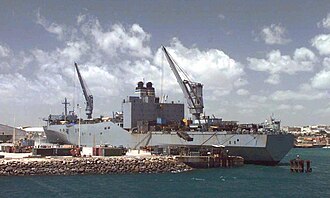
SS Capella (T-AKR 293): The Fast Sealift Ship That Became a Strategic Lifeline for the U.S. Military
A Cargo Ship Built for Speed, Adapted for War
Among the many vessels that have supported American military operations, few represent the evolution of maritime logistics as clearly as SS Capella (T-AKR 293). Unlike traditional warships designed to fight at sea, Capella was created for a different kind of mission: moving enormous quantities of military equipment across oceans quickly, reliably, and efficiently. Her story reflects a fascinating transition from commercial innovation to military necessity, beginning as a high-speed container ship for the commercial shipping industry before becoming one of the U.S. Navy’s important Fast Sealift Ships.
Originally launched as SS Sea-Land McLean, the vessel was built during a period when containerization was transforming global trade. The ship was designed for speed, allowing commercial cargo to travel between continents faster than many conventional freighters of the era. However, operating such a powerful high-speed container ship proved expensive, and the vessel’s future changed dramatically when the United States Navy acquired her in 1982.
After a major conversion program, the ship emerged as USNS Capella (T-AKR 293), a roll-on/roll-off vehicle cargo ship capable of transporting hundreds of military vehicles, including tanks, trucks, helicopters, and other essential equipment. She became part of the U.S. Military Sealift Command’s strategic sealift fleet, providing the ability to rapidly move heavy forces around the world during times of crisis.
The importance of ships like Capella is easy to underestimate. Modern military operations depend not only on aircraft carriers, submarines, and combat ships but also on logistics vessels capable of delivering the tools of warfare. A tank battalion, aviation unit, or expeditionary force cannot operate effectively without vehicles, fuel, spare parts, and supplies. Fast sealift ships were designed to solve exactly this challenge.
Capella’s career included participation in major U.S. military operations, including Operation Desert Shield/Desert Storm, Operation Restore Hope, and logistical support connected with Operation Enduring Freedom. Her long service demonstrated how commercial maritime technology could be adapted into a powerful strategic asset.
From Commercial Giant to Military Asset
The Birth of SS Sea-Land McLean
The origins of SS Capella can be traced back to the early 1970s, when the maritime industry was experiencing a revolution. Container shipping was replacing traditional break-bulk cargo handling, reducing loading times and transforming international commerce. Companies were searching for larger, faster, and more efficient vessels that could carry standardized containers between major ports.
The ship was constructed by Rotterdamsche Droogdok Maatschappij N.V. (Rotterdam Dry Dock Company) in Rotterdam, Netherlands. She was launched on September 1, 1972, and delivered to Sea-Land Service, Inc. in 1973 as SS Sea-Land McLean. The vessel was named in honor of Malcolm McLean, the pioneering businessman widely associated with the development of modern container shipping.
The design philosophy behind the vessel was unusual. Rather than focusing solely on maximum cargo capacity, the ship emphasized speed. Powered by a high-performance steam propulsion system producing approximately 120,000 shaft horsepower, she could reach speeds of around 33 knots. This made her one of the fastest cargo ships of her generation.
At the time, such speed offered commercial advantages. Faster voyages meant improved scheduling, reduced transit times, and potentially greater efficiency in global trade networks. However, maintaining a large vessel with powerful propulsion machinery also came with substantial operating costs. As shipping economics changed, the ship became less attractive as a commercial asset.
The same characteristics that made her expensive for commercial service made her extremely valuable from a military perspective: speed, size, and the ability to move large amounts of cargo quickly.
Acquisition by the United States Navy
The Need for Strategic Sealift
During the Cold War, U.S. military planners recognized that moving forces overseas was one of the greatest logistical challenges facing the nation. The United States maintained military commitments around the world, but many heavy military assets were stored in North America and needed to be transported rapidly during emergencies.
Aircraft could move personnel and some supplies quickly, but heavy equipment such as armored vehicles, engineering machinery, and large quantities of ammunition required maritime transportation. Traditional cargo ships could perform this role but often lacked speed and specialized loading systems.
The Fast Sealift Ship program was created to provide rapid strategic transportation capability. Commercial ships with exceptional speed characteristics were identified as potential candidates for conversion into military logistics vessels.
On April 16, 1982, the U.S. Navy acquired Sea-Land McLean and began planning her transformation into a military cargo ship. The vessel was renamed USNS Capella, following the naming tradition of the Algol-class ships after bright stars. Capella is one of the brightest stars in the constellation Auriga.
The conversion began on October 23, 1982, at Pennsylvania Shipbuilding in Chester, Pennsylvania. The project fundamentally changed the ship’s internal layout and purpose while preserving her powerful propulsion system.
The Transformation into a Fast Sealift Ship
Converting Containers into Combat Capability
The conversion of Capella was far more extensive than a simple modification. Engineers had to transform a commercial container ship into a specialized military logistics platform capable of carrying vehicles directly into operational areas.
The most significant change was the redesign of the cargo spaces. Instead of being arranged primarily for container storage, the interior was rebuilt with multiple vehicle decks connected by ramps. This roll-on/roll-off arrangement allowed military vehicles to be driven aboard and off the ship without requiring extensive dockside cranes or complicated cargo handling procedures.
This capability was especially valuable during military emergencies. In a conflict zone, port facilities may be damaged, overcrowded, or lacking sophisticated equipment. A ship that can unload vehicles efficiently provides commanders with greater flexibility.
Capella was also fitted with additional cargo-handling equipment. The ship received four cranes:
- Two amidships cranes capable of lifting approximately 35 long tons each.
- Two aft cranes capable of lifting approximately 50 long tons each.
These cranes allowed the vessel to handle cargo independently when necessary and increased her usefulness in ports with limited infrastructure. (navysite.de)
On July 1, 1984, the newly converted vessel was delivered to the Military Sealift Command as USNS Capella (T-AKR 293). She joined the Fast Sealift Ship force as one of the world’s fastest military cargo vessels. (navysite.de)
Design and Engineering: A Cargo Ship with Unusual Performance
Speed as a Strategic Advantage
The defining feature of Capella was her extraordinary speed. Most cargo ships of her era operated at significantly lower speeds, but Capella’s propulsion system allowed her to maintain approximately 33 knots. This capability reduced the time required to move military equipment between continents.
Her propulsion plant consisted of two Foster Wheeler boilers supplying steam to two General Electric MST-19 steam turbines. Together, the system produced approximately 120,000 horsepower, an enormous amount of power for a vessel dedicated primarily to logistics.
Speed was not merely a performance statistic; it was a strategic capability. During a crisis, days can determine whether military forces arrive in time to influence events. A fast sealift ship could deliver equipment much faster than conventional transports, improving the U.S. military’s ability to respond globally.
Cargo Capacity and Mission Flexibility
Capella’s primary mission was transporting military vehicles and equipment. She could carry more than 700 Army vehicles, including heavy equipment such as tanks, trucks, and helicopters. (navysite.de)
Her large internal volume made her valuable for large-scale deployments. A single voyage could transport equipment equivalent to what would otherwise require numerous smaller shipments.
The ship also featured a helicopter landing area, providing additional operational flexibility. Although she was not an aviation ship, this facility could support helicopter operations associated with logistics activities. (Wikipedia)
Operational History: Serving as a Maritime Backbone of U.S. Military Logistics
Joining the Military Sealift Command Fleet
After entering service with the Military Sealift Command (MSC) in 1984, USNS Capella (T-AKR 293) became part of a unique class of vessels that bridged the gap between commercial shipping and military transportation. Unlike commissioned warships operated by naval crews, Capella was operated by civilian mariners working under the direction of MSC. This arrangement allowed the U.S. Navy to maintain a powerful strategic transportation capability without requiring a permanent military crew.
The Fast Sealift Ship program represented a major change in how the United States approached global military mobility. Instead of relying entirely on slower cargo ships or waiting for equipment to be transported through limited airlift capacity, the Navy could activate high-speed vessels capable of moving large quantities of combat equipment rapidly.
Capella and her sister ships formed a critical component of America’s ability to reinforce overseas forces. In peacetime, the ships remained available for training, exercises, and maintenance. During emergencies, they could be activated and deployed within a short period, carrying the vehicles and supplies required to support large military formations.
The ship’s combination of speed, cargo volume, and roll-on/roll-off capability made her especially valuable for missions involving the U.S. Army and Marine Corps. Heavy military equipment is among the most difficult cargo to move internationally, and Capella was specifically designed to solve this logistical challenge.
Supporting Operation Desert Shield and Operation Desert Storm
The Gulf War: A Demonstration of Fast Sealift Capability
The most significant chapter in Capella’s operational career came during the Gulf War. Following Iraq’s invasion of Kuwait in August 1990, the United States launched Operation Desert Shield, a massive military buildup designed to protect Saudi Arabia and prepare for possible offensive operations against Iraqi forces.
The deployment required an enormous movement of military personnel, vehicles, aircraft, ammunition, and supplies from the United States and other locations around the world. The success of the operation depended heavily on logistics.
Fast Sealift Ships like Capella played a crucial role by transporting large quantities of Army equipment across the Atlantic and Indian Oceans. Their ability to carry hundreds of vehicles in a single voyage helped accelerate the buildup of coalition forces in the Persian Gulf region.
Capella transported military equipment from U.S. ports to the Middle East, supporting the deployment of forces that would eventually participate in Operation Desert Storm, the coalition offensive that began in January 1991.
The Gulf War demonstrated the importance of strategic sealift. While aircraft and combat ships often receive the most attention in military discussions, the conflict showed that logistics vessels were equally essential. Tanks, armored personnel carriers, fuel trucks, engineering vehicles, and support equipment all had to arrive before ground forces could conduct sustained operations.
The performance of Capella during this period validated the concept behind the Fast Sealift Ship program. Her ability to rapidly transport heavy equipment across thousands of miles proved that maritime logistics could be both massive in scale and responsive in speed.
Humanitarian and Peacekeeping Missions
Operation Restore Hope in Somalia
Capella’s missions were not limited to conventional military deployments. During the early 1990s, she also supported humanitarian and peacekeeping operations.
In 1992, the United States launched Operation Restore Hope in Somalia as part of an international effort to address a severe humanitarian crisis caused by famine and conflict. The operation required not only military personnel but also vehicles, engineering equipment, communications systems, and supplies.
Ships like Capella provided the logistical foundation necessary for such missions. Moving humanitarian support equipment into regions with limited infrastructure presented many of the same challenges as military operations. Ports might lack modern unloading facilities, roads might be damaged, and local transportation networks might be inadequate.
The roll-on/roll-off design of Capella allowed vehicles and equipment to be unloaded efficiently, making her suitable for operations where speed and flexibility were essential.
Her participation demonstrated that strategic sealift assets could support missions beyond traditional warfare, including disaster response, peacekeeping, and international assistance efforts.
Supporting Operations in the Post-Cold War Era
Changing Military Requirements After 1991
After the collapse of the Soviet Union, U.S. military strategy changed significantly. The nation no longer faced the same large-scale conventional threat that had shaped Cold War planning, but the need for global mobility remained.
Instead of preparing primarily for a major conflict in Europe, the U.S. military increasingly focused on regional conflicts, humanitarian interventions, and rapid deployments. This created continued demand for ships capable of transporting equipment quickly.
Capella remained valuable because her basic mission did not depend on a specific enemy or geographic region. Any overseas military operation required transportation capability, and the ship provided exactly that.
Throughout the 1990s, she participated in exercises, readiness operations, and transportation missions designed to ensure that U.S. forces could respond quickly wherever needed.
The War on Terror and Operations After September 11
Supporting Global Military Operations
Following the terrorist attacks of September 11, 2001, the United States entered a new period of sustained military operations. The invasions of Afghanistan and Iraq required enormous logistical support.
Although airlift played an important role in moving personnel and urgent supplies, heavy equipment still depended largely on maritime transportation. Tanks, trucks, construction machinery, spare parts, and other large items were transported by ships such as Capella.
The ship supported U.S. military logistics during this period by moving equipment needed for overseas operations. Her ability to transport large amounts of cargo efficiently helped sustain extended deployments.
Modern warfare depends heavily on supply chains. A military force deployed thousands of miles from home requires constant support. Vehicles need maintenance, replacement parts must arrive, and additional equipment must be transported as missions evolve.
Capella represented the less visible but essential side of military power: the ability to move and sustain forces after they arrive.
Ready Reserve Force Service
Maintaining Strategic Availability
As the U.S. military fleet evolved, Capella became part of the Ready Reserve Force (RRF) under the broader national sealift system. In this status, the ship was maintained in a condition where she could be activated when required.
Ready Reserve vessels occupy an unusual position. They are not constantly deployed like active-duty naval ships, but they provide a strategic capability that can be called upon during national emergencies.
Maintaining ships like Capella in reserve allowed the United States to preserve large-scale transportation capacity without the expense of operating every vessel continuously.
The RRF concept reflects a broader principle of military planning: some capabilities must exist before a crisis begins. A nation cannot build strategic sealift capacity overnight after a conflict starts. Ships require years to design, construct, and prepare.
Capella’s presence in the reserve fleet ensured that the United States retained access to a proven high-speed transport platform.
Retirement and Final Years
The End of an Unusual Career
After decades of service, Capella was eventually removed from active readiness status. Her retirement reflected broader changes in military logistics, including modernization of the sealift fleet and the introduction of newer vessels.
The ship’s career lasted far longer than many commercial vessels, largely because her military value came from capabilities that remained unique. Her speed, cargo capacity, and specialized design allowed her to continue serving long after her original commercial purpose had disappeared.
Capella was eventually sold for recycling after being removed from service. Her retirement marked the end of one chapter in American maritime logistics history.
However, the lessons learned from vessels like Capella continue to influence modern military transportation planning. The ability to rapidly move heavy equipment remains a fundamental requirement for any global military power.
Legacy of SS Capella
A Symbol of Logistics Innovation
The story of SS Capella is a reminder that military strength depends on much more than weapons systems. Aircraft carriers, submarines, and fighter aircraft may represent visible military power, but logistics determines whether those forces can actually operate.
Capella combined commercial engineering with military requirements in a way that produced a highly specialized vessel. Her transformation from a high-speed container ship into a military transport demonstrated the flexibility of maritime assets.
Several aspects of her legacy stand out:
- She proved that commercial vessels could be adapted for strategic military purposes.
- She demonstrated the value of speed in military transportation.
- She supported some of the largest U.S. overseas deployments of the late 20th and early 21st centuries.
- She highlighted the importance of logistics in modern warfare.
The ship also represented an era when extremely fast cargo vessels were considered a possible solution to global transportation challenges. Although modern shipping has moved toward efficiency rather than extreme speed, the military value of rapid transport remains clear.
Technical Specifications of SS Capella (T-AKR 293)
The following table summarizes the major technical characteristics of SS Capella during her service as a Fast Sealift Ship.
| Specification | Details |
|---|---|
| Ship Name | SS Capella |
| Military Designation | USNS Capella (T-AKR 293) |
| Class | Algol-class Fast Sealift Ship |
| Former Name | SS Sea-Land McLean |
| Vessel Type | Fast sealift / roll-on-roll-off cargo ship |
| Operator | Military Sealift Command (MSC) |
| Builder | Rotterdamsche Droogdok Maatschappij N.V., Rotterdam, Netherlands |
| Launched | September 1, 1972 |
| Delivered to Sea-Land | 1973 |
| Acquired by U.S. Navy | April 16, 1982 |
| Converted for Military Service | 1982–1984 |
| Entered MSC Service | July 1, 1984 |
| Length | Approximately 946 feet (288 meters) |
| Beam | Approximately 105 feet (32 meters) |
| Draft | Approximately 38 feet (11.6 meters) |
| Full Load Displacement | Approximately 55,000 tons |
| Propulsion System | Steam turbine propulsion |
| Boilers | Two Foster Wheeler boilers |
| Turbines | Two General Electric MST-19 steam turbines |
| Shaft Horsepower | Approximately 120,000 shp |
| Propellers | Two shafts |
| Maximum Speed | Approximately 33 knots |
| Cargo Type | Military vehicles, containers, equipment, supplies |
| Vehicle Capacity | More than 700 military vehicles |
| Cargo Handling Equipment | Four cranes |
| Crane Capacity | Two 35-ton cranes and two 50-ton cranes |
| Aviation Capability | Helicopter landing area |
| Crew | Civilian merchant mariners under MSC operation |
| Primary Mission | Rapid global transport of military equipment |
| Major Operations Supported | Desert Shield, Desert Storm, Restore Hope, post-9/11 operations |
| Final Status | Retired from service and recycled |
Conclusion: The Ship That Proved Logistics Wins Wars
SS Capella (T-AKR 293) was never designed to fire missiles, launch aircraft, or engage enemy forces directly. Her battlefield was the global transportation network, and her weapon was speed.
From her beginnings as an innovative commercial container ship to her decades of service as a U.S. Navy Fast Sealift Ship, Capella represented a powerful idea: military capability depends on the ability to move.
Her missions during the Gulf War, humanitarian operations, and later military deployments showed that logistics ships are among the most important assets in maintaining global military reach. Without ships capable of transporting equipment, even the most advanced armed forces would struggle to operate far from home.
Although Capella is no longer active, her legacy remains significant. She stands as an example of maritime engineering adapted for national strategy and as a reminder that behind every military operation is an enormous logistical effort carried across the world’s oceans.
