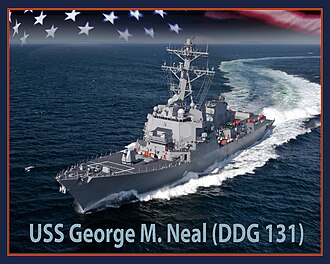
USS George M. Neal (DDG-131): The Next Generation of Arleigh Burke-Class Guided Missile Destroyers
USS George M. Neal (DDG-131) represents the continued evolution of one of the most successful and influential warship designs in modern naval history: the Arleigh Burke-class guided missile destroyer. As a Flight III Arleigh Burke-class destroyer, DDG-131 incorporates decades of operational experience, technological development, and lessons learned from previous generations of U.S. Navy surface combatants. The ship is designed to provide advanced air defense, missile defense, anti-submarine warfare, surface warfare, and expeditionary support capabilities while operating independently or as a key component of a larger naval task force.
Modern naval warfare increasingly depends on the ability to detect threats quickly, share information across networks, and respond with precision. USS George M. Neal is designed around this reality. Rather than serving as a platform focused on a single mission, the ship functions as a highly integrated multi-mission combat system capable of defending carrier strike groups, protecting amphibious forces, escorting logistics vessels, conducting maritime security operations, and supporting joint military campaigns. Its advanced sensors, powerful weapons systems, and networked combat capabilities allow it to contribute to naval operations across the globe.
The ship belongs to the Flight III variant of the Arleigh Burke class, which represents the most advanced version of the design. Flight III destroyers incorporate major improvements including the AN/SPY-6(V)1 Air and Missile Defense Radar, enhanced electrical power generation, upgraded computing systems, and improved capability against increasingly sophisticated threats. These improvements ensure that ships such as USS George M. Neal remain effective against modern aircraft, cruise missiles, ballistic missiles, unmanned systems, and other emerging challenges.
Beyond its technical capabilities, USS George M. Neal continues the Navy tradition of honoring individuals whose service represents dedication, sacrifice, and commitment to the nation. The ship’s name recognizes the contributions of a distinguished Navy figure, connecting the vessel to the broader heritage of American naval service. Like earlier ships named for heroes and leaders, DDG-131 carries a legacy that extends beyond steel and machinery, representing the people and values that define the United States Navy.
The Legacy Behind the Name George M. Neal
USS George M. Neal honors George M. Neal, a U.S. Navy sailor whose service reflected the professionalism and courage associated with generations of American naval personnel. Ship naming traditions serve an important role within the Navy because they connect modern vessels with historical figures, battles, communities, and values. A ship’s name becomes part of its identity, influencing the traditions, pride, and sense of purpose carried by the crew who serve aboard it.
Naval ships named after individuals often recognize people whose actions demonstrate qualities considered essential to military service: leadership, bravery, technical skill, and dedication to others. These names serve as reminders that naval power is ultimately created and maintained by people. While advanced technology provides important advantages, the effectiveness of any warship depends on the sailors who operate, maintain, and employ its systems.
USS George M. Neal continues this tradition by carrying a name associated with service and commitment. Every sailor assigned to the ship becomes part of that continuing story, adding new experiences and achievements to the vessel’s history. As DDG-131 enters service, the crew will establish traditions unique to the ship while maintaining connections to the legacy represented by its name.
The Arleigh Burke-Class Destroyer Program
The Arleigh Burke-class guided missile destroyer is one of the longest-running and most successful naval shipbuilding programs in modern history. The class was introduced during the late twentieth century as a replacement for earlier generations of destroyers and was designed around the Aegis combat system, a revolutionary naval warfare technology that transformed the ability of surface ships to detect and engage multiple threats simultaneously.
Since the commissioning of the first Arleigh Burke-class ship in 1991, the class has continuously evolved through multiple modernization efforts. Rather than replacing the entire design, the Navy has repeatedly upgraded sensors, weapons, computing systems, communications equipment, and engineering capabilities. This approach has allowed the class to remain relevant against changing threats while benefiting from the reliability and operational experience gained through decades of service.
Arleigh Burke-class destroyers have participated in operations around the world, supporting carrier strike groups, conducting missile defense patrols, performing maritime security missions, and contributing to international exercises with allied navies. Their versatility has made them a central component of American naval power.
The Evolution to Flight III
The Flight III version represents one of the most significant improvements in the history of the Arleigh Burke class. The development of Flight III was driven by the need to counter increasingly advanced threats, particularly sophisticated anti-ship missiles and ballistic missile systems. Potential adversaries have developed weapons capable of traveling at high speeds, maneuvering unpredictably, and challenging traditional defense systems. To address these challenges, the Navy required a destroyer with significantly improved detection and tracking capability.
The centerpiece of Flight III modernization is the AN/SPY-6(V)1 Air and Missile Defense Radar. This radar provides substantially greater sensitivity compared with earlier systems, allowing destroyers to detect smaller, faster, and more complex threats at greater distances. Improved radar performance enhances the effectiveness of the Aegis combat system by providing commanders with a more complete understanding of the battlespace.
Flight III ships also feature improvements to electrical generation and cooling systems because modern combat requires significantly more power than previous generations. Advanced radar, computers, communication networks, and future directed-energy technologies all require increased electrical capacity. These engineering improvements ensure that USS George M. Neal can support future upgrades throughout its service life.
Construction of USS George M. Neal (DDG-131)
USS George M. Neal is being constructed by Huntington Ingalls Industries’ Ingalls Shipbuilding division in Pascagoula, Mississippi, one of America’s leading naval shipbuilders. The construction of an Arleigh Burke-class destroyer involves thousands of workers and requires coordination between engineers, designers, manufacturing specialists, technicians, and quality assurance teams.
Building a modern guided missile destroyer requires integrating thousands of individual components into a highly complex combat platform. The ship contains advanced radar arrays, missile launch systems, propulsion equipment, navigation technology, communications networks, electronic warfare systems, aviation facilities, and extensive damage control infrastructure. Every system must operate reliably because the ship may be required to perform missions in some of the world’s most challenging environments.
Modern naval construction relies on advanced manufacturing techniques and modular assembly. Large sections of the ship are constructed separately before being joined together during final assembly. These sections may contain installed electrical systems, piping, machinery, and internal compartments before integration. This method improves efficiency and allows shipbuilders to maintain strict quality standards throughout the construction process.
After construction, USS George M. Neal will undergo extensive testing and evaluation. These trials examine propulsion performance, navigation systems, weapons integration, radar capabilities, communications equipment, and overall operational readiness. The testing process ensures that the ship meets Navy standards before entering active service and joining the fleet.
Design Philosophy and Mission Capability
The central philosophy behind USS George M. Neal is versatility. Modern naval forces face a wide variety of threats, and commanders require ships capable of performing multiple missions without relying exclusively on specialized platforms. Guided missile destroyers provide this flexibility by combining advanced sensors, powerful weapons, aviation support, and long-range endurance into a single platform.
USS George M. Neal can operate as part of a carrier strike group, providing protection against air and missile threats while supporting offensive operations. It can also operate independently for maritime security missions, freedom-of-navigation operations, or international exercises. This flexibility allows the Navy to deploy destroyers wherever they are needed and adapt quickly to changing strategic conditions.
Propulsion and Endurance
USS George M. Neal uses a gas turbine propulsion system designed to provide high speed, reliability, and operational flexibility. The propulsion plant allows the ship to rapidly maneuver during combat operations while maintaining the endurance necessary for long deployments. Guided missile destroyers routinely operate across vast ocean areas, requiring engineering systems capable of supporting sustained missions far from home ports.
Efficient propulsion is particularly important because destroyers frequently operate as escorts for larger naval formations. They must maintain station alongside aircraft carriers, amphibious ships, and logistics vessels while remaining ready to respond immediately to threats. The engineering design of DDG-131 supports these demanding requirements.
The Importance of USS George M. Neal
USS George M. Neal represents the continued importance of surface combatants in American maritime strategy. While aircraft carriers and submarines often receive significant attention, guided missile destroyers provide many of the essential capabilities that allow naval forces to operate effectively. They protect larger ships, conduct independent missions, and provide commanders with a flexible tool for responding to global challenges.
As threats become increasingly complex, the role of destroyers continues to expand. Future naval operations will depend on advanced sensors, integrated networks, and the ability to coordinate actions across multiple domains. USS George M. Neal is designed to contribute to this future environment by combining proven capabilities with next-generation technology.
Aegis Combat System and Advanced Sensor Capabilities
One of the defining features of USS George M. Neal (DDG-131) is its integration of the Aegis combat system, one of the most advanced naval warfare systems ever developed. Aegis provides the ship with the ability to combine information from multiple sensors, analyze potential threats, coordinate responses, and guide weapons against hostile targets. The system is designed around the concept of integrated warfare, allowing the ship to function as part of a larger network of naval and joint forces.
The Aegis system has evolved continuously since its introduction, incorporating improvements in computing power, radar technology, software, and weapons integration. On Flight III Arleigh Burke-class destroyers such as USS George M. Neal, Aegis works together with the AN/SPY-6(V)1 radar to provide significantly improved air and missile defense capability. The combination allows the ship to detect threats earlier, track multiple objects simultaneously, and provide commanders with more accurate information during complex operations.
Modern naval combat increasingly depends on information superiority. The ability to identify threats before they become immediate dangers can determine the success of a mission. USS George M. Neal’s advanced sensor systems are designed to create a detailed picture of the surrounding environment, including aircraft, missiles, ships, and other potential hazards. This information can be shared with other naval units, aircraft, and command centers, creating a coordinated defense network.
The AN/SPY-6(V)1 Air and Missile Defense Radar
The AN/SPY-6(V)1 radar represents a major technological advancement for the U.S. Navy’s surface fleet. Designed specifically to improve air and missile defense, the radar provides greater sensitivity and tracking capability compared with previous generations of naval radar systems. This improvement is especially important as modern threats become faster, smaller, and more difficult to detect.
Unlike older radar systems that relied on earlier technology, the SPY-6 uses scalable radar modules that can be combined to create powerful detection capabilities. The system improves performance against a wide variety of threats, including aircraft, cruise missiles, ballistic missiles, and unmanned aerial vehicles. For USS George M. Neal, this radar significantly enhances its ability to defend itself and other ships operating nearby.
The radar’s increased capability also supports future naval warfare concepts. As missile technology continues to advance, ships require stronger detection and tracking systems to maintain effective defenses. The SPY-6 provides a foundation that allows Flight III destroyers to remain relevant throughout decades of service.
Weapons Systems and Combat Power
USS George M. Neal is equipped with a wide range of weapons systems designed to address multiple types of threats. Unlike ships designed for a single mission, Arleigh Burke-class destroyers are true multi-mission combatants capable of conducting air defense, surface warfare, anti-submarine warfare, and strike operations.
The ship’s primary offensive and defensive weapon system is the Mk 41 Vertical Launch System. This system allows the destroyer to carry and launch various types of missiles, including surface-to-air missiles, anti-submarine weapons, and long-range strike missiles. The vertical launch design provides significant flexibility because individual launch cells can be configured according to mission requirements.
For air defense missions, USS George M. Neal can employ Standard Missile family weapons designed to intercept hostile aircraft and missiles. These weapons work together with the Aegis combat system and advanced radar to provide layered protection for naval forces. The destroyer’s ability to defend itself and other ships makes it a critical element of carrier strike groups and expeditionary formations.
The ship also supports offensive strike missions through its ability to employ long-range precision weapons. These capabilities allow destroyers to contribute to joint military operations by engaging targets far from the immediate maritime environment. The combination of defensive and offensive systems gives USS George M. Neal significant operational flexibility.
Surface Warfare Capability
USS George M. Neal maintains the ability to engage surface threats using advanced missile systems and naval artillery. Surface warfare remains an important mission because naval forces must be prepared to operate against hostile ships, patrol vessels, and maritime threats. The destroyer’s sensors and weapons provide commanders with options for controlling sea space and protecting friendly forces.
The ship’s main gun provides additional flexibility for surface engagements, maritime security missions, and support operations. Although missiles represent the primary long-range weapons, naval artillery remains valuable because of its responsiveness and ability to support a variety of missions.
Anti-Submarine Warfare Capabilities
Submarines represent one of the most challenging threats in naval warfare because they can operate covertly beneath the ocean surface. USS George M. Neal is designed to contribute to anti-submarine warfare operations through advanced sensors, embarked helicopters, and integrated weapons systems.
The ship’s sonar systems allow it to search for and track underwater contacts, providing essential information to commanders. These capabilities become especially important when protecting high-value naval assets such as aircraft carriers and amphibious assault ships. Destroyers operating within carrier strike groups often serve as one layer of defense against underwater threats.
Aviation assets further expand the destroyer’s anti-submarine capability. Helicopters equipped with specialized sensors can search large areas of ocean, locate submarines, and support coordinated engagements. This combination of ship-based and aircraft-based systems creates a powerful underwater defense capability.
Electronic Warfare and Cyber Capabilities
Modern naval combat extends beyond physical weapons systems. Electronic warfare and cyber operations have become increasingly important as military forces rely on complex networks, sensors, and communications systems. USS George M. Neal incorporates technologies designed to detect, analyze, and respond to electronic threats.
Electronic warfare systems can help protect the ship by identifying hostile signals, disrupting enemy sensors, and reducing vulnerability to advanced threats. In a modern conflict environment, controlling information and protecting communications can be just as important as controlling physical territory.
The ship’s advanced computing infrastructure also supports cybersecurity requirements. Naval vessels must protect critical systems from attempts to disrupt operations or gain unauthorized access. Maintaining secure networks is essential because nearly every aspect of modern naval warfare depends on reliable digital systems.
Role Within Carrier Strike Groups
One of the most important missions of USS George M. Neal will be operating as part of a carrier strike group. These formations combine aircraft carriers, destroyers, cruisers, submarines, and support ships to create a highly capable naval force. Each vessel contributes specialized capabilities while benefiting from the protection and support provided by the larger group.
Within a carrier strike group, destroyers perform many essential functions. They provide air defense, missile defense, anti-submarine protection, surface warfare capability, and additional strike capacity. Their advanced sensors allow them to detect threats approaching the formation, while their weapons systems provide the ability to respond quickly.
USS George M. Neal also contributes to distributed maritime operations, a concept emphasizing the ability of naval forces to operate across wide areas while remaining connected through advanced networks. Future conflicts may require ships to operate independently while still contributing information and capabilities to a larger force.
Life and Operations Aboard USS George M. Neal
Operating a modern guided missile destroyer requires a highly trained and dedicated crew. Although smaller than an aircraft carrier, USS George M. Neal contains a complex collection of systems requiring expertise in engineering, weapons, navigation, communications, intelligence, aviation support, and damage control.
Sailors aboard the ship live and work in a demanding environment where readiness is maintained around the clock. Watch teams continuously monitor sensors, engineering systems, and communications networks. Maintenance personnel ensure that weapons, machinery, and electronic systems remain operational. Training exercises prepare the crew to respond to emergencies ranging from mechanical failures to combat situations.
Destroyer crews develop a strong sense of teamwork because every sailor’s responsibilities contribute directly to mission success. A ship’s combat effectiveness depends not only on technology but also on the discipline, skill, and coordination of the people operating it.
Future Service and Modernization Potential
USS George M. Neal is expected to serve for several decades, making adaptability one of its most important characteristics. The Navy designs modern ships with the expectation that technology will continue to change throughout their operational lives. Software updates, improved sensors, new weapons, and emerging technologies can extend a ship’s usefulness long after its initial commissioning.
Future upgrades may include improved electronic systems, enhanced networking capabilities, new missile technologies, and integration with unmanned platforms. The Flight III design provides the electrical power and computing capacity necessary to support many of these developments.
The continued modernization of ships such as USS George M. Neal ensures that the U.S. Navy maintains a capable surface fleet capable of responding to changing global security conditions.
Technical Specifications of USS George M. Neal (DDG-131)
| Specification | Details |
|---|---|
| Ship Name | USS George M. Neal |
| Hull Number | DDG-131 |
| Class | Arleigh Burke-class guided missile destroyer |
| Variant | Flight III |
| Type | Guided missile destroyer |
| Builder | Huntington Ingalls Industries Ingalls Shipbuilding |
| Length | Approximately 509 feet (155 meters) |
| Beam | Approximately 66 feet (20 meters) |
| Displacement | Approximately 9,000+ tons full load |
| Propulsion | Four gas turbine engines driving two shafts |
| Speed | 30+ knots |
| Crew | Approximately 300 sailors |
| Primary Combat System | Aegis Combat System |
| Main Radar | AN/SPY-6(V)1 Air and Missile Defense Radar |
| Missile System | Mark 41 Vertical Launch System |
| Weapons | Surface-to-air missiles, strike missiles, anti-submarine weapons, naval gun, close-in defense systems |
| Aircraft Support | Helicopter operations including MH-60 series aircraft |
| Primary Missions | Air defense, missile defense, anti-submarine warfare, surface warfare, strike operations, and fleet escort |
Conclusion: A Powerful Addition to the Future Fleet
USS George M. Neal (DDG-131) represents the next generation of American surface warfare capability. By combining the proven Arleigh Burke-class design with advanced Flight III technologies, the ship provides the Navy with improved sensors, stronger defensive capability, and greater flexibility against future threats.
The ship’s advanced radar, Aegis combat system, missile capabilities, and networked operations allow it to perform a wide range of missions in support of national security objectives. Whether protecting aircraft carriers, defending allied forces, conducting maritime operations, or contributing to joint campaigns, USS George M. Neal will serve as a highly capable and adaptable naval asset.
More than a machine of steel and technology, USS George M. Neal represents the sailors who will operate it and the traditions of service carried by its name. As the ship enters the fleet and begins its operational career, it will continue the long history of American destroyers providing strength, protection, and readiness across the world’s oceans.
_artist_depiction.jpg)