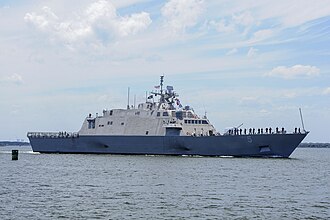
USS Milwaukee (LCS-5): The Freedom-Class Littoral Combat Ship Designed for a New Era of Naval Operations
The history of the United States Navy is defined by constant adaptation. From wooden sailing ships that protected young American trade routes to nuclear-powered aircraft carriers capable of projecting power across the globe, each generation of naval vessels has reflected the strategic challenges and technological possibilities of its time. USS Milwaukee (LCS-5) represents one of the Navy’s most ambitious attempts to create a warship suited for the rapidly changing maritime environment of the twenty-first century. As a member of the Freedom-class Littoral Combat Ship (LCS) family, USS Milwaukee was designed around speed, flexibility, modularity, and the ability to operate effectively in coastal regions where traditional combatants face unique challenges.
Commissioned in November 2015, USS Milwaukee became the fourth United States Navy ship to carry the name of Milwaukee, honoring the major city in Wisconsin known for its industrial heritage, maritime connections, and contributions to American history. The ship’s name continued a naval tradition stretching back to previous vessels, including the famous USS Milwaukee (CL-5), an Omaha-class light cruiser that served during the early twentieth century, and later ships that carried the city’s name during different periods of American naval development.
Unlike large cruisers and destroyers designed primarily around missile warfare and fleet defense, USS Milwaukee was created with a different philosophy. The Littoral Combat Ship concept focused on operating in the near-shore maritime environment, where threats can include small attack boats, mines, submarines, piracy, and irregular forces. These waters require a combination of speed, awareness, flexibility, and the ability to change missions quickly. USS Milwaukee was designed to provide commanders with a platform capable of adapting to different operational demands without requiring a completely new ship.
The vessel’s design represented a significant departure from traditional naval construction. Instead of permanently installing every possible combat capability, the LCS program emphasized interchangeable mission packages that could transform the ship depending on the assignment. A vessel could be configured for surface warfare, mine countermeasures, or anti-submarine warfare missions through specialized equipment modules. This approach reflected a broader change in military thinking: future conflicts would require forces capable of responding quickly to uncertain and rapidly changing circumstances.
USS Milwaukee’s story is therefore not only about one warship but also about a larger period of transformation within the United States Navy. The ship represents experimentation, technological advancement, and the continuing search for new ways to maintain maritime superiority in an increasingly complex world.
The Historical Legacy Behind the Name Milwaukee
The name Milwaukee has a long and distinguished connection with the United States Navy. The city of Milwaukee, Wisconsin, developed as an important industrial and commercial center during the nineteenth and twentieth centuries, becoming known for manufacturing, shipbuilding, and its location on the western shore of Lake Michigan. Its connection to maritime activity made it a fitting namesake for several American naval vessels throughout history.
The first major Navy vessel to carry the name was USS Milwaukee (C-21), commissioned in 1906. This early cruiser served during a period when the United States Navy was expanding its global presence and developing modern concepts of naval power. Later, USS Milwaukee (CL-5), an Omaha-class light cruiser, entered service in 1923. She participated in operations during the interwar period and World War II, performing missions including patrol duties, convoy escort, and support operations in the Pacific theater.
The tradition continued with USS Milwaukee (AOR-2), a replenishment oiler commissioned during the Cold War. That ship reflected another major evolution in naval strategy by demonstrating the importance of logistics and sustained operations. Modern fleets depend not only on combat vessels but also on support ships capable of extending operational reach across oceans.
By naming a Littoral Combat Ship USS Milwaukee, the Navy connected the vessel to this long history of technological change. Each previous ship bearing the name represented a different stage in naval development, and LCS-5 continued that pattern by introducing a new approach to surface warfare.
A Name Reflecting Innovation and Service
The heritage associated with Milwaukee is particularly appropriate for a ship built around adaptability. The city itself has long been associated with industry, engineering, and manufacturing excellence. These qualities mirror the goals behind the Littoral Combat Ship program, which sought to combine advanced engineering with operational flexibility.
For the sailors assigned to USS Milwaukee, the ship’s name represented more than geographic identity. It connected them with generations of Navy personnel who had previously served aboard ships carrying the same name. Naval tradition places great importance on continuity, and each new vessel inherits both the reputation and responsibility created by its predecessors.
The Development of the Littoral Combat Ship Program
The origins of USS Milwaukee can be traced to the Navy’s effort to address a changing security environment after the Cold War. During the Cold War, naval planning focused heavily on the possibility of a large-scale conflict involving the Soviet Union. Aircraft carriers, nuclear submarines, cruisers, and destroyers were designed to operate in open oceans against a technologically advanced opponent.
Following the collapse of the Soviet Union, naval forces increasingly encountered different types of challenges. Regional conflicts, maritime terrorism, piracy, coastal defense systems, and asymmetric threats became more prominent. These situations often occurred in shallow waters and heavily populated coastal areas where traditional warships were not always optimized for the mission.
The Navy began exploring concepts for a smaller and faster surface combatant capable of operating close to shore. This led to the Littoral Combat Ship program, which sought to create a vessel capable of performing multiple missions through interchangeable systems rather than fixed equipment.
The LCS concept represented a significant philosophical shift. Instead of designing a ship around one primary mission, planners envisioned a platform that could change roles depending on operational needs. A ship deployed to one region might require mine-clearing equipment, while another mission might demand anti-submarine sensors or surface warfare capabilities.
The Freedom-Class Design
USS Milwaukee belongs to the Freedom-class variant of the Littoral Combat Ship program. The Freedom-class design emphasizes speed, maneuverability, and operational flexibility through a conventional steel monohull configuration combined with advanced propulsion technology.
The ship was built with a shallow draft compared with larger surface combatants, allowing it to operate closer to shore and in areas where deeper-draft vessels may face restrictions. This characteristic is especially valuable in coastal environments where geography, commercial traffic, and underwater hazards create unique operational challenges.
The Freedom-class also introduced a highly automated design philosophy. By incorporating advanced engineering controls, digital systems, and streamlined manning requirements, the Navy sought to reduce operating costs while maintaining combat effectiveness.
This approach required sailors to become highly skilled across multiple disciplines. Smaller crews meant that personnel often needed broader technical knowledge and greater flexibility in performing their duties.
Construction of USS Milwaukee
USS Milwaukee was constructed by Marinette Marine Corporation in Marinette, Wisconsin, a shipyard located near the city whose name the vessel carries. The location created a unique connection between the ship and the community that inspired its name. Shipbuilding in Wisconsin has a long tradition, and the construction of LCS-5 represented an important milestone for both the shipyard and the region.
The construction of a modern naval vessel requires the coordination of thousands of individual components and specialized systems. Hull fabrication, propulsion installation, electrical integration, communications equipment, combat systems, and navigation technology must all be carefully combined into a single operational platform.
After the hull was assembled and major systems installed, USS Milwaukee underwent extensive testing. Shipbuilders and Navy personnel evaluated propulsion performance, navigation equipment, communications systems, engineering reliability, and mission capabilities. These trials were essential to ensure that the vessel could safely operate in demanding maritime environments.
USS Milwaukee was launched in October 2013 and commissioned on 21 November 2015 in Milwaukee, Wisconsin. The commissioning ceremony represented the official entry of the ship into active naval service and celebrated the connection between the vessel, its namesake city, and the generations of sailors who would serve aboard it.
A Ship Built for Change
From the beginning, USS Milwaukee was designed around the idea that future naval warfare would require flexibility. Rather than focusing exclusively on traditional combat roles, the ship was intended to provide commanders with additional options. Its speed, modular systems, and advanced technology allowed it to support a variety of missions.
The ship’s commissioning marked the continuation of an experiment in naval design. USS Milwaukee became part of a larger effort to determine how smaller, faster, and more adaptable warships could contribute to American maritime strategy in the decades ahead.
Engineering and Design Features of USS Milwaukee
The engineering philosophy behind USS Milwaukee (LCS-5) was centered on achieving a balance between speed, flexibility, and mission capability. Unlike traditional surface combatants that are designed around heavy armor, large missile batteries, and extensive crew requirements, the Freedom-class Littoral Combat Ship focused on mobility and adaptability. Every major design decision reflected the Navy’s desire to create a vessel capable of responding quickly to changing operational demands in complex coastal environments.
USS Milwaukee measures approximately 387 feet in length and displaces more than 3,500 tons when fully loaded. While considerably smaller than cruisers and destroyers, the ship provides substantial internal space for aviation operations, mission equipment, command facilities, and advanced electronic systems. The layout of the vessel was designed to maximize efficiency while supporting rapid changes between different mission configurations.
One of the most notable aspects of the ship’s design is its emphasis on automation. Modern naval vessels require enormous amounts of information processing and system management, and USS Milwaukee incorporates advanced computer networks and automated controls throughout the ship. These systems allow a relatively small crew to operate a highly capable warship while reducing the manpower burden traditionally associated with surface combatants.
High-Speed Propulsion System
Speed is one of the defining characteristics of USS Milwaukee. The ship uses a combined diesel and gas turbine propulsion system that allows it to exceed 40 knots under suitable conditions. This performance makes the Freedom-class among the fastest ships in the United States Navy and provides commanders with significant operational advantages.
The propulsion system combines two Rolls-Royce MT30 gas turbines with two diesel engines. The gas turbines provide tremendous power when maximum speed is required, while the diesel engines offer improved fuel efficiency during normal cruising operations. Waterjet propulsion units replace conventional propellers, improving maneuverability and allowing the ship to operate effectively in shallow waters.
The ability to move rapidly between operating areas is especially valuable in maritime security missions. Coastal threats can emerge quickly, and a vessel capable of repositioning at high speed can respond before situations escalate. Speed also enhances survivability by allowing the ship to avoid potential dangers and adjust its position during tactical operations.
Advanced Automation and Reduced Manning
A major goal of the Littoral Combat Ship program was reducing crew requirements compared with traditional warships. USS Milwaukee operates with approximately 70 core sailors, supported by additional personnel when specialized mission modules are installed. This is significantly fewer than older surface combatants of similar size.
Reduced manning requires a highly trained and versatile crew. Sailors aboard USS Milwaukee must often perform multiple responsibilities and maintain qualifications in several areas. The ship relies heavily on automation, but technology does not replace human expertise. Instead, it allows sailors to focus on critical tasks requiring judgment, technical knowledge, and operational skill.
This approach represented a major shift in naval personnel philosophy. Future warships were expected to combine advanced technology with smaller, highly capable crews rather than relying on large numbers of sailors performing narrowly defined roles.
Mission Modules and Operational Flexibility
The central concept behind the Littoral Combat Ship program is modularity. USS Milwaukee was designed to accept different mission packages that could transform the ship’s capabilities depending on the requirements of a specific deployment. This concept allowed the Navy to use one basic hull design for several specialized roles.
The three original mission areas developed for the Littoral Combat Ship program were surface warfare, mine countermeasures, and anti-submarine warfare. Each package included specialized equipment, sensors, unmanned systems, and personnel designed for that mission. The ability to change configurations provided commanders with greater flexibility than traditional ships permanently equipped for a single role.
Surface Warfare Mission
The surface warfare mission package was designed to address threats from small boats, fast attack craft, and other surface targets commonly found in coastal regions. Modern maritime environments can contain numerous small vessels capable of creating significant challenges for larger ships, particularly when operating near shore.
USS Milwaukee’s surface warfare capability includes advanced sensors, the Mk 110 57mm naval gun, aviation support, and the ability to employ modern anti-surface weapons. The ship can monitor surrounding waters, identify suspicious contacts, and respond quickly to maritime threats.
The surface warfare mission reflects the changing nature of naval combat. Future conflicts may not always involve large fleets confronting each other in open ocean battles. Instead, smaller and faster threats may operate from coastal areas, requiring naval forces capable of rapid response and precise engagement.
Mine Countermeasures Capability
Naval mines remain among the most challenging maritime hazards because they are relatively inexpensive weapons capable of disrupting major naval operations. Mines can block ports, restrict shipping routes, and force expensive delays in military campaigns.
The Littoral Combat Ship program approached mine warfare differently from previous generations of minesweepers. Instead of sending large numbers of sailors directly into dangerous areas, the mission package emphasized unmanned systems, remote sensors, and advanced detection technology.
USS Milwaukee’s ability to support mine countermeasure operations provides commanders with additional options when operating in areas where underwater hazards are present. Remote systems reduce risk while increasing the ability to identify and neutralize threats.
Anti-Submarine Warfare Mission
Submarines operating in shallow coastal waters present unique challenges because traditional sonar methods may be affected by underwater geography, temperature changes, and environmental noise. The Littoral Combat Ship anti-submarine warfare mission package was designed to address these difficulties.
Through advanced sensors, unmanned systems, and helicopter operations, USS Milwaukee can contribute to detecting and tracking submarines. The ship’s ability to operate close to shore gives naval commanders additional flexibility when protecting important maritime areas or supporting larger naval forces.
Weapons and Combat Systems
Although USS Milwaukee was not designed as a replacement for heavily armed destroyers and cruisers, the ship carries a range of weapons and sensors that allow it to perform its intended missions effectively. The vessel’s combat philosophy emphasizes speed, information, and coordination rather than relying exclusively on heavy firepower.
Mk 110 57mm Naval Gun
The primary gun system aboard USS Milwaukee is the Mk 110 57mm naval gun. This automated weapon provides a flexible capability against surface targets, aircraft, and asymmetric threats. Its high rate of fire and programmable ammunition allow it to respond to different types of engagements.
The Mk 110 represents a balance between capability and cost. Not every maritime threat requires the use of expensive guided missiles, and a rapid-firing naval gun provides commanders with an effective option for lower-intensity engagements.
Missile Capability
USS Milwaukee was designed with the ability to incorporate advanced surface warfare missile systems as the Littoral Combat Ship program evolved. The integration of the Naval Strike Missile expanded the offensive potential of LCS vessels by providing a longer-range anti-ship capability.
This capability supports the Navy’s broader shift toward distributed lethality, where offensive weapons are spread across multiple platforms rather than concentrated only aboard a few large ships. Smaller vessels equipped with advanced missiles can complicate enemy decision-making and increase the number of potential threats they must consider.
Close-Range Defensive Systems
The ship also carries defensive systems designed to protect against immediate threats. Machine guns, electronic warfare equipment, decoys, and other defensive measures contribute to the ship’s ability to survive in challenging environments.
Electronic warfare systems are particularly important in modern naval operations. The ability to detect, analyze, and respond to electronic threats can be just as important as traditional weapons because modern combat depends heavily on information and communication networks.
Aviation Facilities and Unmanned Systems
Aviation capability greatly expands the effectiveness of USS Milwaukee. The ship includes a large flight deck and hangar facilities capable of supporting MH-60 helicopters and unmanned aerial systems. These aircraft extend the ship’s awareness far beyond the range of its onboard sensors.
Helicopters can perform surveillance, search and rescue, maritime security, logistics support, and anti-submarine warfare missions. Their ability to rapidly move over large areas makes them essential tools for a ship operating in complex maritime environments.
Unmanned systems also play an important role in the Littoral Combat Ship concept. Remote vehicles can enter dangerous areas, collect information, and perform specialized tasks without exposing sailors to unnecessary risks. This approach reflects the Navy’s increasing emphasis on combining manned and unmanned capabilities.
Early Deployments and Fleet Integration
After commissioning, USS Milwaukee entered a period of training, testing, and operational preparation. New ships require extensive evaluation before becoming fully integrated into fleet operations, and the crew conducted exercises designed to verify navigation, engineering, combat, and mission capabilities.
The ship’s early service provided valuable experience in determining how Littoral Combat Ships could best contribute to naval operations. Training events allowed sailors to refine procedures, evaluate equipment performance, and develop operational methods suited to the unique characteristics of the LCS design.
Operating in the Modern Maritime Environment
USS Milwaukee’s missions reflected the Navy’s changing priorities in the twenty-first century. Instead of preparing only for large-scale fleet battles, modern naval forces must also respond to maritime security challenges, regional instability, humanitarian crises, and competition between major powers.
The ship’s combination of speed, flexibility, and advanced technology allowed it to support a wide range of activities. Its role demonstrated the Navy’s continuing effort to create forces capable of operating effectively in uncertain and rapidly changing environments.
USS Milwaukee’s Role in Modern Naval Strategy
The introduction of USS Milwaukee (LCS-5) occurred during a period when the United States Navy was rethinking how maritime power should be applied in the twenty-first century. The traditional image of naval dominance had long centered on large aircraft carriers, cruisers, and destroyers operating in carefully organized formations. While those ships remain essential elements of American strategy, modern challenges increasingly require forces that are distributed, flexible, and capable of operating across a wide variety of environments.
USS Milwaukee represents the Navy’s effort to create a more adaptable surface fleet. Instead of relying exclusively on a small number of extremely expensive and highly specialized ships, distributed naval operations emphasize using many connected platforms that can share information and contribute different capabilities. In this concept, a Littoral Combat Ship provides value through mobility, presence, specialized missions, and the ability to operate in areas where larger vessels may face limitations.
The ship’s speed and modular design allow commanders to adjust quickly to changing requirements. A vessel deployed for maritime security may perform surveillance and surface warfare missions, while another deployment may focus on mine countermeasures or anti-submarine operations. This flexibility reflects a broader understanding that future naval conflicts may develop unpredictably and require rapid adaptation.
Supporting Distributed Maritime Operations
Modern naval warfare increasingly depends on networks rather than individual platforms. Ships, aircraft, submarines, satellites, and shore facilities must share information to create a complete understanding of the operational environment. USS Milwaukee contributes to this network through its sensors, communications systems, and ability to operate alongside other naval forces.
The ship’s role is not simply defined by the weapons it carries but also by the information it provides and the missions it enables. In a connected fleet, even smaller ships can have significant influence when they contribute data, surveillance, and specialized capabilities to a larger force.
This approach represents a major change from earlier eras when individual ships were often judged primarily by armor, guns, and missile capacity. Today, information, connectivity, and flexibility are equally important measures of naval effectiveness.
Life and Service Aboard USS Milwaukee
Behind the technology and engineering of USS Milwaukee are the sailors who operate and maintain the ship. A modern naval vessel is only as effective as the people who serve aboard it, and the crew of LCS-5 faced the demanding responsibilities associated with operating one of the Navy’s newest classes of warships.
The smaller crew size of the Littoral Combat Ship created a unique environment compared with older surface combatants. Sailors were required to maintain a broad range of skills and often performed responsibilities that would have been divided among larger numbers of personnel on previous ships. Cross-training became an essential part of daily operations because every sailor’s contribution directly affected the ship’s readiness.
Daily life aboard USS Milwaukee included engineering maintenance, navigation duties, combat training, equipment inspections, emergency drills, and mission preparation. Even during routine operations, sailors had to remain prepared for unexpected challenges, including mechanical failures, severe weather, maritime emergencies, or security incidents.
Training and Professional Excellence
Training was central to maintaining USS Milwaukee’s operational capability. Sailors participated in repeated exercises designed to prepare them for a wide range of scenarios. Damage control drills taught crews how to respond to fires, flooding, and other emergencies that could threaten the survival of the ship.
Combat training ensured that sailors understood how to operate sensors, communications systems, and weapons effectively. Engineering personnel maintained complex propulsion and electrical systems, while operations specialists monitored the surrounding maritime environment and coordinated responses to developing situations.
The advanced technology aboard USS Milwaukee required a high level of technical knowledge. Automation reduced manpower requirements, but it also increased the importance of individual expertise. Each sailor became an important part of the ship’s overall capability.
Challenges and Evolution of the Littoral Combat Ship Program
Like many ambitious military programs, the Littoral Combat Ship initiative encountered challenges during development and operational use. Creating a completely new type of warship involved solving difficult engineering problems and determining how best to employ the vessels within the larger fleet structure.
The modular mission concept, while innovative, required significant testing and refinement. Developing equipment packages that could be quickly installed, maintained, and operated effectively proved more complicated than originally expected. The Navy adjusted its approach over time as sailors, engineers, and commanders gained practical experience with the ships.
USS Milwaukee became part of this learning process. Every deployment, exercise, and maintenance period contributed to a better understanding of how Littoral Combat Ships could be used most effectively. Lessons from the LCS fleet influenced future naval planning and helped shape concepts involving unmanned systems, distributed operations, and flexible mission design.
The Value of Experimentation
The history of naval development is filled with examples of experimentation. Submarines, aircraft carriers, nuclear propulsion, guided missiles, and radar systems all represented significant changes that required adaptation. Some innovations became permanent foundations of naval power, while others provided important lessons for future development.
USS Milwaukee represents this tradition of experimentation. The ship was built during a period when the Navy was exploring new approaches to surface warfare, and its operational experience helped inform future decisions about fleet composition and technology.
The Historical Importance of USS Milwaukee
USS Milwaukee holds a unique place in American naval history because it represents a transition between traditional surface warfare and emerging concepts of distributed maritime power. The ship combines advanced engineering, modular design, and high-speed performance in a way that reflects the strategic priorities of the modern era.
The vessel also continues the long tradition of ships named after Milwaukee. Earlier ships bearing the name served during periods of major transformation, from the rise of steel-hulled cruisers to the global naval operations of the twentieth century. USS Milwaukee continues that tradition by representing innovation in the age of information-based warfare.
A Symbol of Naval Adaptation
Every generation of warships reflects the challenges facing the nation at the time of its construction. Battleships emphasized armor and heavy guns because naval warfare centered on surface engagements. Aircraft carriers became dominant as aviation transformed maritime strategy. Guided missile cruisers introduced advanced sensors and long-range weapons. USS Milwaukee represents an era where speed, flexibility, and networked operations have become central elements of naval power.
The ship demonstrates that naval strength is not static. Maintaining maritime superiority requires constant adaptation, experimentation, and willingness to embrace new technologies. USS Milwaukee’s service contributes to that continuing process.
Conclusion: The Continuing Legacy of USS Milwaukee (LCS-5)
USS Milwaukee (LCS-5) represents one of the most distinctive efforts in modern naval ship design. As a Freedom-class Littoral Combat Ship, it was created to address the challenges of a changing maritime environment by emphasizing speed, flexibility, and modular capability. The ship was designed not as a replacement for larger combatants but as a complementary platform capable of performing specialized missions and expanding the Navy’s operational options.
From its construction in Wisconsin and connection to a historic American city to its role in shaping future naval concepts, USS Milwaukee reflects the Navy’s willingness to experiment and adapt. Its design illustrates the importance of developing forces capable of responding to uncertain threats and rapidly changing strategic conditions.
The ship’s greatest contribution may be the lessons it provides. Through operations, training, and fleet integration, USS Milwaukee has helped improve understanding of how smaller, faster, and more flexible warships can contribute to modern naval power. These lessons will influence future vessels and operational concepts for years to come.
Ultimately, USS Milwaukee is more than a ship built from steel, electronics, and machinery. It is a representation of innovation, a continuation of naval tradition, and a reminder that successful maritime forces must constantly evolve. The sailors who serve aboard her carry forward the legacy of previous generations while helping define the future of naval operations.
Technical Specifications Summary of USS Milwaukee (LCS-5)
| Specification | Details |
|---|---|
| Ship Name | USS Milwaukee (LCS-5) |
| Class | Freedom-class Littoral Combat Ship |
| Type | Littoral Combat Ship (LCS) |
| Builder | Marinette Marine Corporation, Marinette, Wisconsin |
| Keel Laid | 22 October 2011 |
| Launched | 18 December 2013 |
| Commissioned | 21 November 2015 |
| Displacement | Approximately 3,500 tons |
| Length | 387 feet (118 meters) |
| Beam | 58 feet (17.7 meters) |
| Draft | Approximately 14 feet (4.3 meters) |
| Propulsion | Combined diesel and gas turbine propulsion with waterjet drives |
| Gas Turbines | 2 × Rolls-Royce MT30 gas turbines |
| Diesel Engines | 2 × Colt-Pielstick diesel engines |
| Maximum Speed | 40+ knots |
| Crew | Approximately 70 core sailors plus mission personnel |
| Main Gun | 1 × Mk 110 57mm naval gun |
| Secondary Weapons | .50 caliber machine guns, defensive systems, electronic warfare equipment |
| Missile Capability | Surface warfare missile systems including Naval Strike Missile capability |
| Aviation Facilities | Flight deck and hangar for MH-60 helicopters and unmanned systems |
| Mission Areas | Surface warfare, mine countermeasures, anti-submarine warfare, maritime security |
| Primary Design Feature | High-speed modular mission capability |
| Namesake | City of Milwaukee, Wisconsin |
