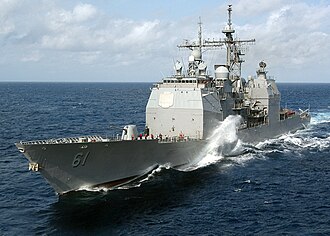
USS Monterey (CG-61): A Ticonderoga-Class Cruiser That Demonstrated the Power of the Aegis Fleet
Commissioned in June 1990, USS Monterey entered service at a fascinating moment in history. The Soviet Union was approaching its final years, the Cold War was rapidly ending, and American military planners were preparing for an uncertain future rather than a single predictable adversary. Unlike earlier generations of cruisers built primarily for fleet engagements against enemy naval forces, USS Monterey would spend much of its career responding to regional crises, supporting coalition operations, protecting international shipping, and contributing to the expanding role of integrated missile defense. The ship’s versatility made it an ideal platform for these evolving missions.
Named after the historic Battle of Monterey during the Mexican-American War, USS Monterey continued a long tradition of naval vessels carrying names associated with significant American military victories. Earlier ships bearing the name had served with distinction in previous conflicts, and CG-61 inherited both that proud heritage and the responsibility of representing the professionalism of the United States Navy around the world.
The ship’s most defining feature was its Aegis Combat System, one of the most revolutionary technological developments ever introduced aboard a surface warship. Combined with the powerful AN/SPY-1 phased-array radar, an extensive vertical launch missile battery, advanced communications systems, and aviation facilities, USS Monterey became much more than a missile cruiser. It served as a command platform capable of protecting entire naval task forces while simultaneously conducting offensive strike missions, anti-submarine operations, and maritime security patrols.
The story of USS Monterey therefore extends beyond the history of a single vessel. It illustrates the broader evolution of naval warfare during the late twentieth and early twenty-first centuries, showing how technology, doctrine, and skilled sailors combined to maintain American maritime superiority during an era of unprecedented geopolitical change.
The Historical Legacy Behind the Name Monterey
The name “Monterey” has appeared several times in United States naval history, each time honoring the Battle of Monterey, fought in September 1846 during the Mexican-American War. That battle represented one of the most important urban engagements of the conflict, as American forces fought through the fortified city of Monterrey in northern Mexico. Despite difficult terrain and determined resistance, American troops ultimately secured victory after several days of intense combat. The battle became remembered for courage, determination, and effective combined military operations.
The United States Navy has traditionally selected names that preserve important moments in American military history, allowing modern sailors to maintain connections with those who served before them. By assigning the name Monterey to successive warships, the Navy emphasized continuity between generations of military service while reminding crews that their own accomplishments would eventually become part of that historical tradition.
Before CG-61 entered service, several notable naval vessels had already carried the Monterey name. Perhaps the best known was USS Monterey (CVL-26), an Independence-class light aircraft carrier that served with distinction during World War II. That carrier participated in numerous Pacific operations and became famous not only for its combat service but also because future U.S. President Gerald R. Ford served aboard her during the war. Earlier and later vessels carrying the Monterey name similarly reflected different eras of naval development, ranging from sailing ships to aviation platforms.
USS Monterey (CG-61) therefore inherited a distinguished lineage. Although its mission differed greatly from those of its predecessors, the ship continued the same tradition of representing American naval professionalism, technological excellence, and readiness to operate wherever national interests required.
The Symbolism Behind the Ship’s Name
Names carry special meaning in naval culture. Every sailor assigned to USS Monterey became part of a story stretching back more than a century, linking modern service with earlier generations of American seamen. The name reminded the crew that every deployment, exercise, and mission added another chapter to a legacy built through discipline, courage, and commitment.
The city of Monterey itself has also long been associated with maritime activity, serving as an important coastal community overlooking California’s Pacific coastline. Although the cruiser officially commemorated the historic battle, the name also naturally evoked America’s longstanding relationship with the sea, reinforcing the vessel’s identity as part of a global naval force.
The Development of the Ticonderoga-Class Guided Missile Cruiser
USS Monterey emerged from one of the most successful surface combatant programs ever undertaken by the United States Navy. During the 1970s, naval planners recognized that future conflicts would involve increasingly sophisticated aircraft, anti-ship missiles, submarines, and electronic warfare systems. Existing cruisers and destroyers possessed excellent capabilities, but they relied upon combat systems that required significant human coordination and could become overwhelmed during large-scale missile attacks.
To address this challenge, the Navy developed the revolutionary Aegis Combat System, an integrated network that combined powerful phased-array radar, advanced computers, automated threat evaluation, weapons control, and communications into a unified battle management system. Rather than simply detecting targets, Aegis continuously tracked hundreds of contacts simultaneously while automatically assisting operators in prioritizing threats and assigning defensive weapons.
The first Ticonderoga-class cruisers demonstrated the effectiveness of this concept, and later ships—including USS Monterey—benefited from continuous improvements in software, electronics, and missile technology. By the time CG-61 entered service, the class had matured into one of the world’s most capable multi-mission surface combatants.
Unlike earlier cruisers that often specialized in particular mission areas, USS Monterey was designed from the beginning to perform numerous roles simultaneously. It could defend aircraft carriers from air attack, launch precision strike missiles against land targets, engage hostile surface vessels, hunt submarines, coordinate fleet operations, and support humanitarian missions. This remarkable flexibility became one of the defining strengths of both the ship and the entire Ticonderoga class.
The Revolutionary Aegis Combat System
At the heart of USS Monterey lay the Aegis Combat System, whose most visible component was the AN/SPY-1 phased-array radar. Unlike traditional rotating radar antennas that mechanically swept the horizon, the SPY-1 used electronically steered beams capable of changing direction almost instantly. This technology dramatically increased tracking speed and accuracy while allowing the radar to monitor vast portions of surrounding airspace and sea lanes without interruption.
Information gathered by the radar flowed into sophisticated combat computers that continuously evaluated potential threats and presented commanders with a comprehensive tactical picture. Operators could monitor hundreds of contacts simultaneously while coordinating defensive and offensive actions across the entire task force. This represented a fundamental shift in naval warfare, transforming the cruiser from an individual fighting ship into the central command node of an integrated fleet defense network.
The effectiveness of Aegis quickly established the Ticonderoga class as indispensable elements of carrier battle groups, and USS Monterey would spend much of its career demonstrating precisely why this technological revolution proved so successful.
Construction and Commissioning of USS Monterey
USS Monterey was constructed at Bath Iron Works in Bath, Maine, one of America’s premier naval shipyards and a facility renowned for producing some of the world’s finest surface combatants. Construction of a Ticonderoga-class cruiser required exceptional precision because every mechanical, electrical, electronic, and combat component had to function as part of one integrated system. Thousands of workers contributed specialized expertise throughout the building process, assembling everything from massive propulsion machinery to highly sophisticated radar arrays and missile launch systems.
The keel of USS Monterey was laid on 19 August 1986, marking the official beginning of construction. Over the following years, the vessel steadily took shape as sections of the hull were joined together, propulsion systems installed, combat electronics integrated, and interior spaces prepared for future crews. Each construction milestone brought the cruiser closer to becoming one of the Navy’s newest and most capable warships.
The ship was launched on 16 October 1988 and officially commissioned into active naval service on 16 June 1990. During the commissioning ceremony, responsibility for the vessel transferred from the builders to the United States Navy. Officers and enlisted sailors accepted the responsibility of operating, maintaining, and defending one of the fleet’s newest Aegis cruisers.
Preparing for Operational Service
Commissioning marked only the beginning of USS Monterey’s career. Before undertaking overseas deployments, the ship completed extensive sea trials, engineering evaluations, combat system certifications, and crew training exercises. These demanding preparations ensured that every department could operate effectively under realistic operational conditions. Navigation teams practiced ship handling, engineers mastered propulsion systems, combat specialists refined missile and radar procedures, and damage-control teams repeatedly rehearsed emergency responses.
This period of intensive preparation reflected an enduring principle of naval service: advanced technology alone cannot guarantee success. Even the world’s most capable warship ultimately depends upon the knowledge, discipline, and teamwork of the sailors who serve aboard her. Those qualities would become central to USS Monterey’s operational success throughout the decades that followed.
Weapons Systems and Multi-Mission Combat Capability
USS Monterey (CG-61) was designed to perform a remarkable variety of combat missions without sacrificing effectiveness in any individual area. Unlike earlier generations of cruisers that often specialized in anti-aircraft warfare or anti-submarine operations, the Ticonderoga-class represented a true multi-role combat platform capable of responding to virtually every conventional naval threat. This versatility was achieved through the integration of advanced sensors, digital command systems, vertical missile launchers, naval guns, electronic warfare equipment, and aviation facilities into a unified combat architecture. The result was a cruiser capable of protecting entire carrier strike groups while simultaneously conducting independent operations across vast areas of ocean. Throughout its service, USS Monterey repeatedly demonstrated that the effectiveness of a modern warship depends not merely upon the number of weapons it carries, but upon the ability to coordinate those weapons rapidly and accurately against multiple threats at the same time.
MK 41 Vertical Launch System
The heart of USS Monterey’s offensive and defensive firepower was the MK 41 Vertical Launch System (VLS). Rather than using traditional missile launch rails, the cruiser employed vertical launch cells located beneath the forward and aft decks. Each missile occupied its own armored launch cell, allowing rapid firing without requiring mechanical movement of the launcher itself. This design significantly increased reliability, reduced reaction time, and enabled the ship to carry a diverse mix of missiles simultaneously. Depending upon operational requirements, USS Monterey could load Standard surface-to-air missiles for fleet defense, Tomahawk land-attack cruise missiles for precision strikes, Vertical Launch ASROC anti-submarine rockets, and other specialized weapons. The flexibility of the VLS meant commanders could tailor the ship’s weapons inventory before deployment according to anticipated mission requirements.
This modular missile arrangement became one of the defining characteristics of modern American surface combatants. Instead of constructing separate classes of ships for different missions, the Navy could employ the same cruiser in air-defense operations, strike warfare, anti-submarine missions, or maritime security patrols simply by adjusting the missile loadout. USS Monterey benefited enormously from this flexibility throughout its long operational career.
Standard Missile Family
Among the most important weapons aboard USS Monterey were the Standard Missile variants carried within the vertical launch system. These missiles formed the backbone of the Navy’s fleet air-defense network. Controlled through the Aegis Combat System, Standard Missiles could intercept hostile aircraft, cruise missiles, and other airborne threats long before they approached protected naval forces. Their combination of speed, guidance accuracy, and extended range allowed USS Monterey to establish a defensive umbrella covering aircraft carriers, amphibious groups, logistics ships, and allied vessels operating nearby.
As missile technology evolved, newer variants expanded the ship’s capabilities even further. Improved guidance systems, longer engagement ranges, and enhanced reliability ensured that USS Monterey remained an effective air-defense platform despite rapidly advancing threats. The cruiser became an essential component of nearly every carrier strike group to which it was assigned because commanders depended upon its ability to coordinate fleet-wide defensive operations.
Tomahawk Land Attack Missiles
USS Monterey’s offensive reach extended far beyond the horizon through its ability to launch Tomahawk Land Attack Missiles (TLAMs). These precision-guided cruise missiles enabled the cruiser to strike important military targets hundreds of miles inland while remaining safely offshore. Tomahawk technology fundamentally changed naval strategy by allowing surface warships to influence land campaigns without exposing themselves to coastal defenses or requiring direct visual contact with the target.
The precision of these missiles also reduced collateral damage compared with older forms of naval bombardment. During coalition operations, Tomahawk strikes frequently served as the opening phase of military campaigns by disabling radar installations, command centers, air-defense systems, and strategic infrastructure before aircraft entered hostile airspace. USS Monterey’s participation in such operations demonstrated the growing importance of surface combatants in joint military planning.
Naval Guns and Close-In Defense
Although missiles dominated modern naval warfare, USS Monterey retained conventional gun systems that remained valuable for numerous operational situations. Two 5-inch/54 caliber naval guns provided highly reliable firepower against surface targets, coastal positions, and smaller vessels. Naval guns offered several practical advantages: ammunition costs were significantly lower than guided missiles, magazines carried hundreds of rounds, and sustained fire support could be delivered for extended periods without exhausting expensive missile inventories.
For protection against missiles or aircraft that penetrated the ship’s outer defensive layers, USS Monterey employed the Phalanx Close-In Weapon System (CIWS). This radar-controlled rapid-fire weapon served as the cruiser’s final defensive barrier. Operating almost automatically once activated, the system could detect, track, and engage incoming threats within seconds, providing valuable additional protection for both the cruiser and nearby vessels.
Propulsion, Engineering, and Seakeeping Performance
USS Monterey’s engineering systems reflected the Navy’s emphasis on reliability, endurance, and sustained high-speed operations. Powered by four General Electric LM2500 gas turbines arranged in a Combined Gas and Gas (COGAG) configuration, the cruiser generated approximately 80,000 shaft horsepower. This propulsion arrangement enabled speeds exceeding 30 knots while maintaining impressive operational endurance across long ocean deployments.
Gas turbine propulsion represented a significant improvement over earlier steam-powered warships. The engines required less maintenance, could be started more rapidly, and offered greater operational flexibility. Their relatively compact size also freed valuable internal space for combat systems, crew accommodations, and additional equipment. Throughout decades of worldwide deployments, USS Monterey’s propulsion plant proved both dependable and efficient, supporting missions that often required months at sea without returning to home port.
Endurance and Ocean Operations
The size and engineering capacity of USS Monterey allowed it to remain deployed for extended periods while operating under demanding conditions. Replenishment-at-sea operations enabled the cruiser to receive fuel, food, ammunition, and spare parts without entering port, allowing continuous participation in fleet operations across the Atlantic Ocean, Mediterranean Sea, Persian Gulf, Arabian Sea, and other strategically important regions. This logistical flexibility became one of the defining strengths of modern carrier strike groups, permitting sustained global naval presence virtually anywhere in the world.
Aviation Facilities and Helicopter Operations
An important element of USS Monterey’s versatility was its embarked aviation capability. The cruiser featured a flight deck and hangar designed to support SH-60 Seahawk helicopters, which dramatically expanded the ship’s operational reach. While radar systems provided extensive surveillance, helicopters extended the cruiser’s awareness even farther by investigating distant contacts, searching for submarines, conducting rescue missions, and transporting personnel or supplies between ships.
The SH-60 Seahawk proved especially valuable in anti-submarine warfare. Equipped with dipping sonar, sonobuoys, radar, and lightweight torpedoes, the helicopter could rapidly investigate underwater contacts well beyond the detection range of the ship’s hull-mounted sonar. This combination of airborne and shipboard sensors greatly increased the effectiveness of naval task forces operating in submarine-threat environments.
Search and Rescue Operations
Beyond combat missions, embarked helicopters frequently supported humanitarian assistance and emergency response. Search-and-rescue operations at sea demand speed and flexibility, and helicopters can reach survivors far more quickly than surface vessels alone. Throughout its career, USS Monterey’s aviation facilities supported rescue exercises, medical evacuations, personnel transfers, and disaster-relief activities, demonstrating that modern warships often perform vital humanitarian functions in addition to their military responsibilities.
Operational Service During the Post-Cold War Era
Although USS Monterey entered service only months before the Cold War officially ended, the conclusion of superpower rivalry did not reduce the demand for capable naval forces. Instead, the strategic environment became more complex and unpredictable. Regional conflicts, maritime terrorism, piracy, humanitarian emergencies, and coalition operations required flexible warships capable of responding rapidly across the globe. USS Monterey’s multi-mission design made it exceptionally well suited to this changing environment.
Throughout the 1990s and early twenty-first century, the cruiser participated in numerous deployments supporting American and allied interests. Carrier strike group operations, multinational exercises, freedom of navigation patrols, and deterrence missions became routine aspects of its service. Whether operating in the Mediterranean, the Arabian Gulf, or the Atlantic Ocean, USS Monterey consistently demonstrated the adaptability envisioned by its designers.
Supporting Carrier Strike Groups
One of USS Monterey’s primary responsibilities involved protecting aircraft carriers. A carrier strike group represents one of the most valuable and strategically significant formations in modern military operations, making comprehensive air and missile defense essential. As an Aegis cruiser, USS Monterey frequently served as the air-defense commander within these formations, coordinating radar coverage, identifying potential threats, and directing defensive missile engagements when necessary.
This leadership role required exceptional coordination with destroyers, aircraft, submarines, and allied naval forces. Rather than functioning independently, the cruiser became the information hub of a sophisticated defensive network extending hundreds of miles across the surrounding maritime battlespace.
Ballistic Missile Defense and Twenty-First Century Missions
As ballistic missile technology spread to additional nations during the early twenty-first century, the United States Navy expanded the role of Aegis-equipped warships beyond traditional fleet air defense. USS Monterey became one of the cruisers supporting ballistic missile defense (BMD) missions, demonstrating how adaptable the Aegis architecture remained decades after its original introduction.
Ballistic missile defense required upgrades to software, radar processing, communications systems, and interceptor missiles. These improvements enabled Aegis warships to detect, track, and potentially intercept ballistic missiles during portions of their flight. This mission represented a major expansion of the cruiser’s responsibilities, extending its role from protecting naval forces to contributing to regional and allied defensive strategies.
Deployments supporting ballistic missile defense often involved close cooperation with NATO allies and partner nations. USS Monterey’s advanced sensors and communications capabilities enabled seamless integration into multinational command networks, reflecting the increasingly cooperative nature of modern maritime security operations.
Life Aboard USS Monterey
Behind every advanced combat system, missile launcher, radar array, and propulsion plant aboard USS Monterey (CG-61) stood the officers and enlisted sailors who made the ship an effective fighting unit. While the cruiser was often recognized for its sophisticated Aegis Combat System and impressive arsenal, its true strength came from the professionalism, discipline, and teamwork of its crew. Like every major surface combatant in the United States Navy, USS Monterey functioned as a self-contained community at sea, where hundreds of individuals with different specialties worked together around the clock to maintain readiness. Life aboard the ship demanded technical expertise, physical endurance, adaptability, and a commitment to continuous training, because the operational environment could change from routine patrols to high-intensity combat with very little warning.
The ship typically carried a complement of approximately 350 to 400 officers and enlisted personnel. These sailors represented dozens of different occupational specialties, including engineering, navigation, operations, weapons, communications, intelligence, aviation support, medical services, logistics, culinary services, administration, and damage control. Every department played a vital role in maintaining the ship’s operational capability. Engineers kept the propulsion plant functioning efficiently, combat systems technicians maintained radar and missile equipment, operations specialists monitored tactical information, and supply personnel ensured that the crew received food, equipment, and replacement parts during long deployments.
Daily life followed a demanding schedule structured around rotating watches. Because a warship never stops operating while at sea, sailors worked day and night in carefully organized shifts. Personnel assigned to the bridge supervised navigation and safe ship handling, while engineers continuously monitored machinery spaces deep within the hull. Combat Information Center watch teams maintained awareness of surrounding aircraft, ships, and potential threats through radar, sonar, satellite communications, and intelligence reports. Even during periods of apparent routine, the crew remained prepared to respond immediately to emergencies or operational tasking.
Training and Damage Control
One of the defining characteristics of service aboard USS Monterey was the Navy’s constant emphasis on training. Damage-control drills occurred regularly throughout deployments because every sailor, regardless of specialty, had responsibilities during emergencies. Fires, flooding, equipment failures, or combat damage could threaten the survival of the ship, making rapid and coordinated responses essential. Crew members repeatedly practiced firefighting procedures, hull repair techniques, medical response, casualty evacuation, and emergency communications until these actions became second nature.
Combat readiness received equal attention. Missile exercises, radar tracking drills, electronic warfare scenarios, anti-submarine exercises, and helicopter operations were routinely conducted to ensure that every department could perform effectively under realistic operational conditions. This continuous cycle of preparation reflected a core principle of naval service: technology provides capability, but disciplined and well-trained sailors transform that capability into operational success.
Modernization and the Continuing Evolution of the Aegis Fleet
One of the greatest strengths of the Ticonderoga-class cruiser program was the ability to modernize existing ships rather than replacing them entirely. USS Monterey benefited from numerous upgrades throughout its service life, allowing the cruiser to remain effective despite rapid advances in military technology. Improvements to computer hardware, software architecture, communications systems, radar processing, and missile technology ensured that the ship continued meeting evolving operational requirements decades after its commissioning.
The adaptability of the Aegis Combat System proved particularly valuable. Unlike earlier combat systems that required extensive hardware replacement to achieve meaningful improvements, Aegis could incorporate new software capabilities and integrate increasingly sophisticated weapons. As ballistic missile defense, network-centric warfare, and cooperative engagement concepts became central elements of naval strategy, USS Monterey evolved alongside these developments without losing its fundamental operational effectiveness.
Modernization also extended beyond combat systems. Habitability improvements enhanced living conditions for sailors during lengthy deployments, while engineering upgrades improved reliability and maintenance efficiency. Such investments reflected the Navy’s recognition that sustaining experienced crews aboard capable ships often provided greater strategic value than prematurely replacing proven platforms.
The Importance of Adaptability
The operational history of USS Monterey illustrates a broader lesson in naval engineering. Successful warships are rarely defined solely by their original specifications. Instead, their long-term value depends upon their ability to incorporate new technologies, respond to emerging threats, and support evolving operational concepts. Throughout its career, USS Monterey consistently demonstrated this adaptability, transitioning from Cold War fleet defense to precision strike operations, maritime security, ballistic missile defense, and multinational coalition missions with remarkable effectiveness.
The Legacy of USS Monterey (CG-61)
USS Monterey occupies an important place within the history of the United States Navy because it served during one of the most transformative periods in modern maritime strategy. Entering service just before the conclusion of the Cold War, the cruiser witnessed dramatic changes in the international security environment while remaining a relevant and valuable component of American naval power. Few classes of warships have demonstrated such consistent versatility across changing geopolitical conditions, and USS Monterey stands as an excellent example of that success.
The ship’s contributions extended beyond individual deployments. By participating in multinational exercises, coalition operations, missile defense missions, humanitarian support activities, and freedom of navigation patrols, USS Monterey strengthened relationships with allied navies while reinforcing the United States’ commitment to maintaining stability across the world’s oceans. These operations highlighted the increasingly international nature of maritime security, where cooperation between allied nations became as important as individual combat capability.
USS Monterey also contributed to the continuing development of naval doctrine. Operational experience gained aboard Aegis cruisers influenced the design of future guided missile destroyers, integrated air-defense systems, cooperative engagement capabilities, and ballistic missile defense concepts. Lessons learned during decades of service helped shape the next generation of surface combatants that continue protecting American interests today.
A Symbol of American Naval Excellence
Every generation of warships reflects the strategic priorities and technological achievements of its era. Battleships symbolized industrial power during the early twentieth century, aircraft carriers transformed naval aviation during World War II, and guided missile cruisers like USS Monterey demonstrated the growing importance of electronics, computers, and integrated combat networks. By combining these technologies with highly trained crews and global operational experience, USS Monterey became a symbol of the professionalism and adaptability that have long characterized the United States Navy.
Conclusion
USS Monterey (CG-61) represents one of the finest examples of the Ticonderoga-class guided missile cruiser and remains an important chapter in the history of modern naval warfare. Designed around the revolutionary Aegis Combat System, the ship combined exceptional radar capability, advanced missile technology, flexible mission planning, and outstanding operational endurance into a single platform capable of defending fleets, projecting power ashore, hunting submarines, and supporting multinational security operations around the world.
Throughout more than three decades of service, USS Monterey adapted successfully to changing military requirements while maintaining the high standards expected of one of the Navy’s premier surface combatants. From Cold War deterrence to post-Cold War regional operations, from precision strike missions to ballistic missile defense, the cruiser repeatedly demonstrated the value of technological innovation supported by disciplined and highly trained sailors.
Perhaps the ship’s greatest legacy lies in the example it established for future generations of naval vessels. The concepts pioneered and refined aboard USS Monterey—including integrated air defense, networked warfare, multi-mission flexibility, and continuous modernization—continue influencing modern surface combatants across the world. Although newer ships have entered service, the operational lessons learned from USS Monterey remain highly relevant to contemporary naval strategy.
Ultimately, USS Monterey was far more than steel, machinery, radar arrays, and missile launchers. It was a living community of dedicated sailors, an instrument of American foreign policy, and a powerful reminder that maritime strength depends not only upon advanced technology but also upon the professionalism, courage, and commitment of those who serve at sea. Its distinguished career ensures that the name Monterey will continue to occupy an honored place within the long history of the United States Navy.
Technical Specifications Summary
| Specification | Details |
|---|---|
| Ship Name | USS Monterey (CG-61) |
| Hull Classification | CG-61 |
| Class | Ticonderoga-class guided missile cruiser |
| Type | Aegis guided missile cruiser |
| Builder | Bath Iron Works, Bath, Maine |
| Keel Laid | 19 August 1986 |
| Launched | 16 October 1988 |
| Commissioned | 16 June 1990 |
| Displacement | Approximately 9,800 tons (full load) |
| Length | 567 ft (173 m) |
| Beam | 55 ft (16.8 m) |
| Draft | Approximately 34 ft (10.4 m) |
| Propulsion | 4 × General Electric LM2500 gas turbines (COGAG) |
| Power Output | Approximately 80,000 shaft horsepower |
| Maximum Speed | 30+ knots |
| Range | Approximately 6,000 nautical miles at 20 knots |
| Crew | Approximately 350–400 officers and enlisted personnel |
| Combat System | Aegis Combat System |
| Primary Radar | AN/SPY-1 phased-array radar |
| Missile Launch System | MK 41 Vertical Launch System (VLS) |
| Primary Missiles | Standard Missile family, Tomahawk cruise missiles, VL-ASROC |
| Main Guns | 2 × 5-inch (127 mm)/54 caliber naval guns |
| Close-In Defense | Phalanx CIWS |
| Anti-Submarine Weapons | MK 32 torpedo tubes and VL-ASROC |
| Aircraft Carried | Up to 2 × SH-60 Seahawk helicopters |
| Primary Roles | Fleet air defense, ballistic missile defense, strike warfare, anti-submarine warfare, surface warfare, command and control |
| Namesake | Battle of Monterey (Mexican-American War) |
