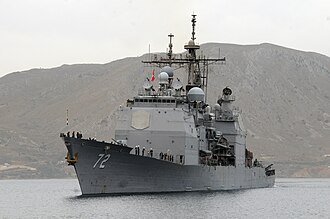
USS Vella Gulf (CG-72) – The Story of an Aegis Cruiser That Served Across Three Decades of Naval History
The cruiser was equipped with the revolutionary Aegis Combat System, one of the most sophisticated naval warfare systems ever developed. Combining phased-array radar, advanced command-and-control software, vertical launch missile technology, and long-range defensive capabilities, the ship became a floating command center capable of protecting aircraft carriers, amphibious groups, merchant shipping, and allied naval forces against a wide variety of threats. Whether operating in the Mediterranean Sea, the Persian Gulf, the Atlantic Ocean, or other strategically important waterways, USS Vella Gulf demonstrated how information technology and precision weapons had fundamentally changed the nature of naval warfare.
Beyond its impressive technology, USS Vella Gulf also represents an important chapter in the long tradition of naming American warships after significant naval battles. Its name commemorates the Battle of Vella Gulf, fought during the Solomon Islands campaign of the Second World War, where American destroyers achieved a decisive nighttime victory against Japanese naval forces. That historical connection reminds sailors and historians alike that every modern warship carries not only advanced weapons and sensors but also the memory of earlier generations whose sacrifices shaped naval history.
This article explores the complete story of USS Vella Gulf, from the origins of its name and the development of the Ticonderoga-class, through its construction, technological innovations, operational deployments, modernization efforts, and eventual retirement from active service. Together these elements illustrate why the ship became one of the defining guided missile cruisers of its generation.
The Historical Origin of the Name “Vella Gulf”
USS Vella Gulf derives its name from the Battle of Vella Gulf, fought during the Pacific campaign of the Second World War on the night of 6–7 August 1943. The engagement occurred near Kolombangara Island in the Solomon Islands chain, where American destroyers intercepted a Japanese reinforcement force attempting to transport troops and supplies. Unlike many earlier nighttime naval engagements, the American force relied on radar-directed tactics rather than visual detection, allowing the destroyers to launch a devastating surprise attack without suffering damage themselves. Three Japanese destroyers were sunk while the American ships escaped unscathed, making the battle one of the most successful destroyer actions of the Pacific War.
Naming a cruiser after this victory reflects the United States Navy’s long-standing tradition of honoring significant naval engagements. It also serves as a reminder that technological superiority, careful planning, disciplined crews, and tactical innovation often determine success at sea. These same qualities would later characterize USS Vella Gulf throughout its own decades of service.
The Evolution of the Ticonderoga-Class
Cold War Requirements
During the 1970s and early 1980s, the United States Navy faced an increasingly sophisticated Soviet naval threat. Long-range bombers carrying anti-ship missiles, nuclear-powered submarines, and advanced surface combatants required a new generation of escorts capable of defending carrier battle groups against coordinated attacks. Existing guided missile cruisers possessed impressive capabilities but lacked the integrated sensor and command systems necessary to counter multiple simultaneous threats. Naval planners therefore initiated the Ticonderoga-class program to create a ship capable of functioning as the centerpiece of fleet air defense.
The Aegis Revolution
The defining innovation of the class was the Aegis Combat System. Instead of treating radar, weapons, and command functions as separate components, Aegis integrated them into a unified digital architecture. The powerful AN/SPY-1 phased-array radar continuously scanned the surrounding airspace while advanced computers analyzed hundreds of contacts in real time. Commanders could assign missiles automatically, coordinate with other ships, and respond almost instantly to changing tactical situations. USS Vella Gulf inherited this revolutionary capability, becoming one of the world’s most advanced surface combatants.
Construction and Commissioning
USS Vella Gulf was built by Ingalls Shipbuilding in Pascagoula, Mississippi, one of the United States Navy’s premier shipbuilding facilities. Construction reflected decades of accumulated expertise in producing complex warships capable of serving around the globe under demanding operational conditions. The keel was laid on 22 April 1991, marking the official beginning of the ship’s construction. Over the following months, thousands of workers assembled the hull, installed propulsion systems, integrated combat electronics, and completed extensive testing before launch.
The cruiser was launched on 13 June 1992 and officially commissioned on 18 September 1993. During the commissioning ceremony, the ship formally entered active service and became part of the Atlantic Fleet. From its very first deployment, USS Vella Gulf demonstrated the capabilities expected of an Aegis cruiser, participating in complex fleet exercises that emphasized air defense, anti-submarine warfare, and multinational cooperation.
Design Philosophy
Multi-Mission Capability
Unlike specialized warships optimized for a single mission, USS Vella Gulf was designed to perform numerous tasks simultaneously. It could defend against aircraft, intercept cruise missiles, launch precision strikes against land targets, hunt submarines, engage hostile surface ships, coordinate fleet operations, and support humanitarian missions. This extraordinary flexibility allowed commanders to assign the cruiser to carrier strike groups, amphibious ready groups, or independent deployments depending upon strategic requirements.
Hull and Structural Features
The cruiser measured nearly 567 feet (173 meters) in length and displaced approximately 9,600 tons at full load. Its steel hull provided excellent endurance for long deployments while maintaining sufficient speed to accompany fast carrier groups. The superstructure housed the distinctive fixed radar arrays of the Aegis system, communications equipment, electronic warfare suites, and command facilities that allowed the ship to coordinate complex naval operations over vast distances.
Propulsion System
USS Vella Gulf is powered by four General Electric LM2500 gas turbines arranged in a Combined Gas and Gas (COGAG) configuration. Together these engines produce approximately 80,000 shaft horsepower, driving two propeller shafts and allowing the cruiser to exceed 30 knots under favorable conditions. Gas turbine propulsion offers several advantages, including rapid acceleration, reduced maintenance compared with steam plants, and improved operational flexibility. These characteristics enabled the cruiser to reposition quickly during tactical operations while maintaining the endurance necessary for extended overseas deployments.
The Aegis Combat System
AN/SPY-1 Radar
Perhaps no single feature defines USS Vella Gulf more than its AN/SPY-1 phased-array radar. Unlike conventional rotating radar antennas, the phased-array system electronically steers radar beams without moving mechanical parts. This enables continuous surveillance across vast areas while simultaneously tracking hundreds of targets. Aircraft, ballistic missiles, cruise missiles, and surface vessels can all be monitored at once, providing commanders with exceptional situational awareness.
Integrated Battle Management
Information gathered by the radar is processed through advanced combat computers that evaluate threats, assign priorities, recommend weapon solutions, and coordinate engagements. The system greatly reduces reaction time, allowing USS Vella Gulf to defend both itself and nearby vessels against highly complex attacks involving multiple incoming missiles or aircraft.
Weapons Systems
Vertical Launch System
The cruiser carries 122 Mk 41 Vertical Launch System cells distributed between the bow and stern. These launchers provide remarkable flexibility because they can accommodate multiple missile types without requiring dedicated launch rails. Depending on mission requirements, USS Vella Gulf could carry Standard surface-to-air missiles, Tomahawk land-attack cruise missiles, Vertical Launch ASROC anti-submarine rockets, or other compatible weapons.
Main Gun
A single 5-inch (127 mm) Mk 45 naval gun provides effective fire support against surface targets, coastal positions, and airborne threats. Although missiles dominate modern naval warfare, naval guns remain valuable because they deliver sustained fire at comparatively low cost while supporting amphibious operations and maritime security missions.
Close-In Defense
As the final protective layer, the cruiser employs the Phalanx Close-In Weapon System, an automated radar-guided Gatling gun capable of intercepting incoming missiles and aircraft at extremely short range. Combined with electronic warfare systems, decoys, and layered missile defenses, Phalanx forms part of a comprehensive defensive network.
Aviation Facilities
USS Vella Gulf includes a helicopter flight deck and enclosed hangar capable of supporting two SH-60 Seahawk or MH-60R helicopters. These aircraft dramatically expand the ship’s operational reach by conducting anti-submarine patrols, over-the-horizon targeting, search and rescue missions, logistics support, and maritime surveillance. Helicopter operations are carefully coordinated by trained flight deck crews working in challenging sea conditions, demonstrating the integration of aviation into modern surface warfare.
Operational History
Early Deployments
Following commissioning, USS Vella Gulf conducted training exercises and work-up deployments to prepare its crew for operational service. These early missions emphasized integration with carrier strike groups, multinational exercises with allied navies, and mastery of the Aegis combat system under realistic conditions.
Mediterranean and Middle Eastern Operations
Throughout its career, the cruiser frequently deployed to the Mediterranean Sea and the Persian Gulf. During these deployments it supported maritime security operations, enforced international sanctions, protected commercial shipping, and participated in multinational naval exercises. The ship’s ability to defend entire task groups against aerial threats made it an indispensable component of American naval presence in these strategically important regions.
Operations Enduring Freedom and Iraqi Freedom
USS Vella Gulf participated in operations connected with the Global War on Terror. During deployments supporting Operations Enduring Freedom and Iraqi Freedom, the cruiser provided air defense, command-and-control capabilities, and Tomahawk strike capacity. Its ability to launch precision-guided cruise missiles enabled naval forces to influence events far inland while remaining safely offshore.
Ballistic Missile Defense
As ballistic missile threats became increasingly significant during the twenty-first century, USS Vella Gulf received upgrades enabling participation in ballistic missile defense missions. Through software improvements and integration with evolving Aegis capabilities, the cruiser contributed to regional missile defense networks designed to detect, track, and potentially intercept ballistic missiles. This mission reflected the adaptability of the Ticonderoga-class and demonstrated how ships originally designed during the Cold War continued evolving to address modern security challenges.
Life Aboard USS Vella Gulf
Serving aboard USS Vella Gulf required exceptional professionalism from a crew of approximately 350 sailors. Life at sea involved long working hours, continuous maintenance, regular training exercises, and extended deployments that often lasted many months. Sailors worked in engineering spaces, combat information centers, radar rooms, weapons magazines, aviation facilities, medical departments, communications centers, and countless other specialized areas. Every department contributed to maintaining the ship’s readiness, and cooperation between these diverse specialties was essential to operational success.
Despite demanding conditions, crew members developed strong bonds forged through shared responsibilities and extended time at sea. Naval traditions, ceremonies, athletic competitions, educational opportunities, and community outreach activities helped maintain morale while reinforcing the sense of belonging associated with serving aboard a major warship.
Modernization Throughout Service
Like other Ticonderoga-class cruisers, USS Vella Gulf underwent periodic modernization to ensure continued effectiveness. Upgrades included improvements to combat software, communications systems, navigation equipment, electronic warfare capabilities, cybersecurity protections, and missile compatibility. Rather than constructing entirely new classes of ships for every technological advance, the Navy invested in upgrading proven platforms capable of remaining operationally relevant for decades.
These modernization efforts demonstrated the flexibility built into the original Ticonderoga-class design. Engineers anticipated future technological development by providing sufficient space, electrical capacity, and computing architecture to accommodate new systems as they became available.
Retirement and Legacy
After nearly three decades of distinguished service, USS Vella Gulf was decommissioned in 2024 as part of the Navy’s ongoing fleet modernization efforts. Although retirement marked the end of the ship’s active operational career, its contributions to American naval power remain significant. Throughout its service, the cruiser participated in countless exercises, combat deployments, security operations, and international missions while helping demonstrate the effectiveness of the Aegis combat system.
The ship also represents an important stage in the evolution of modern naval warfare. During its operational lifetime, technology advanced dramatically, yet USS Vella Gulf continued adapting through modernization programs that kept it relevant in an increasingly complex security environment. Its legacy therefore extends beyond individual deployments, illustrating how thoughtful engineering and flexible design can produce warships capable of serving effectively across multiple generations of military technology.
Technical Specifications
| Specification | USS Vella Gulf (CG-72) |
|---|---|
| Class | Ticonderoga-class guided missile cruiser |
| Builder | Ingalls Shipbuilding, Pascagoula, Mississippi |
| Country | United States |
| Keel Laid | 22 April 1991 |
| Launched | 13 June 1992 |
| Commissioned | 18 September 1993 |
| Decommissioned | 2024 |
| Displacement | Approximately 9,600 tons (full load) |
| Length | 567 ft (173 m) |
| Beam | 55 ft (16.8 m) |
| Draft | Approximately 34 ft (10.4 m) |
| Propulsion | 4 × General Electric LM2500 gas turbines (COGAG) |
| Total Power | Approximately 80,000 shaft horsepower |
| Maximum Speed | 30+ knots (56+ km/h) |
| Range | Approximately 6,000 nautical miles at 20 knots |
| Crew | Approximately 350 officers and enlisted personnel |
| Combat System | Aegis Combat System |
| Main Radar | AN/SPY-1 phased-array radar |
| Vertical Launch System | 122-cell Mk 41 VLS |
| Main Gun | 1 × 5-inch (127 mm) Mk 45 naval gun |
| Close-In Defense | 2 × Phalanx CIWS |
| Aircraft Facilities | Flight deck and hangar for 2 × MH-60R/SH-60 Seahawk helicopters |
| Primary Missions | Air defense, ballistic missile defense, anti-submarine warfare, surface warfare, strike warfare, fleet command |
| Status | Decommissioned |
