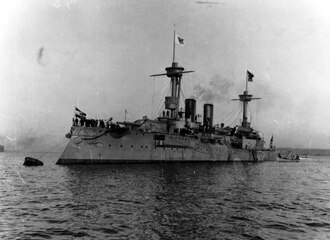
SMS Brandenburg: The Battleship That Marked Germany’s Entry Into the Pre-Dreadnought Era
SMS Brandenburg was one of the most important battleships of the Imperial German Navy during the final decade of the nineteenth century. Commissioned in 1893, she was the lead ship of the Brandenburg class, a group of four vessels that represented Germany’s first serious attempt to build modern ocean-going battleships rather than primarily relying on coastal-defense ships and armored frigates. At a time when naval technology was changing at remarkable speed, Brandenburg introduced an unusually powerful main battery, substantial armor protection, and a design intended for fleet operations rather than simply defending German harbors. Her six 28 cm guns were particularly distinctive because most contemporary battleships mounted only four heavy guns. Although Brandenburg would be rendered obsolete by the rapid development of naval technology within little more than a decade, her career helped establish the foundation upon which the much larger and more sophisticated German battleship fleet of the early twentieth century would be built. She served during a period of major political and strategic change, including Germany’s growing interest in overseas power, the development of the Imperial Navy under Kaiser Wilhelm II, and the international intervention against the Boxer Uprising in China. By the time the First World War began, however, Brandenburg was already an aging warship. She was relegated to secondary duties, eventually becoming a coastal-defense vessel and later a floating barracks before being removed from service and scrapped in the aftermath of the war.
The Origins of SMS Brandenburg
Germany begins building true battleships
The construction of Brandenburg reflected the transformation of German naval policy during the reign of Kaiser Wilhelm II. When Wilhelm became German Emperor in 1888, Germany was already an important European industrial power, but its navy remained considerably less impressive than those of Britain and France. Earlier German warships had often been designed with coastal defense and limited overseas operations in mind. The Brandenburg class represented a major departure from that approach. German naval planners increasingly recognized that an industrial and commercial power with growing overseas interests required ships capable of operating with a battle fleet and projecting military power beyond German coastal waters. The four Brandenburg-class vessels—Brandenburg, Kurfürst Friedrich Wilhelm, Weißenburg, and Wörth—were therefore conceived as genuine battleships rather than simply enlarged coastal-defense ships. Contemporary German naval sources describe the class as the first serious German attempt to construct this type of battleship, making Brandenburg an important transitional vessel between the older armored ships of the Imperial Navy and the pre-dreadnought battleships that followed.
Brandenburg was laid down at the AG Vulcan shipyard in Stettin in 1890. She was launched on September 21, 1891, and entered commissioned service on November 19, 1893. Her construction cost was reported at approximately 15.8 million Reichsmark, a substantial investment that reflected the importance Germany attached to creating a modern fleet. Her name came from the Prussian province of Brandenburg, continuing the German practice of naming major warships after German territories, regions, rulers, or important historical figures. The ship’s entry into service gave the Imperial German Navy a powerful new centerpiece for its fleet exercises and represented an important step toward the much larger naval expansion that would take place under Alfred von Tirpitz during the following decade.
An Unusual Battleship Design
Six heavy guns instead of four
The most distinctive characteristic of Brandenburg was her main armament. She carried six 28 cm guns arranged in three twin turrets, with one turret forward, one aft, and another positioned amidships. This was an unusual arrangement for the period and gave Brandenburg a considerably heavier theoretical broadside than many contemporary battleships, which commonly carried four heavy guns in two twin turrets. The German decision to install six heavy weapons reflected the naval thinking of the late nineteenth century, when designers were still experimenting with the best balance between caliber, number of guns, armor, speed, and displacement. Brandenburg’s arrangement was consequently an important experiment in concentrating substantial firepower within a relatively compact battleship.
The three turrets were not completely identical. The forward and aft guns used longer 28 cm L/40 weapons, while the amidships turret was equipped with shorter L/35 guns. The difference resulted from the physical limitations of the ship’s layout and the need to accommodate the central turret within the superstructure. This arrangement gave Brandenburg an impressive battery for her era, although the guns had limitations. German naval sources note that the 28 cm weapons could be loaded only when brought into a particular position, and their rate of fire was relatively slow after ready ammunition had been expended. These characteristics reflected the technological limitations of the period, when turret mechanisms, ammunition handling, and fire-control systems were still far less sophisticated than those developed during the dreadnought era.
Armor and survivability
Brandenburg was also heavily protected for her time. Her armored belt reached a maximum thickness of approximately 400 mm in the most heavily protected areas, while the deck armor was considerably thinner. The main gun positions and conning tower also received substantial armor, reflecting the importance German designers placed on protecting the ship’s vital machinery, ammunition spaces, and command facilities. The combination of heavy armor and a large main battery meant that Brandenburg was intended to fight in the line of battle rather than simply engage smaller vessels.
The ship’s protection was particularly significant because naval artillery was undergoing rapid development during the period. Steel armor was becoming more effective, smokeless propellants were changing gunnery, and larger guns were appearing on battleships across Europe. Brandenburg therefore represented an attempt to create a vessel capable of surviving the increasingly powerful weapons of contemporary naval combat while still maintaining enough mobility to operate with a fleet.
Propulsion and Performance
Steam power in the age of rapid naval development
Brandenburg was powered by two triple-expansion steam engines driving two propeller shafts. Steam was supplied by twelve marine boilers, and the machinery was designed to produce approximately 10,000 horsepower. Her maximum speed was around 16.3 knots, an impressive figure for a battleship of the early 1890s, although later generations of warships would quickly surpass it. Sources differ slightly in their published performance figures, with some contemporary or retrospective references giving values around 16.5 knots. The United States Naval History and Heritage Command, for example, records the ship at approximately 16.5 knots and about 10,100 tons, while German naval references give approximately 16.3 knots and a maximum displacement of about 10,670 tons.
Her range was approximately 4,300 nautical miles at 10 knots, giving Brandenburg enough endurance for extended fleet operations and overseas deployments. Her propulsion system also reflected the broader transition from older compound-engine technology toward the triple-expansion machinery that became increasingly common in major warships. Although the ship would eventually be overtaken by newer propulsion systems and faster battleships, her machinery represented contemporary German engineering at a time when naval architecture was changing at extraordinary speed.
Early Fleet Service
The development of German naval doctrine
Brandenburg spent much of her early career with the German fleet, participating in training exercises, maneuvers, and visits to foreign ports. These activities might appear uneventful when compared with later battleship campaigns, but they were extremely important to the development of Germany’s naval doctrine. The Imperial German Navy was still relatively young, and its officers needed experience operating large formations of battleships together. Fleet exercises provided opportunities to practice maneuvering, signaling, gunnery, tactical formations, and coordinated operations.
During the 1890s, Germany was gradually developing the naval institution that would eventually become the High Seas Fleet. Brandenburg and her sister ships were among the vessels that provided the practical foundation for this process. Their crews gained experience with modern battleship operations, while naval planners could evaluate how such ships performed under realistic conditions. The German Navy’s later development under Admiral Alfred von Tirpitz depended partly upon this earlier generation of fleet experimentation.
Brandenburg’s service therefore had significance beyond her individual combat capabilities. She was part of the transition from a navy centered largely on coastal defense toward one capable of sustained fleet operations. The exercises and international visits of the 1890s helped establish procedures and traditions that would become increasingly important as Germany expanded its naval ambitions.
Brandenburg and the Boxer Uprising
Germany sends its battleships to China
Brandenburg’s most important overseas deployment came in 1900, when she and her three sister ships were sent to East Asia as part of the international military intervention during the Boxer Uprising in China. The uprising had created a major crisis for foreign powers with interests and diplomatic missions in China, and several nations assembled military forces to protect their citizens and interests and suppress the rebellion. Germany was among the powers that dispatched naval and military forces to the region.
The Brandenburg-class battleships were valuable assets because they combined substantial firepower with the endurance necessary for an overseas deployment. Their participation demonstrated that the Imperial German Navy was increasingly capable of operating far beyond the North Sea and Baltic Sea. The deployment also reflected Germany’s growing interest in overseas influence, particularly in an era when European powers competed for commercial privileges, colonial possessions, and strategic positions around the world. Brandenburg’s service in East Asia consequently formed an important part of Germany’s transition from a predominantly continental power toward a state with growing global ambitions.
The ships remained involved in the Asian deployment during 1900 and 1901. Although Brandenburg did not become famous for a dramatic ship-to-ship battle during the expedition, the deployment demonstrated the practical value of having modern battleships capable of crossing oceans and supporting expeditionary operations. It also gave German naval personnel experience in a very different operational environment from the waters around northern Europe.
Obsolescence in the Dreadnought Age
How quickly naval technology changed
The greatest challenge facing Brandenburg was not an enemy battleship but technological progress. When she entered service in 1893, she was among Germany’s strongest warships. Within little more than a decade, however, battleship design had changed dramatically. Larger and more powerful vessels were being constructed, secondary batteries were becoming heavier and more standardized, armor schemes were improving, and propulsion technology was allowing increasingly fast ships to carry greater amounts of weaponry and protection.
The arrival of the British HMS Dreadnought in 1906 accelerated this transformation. Dreadnought’s combination of an all-big-gun battery, turbine propulsion, and high speed effectively established a new standard for battleships. Ships such as Brandenburg, with mixed-caliber batteries and relatively modest speed, rapidly became obsolete in comparison. This did not mean that Brandenburg was suddenly useless, but it did mean that the German Navy had to assign her to roles that made better use of her remaining capabilities.
Brandenburg’s experience illustrates one of the central characteristics of naval history: warships can have relatively short periods in which they represent the cutting edge of technology. A battleship that requires years to design and construct can already be approaching obsolescence by the time she enters service. Brandenburg was therefore both an advanced battleship in the 1890s and an aging vessel by the beginning of the First World War.
Brandenburg During the First World War
From battleship to secondary duties
When World War I began in 1914, Brandenburg was no longer a front-line battleship. The Imperial German Navy possessed newer and substantially more powerful dreadnoughts, including the Nassau, Helgoland, Kaiser, König, and later Bayern classes. Against these modern ships, Brandenburg’s relatively slow speed and older armament made her unsuitable for major fleet engagements.
Instead, she was employed in secondary roles. German naval records indicate that Brandenburg was used as a coastal-defense ship in 1915. By this stage of her career, the ship’s value came from her remaining armor, guns, and ability to serve as a stationary or limited-mobility defensive platform rather than from her usefulness as a fast fleet battleship. This was a common fate for older capital ships during the First World War, as newer dreadnoughts and battlecruisers took over the principal combat roles.
From 1916 through 1918, Brandenburg was used as a floating barracks at Libau, in the Baltic region. Her transformation from front-line battleship to accommodation vessel was a clear indication of how far naval technology had advanced since her commissioning. A ship that had once represented the future of the German fleet was now being used primarily as a floating support facility. There were plans to convert her into a target ship, but those plans were ultimately abandoned.
The End of SMS Brandenburg
Scrapped after the war
Brandenburg survived the First World War, but the defeat of Germany brought the end of the Imperial German Navy in its traditional form. Unlike many of the later German battleships interned at Scapa Flow, Brandenburg was not among the major modern capital ships sent there. Having already been relegated to secondary duties, she was removed from active service and ultimately sold for scrapping.
The ship was broken up in 1920, bringing a career that had lasted more than a quarter of a century to an end. By then, the warship that had once represented the cutting edge of German naval construction was technologically far removed from the battleships of the new postwar era. The dismantling of Brandenburg was therefore more than the disposal of an obsolete vessel; it symbolized the end of the generation of German battleships that had preceded the dreadnought revolution.
Why SMS Brandenburg Remains Historically Important
A bridge between two eras of naval warfare
SMS Brandenburg is historically significant because she occupies a transitional position in naval development. She was not a dreadnought, but she was far more than a traditional coastal-defense ship. She represented Germany’s first serious effort to construct modern battleships for fleet operations and helped establish the design principles that would influence later German capital ships.
Her unusual six-gun main battery was particularly significant. At a time when four heavy guns were common, Brandenburg’s designers deliberately sought to increase the number of large-caliber weapons that could be brought against an enemy. Although the arrangement had practical limitations and would soon be overtaken by more sophisticated designs, it demonstrated the willingness of German naval architects to experiment with battleship layouts.
Her career also reflects the transformation of Germany itself. Brandenburg entered service during the early years of Germany’s naval expansion, participated in overseas intervention during the Boxer Uprising, served as part of the developing German battle fleet, and eventually became a secondary vessel during the First World War. Her history therefore parallels Germany’s emergence as a major naval power and the rapid technological changes that transformed battleships between the 1890s and the 1910s.
Technical Specifications of SMS Brandenburg
| Specification | SMS Brandenburg |
|---|---|
| Country | German Empire |
| Navy | Imperial German Navy (Kaiserliche Marine) |
| Ship type | Pre-dreadnought battleship |
| Class | Brandenburg class |
| Builder | AG Vulcan, Stettin |
| Laid down | 1890 |
| Launched | September 21, 1891 |
| Commissioned | November 19, 1893 |
| Length overall | Approximately 115.7 m |
| Length at waterline | Approximately 113.9 m |
| Beam | 19.5 m |
| Draft | Approximately 7.9 m |
| Maximum displacement | Approximately 10,670 metric tons |
| Normal displacement | Approximately 10,000 tons |
| Propulsion | 2 × triple-expansion steam engines |
| Propeller shafts | 2 |
| Boilers | 12 marine boilers |
| Power | Approximately 10,000 shp |
| Maximum speed | Approximately 16.3 knots |
| Range | Approximately 4,300 nautical miles at 10 knots |
| Main armament | 6 × 28 cm guns |
| Main-gun arrangement | 3 × twin turrets |
| Main guns | 2 × 28 cm L/40 forward and aft; 2 × 28 cm L/35 amidships |
| Secondary armament | 6–8 × 10.5 cm guns, depending on configuration |
| Light guns | 8 × 8.8 cm guns |
| Machine guns | 2 |
| Torpedo armament | 6 × 45 cm torpedo tubes |
| Maximum belt armor | Approximately 400 mm |
| Deck armor | Approximately 60 mm |
| Conning tower armor | Up to approximately 300 mm |
| Main-gun armor | Up to approximately 120 mm |
| Crew | Approximately 568–591 |
| Major overseas deployment | China, 1900–1901 |
| World War I role | Coastal-defense ship and floating barracks |
| Final fate | Scrapped |
| Scrapping | 1920 |
Figures for SMS Brandenburg vary somewhat between references because different sources use different standards for displacement, dimensions, armament configuration, and wartime modifications. German naval references list a maximum displacement of about 10,670 tons, a length of 115.7 meters, a speed of 16.3 knots, and a crew of roughly 568–591 personnel. The United States Naval History and Heritage Command gives a broadly comparable historical summary, listing approximately 10,100 tons and a speed of 16.5 knots.
Conclusion
SMS Brandenburg was a pioneering battleship for the Imperial German Navy and an important link between the armored warships of the nineteenth century and the dreadnoughts that would dominate naval warfare in the twentieth. When she entered service in 1893, her six 28 cm guns, heavy armor, and respectable speed made her one of Germany’s most formidable warships. Her unusual main-battery arrangement showed that German naval designers were actively experimenting with ways to maximize battleship firepower, while her service with the fleet helped German officers develop the operational experience required for large-scale naval warfare.
Her deployment to China during the Boxer Uprising was particularly important because it demonstrated that Germany’s new battleships could operate overseas and support the country’s expanding international ambitions. Brandenburg and her sisters were no longer simply vessels intended to defend Germany’s coastline; they were instruments of a state increasingly interested in global naval power.
Yet Brandenburg’s career also demonstrates how rapidly naval technology evolved. The ship that represented German naval progress in the early 1890s was already becoming obsolete by the first decade of the twentieth century. The appearance of all-big-gun battleships and, above all, HMS Dreadnought transformed the meaning of battleship power. Brandenburg could no longer compete with the newest German dreadnoughts, and by the First World War she had been relegated to coastal defense and support duties.
Her final years as a floating barracks at Libau were a world away from the ambitions that had shaped her construction. Nevertheless, her career should not be judged solely by her lack of major combat victories. Brandenburg’s importance lies in what she represented: the Imperial German Navy’s transition toward genuine battleship construction, the emergence of German naval power on an international scale, and the beginning of a design tradition that would eventually produce some of the most heavily protected and powerful battleships of the First World War.
In that sense, SMS Brandenburg was more than an obsolete pre-dreadnought. She was one of the ships that helped Germany learn how to build, operate, and deploy a modern battle fleet. Her service connected two dramatically different eras of naval history, beginning in the age of nineteenth-century armored ships and ending after the First World War, when the dreadnought had transformed the battleship into one of the most technologically sophisticated weapons ever constructed. Her relatively quiet final years should therefore not obscure her larger historical importance: Brandenburg was one of the foundational ships of the German battleship fleet and a significant milestone on the road toward the Imperial Navy’s later High Seas Fleet.
