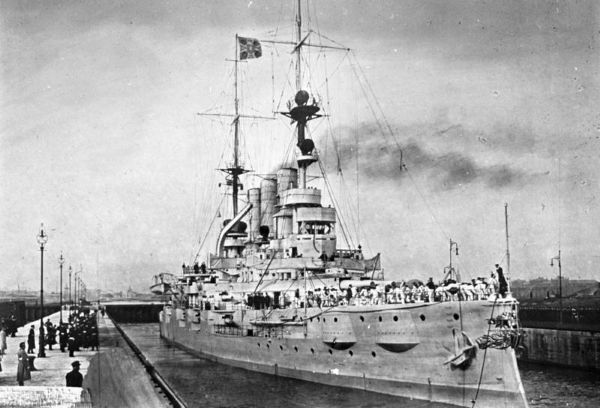
SMS Deutschland: The Last German Pre-Dreadnought Battleship of Its Generation
SMS Deutschland was the lead ship of the Deutschland class of pre-dreadnought battleships built for the Imperial German Navy in the first years of the twentieth century. Laid down in 1903, launched in November 1904, and commissioned in August 1906, she entered service at one of the most consequential moments in naval history. Deutschland was designed as a powerful fleet battleship, carrying four 28 cm guns, fourteen 17 cm secondary guns, extensive armor, and machinery capable of driving her at more than 18 knots. Yet only a few months after her commissioning, the arrival of the British battleship HMS Dreadnought fundamentally changed the meaning of battleship power. The revolutionary British vessel’s all-big-gun armament and turbine propulsion rendered Deutschland and every other pre-dreadnought battleship comparatively obsolete almost overnight. Nevertheless, Deutschland enjoyed a long and useful career. She served as the flagship of Germany’s active battle fleet before the First World War, participated in major fleet operations during the conflict, fought at the Battle of Jutland in 1916, and later became a barracks ship before being removed from the naval register and sold for scrap in 1920. Her story is therefore particularly valuable for understanding the rapid technological transformation of naval warfare and the development of the Imperial German Navy into the High Seas Fleet.
The Origins of SMS Deutschland
Germany’s expanding battle fleet
The construction of Deutschland was part of the ambitious naval expansion associated with Admiral Alfred von Tirpitz and the German Naval Laws. Germany’s leaders increasingly believed that the empire required a modern fleet capable of defending the coastline, protecting maritime commerce, and serving as a strategic instrument against rival naval powers. The Deutschland class was authorized within this expansion program and represented the culmination of the traditional pre-dreadnought battleship design in Germany. The class consisted of five ships: Deutschland, Hannover, Pommern, Schlesien, and Schleswig-Holstein. Their construction reflected the German Navy’s continuing commitment to battleships that could operate in a battle line, but their careers would ultimately be shaped by the sudden appearance of a completely new type of capital ship.
Deutschland was built at Germaniawerft in Kiel. Her keel was laid down in June 1903, and the ship was launched on November 19, 1904. Construction continued for nearly two additional years before she was commissioned on August 3, 1906. When she entered service, she was an impressive battleship by contemporary standards, combining a heavy main battery with a large secondary armament and substantial protection. Her commissioning also came at a fascinating moment because HMS Dreadnought was already under construction in Britain. Within months, the naval world would be transformed, making Deutschland one of the last major battleships to enter service under the old pre-dreadnought philosophy.
Design and Construction
A refined pre-dreadnought battleship
Deutschland measured approximately 127.6 meters in length, with a beam of 22.2 meters and a draft of about 8.21 meters. Her maximum displacement was approximately 14,218 metric tons. These dimensions made her substantially larger than many earlier German battleships, reflecting the steady increase in battleship size that characterized the late nineteenth and early twentieth centuries. The ship’s broad hull provided stability for her artillery and armor while giving the designers sufficient internal space for machinery, ammunition storage, coal bunkers, crew accommodations, and extensive watertight subdivision.
The armor scheme was designed according to the principles of contemporary German naval architecture. The main belt reached approximately 240 mm at its thickest point, while the main gun turrets received armor up to 280 mm thick. The armored deck was approximately 40 mm thick. This protection was intended to keep the ship’s machinery, ammunition magazines, and other vital areas functional after suffering enemy fire. German designers placed considerable emphasis on survivability, and the Deutschland class benefited from the experience gained from earlier generations of German battleships.
The result was a ship that was strongly protected for its era, although her armor and weapon layout were soon overtaken by the new generation of dreadnoughts. This illustrates an important point about naval development: Deutschland was not poorly designed simply because she became obsolete. Rather, she was the product of a mature design philosophy that was overtaken by a technological revolution almost immediately after she entered service.
Propulsion and Performance
Triple-expansion engines and three shafts
Deutschland was powered by three triple-expansion steam engines, each connected to its own propeller shaft. Twelve Scotch marine boilers provided the steam required to drive the machinery. The propulsion system produced approximately 16,990 shaft horsepower according to German naval references, although figures vary somewhat among sources depending on how power was measured. Her maximum speed was approximately 18.6 knots, while her economical range was about 4,800 nautical miles at 10 knots.
This performance made Deutschland a capable fleet battleship in the years immediately before the dreadnought revolution. Her speed was sufficient to maneuver with other German pre-dreadnoughts and to participate in fleet exercises, while her endurance allowed extended operations in the North Sea and Baltic. Triple-expansion engines were mature and reliable technology, but they would soon be eclipsed by the steam turbines adopted by HMS Dreadnought and subsequent generations of battleships.
The three-shaft arrangement also provided a useful compromise between power and maneuverability. As a fleet vessel, Deutschland needed to maintain station in battle formations while responding rapidly to changes in course and speed. Her machinery was therefore well suited to the operational demands of the Imperial German Navy, even though later battleships would achieve much higher speeds with more advanced propulsion systems.
The Armament of SMS Deutschland
Four 28 cm main guns
The primary offensive weapon of Deutschland consisted of four 28 cm SK L/40 guns mounted in two twin turrets, one forward and one aft. This centerline arrangement was typical of pre-dreadnought battleships and allowed the main battery to fire broadside while keeping the heaviest weapons concentrated around the ship’s central axis. The 28 cm guns were powerful weapons for the period and were capable of engaging enemy battleships at substantial distances.
The main battery, however, was where the difference between pre-dreadnought and dreadnought philosophy became most obvious. Deutschland carried only four heavy-caliber guns, whereas HMS Dreadnought carried ten 12-inch weapons. The British battleship could therefore concentrate far more heavy shells against an enemy target, while her turbine propulsion gave her a speed advantage. Once naval planners recognized the potential of an all-big-gun battleship, ships such as Deutschland were no longer considered capable of competing on equal terms with the newest capital ships.
Fourteen 17 cm secondary guns
Where Deutschland carried considerable firepower was in her secondary battery. She was equipped with fourteen 17 cm SK L/40 guns, most of them mounted in protected casemates. These weapons were intended for use against enemy cruisers, destroyers, and other targets that did not require the use of the main 28 cm battery. The heavy secondary battery was a characteristic feature of pre-dreadnought battleship design, when naval officers expected battles to involve several different classes of enemy vessels and believed that a mixture of calibers offered greater tactical flexibility.
The ship also carried twenty 8.8 cm guns and four machine guns, giving her substantial close-range defensive firepower. Six 45 cm torpedo tubes provided another weapon for attacks at short range. Taken together, this armament reflected a transitional period in naval thinking, when battleships were designed to perform multiple roles within a fleet action rather than relying almost exclusively on a uniform battery of heavy guns.
Flagship of the German Battle Fleet
A prominent peacetime role
One of the most important aspects of Deutschland’s career was her role as flagship of the German active battle fleet. After commissioning, she became one of the principal command ships of the Imperial Navy, and she remained the fleet flagship until 1913. This was an important position because the German Navy was increasingly organized around large-scale fleet exercises intended to prepare its battleships for a potential confrontation with the Royal Navy.
As flagship, Deutschland was more than a combat vessel. She served as a command center from which senior officers could direct exercises, maneuvers, and fleet movements. The ship’s communications facilities, accommodation for senior officers, and position within the battle fleet made her an important part of Germany’s developing naval command structure. Her years as flagship therefore contributed to the institutional development of the High Seas Fleet, even though she was soon overtaken technologically by the first dreadnoughts.
Her peacetime career included fleet exercises and training cruises. These activities were essential for the German Navy because large battleships were complicated systems requiring highly coordinated crews. Gunnery teams, engineers, navigators, signal personnel, and officers all needed extensive training to operate effectively as part of a battle squadron.
The Dreadnought Revolution
Obsolescence almost immediately
The most remarkable feature of Deutschland’s history is the extraordinary speed with which she became obsolete. HMS Dreadnought was commissioned in December 1906, only a few months after Deutschland. The British ship carried ten 30.5 cm guns and used steam turbines that gave her a major speed advantage. Her design eliminated the traditional distinction between main and secondary batteries by concentrating on a uniform battery of heavy guns.
The consequences were enormous. A fleet composed of pre-dreadnought battleships could no longer expect to compete effectively against a fleet of modern dreadnoughts, because the latter could engage at longer ranges with more heavy guns while maintaining greater speed. The result was a dramatic acceleration of naval construction. Germany responded by building its own dreadnoughts, beginning with the Nassau class and continuing through increasingly powerful generations.
For Deutschland, this meant that her career as a first-line capital ship was effectively shortened before it had properly begun. She remained valuable because she was heavily armed and protected, but her strategic status changed from modern battleship to second-line vessel almost overnight.
SMS Deutschland During the First World War
The outbreak of war
When the First World War began in 1914, Deutschland had already been transferred from the flagship role to the II Battle Squadron. She and her sister ships were older than the dreadnoughts and battlecruisers forming the most modern elements of the High Seas Fleet, but they remained useful for defensive and supporting operations. The outbreak of war gave these older ships renewed importance because Germany needed to deploy naval forces across multiple areas while preserving its most modern battleships for potential major engagements.
Deutschland and the other ships of the II Battle Squadron were initially tasked with defending the German Bight and the mouth of the Elbe against possible British attacks. Their presence provided Germany with additional heavy artillery and a substantial defensive force. The pre-dreadnoughts could not realistically be expected to defeat Britain’s modern Grand Fleet in a direct confrontation, but they could contribute to coastal defense and support larger fleet operations.
As the war progressed, however, Germany increasingly concentrated its modern battleships for offensive sorties against the British fleet. The older pre-dreadnoughts remained useful but were inherently vulnerable when operating alongside dreadnoughts. Their slower speeds and smaller main batteries meant that they could become liabilities if forced into prolonged combat against Britain’s newest capital ships.
The Battle of Jutland
Deutschland enters the great fleet battle
The most important combat operation of Deutschland’s career came during the Battle of Jutland, fought on May 31 and June 1, 1916. Jutland was the largest surface naval battle of the First World War and the only major clash between the British Grand Fleet and German High Seas Fleet. The battle involved dozens of battleships, battlecruisers, cruisers, destroyers, and other vessels, making it an enormous test of naval gunnery and fleet tactics.
Deutschland and the other pre-dreadnoughts of the II Battle Squadron were present with the German fleet. Late on the first day, they briefly engaged British battlecruisers. Their involvement demonstrated both the potential and the limitations of older battleships operating alongside modern capital ships. The pre-dreadnoughts possessed significant firepower, but their slower speed and weaker main batteries made them increasingly vulnerable in a battle dominated by modern dreadnoughts and battlecruisers.
The Battle of Jutland ultimately confirmed the problem that German naval planners had already recognized. Although the German High Seas Fleet inflicted serious losses on the British, the older pre-dreadnoughts were not suitable for sustained action against modern capital ships. After Jutland, Deutschland and her surviving sisters were progressively removed from the front line.
Withdrawal From Combat Service
From battleship to auxiliary vessel
Following Jutland, Deutschland was assigned increasingly defensive duties. The pre-dreadnoughts of the II Battle Squadron were considered too vulnerable for major fleet actions, especially as Germany sought to preserve its most modern ships. Their heavy guns and armor still had potential value in coastal defense, but their role within the battle fleet had effectively ended.
By 1917, Deutschland had been withdrawn from combat service and disarmed. She was subsequently used as a barracks ship at Wilhelmshaven. This transformation was a striking conclusion to her battleship career. Only a decade earlier, she had served as the flagship of Germany’s active battle fleet; now her primary purpose was to provide accommodation and support for naval personnel.
This was not an unusual fate for aging warships during the First World War. Once the technological and tactical environment changed, older battleships could be repurposed as training ships, depot ships, barracks, or coastal-defense platforms. Their hulls and internal spaces remained useful even when their combat capabilities no longer justified exposing them to enemy fire.
The End of SMS Deutschland
Scrapping after the First World War
Deutschland survived the First World War but did not return to active service afterward. Germany’s defeat and the restrictions imposed on its navy meant that the Imperial German battle fleet was effectively dismantled. The newer capital ships faced internment and other restrictions, while older vessels such as Deutschland had little future in the drastically reduced German Navy.
She was struck from the naval register on January 25, 1920, and sold to ship breakers later that year. Her dismantling was completed by 1922. The process marked the physical end of one of the ships that had once represented the growing power and ambition of Imperial Germany’s battle fleet.
The fate of Deutschland contrasted with that of some later German battleships that survived into the Reichsmarine or even the Second World War. Her early disposal was largely a consequence of her age and the fact that her design had already been superseded by the dreadnought revolution. Nevertheless, she had served for more than a decade and had participated in one of the most important naval battles in history.
Why SMS Deutschland Matters in Naval History
The final step before the dreadnought era
SMS Deutschland is historically significant because she represents the culmination of the traditional German pre-dreadnought battleship. Her design incorporated the accumulated experience of earlier classes while increasing dimensions, armor, machinery power, and artillery. Yet she was also one of the last ships built according to a philosophy that would soon disappear.
Her four 28 cm guns were powerful, but the emergence of the all-big-gun battleship demonstrated that the future belonged to ships carrying numerous weapons of very large caliber. Her fourteen 17 cm guns represented the older belief in a substantial secondary battery, while later dreadnoughts would largely abandon that concept in favor of uniform heavy artillery supported by smaller weapons. Her triple-expansion engines likewise belonged to an era that would soon be dominated by turbine propulsion.
Her career consequently provides an unusually clear illustration of technological transition. She went from being one of the most important ships in the German fleet to a second-line battleship, then to a barracks ship, all within approximately a decade. Few warships demonstrate so clearly how quickly naval technology could alter strategic calculations during the early twentieth century.
Technical Specifications of SMS Deutschland
The following figures are based primarily on German naval reference data, with additional historical references used for comparison. Exact values can vary depending on whether normal or maximum displacement is quoted and on how wartime configurations are recorded.
| Specification | SMS Deutschland |
|---|---|
| Country | German Empire |
| Navy | Imperial German Navy (Kaiserliche Marine) |
| Ship type | Pre-dreadnought battleship |
| Class | Deutschland class |
| Builder | Germaniawerft, Kiel |
| Laid down | June 20, 1903 |
| Launched | November 19, 1904 |
| Commissioned | August 3, 1906 |
| Length overall | 127.6 m |
| Length at waterline | 125.9 m |
| Beam | 22.2 m |
| Draft | 8.21 m |
| Maximum displacement | Approximately 14,218 metric tons |
| Propulsion | 3 × triple-expansion steam engines |
| Propeller shafts | 3 |
| Boilers | 12 × Scotch marine boilers |
| Power | Approximately 16,990 shp |
| Maximum speed | Approximately 18.6 knots |
| Range | Approximately 4,800 nautical miles at 10 knots |
| Main armament | 4 × 28 cm SK L/40 guns |
| Main-gun arrangement | 2 × twin turrets |
| Secondary armament | 14 × 17 cm SK L/40 guns |
| Light armament | 20 × 8.8 cm guns |
| Machine guns | 4 |
| Torpedo armament | 6 × 45 cm torpedo tubes |
| Maximum belt armor | Approximately 240 mm |
| Main turret armor | Up to approximately 280 mm |
| Deck armor | Approximately 40 mm |
| Crew | Approximately 743 |
| Prewar flagship | German active battle fleet |
| World War I formation | II Battle Squadron |
| Major battle | Battle of Jutland, 1916 |
| Later role | Barracks ship |
| Decommissioned | September 10, 1917 |
| Struck from register | January 25, 1920 |
| Final fate | Sold for scrap in 1920; broken up by 1922 |
Conclusion
SMS Deutschland was a battleship caught between two technological eras. Conceived during Germany’s ambitious naval expansion, she was designed as a heavily armed and protected fleet battleship capable of serving at the center of the Imperial Navy’s battle line. Her four 28 cm guns, fourteen 17 cm secondary weapons, substantial armor, and approximately 18.6-knot speed made her an impressive capital ship when construction began. When commissioned in August 1906, she represented the culmination of a generation of German pre-dreadnought development.
Yet her timing could hardly have been more consequential. The commissioning of HMS Dreadnought only months later transformed naval warfare and made Deutschland obsolete in the technical sense, even though she remained operationally useful. The all-big-gun battleship established a new standard for capital ships, forcing Germany to redirect its naval construction toward dreadnoughts and leaving the Deutschland class in a secondary position almost from the beginning of its service lives.
Despite this disadvantage, Deutschland enjoyed a significant career. As flagship of the German active battle fleet until 1913, she played an important role in fleet training and command. During the First World War, she and her sisters provided useful defensive strength and participated in major German fleet operations. Her appearance at Jutland in 1916 gave her a place in the largest surface battle of the war, even though the battle also demonstrated the vulnerability of pre-dreadnoughts when operating alongside or against modern capital ships.
Her eventual conversion into a barracks ship was a practical response to the changing strategic environment. By 1917, the German Navy no longer considered her suitable for frontline combat, but her hull and accommodation spaces still had value. After the war, however, the defeat of Germany and the restrictions placed upon its navy brought her career to an end. She was struck from the naval register in January 1920 and sold for scrapping that same year.
Today, SMS Deutschland is remembered less for individual combat achievements than for what she represents in naval history. She was one of the last German battleships designed according to the pre-dreadnought model and one of the first German capital ships to become obsolete because of a revolutionary change in naval technology rather than because of age or battle damage. Her career captures the extraordinary pace of naval innovation in the years immediately before the First World War, when battleships evolved from mixed-caliber armored vessels into enormous all-big-gun ships capable of fighting at unprecedented distances.
In that sense, Deutschland was both the culmination of an era and a symbol of its ending. She embodied the naval technology of the early twentieth century just as the dreadnought revolution was beginning to make that technology obsolete. Her service as a flagship, combatant, coastal-defense vessel, and finally barracks ship provides a remarkably complete picture of the changing role of the battleship between 1906 and the aftermath of the First World War.