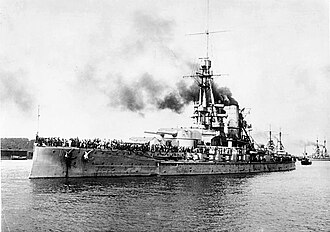
SMS Bayern: The Imperial German Navy’s Final Dreadnought Battleship
SMS Bayern was one of the most powerful battleships constructed for the Imperial German Navy during the First World War and the lead ship of the Bayern class, the final generation of German dreadnoughts completed during the conflict. Armed with eight enormous 38 cm guns, protected by a sophisticated armor scheme, and capable of more than 21 knots, Bayern represented the culmination of Germany’s prewar naval arms race with Britain. Yet her career was shaped by unfortunate timing. She entered service only after the Battle of Jutland, the largest surface engagement of the First World War, and consequently missed the opportunity to participate in the great battleship confrontation for which she had been designed. Instead, Bayern spent most of her short operational career training with the High Seas Fleet and conducting limited operations in the Baltic and North Sea. Her one major wartime operation came in the Baltic during Operation Albion in 1917, when she struck a mine and had to withdraw for repairs. At the end of the war, Bayern was interned with the German fleet at Scapa Flow. On June 21, 1919, her crew scuttled the battleship along with most of the interned German fleet. Bayern sank rapidly and remained underwater until salvage operations in the 1930s finally removed the wreck.
The Development of the Bayern Class
Germany’s final generation of dreadnoughts
The Bayern class emerged from the intense naval competition between Germany and Britain in the years before the First World War. German battleship designers had progressively increased the caliber of their main guns, improved armor protection, and refined propulsion and underwater-defense systems with each successive class. By the time work began on Bayern, German naval architects were considering main batteries ranging from approximately 35.6 cm to 40 cm. The eventual decision to adopt the 38 cm gun represented a major step forward for the Imperial Navy. The resulting battleship would carry weapons comparable in caliber to those installed aboard Britain’s powerful Queen Elizabeth-class battleships.
Bayern was ordered as part of this effort to create a new generation of heavily armed capital ships. Her keel was laid at the Howaldtswerke shipyard in Kiel on September 20, 1913, and the ship was launched on February 18, 1915. The First World War had already begun by the time she entered the water, and construction proceeded under wartime conditions. She was finally commissioned into the Imperial German Navy on July 15, 1916, shortly after the Battle of Jutland had concluded. This timing was particularly unfortunate because Bayern represented a significant increase in German battleship firepower, yet the largest naval battle of the war had already passed before she was ready for operational service.
A design built around heavy firepower
The basic layout of Bayern followed the German preference for concentrating the main battery along the ship’s centerline. Eight 38 cm guns were mounted in four twin turrets, with two turrets forward and two aft. The arrangement provided a powerful broadside while keeping the ship’s heavy artillery relatively compact. The Bayern design was closely related to the preceding König-class battleships, but the larger guns gave the new class considerably greater striking power.
The adoption of 38 cm artillery was especially important because German battleships had traditionally relied on somewhat smaller-caliber weapons than some of their British counterparts. German designers compensated with excellent fire control, robust construction, strong armor protection, and high-quality ammunition, but the Bayern class demonstrated that the Imperial Navy was prepared to match the increasing caliber of foreign battleship guns directly. In this respect, Bayern can be regarded as the culmination of the German dreadnought development that had begun with the Nassau class.
Construction and Physical Characteristics
A large and heavily protected battleship
Bayern was approximately 180 meters long and about 30 meters wide, giving her a broad hull that provided both stability and internal space for machinery, ammunition, armor, and crew facilities. Her displacement was roughly 28,000 tons under design conditions and exceeded 31,000 tons at full load, depending on the measurement used. These figures placed her among the largest and most heavily armed battleships constructed by Germany during the First World War.
The ship’s broad hull was not simply a consequence of her heavy guns. German naval designers placed great importance on underwater protection and compartmentation because they anticipated that mines and torpedoes would be serious threats in the confined waters of the North Sea. Bayern consequently incorporated extensive subdivision and protective structures intended to prevent flooding from spreading rapidly through the hull.
Armor protection was another defining characteristic. The main armored belt, turret faces, barbettes, conning tower, and other vital areas received substantial protection. Like other German capital ships, Bayern was designed with survivability in mind, reflecting the Imperial Navy’s expectation that its battleships might have to fight while under sustained fire in the rough and relatively restricted waters of the North Sea.
Powerful machinery and useful speed
Bayern was powered primarily by steam turbines driving three propeller shafts. Her machinery was designed to generate approximately 35,000 horsepower, although the ship could develop considerably more power during trials. Her designed maximum speed was around 21 knots, while trials demonstrated that she could exceed this figure under favorable conditions.
This performance was significant because Bayern combined heavy armor and very large guns without becoming excessively slow. She was not intended to function as a battlecruiser, but her speed allowed her to operate effectively with the main body of the High Seas Fleet. The combination of firepower, protection, and mobility made the class a well-balanced battleship design by First World War standards.
The original Bayern-class design also reflected Germany’s interest in improving long-distance endurance. German engineers considered incorporating diesel propulsion into the later members of the class, but Bayern herself retained a conventional steam-turbine arrangement. The ambition to combine steam turbines with large diesel machinery reflected the German Navy’s growing awareness that future battleships might need to operate over much greater distances than the North Sea environment traditionally required.
The Armament of SMS Bayern
Eight 38 cm guns
Bayern’s main battery was her defining feature: eight 38 cm SK L/45 guns arranged in four twin turrets. These weapons fired shells weighing hundreds of kilograms and were capable of engaging enemy capital ships at long range. Their introduction represented a major increase in German naval firepower and placed Bayern among the most heavily armed battleships of the period.
The four turrets were arranged on the centerline in pairs, with superfiring positions at the bow and stern. This arrangement allowed the higher turret in each pair to fire over the lower turret and provided effective firing arcs without the need for wing turrets. Concentrating the main armament along the centerline also simplified the ship’s overall layout and allowed a large proportion of its guns to bear on targets to either side.
The main battery was supported by sixteen 15 cm guns, which formed the ship’s secondary armament. These weapons were intended for use against cruisers, destroyers, smaller surface vessels, and other targets for which the enormous 38 cm guns were unnecessary. Bayern also carried smaller-caliber weapons for defense against torpedo craft and aircraft, along with five submerged torpedo tubes. The resulting armament suite reflected the wide range of threats a battleship was expected to confront in the early twentieth century.
Entering Service After the Battle of Jutland
A powerful battleship that arrived too late
Bayern was commissioned in July 1916, only weeks after the Battle of Jutland. Jutland had been the great opportunity for Germany and Britain to settle their battleship rivalry in a decisive fleet engagement, but the battle ended without the strategic breakthrough either side had hoped for. Germany’s High Seas Fleet returned to port, while Britain retained control of the wider North Sea and its naval blockade.
Bayern therefore entered a fleet whose strategic circumstances had changed dramatically. The German Navy still possessed powerful battleships, but the risks associated with another full-scale fleet confrontation were enormous. Britain retained numerical superiority, and Germany had little to gain from sacrificing its remaining capital ships in an uncertain attempt to break the British blockade.
As a result, Bayern’s early service was dominated by training and limited fleet operations. She became part of the III Battle Squadron, joining some of the most powerful battleships of the High Seas Fleet. Her arrival nevertheless strengthened the German battle line with a ship whose main battery was among the most formidable in Europe.
Operation Albion and Bayern’s Only Major Combat Operation
The Baltic campaign of 1917
Bayern’s most important wartime operation came not in the North Sea against Britain, but in the Baltic against Russian forces. In October 1917, Germany launched Operation Albion, a major amphibious and naval campaign designed to seize the strategically important islands of Ösel, Dagö, and Muhu in the Gulf of Riga.
The operation required a substantial German naval force, including battleships, cruisers, destroyers, minesweepers, and support vessels. Bayern was deployed as part of this force, providing heavy artillery that could be used against Russian naval and coastal positions. Her presence demonstrated the flexibility of the battleship as a weapon: although designed primarily for fleet combat in the North Sea, her heavy guns could also support amphibious operations and suppress enemy batteries.
Striking a mine
Bayern’s participation in Operation Albion was cut short when she struck a mine. The explosion caused serious damage and flooding, particularly in the forward part of the ship. The battleship had to withdraw from the operational area for repairs, preventing her from playing a sustained role in the remainder of the campaign.
The incident illustrated one of the major vulnerabilities of even the most heavily armored battleships. Armor could protect against gunfire, but mines attacked the underwater hull in a fundamentally different way. The extensive flooding protection incorporated into Bayern’s design helped prevent the damage from becoming catastrophic, but the incident still demonstrated how a relatively inexpensive weapon could disable an enormously expensive capital ship.
After temporary repairs, Bayern eventually returned to Germany for more extensive work. Her mine damage was the most serious wartime incident she experienced and effectively became the defining event of her short combat career.
The Final Year of the Imperial German Navy
A battleship trapped by strategic circumstances
By 1918, Germany’s naval situation had become increasingly desperate. The High Seas Fleet remained powerful, but the British blockade continued to exert enormous pressure on Germany, while the country’s military position on land deteriorated. Plans for a final major fleet action against Britain contributed to unrest among German sailors and eventually helped trigger the naval mutiny that preceded the German Revolution.
Bayern was therefore caught between two very different roles. On paper she was one of the most powerful battleships in the world, equipped with weapons capable of devastating an enemy capital ship. In practice, she was increasingly constrained by political collapse, fuel shortages, strategic caution, and the approaching end of the war.
The planned final fleet sortie never developed into the climactic battle that German naval planners had imagined. Instead, the German fleet was ordered into internment following the armistice in November 1918. Bayern was among the ships sent to Scapa Flow, where the High Seas Fleet was placed under Allied supervision.
The Scuttling of SMS Bayern
June 21, 1919
The German ships remained at Scapa Flow while the victorious Allies debated their ultimate disposition. Rear Admiral Ludwig von Reuter, concerned that the ships might eventually be divided among the Allied powers, ordered the German crews to scuttle the fleet on June 21, 1919.
Bayern was among the ships whose crews opened valves and otherwise allowed seawater to enter their vessels. Unlike SMS Baden, which British sailors managed to save, Bayern sank and remained on the bottom of Scapa Flow. The sinking was part of one of the largest deliberate losses of naval vessels in history, as dozens of German ships went to the seabed within hours.
The scuttling represented a final act of defiance by the defeated Imperial German Navy. The battleships that had once formed the core of the High Seas Fleet were now lying underwater, effectively ending the naval force that had challenged British maritime supremacy before and during the First World War.
Salvage and the End of Bayern
Raised in the 1930s
For many years, Bayern remained underwater at Scapa Flow. Eventually, the wreck became part of the large-scale salvage operations undertaken in the area. Cox & Danks raised the battleship in September 1934, more than fifteen years after she had been scuttled. The operation was technically challenging because of Bayern’s size and the condition in which she lay.
The salvage operation produced an unusual consequence: Bayern’s four main gun turrets broke free from the hull as the ship was raised. The turrets were subsequently towed to Rosyth, where they were scrapped along with the remainder of the battleship. By 1935, the last physical remnants of the ship were being dismantled, bringing Bayern’s story to its final conclusion.
Today, the wreck site and surviving archaeological evidence remain important to the study of the German fleet at Scapa Flow. Bayern’s loss and subsequent salvage form part of the wider history of the interned High Seas Fleet, whose wrecks have become an important part of Britain’s maritime archaeological heritage.
Why SMS Bayern Matters in Naval History
The peak of Imperial German battleship design
Bayern was historically important because she represented the final stage of Imperial Germany’s dreadnought battleship development. The German Navy had progressed from the first Nassau-class dreadnoughts through the Helgoland, Kaiser, König, and finally Bayern classes. Each generation incorporated heavier weapons and increasingly sophisticated protection and machinery.
The Bayern class was arguably the most balanced expression of that evolution. The ships were heavily armed, heavily protected, and fast enough to operate effectively with the fleet. Their eight 38 cm guns placed them in the same broad category of heavy artillery battleships as Britain’s most powerful dreadnoughts of the period.
Yet Bayern also represents the limits of technological superiority when strategic circumstances work against a ship. She was completed too late to participate in Jutland, and Germany’s deteriorating position meant that the High Seas Fleet never received another opportunity for a decisive fleet action. Her only significant combat operation ended when she struck a mine, and her ultimate fate was determined not by enemy gunfire but by her own crew at Scapa Flow.
Technical Specifications of SMS Bayern
The following table summarizes commonly published specifications for SMS Bayern. Exact figures can vary between historical sources depending on whether standard, design, or full-load displacement is being used.
| Specification | SMS Bayern |
|---|---|
| Country | German Empire |
| Navy | Imperial German Navy (Kaiserliche Marine) |
| Ship type | Dreadnought battleship |
| Class | Bayern class |
| Builder | Howaldtswerke, Kiel |
| Laid down | September 20, 1913 |
| Launched | February 18, 1915 |
| Commissioned | July 15, 1916 |
| Length | Approximately 180 m |
| Beam | Approximately 30 m |
| Draft | Approximately 9.4 m |
| Design displacement | Approximately 28,000 tons |
| Full-load displacement | Approximately 31,000–32,000 tons |
| Propulsion | Steam turbines |
| Propeller shafts | 3 |
| Boilers | 14 water-tube boilers |
| Power | Approximately 35,000 shp designed |
| Maximum speed | Approximately 21–22 knots |
| Range | Approximately 5,000 nautical miles at 12 knots |
| Main armament | 8 × 38 cm SK L/45 guns |
| Main turrets | 4 × twin turrets |
| Secondary armament | 16 × 15 cm guns |
| Light/anti-aircraft armament | 8.8 cm guns, configuration varied |
| Torpedo armament | 5 × 60 cm submerged torpedo tubes |
| Crew | Approximately 1,180–1,270 |
| Primary role | Fleet battleship |
| Major operation | Operation Albion, 1917 |
| Major damage | Mine strike during Operation Albion |
| Interned | Scapa Flow, November 1918 |
| Scuttled | June 21, 1919 |
| Salvaged | September 1934 |
| Final fate | Scrapped in 1935 |
Conclusion
SMS Bayern was the final expression of an extraordinary period in German naval history. Built during the height of the dreadnought era, she combined enormous 38 cm guns with heavy armor, a powerful propulsion system, and a carefully balanced hull. She was intended to fight alongside the High Seas Fleet in the great naval battles that Germany expected might decide control of the North Sea. Instead, history denied her that opportunity.
Her commissioning shortly after Jutland meant that Bayern missed the most important battleship confrontation of the First World War. Her later service was limited by Germany’s strategic position, and her only significant combat deployment came during Operation Albion in the Baltic. Even there, a mine ended her participation and demonstrated the vulnerability of a battleship to underwater weapons.
The final chapter at Scapa Flow was even more dramatic. Bayern was deliberately scuttled by her German crew in June 1919, joining most of the High Seas Fleet on the seabed. More than fifteen years later, salvors raised the huge battleship, and her main turrets separated from the hull during the process. The wreck was ultimately dismantled in 1935.
What makes Bayern particularly fascinating is the contrast between her enormous potential and her limited wartime career. On paper, she was among the most formidable battleships of her generation. In reality, she never fought the Royal Navy’s Grand Fleet in a major surface battle and never had the opportunity to demonstrate what her eight 38 cm guns could accomplish in a full-scale dreadnought engagement.
Nevertheless, Bayern remains an important milestone in naval architecture. She was the lead ship of the last completed battleship class of the Imperial German Navy and represented the culmination of years of German experimentation in armor, firepower, propulsion, and underwater protection. Her story is therefore not simply that of a battleship lost at Scapa Flow; it is the story of the final chapter of an entire naval era, when steel dreadnoughts represented national power and the fate of fleets could influence the course of empires.
