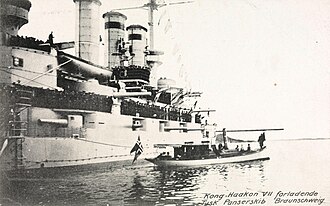
SMS Braunschweig: Germany’s Pre-Dreadnought Battleship at the Dawn of the Dreadnought Age
SMS Braunschweig was the lead ship of the Braunschweig class and one of the last major pre-dreadnought battleships built by the Imperial German Navy before the revolutionary HMS Dreadnought transformed naval warfare. Laid down in 1901, launched in December 1902, and commissioned in October 1904, Braunschweig represented a substantial step forward from the preceding generation of German battleships. She carried four powerful 28 cm guns as her main battery, supported by an unusually heavy secondary battery of fourteen 17 cm guns, and could reach approximately 18 knots. Her design reflected the rapid evolution of German naval construction at the beginning of the twentieth century, when the Imperial Navy was moving from a relatively modest coastal-defense force toward a modern fleet capable of operating in the North Sea and beyond. Yet Braunschweig’s career also illustrates how quickly technological progress could transform a powerful warship into an obsolete one. Only two years after her commissioning, HMS Dreadnought entered service and rendered virtually every pre-dreadnought battleship obsolete in comparative terms. Braunschweig consequently spent much of her career performing training, flagship, coastal-defense, and support duties rather than fighting major battles. During the First World War she served with the German fleet in both the North Sea and Baltic, and after Germany’s defeat she was among the older battleships permitted to remain in German service under the postwar naval restrictions. She continued serving with the Reichsmarine during the 1920s before finally being removed from the fleet and scrapped in the early 1930s.
The Origins of SMS Braunschweig
Germany’s changing naval ambitions
The construction of Braunschweig must be understood against the background of Germany’s rapidly expanding naval ambitions. During the final years of the nineteenth century, the German Empire had developed into one of Europe’s leading industrial powers, but its navy remained considerably smaller than Britain’s Royal Navy and lagged behind several other European fleets in the number and sophistication of its modern battleships. The appointment and influence of Admiral Alfred von Tirpitz helped change this situation. German naval policy increasingly emphasized the creation of a battle fleet capable of challenging a superior maritime power and protecting Germany’s growing commercial and overseas interests. The Braunschweig class was part of this transformation, providing the Imperial Navy with a new generation of larger and more heavily armed battleships. German naval references describe the class as an improvement over earlier German designs, particularly in artillery, with the main battery increased to 28 cm guns and the introduction of 17 cm weapons as the principal secondary battery.
Braunschweig herself was built by Germaniawerft at Kiel, with her keel laid down on October 24, 1901. She was launched on December 20, 1902, and commissioned on October 15, 1904. The ship was named after the German territory of Braunschweig, continuing the Imperial German Navy’s tradition of naming battleships after German states and regions. Her construction cost was approximately 24 million Reichsmark, a substantial investment that reflected the importance attached to modern battleship construction under the naval expansion program. When she entered service, Braunschweig was a formidable capital ship by contemporary standards, combining a substantial main battery, an exceptionally powerful secondary armament, extensive armor, and a speed of approximately 18 knots.
Design and Construction
A major step beyond earlier German battleships
Braunschweig measured approximately 127.7 meters in overall length and 22.2 meters in beam. Her full-load displacement was around 14,400 metric tons, although published figures differ depending upon the loading condition and measurement standard being used. Her broad hull gave the ship sufficient stability to support her heavy armor and artillery, while the relatively compact dimensions reflected the operational environment for which she had been designed. The German fleet was primarily concerned with the North Sea and Baltic approaches, where maneuverability, seaworthiness, and protection were particularly important characteristics. German naval assessments described the Braunschweig-class ships as maneuverable and good seagoing vessels, although they were prone to rolling in heavy seas.
The armor scheme was designed to protect the ship’s most important areas against contemporary naval artillery. The main belt was approximately 225 mm thick in its heaviest sections, while the gun turrets received armor of up to roughly 250 mm. The protective deck was around 40 mm thick, supplemented by the ship’s internal subdivision and underwater protection. The objective was to ensure that hits below the waterline or against the central machinery and ammunition spaces would not immediately cripple the ship. Like other German battleships of the period, Braunschweig placed considerable emphasis on survivability, recognizing that a battleship might have to continue fighting after receiving multiple hits.
Machinery and speed
Braunschweig was powered by three triple-expansion steam engines, each driving a separate propeller shaft. Steam was generated by a mixed group of water-tube and cylindrical boilers, with published sources generally listing fourteen boilers in total. The machinery developed approximately 16,000 metric horsepower and gave the battleship a top speed of around 18 knots. Her range was approximately 5,200 nautical miles at 10 knots, which provided enough endurance for extended fleet movements and patrols without making the ship excessively large.
The three-shaft arrangement was an important characteristic of the design. It provided a balance between power, redundancy, and maneuverability, while the triple-expansion engines represented mature steam-engine technology before the widespread adoption of steam turbines in major battleships. In retrospect, Braunschweig’s machinery belonged to the final generation of conventional reciprocating-engine battleships. Turbine propulsion was already beginning to demonstrate its advantages, and within a few years the most advanced capital ships would combine turbines with much greater speed and heavier armament.
The Armament of SMS Braunschweig
Four powerful 28 cm guns
The centerpiece of Braunschweig’s offensive capability was her main battery of four 28 cm SK L/40 guns. They were mounted in two twin turrets, one forward and one aft, giving the ship a traditional battleship arrangement with heavy artillery concentrated along the centerline. These guns were capable of engaging enemy capital ships at substantial ranges for the period and represented an improvement over the main batteries carried by several preceding German battleship classes.
The decision to standardize on four 28 cm guns was part of a broader trend toward increasingly powerful main batteries. Germany’s earlier battleships had used a variety of calibers, but the 28 cm weapon became an important standard for the Imperial Navy before the transition to larger 30.5 cm and eventually 38 cm guns. Braunschweig therefore occupied an important point in the progression from nineteenth-century battleship artillery toward the enormous weapons of the dreadnought era.
An unusually powerful secondary battery
Where Braunschweig was particularly distinctive was her secondary armament. She carried fourteen 17 cm SK L/40 guns, giving her an unusually heavy intermediate-caliber battery. These guns were intended primarily for use against cruisers, destroyers, and other targets that did not justify expenditure of the main battery’s heavy shells. Their presence reflected contemporary naval thinking, in which battleships were expected to fight a range of enemy vessels at different distances.
The ship also carried eighteen 8.8 cm guns and six 45 cm torpedo tubes. The smaller guns provided defense against torpedo boats and other light craft, while the torpedoes offered an additional offensive weapon at close range. Taken together, Braunschweig’s armament represented a transitional battleship philosophy: powerful main guns for engaging enemy capital ships, numerous medium guns for secondary targets, and smaller weapons and torpedoes for close-range threats.
Prewar Fleet Service
Training and naval diplomacy
Braunschweig entered service at a time when the Imperial German Navy was becoming increasingly organized as a permanent battle fleet. Her early career therefore centered heavily on training exercises, fleet maneuvers, gunnery practice, and naval visits. Such activities were essential because a modern battleship was not simply a large gun platform; operating one effectively required a highly trained crew capable of coordinating propulsion, steering, artillery, communications, navigation, damage control, and tactical maneuvering.
Braunschweig also served as a flagship for much of her prewar career. This gave her additional importance beyond her basic combat capabilities, as a flagship needed to accommodate senior officers and support the command and communication requirements of fleet operations. The Imperial Navy used annual exercises to develop tactical formations and procedures, and ships such as Braunschweig formed the backbone of these exercises before the arrival of the much larger dreadnoughts.
Her peacetime service also occurred during a period of increasing international naval competition. Germany’s naval expansion alarmed Britain, while the growth of the German battle fleet became a central element of European strategic planning. Braunschweig was therefore both a military instrument and a visible symbol of Germany’s growing maritime ambitions.
The Dreadnought Revolution
Obsolete almost overnight
One of the most important aspects of Braunschweig’s history is how quickly she became technologically outdated. When she entered service in 1904, she was a modern battleship with powerful guns and respectable speed. Only two years later, however, Britain launched HMS Dreadnought. The new British battleship combined an all-big-gun armament with turbine propulsion and high speed, creating a new standard by which all capital ships would be judged.
The significance of Dreadnought went beyond the individual superiority of one ship. Its design effectively divided battleships into two categories: those built before the dreadnought revolution and those built afterward. Braunschweig was therefore a pre-dreadnought, and although she remained a capable warship, she could no longer compete on equal terms with the new generation of all-big-gun battleships. German naval planners responded by accelerating their own dreadnought construction, eventually producing the Nassau, Helgoland, Kaiser, König, and Bayern classes.
This technological shift explains much of Braunschweig’s later career. She was not simply discarded because she was poorly designed; rather, the entire concept of the pre-dreadnought battleship had been overtaken by a fundamentally different approach to naval combat.
SMS Braunschweig During the First World War
Reactivation in 1914
Braunschweig had been decommissioned in 1913 as newer dreadnoughts entered service, but the outbreak of the First World War changed the situation. Germany needed every useful warship available, and Braunschweig was reactivated in 1914. She was assigned to the IV Battle Squadron, which operated in both the North Sea and Baltic Sea.
Her role was considerably different from that of Germany’s newest battleships and battlecruisers. She was no longer expected to spearhead a battle line against Britain’s Grand Fleet. Instead, her duties centered on coastal defense, patrols, and operations in waters where the threat from enemy surface forces was more manageable. The Baltic offered particular opportunities for older German capital ships because the opposing Russian Baltic Fleet was closer in strength and geography to Germany’s own naval forces than Britain’s enormous Grand Fleet.
Braunschweig’s service during this period demonstrated that an obsolete battleship could still possess military value. Her heavy armor and 28 cm guns remained dangerous, and her secondary battery could provide considerable firepower against lighter vessels. Yet her commanders had to recognize that engaging modern dreadnoughts would be extremely risky.
Coastal defense and the Baltic
The German Navy’s use of older battleships for coastal defense was partly a consequence of the changing strategic environment. The High Seas Fleet had to preserve its most modern capital ships while still maintaining forces across Germany’s extensive coastline. Pre-dreadnoughts such as Braunschweig could fulfill many defensive tasks without risking the newest and most strategically valuable ships.
Her operational career therefore became one of limited but useful employment. She did not become famous for a major surface battle, but that does not mean she was irrelevant. Her presence contributed to the German fleet’s ability to distribute naval forces across multiple theaters and maintain defensive strength while the principal dreadnought squadrons remained concentrated for possible action against Britain.
Becoming a Floating Barracks
The end of active fleet service
By July 1916, the German Navy had increasingly little need for Braunschweig as an active battleship. The Battle of Jutland had demonstrated the importance of modern dreadnoughts and battlecruisers, while Germany’s older capital ships were increasingly unsuitable for frontline operations. Braunschweig was subsequently reclassified as a floating barracks.
This change represented the final stage of her Imperial German Navy career. A ship that had once served as a flagship and embodied the modern German battle fleet was now primarily a support vessel. Yet this was a practical and economical decision. Her hull, accommodation spaces, and remaining equipment could still serve the navy even if her value as a combat battleship had largely disappeared.
Braunschweig survived the war in this secondary role. Unlike many of Germany’s more modern battleships, she did not become part of the interned High Seas Fleet at Scapa Flow. Her older status ultimately worked in her favor when the postwar naval restrictions were imposed.
Service With the Reichsmarine
Surviving the postwar restrictions
The Treaty of Versailles imposed severe restrictions on Germany’s navy, but Germany was permitted to retain a small number of older battleships for coastal defense and training purposes. Braunschweig was among the vessels that survived into the new Reichsmarine, the navy of the Weimar Republic. This gave the veteran battleship an unexpected second career.
From 1921 to 1926, Braunschweig returned to fleet service. By then she was an exceptionally old design by international standards, but the Reichsmarine had few major warships available and therefore made practical use of surviving pre-dreadnoughts. Her employment reflected the realities of the postwar German Navy: rather than possessing a large modern battle fleet, Germany had to work with a very limited collection of older ships.
The ship’s return to fleet duties also gave a new generation of German sailors an opportunity to gain experience at sea. Although Braunschweig could no longer compete with modern foreign battleships, she remained useful as a training and operational platform. Her service continued until the Reichsmarine gradually replaced the old battleships with newer vessels permitted under the postwar naval treaties.
The Final Years of SMS Braunschweig
Scrapping in the early 1930s
Braunschweig’s final years were spent in increasingly secondary roles as the German Navy modernized. The emergence of the Deutschland-class ships and later treaty cruisers meant that the old pre-dreadnought was no longer necessary as a frontline unit. She was eventually removed from the fleet and sold for scrap. Sources differ slightly on the precise final date, but German naval records place her disposal and breaking-up in the early 1930s, with the ship struck from the naval list in 1931 and scrapped by 1932.
Her dismantling marked the physical end of one of Germany’s most important pre-dreadnought designs. By this point, the naval world had changed almost beyond recognition. Aircraft, submarines, radio, improved fire control, and long-range artillery had transformed naval warfare, while the battleship itself had evolved into a vastly larger and more sophisticated weapon.
The Historical Importance of SMS Braunschweig
A transitional warship
SMS Braunschweig is particularly interesting because she occupied a transitional position in naval history. She was more advanced than the preceding German battleships, yet she arrived immediately before one of the greatest technological revolutions in naval warfare. Her four 28 cm guns and fourteen 17 cm secondary guns represented serious firepower in 1904, but the appearance of HMS Dreadnought only two years later changed the standards by which such power was measured.
The ship’s career also demonstrates that naval obsolescence does not necessarily mean immediate uselessness. Braunschweig continued to serve for decades after the dreadnought revolution, first with the Imperial German Navy, then as a support ship, and finally with the Reichsmarine. Her continued use reflected the value of existing ships in an era when building and maintaining modern warships was enormously expensive.
She also illustrates the institutional importance of older warships. Battleships served as training platforms, flagships, barracks, coastal-defense vessels, and symbols of national power even after they had ceased to be competitive in a modern fleet engagement. Braunschweig’s long career is therefore an example of how a warship’s practical usefulness can outlast its technological relevance.
Technical Specifications of SMS Braunschweig
The figures below represent commonly cited specifications for the ship. Small differences occur among historical sources, particularly in displacement and the exact configuration of the armament after wartime modifications. (Wikipedia)
| Specification | SMS Braunschweig |
|---|---|
| Country | German Empire |
| Navy | Imperial German Navy; later Reichsmarine |
| Ship type | Pre-dreadnought battleship |
| Class | Braunschweig class |
| Builder | Germaniawerft, Kiel |
| Laid down | October 24, 1901 |
| Launched | December 20, 1902 |
| Commissioned | October 15, 1904 |
| Length | 127.7 m (419 ft) |
| Beam | 22.2 m (72.8 ft) |
| Draft | Approx. 8.1 m |
| Normal displacement | Approx. 13,208 metric tons |
| Full-load displacement | Approx. 14,394 metric tons |
| Propulsion | 3 × triple-expansion steam engines |
| Propeller shafts | 3 |
| Boilers | 14 total, including water-tube and cylindrical boilers |
| Power | Approx. 16,000 PS |
| Maximum speed | Approx. 18 knots |
| Range | Approx. 5,200 nautical miles at 10 knots |
| Main armament | 4 × 28 cm SK L/40 guns |
| Main-gun arrangement | 2 × twin turrets |
| Secondary armament | 14 × 17 cm SK L/40 guns |
| Light armament | 18 × 8.8 cm guns |
| Torpedo armament | 6 × 45 cm torpedo tubes |
| Belt armor | Up to approx. 225 mm |
| Turret armor | Up to approx. 250 mm |
| Deck armor | Approx. 40 mm |
| Crew | Approx. 35 officers and 708 enlisted personnel |
| Primary prewar role | Fleet battleship and flagship |
| World War I role | Coastal defense and Baltic operations |
| From July 1916 | Floating barracks |
| Reichsmarine service | Fleet service, 1921–1926 |
| Struck from naval list | 1931 |
| Final fate | Scrapped, early 1930s |
Conclusion
SMS Braunschweig was a product of a rapidly changing naval world. When she was commissioned in 1904, she represented a significant advance in German battleship design, combining four 28 cm main guns with an unusually powerful 17 cm secondary battery, heavy armor, three-shaft propulsion, and a speed of approximately 18 knots. She was large, heavily armed, and capable of operating with the developing German battle fleet. Her design reflected Germany’s growing determination to possess a modern navy capable of defending the empire and challenging rival maritime powers.
Yet her timing proved unfortunate. The arrival of HMS Dreadnought in 1906 fundamentally altered battleship design and made Braunschweig and her contemporaries pre-dreadnoughts almost overnight. Rather than becoming a dominant fleet unit, Braunschweig spent much of her career training, serving as a flagship, performing coastal-defense duties, and supporting naval operations in the Baltic. Her later conversion into a floating barracks demonstrated just how dramatically the balance between technological capability and strategic usefulness had changed.
Her survival into the postwar Reichsmarine was nevertheless remarkable. While the most modern German battleships were surrendered or otherwise removed from service, Braunschweig was old enough to fall within the category of vessels Germany was allowed to retain. She returned to fleet duties during the 1920s, giving the small postwar German Navy a valuable training and operational platform before ultimately being scrapped in the early 1930s.
The legacy of SMS Braunschweig therefore lies less in dramatic combat achievements than in her place within the evolution of naval technology. She was among the last German battleships designed according to the pre-dreadnought philosophy, yet she helped bridge the gap between the older armored battleships of the nineteenth century and the enormous dreadnoughts that soon dominated naval warfare. Her career demonstrates how quickly a naval revolution could alter the value of even a sophisticated warship, while her decades of subsequent service show that obsolete ships could remain useful when circumstances demanded it.
For students of naval history, Braunschweig is consequently much more than an obscure German battleship. She represents a critical moment in the development of the Imperial German Navy: a period when Germany was transforming its fleet, naval technology was advancing at extraordinary speed, and the battleship was evolving from the pre-dreadnought designs of the nineteenth century into the all-big-gun capital ships that would define the first half of the twentieth century. Her story is the story of a warship caught directly between those two eras.
