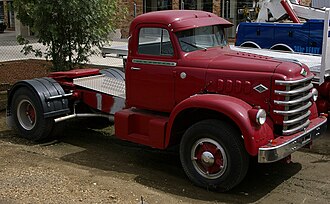
Diamond T 630: The “Cadillac of Trucks” from America’s Golden Age of Hauling
The Diamond T 630 represents a fascinating chapter in the history of American commercial trucks. Built by the Chicago-based Diamond T Motor Car Company during the 1950s, the 630 belonged to a generation of medium-duty trucks that combined serious working ability with a degree of styling, comfort, and finish that was unusual for commercial vehicles of the period. Diamond T had already earned a reputation for producing exceptionally well-built trucks, and by the post-war era the company was frequently associated with the nickname “Cadillac of Trucks.” The 630 embodied that philosophy in a practical 4×2 package, offering buyers a conventional truck that could be configured for a variety of commercial duties. Period advertising for the 1957 model year even promoted gasoline, diesel, and LPG power options, demonstrating how broadly Diamond T positioned the model.
Although the 630 is not as famous today as Diamond T’s legendary World War II 980/981 tank-transport tractors or its 969-series wreckers, it deserves attention because it shows another side of the company. The Diamond T name became synonymous with military trucks during the Second World War, but its civilian business remained an important part of the company’s identity. The 630 was a road-going working truck designed for operators who wanted strength without necessarily needing a specialized military chassis. It appeared during a period when American truck manufacturers were increasingly paying attention to driver comfort, exterior appearance, engine choice, and the practical needs of increasingly sophisticated commercial fleets.
The Story Behind Diamond T
From Automobile Manufacturer to Truck Specialist
The history of Diamond T began in Chicago in 1905, when Charles Arthur Tilt established the Diamond T Motor Car Company. The company initially built passenger cars, but automobile production ended in 1911 as the business increasingly concentrated on trucks. The company’s name and distinctive diamond-shaped emblem came from the Tilt family name and were intended to convey quality. Within a relatively short period, Diamond T developed a reputation for producing durable commercial vehicles and eventually became one of America’s better-known independent truck manufacturers.
The move toward trucks proved to be an excellent decision. During the First World War, Diamond T produced Liberty trucks for the U.S. Army, while in the following decades the company expanded its commercial range. By the 1930s, Diamond T was producing trucks in light, medium and heavy categories and had developed an unusually strong reputation for engineering quality. Its trucks were known for substantial construction, carefully finished cabs and a level of attention to detail that was not always associated with working vehicles.
That reputation became particularly important during the 1930s and 1940s. Diamond T introduced streamlined-looking cabs, pneumatic tires and improved suspension technology while maintaining its focus on heavy-duty construction. The company also built specialized fire apparatus and other custom vehicles, giving it considerable experience in tailoring truck chassis to individual customer requirements.
Diamond T and the Second World War
The Military Reputation
The company’s wartime achievements inevitably cast a long shadow over later Diamond T trucks. During the Second World War, Diamond T became one of America’s most important manufacturers of heavy military vehicles. Its 980 and 981 tractors were used for heavy tank transportation, while the company also manufactured the G509 series of 4-ton 6×6 trucks, including cargo trucks, dump trucks, wreckers and tractor versions. Diamond T even produced half-track vehicles.
The heavy 980/981 tank transporters became particularly famous in British service. Paired with Rogers trailers, they were used in North Africa to recover and transport damaged tanks under extremely demanding conditions. Their reputation for strength and pulling ability contributed enormously to the Diamond T image after the war.
But the company was not exclusively a military manufacturer. Its civilian trucks continued to serve businesses throughout the United States and international markets. This distinction is important when looking at the 630. It was not a military truck that happened to receive a civilian body. It belonged to Diamond T’s civilian commercial tradition, even though the engineering philosophy behind it shared the same emphasis on durability.
The Arrival of the Diamond T 630
A Medium-Duty Truck for the 1950s
By the middle of the 1950s, American truck buyers had an increasingly broad selection of vehicles. Fleets wanted trucks that could perform specialized jobs, but they also expected better road manners and greater flexibility. The Diamond T 630 occupied the medium-duty portion of the company’s range and was configured as a 4×2 conventional truck. Historical model listings identify the 630 as a medium-duty 4×2, alongside closely related Diamond T models such as the 631.
The 630’s conventional arrangement was familiar to American drivers: a long engine hood at the front, a separate cab behind it, and a frame extending rearward for the cargo body or other equipment. This layout had several practical benefits. The engine remained readily accessible for servicing, while the frame could be fitted with different body styles according to the operator’s needs.
A surviving 1958 Diamond T 630 illustrates the visual character of the model particularly well. The truck has the tall, upright proportions of a traditional American conventional, but its front end carries the distinctive Diamond T grille treatment that made the company’s vehicles immediately recognizable.
The Famous Diamond T Styling
Why These Trucks Looked Different
One of the most appealing characteristics of the 630 is its appearance. Diamond T trucks were working machines, but the company understood that appearance could be an important selling point. During the 1930s, Diamond T had already experimented with rounded, streamlined cabs, and it continued to emphasize styling and finish in later decades.
The 630 carried this tradition into the 1950s. Its front grille was particularly distinctive, with horizontal metal bars or “teeth” that immediately separated the truck from more utilitarian competitors. The stainless-steel grille became one of the visual signatures of Diamond T, while the central emblem and carefully finished bodywork reinforced the company’s premium image.
This styling was not merely decorative. A truck was often the most visible part of a company’s business, particularly for delivery companies, contractors and service organizations. An attractive truck could therefore function as rolling advertising. Diamond T’s approach anticipated the idea that a commercial vehicle could be both a working tool and a representation of the company’s image.
The 630 consequently looked more substantial and carefully finished than many ordinary fleet trucks. That is one reason restored examples remain so appealing to collectors today.
A Choice of Power
Gasoline, Diesel and LPG
One particularly interesting aspect of the Diamond T 630 is the variety of power options associated with the model. A 1957 Diamond T advertisement promoted the 630 with engines capable of running on gasoline, diesel or liquefied petroleum gas (LPG).
This flexibility reflected the changing American commercial-vehicle market. Gasoline engines remained extremely common in the 1950s because they were familiar, readily serviced and offered good performance. Diesel engines, meanwhile, were becoming increasingly attractive for commercial operators because of their fuel economy and durability under sustained heavy use. LPG offered another alternative, particularly for operators interested in fuel availability and operating characteristics.
It is therefore important not to assign a single engine specification to every Diamond T 630. Unlike a highly standardized military truck, the civilian 630 could be ordered or configured in different ways. Engine specifications could vary according to model year, market and application.
This is also why surviving examples sometimes differ considerably from their original factory configuration. A collector-restored 630 may have received an engine replacement during its working life, and one preserved example in Australia is reported to have been restored with a GM V6 53-series diesel rather than its original powerplant.
Built for Commercial Work
The Importance of the 4×2 Layout
The 630’s 4×2 drivetrain was perfectly suited to ordinary road transportation. Unlike the company’s military 4×4 and 6×6 trucks, it did not need the additional weight and mechanical complexity of driving all four or six wheels. Instead, the rear axle provided propulsion while the front axle concentrated on steering.
For operators working primarily on paved or well-maintained roads, this was exactly the configuration required. A 4×2 truck could carry useful loads while remaining mechanically straightforward. The absence of front-drive components also reduced the number of parts requiring maintenance.
The truck’s conventional chassis could accommodate different wheelbases and bodies, allowing the same basic mechanical package to perform several commercial tasks. This adaptability was fundamental to the American truck market. A manufacturer did not necessarily need to sell an entirely different model for every industry; it could provide a common chassis and allow body builders to tailor the vehicle to the customer.
Diamond T had considerable experience with this approach. Its pre-war trucks were available in numerous configurations, and the company was accustomed to supplying vehicles for specialist applications ranging from fire engines to heavy tractors.
A Truck with a Premium Reputation
The “Cadillac of Trucks”
The phrase “Cadillac of Trucks” is central to understanding the Diamond T brand. It did not mean that the trucks were luxury vehicles in the passenger-car sense. Instead, it reflected their reputation for unusually high-quality construction, attractive styling and attention to detail. Contemporary and later accounts repeatedly associate Diamond T with this description.
The company pursued this image at a time when many truck manufacturers were concentrating primarily on cost and functionality. Diamond T believed that a working truck could also be well finished and pleasant to operate. Features such as roll-out front windows, ventilation provisions and carefully finished interiors contributed to this impression.
For the driver, these details mattered. A truck could spend many hours every day on the road, so improvements to ventilation, visibility, seating and cab construction had real practical value. Diamond T’s emphasis on these features helped distinguish its products from basic commercial vehicles.
The 630 therefore sits at an interesting intersection between old-fashioned American truck construction and the increasingly driver-oriented designs of the post-war era.
The Diamond T 630 in the 1950s Economy
A Working Vehicle for a Changing America
The period in which the 630 appeared was one of enormous change in American transportation. The interstate highway system was beginning to transform long-distance trucking, suburban expansion was creating new delivery requirements, and businesses increasingly depended on road transportation to move goods between factories, warehouses and customers.
Medium-duty trucks such as the 630 were essential to this system. Not every load required a huge tractor-trailer, and not every business had access to railroad sidings. A dependable medium-duty truck could deliver building materials, machinery, agricultural products, industrial goods or commercial supplies directly to their destination.
The Diamond T’s ability to accept different bodies made it especially useful in this environment. A chassis could become a flatbed, service truck, stake truck, dump truck or another specialist vehicle depending on the needs of its owner.
This flexibility also helped explain why Diamond T remained relevant even as the American truck industry became increasingly dominated by much larger manufacturers.
Diamond T and White Motor Company
The Beginning of the Final Chapter
The 630 belongs to the final period of independent Diamond T production. In 1958, Diamond T was acquired by White Motor Company, ending the company’s long period as an independent manufacturer. The change did not immediately erase the Diamond T identity, however. Trucks continued to carry the Diamond T name, and the brand remained recognizable for years afterward.
White’s acquisition reflected the economic pressures facing smaller American truck manufacturers. Diamond T had an excellent reputation, but it competed against much larger companies with enormous production volumes and increasingly broad model ranges. The post-war truck market was becoming more competitive, and maintaining an independent manufacturing operation required considerable investment.
The merger eventually led to an even larger corporate combination. In 1967, Diamond T and Reo were brought together under the Diamond Reo Trucks name. The resulting company continued for several years before eventually entering bankruptcy in the 1970s.
The 630 thus belongs to the final generation of trucks produced under the original Diamond T identity.
The 630 Compared with Diamond T’s Famous Military Trucks
Civilian Strength Rather Than Battlefield Specification
It is tempting to judge the 630 against the famous wartime 980/981 or 969 models, but the comparison is misleading because the vehicles were designed for different purposes. The 980/981 was a heavy 6×4 tank-transport tractor, while the 969 was a specialized 6×6 recovery vehicle. The 630, by contrast, was a medium-duty 4×2 civilian truck. (Wikipedia)
Nevertheless, there was a common engineering philosophy. Diamond T had built its reputation by producing strong frames, dependable drivetrains and trucks capable of sustained commercial use. The 630 benefited from the company’s decades of experience.
This makes the 630 particularly interesting historically. It demonstrates that Diamond T’s identity was not created solely by wartime contracts. The military trucks made the company famous, but civilian models such as the 630 show that the underlying reputation for quality existed across the broader product range.
Life After the Factory
Surviving Trucks and Restorations
Like most working trucks, Diamond T 630s were not originally built to become collectibles. They were tools, and owners generally expected them to work until their operating costs became greater than their value. Many were subsequently scrapped, dismantled or modified.
The surviving examples are therefore especially valuable. A preserved 630 gives enthusiasts a glimpse into the appearance and mechanical philosophy of a late-1950s American medium-duty truck. The 1958 example documented by Wikimedia Commons provides a particularly useful visual reference for the model.
Other survivors have been restored for truck shows and historic transport events. The National Road Transport Hall of Fame records a 1957 Diamond T 630 among restored vehicles displayed at shows in Australia. That example has been given a later GM V6 53-series engine, illustrating both the durability of the original chassis and the modifications that working trucks could undergo during their long service lives.
For collectors, such trucks are appealing because they combine imposing American proportions with comparatively manageable mechanical architecture. They are large enough to have the visual presence of a classic American truck while retaining the conventional engineering that makes historic commercial vehicles fascinating to study.
Why the Diamond T 630 Still Matters
A Forgotten but Important Diamond T
The 630 is sometimes overlooked because the Diamond T name is so strongly connected with wartime vehicles. Yet that is precisely what makes the model worth remembering. It demonstrates that the company was more than a military contractor. Diamond T was a serious civilian truck manufacturer whose products served businesses across America and international markets.
The 630 also captures the character of the late 1950s. It was large, mechanical and unapologetically functional, but it also embraced the period’s interest in styling and driver comfort. Its gleaming grille, conventional bonneted layout and carefully finished cab made it a product of an era when American trucks were becoming increasingly distinctive.
Most importantly, the 630 represented a practical philosophy: build a strong chassis, provide the customer with engine choices, allow body builders freedom to adapt the truck, and give the driver a vehicle that feels substantial and well made. That philosophy helped Diamond T earn its remarkable reputation.
Diamond T 630 Technical Specifications
Because the civilian Diamond T 630 was available with different powertrain and body configurations, specifications can vary by model year and individual truck. The table below summarizes the commonly documented characteristics of the 630 rather than presenting every possible factory combination. Contemporary advertising confirms gasoline, diesel and LPG availability, while model listings identify the 630 as a 4×2 medium-duty truck.
| Specification | Diamond T 630 |
|---|---|
| Manufacturer | Diamond T Motor Car Company |
| Country of manufacture | United States |
| Production era | 1950s |
| Documented model years | Including 1957–1958 |
| Factory | Chicago, Illinois |
| Vehicle class | Medium-duty commercial truck |
| Drive configuration | 4×2 |
| Engine options | Gasoline, diesel and LPG depending on specification |
| Engine layout | Front-mounted, longitudinal |
| Transmission | Manual, specification-dependent |
| Chassis | Conventional ladder-frame truck chassis |
| Cab design | Conventional bonneted cab |
| Main applications | Freight, delivery, service and specialist bodies |
| Body possibilities | Flatbed, stake, service and other commercial configurations |
| Front axle | Steered, non-driven |
| Rear axle | Driven |
| Manufacturer reputation | “Cadillac of Trucks” |
| Related model | Diamond T 631 |
| 1957 model status | Offered as part of Diamond T’s civilian range |
| 1958 example | 4×2 Diamond T 630 |
| Original engine specification | Varied according to order and model year |
| Preserved-example engines | Some trucks have later replacement engines |
| Parent company from 1958 | White Motor Company |
| Later corporate successor | Diamond Reo Trucks |
| Distinctive feature | Horizontal-bar Diamond T grille |
Conclusion
The Diamond T 630 may not have the battlefield fame of the 980/981 tank transporter or the 969 wrecker, but it is an important part of the Diamond T story. The model represents the company’s civilian side during a fascinating period in American trucking, when traditional heavy-duty engineering was being combined with increasingly sophisticated styling, improved driver accommodations and greater powertrain choice.
Its 4×2 configuration, conventional chassis and adaptable body arrangement made the 630 a practical medium-duty truck, while the availability of gasoline, diesel and LPG power demonstrated the flexibility expected by commercial operators in the 1950s.
The truck’s distinctive appearance is perhaps its most memorable characteristic today. The broad bonnet, upright cab, prominent horizontal grille and substantial proportions give the 630 exactly the kind of visual presence associated with classic American trucks. Yet beneath the styling was a serious commercial machine, backed by the same engineering philosophy that had made Diamond T famous in heavy transportation and military service.
The company’s “Cadillac of Trucks” reputation was not created by advertising alone. It came from decades of producing trucks that were strong, carefully finished and distinctive. The 630 carried that reputation into the late 1950s, just before Diamond T passed into White Motor Company’s ownership.
Today, surviving Diamond T 630s provide an unusually tangible connection to America’s post-war trucking industry. They show what a medium-duty truck looked like before modern cab designs, electronic engines and aerodynamic bodies transformed commercial transportation. More than that, they preserve the personality of a manufacturer that believed a work truck could be both tough and beautiful.
For anyone interested in classic American commercial vehicles, the Diamond T 630 deserves a place alongside the company’s more famous military machines. It is a reminder that Diamond T’s legacy was built not only on wartime strength, but also on the everyday trucks that carried America’s goods, served its businesses and helped establish one of the most respected names in American truck manufacturing.
