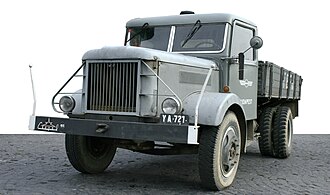
Csepel D350: The Hungarian Truck That Helped Rebuild a Nation
The Csepel D350 occupies a special place in Hungarian automotive history. It was the first series-production truck built by the newly established Csepel Automobile Factory and became one of the principal commercial vehicles of post-war Hungary. Produced from 1950 until 1958, the D350 was conceived during a period when the country urgently needed domestic truck production for reconstruction, industry, agriculture, transportation, and military use. Its engineering roots lay in the Austrian Steyr 380, produced under license, but the Hungarian version soon developed its own identity through local manufacturing, modifications, and an increasingly important family of Csepel-built engines. The truck’s conventional bonneted layout, sturdy ladder frame, rear-wheel drive, diesel engine, and approximately 3.5-ton payload made it an ideal working machine for an economy rebuilding after the devastation of the Second World War.
Although the D350 was based on foreign technology, its significance was unmistakably Hungarian. The factory at Szigethalom, established in 1949 on the site of a former aircraft plant, rapidly became a major center of domestic vehicle production. The first Csepel engine was assembled in December 1949, and the first three trucks left the factory in April 1950. In that same year, production reached 1,666 D350 vehicles according to the local historical collection of Szigetszentmiklós. The truck consequently appeared on Hungarian roads at exactly the moment when reliable domestic transport was most urgently required.
The Birth of Csepel’s Truck Industry
From Aircraft Factory to Automobile Manufacturer
The origins of the D350 are closely connected with the transformation of Hungary’s industrial landscape after 1945. The country had previously produced trucks in smaller quantities, but the destruction and disruption caused by the war created an enormous need for new commercial vehicles. At the same time, Hungary could not simply depend on imported trucks to satisfy its transportation requirements. A domestic mass-production capability was therefore considered strategically important.
In 1949, the Hungarian government established the Csepel Automobile Factory at Szigethalom, on the site of the former Danube Aircraft Factory. Rather than designing a truck entirely from scratch, Hungarian authorities acquired rights connected with the Austrian Steyr 380 and its diesel engines. This gave the new factory access to an established commercial-vehicle design and powertrain technology, allowing production to begin much sooner than would have been possible with an independent design program.
The choice of Steyr technology was particularly significant because Steyr had considerable experience with diesel engines and medium-duty trucks. The D350 therefore entered production with a mechanical foundation that had already been developed and tested. Hungarian engineers could concentrate on establishing manufacturing processes and subsequently adapting the design to local requirements.
The early production period was understandably challenging. Some of the first approximately 1,000 engines were assembled using Austrian-made components, while other parts were supplied by Hungarian companies. The chassis was initially produced by the Győr-based Magyar Waggon- és Gépgyár, while Ikarus supplied cab components. Csepel gradually took over more of the manufacturing process as its own industrial capacity expanded.
A Truck Designed for Reconstruction
The Importance of a 3.5-Ton Workhorse
The D350 belonged to an extremely useful category of commercial vehicles. With a payload of approximately 3.5 tonnes, it was large enough for substantial freight work without becoming a heavy long-distance truck. This made it appropriate for construction, agriculture, industrial distribution, municipal transportation, and military logistics.
The truck’s conventional layout reflected the engineering thinking of the period. The engine was mounted at the front beneath a bonnet, the cab sat behind it, and power was transmitted to the rear wheels. A separate ladder frame supported the body and allowed different superstructures to be installed. This approach may look old-fashioned today, but it offered major practical advantages in the 1950s. The chassis could be adapted to different bodies, while individual mechanical components remained accessible for maintenance.
The Szigetszentmiklós historical collection emphasizes the D350’s modular construction as one of its principal advantages. Different bodies could be mounted on the same basic chassis, while the straightforward mechanical layout made servicing relatively easy. This combination of adaptability and simplicity helped turn the D350 into much more than a single-purpose cargo truck.
The Csepel D413 Diesel Engine
A Four-Cylinder Heart
One of the defining characteristics of the D350 was its Csepel D413 four-cylinder diesel engine. The engine was derived from the Steyr WD-413 and used a 5.3-litre displacement. Contemporary and historical specifications generally give the engine an output of approximately 85 horsepower, or around 63 kW, at roughly 2,200 rpm. Maximum torque was approximately 294 Nm at about 1,400 rpm.
The D413 was a four-stroke diesel with overhead valves and pre-combustion-chamber injection. In an era when diesel technology was rapidly becoming essential to commercial transportation, this engine gave the D350 the low-speed pulling ability required for heavy loads. Its relatively large displacement and modest engine speed were characteristic of the period, when durability and torque were generally valued more highly than high specific power.
The engine was not designed to make the D350 fast. Instead, it was designed to keep a heavily loaded truck moving. That distinction is important when considering historical commercial vehicles. A modern truck may produce several times the power of the D350 while carrying a similar load, but the D350’s engine was deliberately conservative and mechanically straightforward.
The same engine family eventually became important to other Csepel products as well. The company’s numbering system included four-cylinder D413 and six-cylinder D613 engines, demonstrating how the manufacturer built a broader domestic engine family around its initial Steyr-derived technology.
Transmission and Chassis
Five Speeds for Better Control
The D350 transmitted its engine power through a five-speed manual gearbox. This was an important feature for a working truck because the driver needed to select an appropriate ratio according to payload, road gradient, and operating conditions. The transmission was non-synchronized, meaning that changing gears required greater mechanical skill than in a modern truck.
The conventional rear-wheel-drive layout was well suited to the vehicle’s mission. The rear axle carried the main driving load, while the front axle was responsible for steering. The front wheels used single tires and the rear wheels were fitted with twin tires, providing the load-bearing capacity expected of a three-and-a-half-ton truck. The truck used hydraulic drum brakes on all wheels.
The chassis was a sturdy ladder frame made from steel sections. Early examples used riveted construction, while later manufacturing methods included hot-formed steel sections joined by electric welding. This relatively straightforward frame was one of the reasons the D350 was so adaptable. It provided a robust foundation without incorporating unnecessary complexity.
For a vehicle operating in post-war Hungary, ease of repair was crucial. A damaged or worn component needed to be accessible to mechanics, and the truck had to tolerate roads and working conditions that were often far from ideal. The D350’s straightforward architecture was therefore not merely a technical characteristic; it was part of the reason the truck could fulfill its historical role so effectively.
Performance on the Road
Strong Rather Than Fast
The D350 was never intended to be a high-speed truck. Contemporary information places its maximum speed at roughly 73–80 km/h, depending on the specification and source. One historical test cited an average fuel consumption of about 20.3 litres per 100 kilometres, while a carefully controlled run on level concrete at 50 km/h produced a substantially lower figure of approximately 15.4 litres per 100 kilometres.
These numbers illustrate the difference between the D350 and modern commercial vehicles. Fuel consumption was considerable by today’s standards, but the truck’s mission was different. It was designed to carry a heavy load reliably over relatively short and medium distances, often on roads that could be rough or poorly surfaced.
The D350 was also capable of climbing significant gradients while fully loaded. Contemporary descriptions indicate that it could negotiate grades of around 32 percent under full load. Such performance was far more important to its operators than acceleration or cruising speed. A truck that could steadily climb a difficult road with several tonnes of cargo was a genuinely useful machine.
The D350 as a Platform
Flatbeds, Specialist Bodies and Military Vehicles
The standard flatbed was perhaps the most recognizable D350 configuration, but the chassis was designed to accept a wide variety of bodies. The long-wheelbase flatbed version was particularly common, with a cargo platform measuring approximately 3,920 by 2,100 millimetres. This provided a substantial working area for general freight.
The modular nature of the chassis meant that the D350 could be adapted for numerous specialized roles. Trucks of the family served civilian transportation requirements as well as military applications, while later developments expanded the range of bodies and missions available to Csepel vehicles.
The truck’s military importance was particularly significant in the early years of the company. Hungary required domestic transport equipment for its armed forces, and a locally manufactured medium-duty truck offered logistical advantages over reliance on foreign vehicles. The D350’s robust construction, relatively simple maintenance requirements, and useful payload made it a natural choice.
The closely related D352 eventually became a major military development of the basic concept, demonstrating that the original D350 platform provided a useful foundation for further Csepel engineering. Historical publications devoted to the D350 and D352 describe them together as an important chapter in Hungarian military and civilian truck development during the period from 1949 to 1960.
The D350’s Early Success
A Remarkable Reliability Trial
One of the most interesting episodes in the D350’s early history occurred in 1950, when Csepel trucks participated in an international reliability and speed competition in Poland. Eight Hungarian teams entered with Csepel trucks, and the vehicles competed over approximately 2,000 kilometres while carrying their maximum permitted loads.
According to the historical collection of Szigetszentmiklós, the Csepel-equipped Hungarian teams achieved a remarkable result, finishing ahead of several established international truck manufacturers. The success generated valuable publicity for the new Hungarian manufacturer and helped create opportunities for export.
For a newly established truck manufacturer, this kind of result was extremely important. It provided evidence that a Hungarian-built truck could compete successfully beyond its domestic market. The D350 therefore quickly became more than a solution to Hungary’s own transportation shortage; it became a potential export product.
Exporting the Csepel
From Hungary to the Wider World
The D350 and later Csepel trucks were exported to other Comecon countries, as well as markets in the Middle East and Asia. Historical sources note that Csepel vehicles eventually reached countries including Poland, East Germany, the Soviet Union, Egypt, China, Nigeria, and Syria.
Exporting the D350 was significant for Hungary’s developing vehicle industry because commercial-vehicle production could generate valuable industrial expertise and establish relationships with foreign customers. It also demonstrated the versatility of the basic design: the same fundamental truck could be adapted to different road conditions, body configurations, and operational requirements.
The international reach of the D350 also explains why surviving examples can occasionally be found outside Hungary. Although Csepel trucks never achieved the global visibility of Western European giants such as Mercedes-Benz or Volvo, their presence across socialist and developing markets was considerable.
Evolution During the 1950s
Improving the Original Design
The D350 was not simply produced unchanged from 1950 until 1958. Csepel engineers continually refined the truck, responding to practical experience with engines, chassis components, and manufacturing methods.
Early examples had technical components that were susceptible to wear or failure. The original Steyr-derived pistons, for example, were redesigned with changes to their surface area and upper piston-ring arrangement. Other modifications improved pushrod sealing, the fan-shaft washer, and clutch-release mechanism. These changes illustrate how the D350 gradually became a genuinely Hungarian-developed product rather than merely a licensed copy.
Manufacturing itself also evolved. As Csepel became more capable, more components were produced domestically. The result was a truck that retained the basic DNA of the Steyr 380 but increasingly reflected the expertise and industrial capabilities of Hungarian engineers and manufacturers.
The D350 and the Hungarian Automotive Tradition
A Foundation for Csepel’s Future
The importance of the D350 cannot be measured only by the number of trucks built. It established the manufacturing and engineering foundation for an entire generation of Hungarian commercial vehicles.
The factory went on to develop numerous trucks, engines, buses, and specialized chassis. The D350 was the starting point, proving that a modern medium-duty vehicle could be manufactured in Hungary on an industrial scale.
Its descendants became increasingly sophisticated. Csepel moved toward more powerful engines, heavier trucks, tractor units, military vehicles, and specialized transportation equipment. The success of those later products can be traced back in part to the experience gained manufacturing and improving the D350.
The truck also established a philosophy that remained important throughout Csepel’s history: strong basic engineering, interchangeable components, simple maintenance, and flexible body mounting. Those qualities were especially valuable in the economic environment of Central and Eastern Europe during the middle decades of the twentieth century.
The End of D350 Production
The D420 Takes Over
Production of the D350 ended in 1958, by which point Csepel had developed newer and more capable trucks. The D420 became the successor to the original model, carrying forward the basic philosophy while incorporating further technical and visual development.
The transition did not make the D350 irrelevant. Thousands of examples had already entered service, and many continued working for years after production ended. Trucks of this kind were rarely discarded simply because a newer model appeared. Their value lay in their ability to perform useful work, and operators often kept them in service for as long as mechanical condition allowed.
That long working life helped turn the D350 into a symbol of Hungary’s reconstruction period. It was a vehicle that could be seen on construction sites, roads, farms, industrial premises, and military bases during a period of enormous social and economic change.
Why the Csepel D350 Still Matters
More Than a Licensed Steyr
It would be easy to describe the D350 simply as a Hungarian copy of the Steyr 380, but that would overlook its real historical importance. The truck began with licensed foreign technology because Hungary needed a fast route into modern truck manufacturing. Yet the D350 became the foundation for domestic engineering, production expertise, export activity, and an entire family of later Csepel vehicles.
Its significance is also tied to timing. The D350 appeared only a few years after the Second World War, when Hungary urgently needed vehicles to rebuild infrastructure and restart industrial production. In that context, every reliable truck represented more than another commercial vehicle. It was a tool for reconstruction.
The D350’s simplicity was another major strength. Its ladder frame, front-mounted diesel, rear-wheel drive, five-speed gearbox, twin rear tires, and hydraulic drum brakes represented conventional engineering, but conventional engineering was precisely what the period required. The truck did not need to be revolutionary. It needed to work.
Csepel D350 Technical Specifications
Specifications varied between production versions, body configurations, and later modifications. The following table summarizes the commonly cited characteristics of the long-wheelbase diesel flatbed D350.
| Specification | Csepel D350 |
|---|---|
| Manufacturer | Csepel Autógyár |
| Country | Hungary |
| Production | 1950–1958 |
| Factory | Szigethalom, Hungary |
| Original design basis | Steyr 380 |
| Vehicle type | Medium-duty lorry |
| Body construction | Separate ladder-frame chassis |
| Layout | Front engine, rear-wheel drive |
| Engine | Csepel D413 diesel |
| Engine type | 4-cylinder, 4-stroke diesel |
| Displacement | Approximately 5.3 litres |
| Fuel system | Pre-combustion chamber injection |
| Valvetrain | OHV |
| Maximum power | Approx. 85 hp / 63 kW at 2,200 rpm |
| Maximum torque | Approx. 294 Nm at 1,400 rpm |
| Transmission | 5-speed manual |
| Clutch | Single-disc dry clutch |
| Brakes | Hydraulic drum brakes |
| Front tires | 8.25 × 20 |
| Rear tires | 8.25 × 20, twin |
| Drive | 4×2 |
| Wheelbase | Approx. 3,710 mm |
| Length | Approx. 6,735 mm |
| Width | Approx. 2,260 mm |
| Height | Approx. 2,740 mm |
| Kerb weight | Approx. 3,200 kg |
| Payload | Approx. 3,500 kg |
| Gross vehicle weight | Approx. 6,700 kg |
| Trailer capacity | Approx. 3,500 kg |
| Flatbed dimensions | Approx. 3,920 × 2,100 mm |
| Maximum speed | Approx. 73–80 km/h |
| Turning diameter | Approx. 16.8 m |
| Fording depth | Approx. 255 mm |
| Typical fuel consumption | Around 20 L/100 km in period testing |
| Successor | Csepel D420 |
Conclusion
The Csepel D350 was the truck that established Hungary as a significant producer of commercial vehicles in the post-war period. Built from licensed Steyr technology but progressively modified and manufactured domestically, it provided the country with a reliable 3.5-ton workhorse precisely when such a vehicle was needed most. The truck’s importance therefore extended far beyond its technical specifications. It was part of the machinery of national reconstruction.
Its four-cylinder D413 diesel, five-speed gearbox, rugged ladder frame, rear-wheel drive, and flexible body mounting made it a practical vehicle for civilian and military applications alike. The D350 was not fast, luxurious, or technologically exotic, but it was strong, understandable, serviceable, and adaptable. Those qualities allowed it to succeed in an era when durability mattered more than refinement.
The truck’s early international competition success and subsequent exports further demonstrated the potential of the young Csepel factory. Within only a few years, a company that had effectively begun from the remains of an aircraft factory had established itself as a producer capable of competing beyond Hungary’s borders.
Today, the Csepel D350 is remembered as one of the foundational vehicles of Hungarian automotive history. It represents the beginning of Csepel’s mass-production truck era, the industrial ambitions of post-war Hungary, and the successful adaptation of Austrian engineering to a new manufacturing environment. More than seventy years after the first examples appeared, the surviving D350s are valuable reminders of a period when a sturdy truck could become an essential part of rebuilding an entire country.
