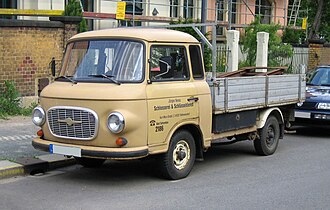
Barkas B1000: The Story of East Germany’s Remarkable Two-Stroke Van
The Barkas B1000 was one of the most distinctive commercial vehicles produced in East Germany and one of the most recognizable vans of the former Eastern Bloc. Built by VEB Barkas-Werke in Karl-Marx-Stadt, today Chemnitz, the B1000 served as a delivery van, minibus, pickup, ambulance, fire-service vehicle, workshop van, camper, and countless other specialist vehicles. Its production began in 1961, and although the original B1000 was eventually replaced by the four-stroke B1000-1, the basic design remained in production until 1991. More than 170,000 vehicles were manufactured during the long production run, making the Barkas an essential part of everyday transportation in the German Democratic Republic and a familiar sight throughout other socialist countries.
What makes the B1000 especially fascinating is the contrast between its advanced basic concept and its increasingly old-fashioned powertrain. When it appeared in the early 1960s, the Barkas offered a modern forward-control layout, front-wheel drive, independent suspension, a useful payload of approximately one tonne, and an exceptionally practical body. Yet it remained powered by a three-cylinder, two-stroke petrol engine derived from DKW engineering and shared with the Wartburg family. The result was a vehicle that was clever, spacious, versatile, and surprisingly sophisticated in its chassis design, but also unmistakably tied to the technological limitations of East German automotive production.
The Origins of the Barkas B1000
Replacing the Framo
The story of the B1000 began before the Barkas name itself became associated with light commercial vehicles. The factory in Hainichen and later Karl-Marx-Stadt had a long tradition of producing small utility vehicles under the Framo name. After the Second World War, the East German automotive industry was reorganized, and development work began on a modern successor to the existing Framo range.
By the middle of the 1950s, engineers were working on a new light commercial vehicle known internally as the L1. The objectives were ambitious: the new vehicle was expected to have a modern cab-over configuration, independent suspension, torsion-bar springing, and a much more efficient use of interior space than the older Framo products. Prototypes were extensively tested, and after almost a million kilometres of testing, the first production B1000 finally left the factory on 14 June 1961.
This background is important because the B1000 was not simply a conservative replacement for an aging van. Its engineering philosophy was considerably more modern. Instead of placing the engine ahead of the cabin in the conventional manner, Barkas created a forward-control vehicle in which the engine was positioned between the driver and passenger seats. This allowed the designers to use the vehicle’s relatively short overall length extremely efficiently.
A Modern Concept for the 1960s
Compact Exterior, Generous Interior
The B1000 was designed around a simple but highly effective idea: maximize useful space without making the vehicle excessively large. Its cab-over configuration and front-wheel drive freed much of the vehicle’s rear structure for cargo or passengers. The result was a van that could maneuver through narrow urban streets while still providing a remarkably useful load compartment.
The standard panel van had four doors and a large enclosed cargo area, while the same basic platform could be configured as an eight-seat minibus, a two-door pickup, or one of numerous specialist vehicles. The first minibus version appeared in 1964, followed by the pickup in 1965.
The practical nature of the design made the B1000 particularly valuable in East Germany. The country had a constant need for small commercial vehicles, but production capacity was limited and private businesses had restricted access to new vehicles. State organizations, municipalities, tradesmen, agricultural enterprises, hospitals, and emergency services all required compact transporters, and the Barkas could be adapted to nearly all of these roles.
The name itself became synonymous with the vehicle. For many people in the former GDR, a “Barkas” was simply the small working van that appeared everywhere, from city streets and railway stations to construction sites and rural communities.
The Two-Stroke Engine
A Wartburg Connection
The most famous mechanical feature of the B1000 was its three-cylinder, two-stroke petrol engine. Early vehicles used a 901 cc engine producing around 40 horsepower, while later development increased displacement to approximately 992 cc and output to roughly 45 horsepower, with later references listing around 33 kW or 45 PS for the final two-stroke configuration.
The engine was derived from the DKW engineering tradition and was closely related to the powerplants used in the Wartburg 353. It was liquid-cooled and mounted longitudinally between the front seats, driving the front wheels through a four-speed manual transmission. The unusual combination of a three-cylinder two-stroke engine and front-wheel drive gave the Barkas a mechanical identity unlike most Western European vans of the same period.
Two-stroke engines had certain advantages in this application. Their construction was comparatively simple, with fewer moving components than a conventional four-stroke engine. They could be compact and relatively light while producing useful power from a small displacement. For an industrial system that valued ease of production and established component families, sharing the engine architecture between Barkas and Wartburg made considerable sense.
However, the same technology had obvious disadvantages. The engine required oil to be mixed with the fuel, and the characteristic exhaust smoke of a two-stroke engine became increasingly difficult to reconcile with changing expectations concerning emissions and refinement. The B1000’s engine could be dependable when properly maintained, but by the 1980s its technology was becoming visibly outdated.
The B1000’s Chassis Engineering
Front-Wheel Drive and Independent Suspension
The Barkas’s mechanical design was more sophisticated than its humble appearance might suggest. The vehicle used front-wheel drive, which was particularly useful in a commercial vehicle because it eliminated the need for a long propeller shaft and conventional rear-drive arrangement. The flat floor and efficient packaging made the rear of the van exceptionally useful.
Both front and rear wheels used independent suspension with torsion bars and hydraulic shock absorbers. This was an impressive feature for a light commercial vehicle designed in the 1950s. Rather than relying on a simple rigid axle at the rear, Barkas engineers pursued a suspension arrangement that helped provide good road manners and a relatively comfortable ride.
The brakes were hydraulic drums on both axles. Again, this was conventional technology for the period, but it was sufficient for a vehicle with a payload around one tonne and a top speed generally in the region of 95–100 km/h depending on configuration.
The combination of front-wheel drive, independent suspension, and forward-control bodywork made the B1000 unusually well packaged. In many respects, the underlying architecture was closer to the philosophy of a modern compact van than its age might suggest.
A Versatile Family of Vehicles
Panel Van, Pickup and Minibus
The most familiar B1000 is probably the panel van, but the model was never limited to one body style. Its chassis became the basis for a remarkably broad range of vehicles.
The minibus version provided seating for passengers and was used by public institutions, businesses, and other organizations. The pickup offered an open cargo platform suitable for construction, agriculture, municipal maintenance, and other work where an enclosed body was unnecessary.
Specialist versions extended the Barkas’s usefulness even further. Fire-service vehicles, ambulances, refrigerated bodies, mobile workshops, service vehicles, and other conversions were built from the B1000 platform. Historical accounts list more than sixteen different configurations during the model’s long life, demonstrating just how adaptable the basic vehicle proved to be.
This adaptability was one of the major reasons the B1000 remained in production for so long. Instead of requiring a separate vehicle for every light-duty task, organizations could adapt the Barkas chassis to suit their particular needs. In a planned economy where vehicle supply was often restricted, that flexibility was especially valuable.
The Barkas as a Fire and Emergency Vehicle
The KLF and Other Special Versions
Among the most interesting B1000 derivatives were the vehicles used by emergency services. Fire brigades operated Barkas-based KLF vehicles, while medical and rescue organizations also used specialized versions. These applications demonstrate how a relatively small van could be turned into an effective service vehicle through careful body engineering.
A fire-service Barkas could carry firefighters, hoses, extinguishing equipment, and other essential tools while remaining compact enough for rapid movement through narrow streets. The same basic concept made the vehicle suitable for ambulances and emergency-response duties.
These specialist versions also became important historically because they were often maintained by organizations with dedicated workshops. As a result, many surviving Barkas vehicles today are not standard delivery vans but preserved or restored emergency-service derivatives.
Continuous Development During a Long Production Run
Small Improvements Instead of a New Van
One of the defining characteristics of the B1000 was the extraordinary length of its production life. The basic design remained fundamentally recognizable for approximately three decades, yet Barkas engineers introduced numerous detail improvements along the way.
In 1963, the braking system was upgraded from a single-circuit arrangement to a dual-circuit system, while the gearshift was moved from the steering column to a conventional central position. In 1972, the electrical system received a more powerful 500-watt alternator, while engine output increased from approximately 31 kW to 33 kW.
Other improvements appeared over the years, including revisions to the exhaust system, electrical washer equipment, hazard-warning lights, dashboard and instruments, windshield-wiper systems, and door arrangements. None transformed the B1000 overnight, but together these changes kept the vehicle functional and competitive within the limitations of the East German automotive industry.
The approach was evolutionary rather than revolutionary. The basic body, chassis, and engine architecture remained familiar because replacing the entire production system would have required enormous investment and resources that simply were not readily available.
Why Was the B1000 Never Fully Replaced?
The Problem of Industrial Limitations
The long life of the B1000 was partly a testament to the design, but it also reflected the difficult industrial circumstances of the GDR. Engineers reportedly developed replacement concepts and prototypes, yet many never reached series production. The B1000 consequently continued to serve long after its original technology had begun to age.
This created an unusual situation. From an engineering perspective, the B1000 had several genuinely modern characteristics, but its powertrain and overall product concept became increasingly dated. Western European manufacturers were introducing newer vans with four-stroke engines, improved ergonomics, and more refined drivetrains, while Barkas continued refining a design that had originated in the 1950s.
Nevertheless, the B1000 remained valuable because there was no adequate replacement available in sufficient numbers. For many East German organizations, a familiar Barkas was preferable to having no suitable light transporter at all.
The B1000-1 and the Four-Stroke Revolution
A Last-Minute Modernization
The most dramatic technical change finally arrived in 1989, when Barkas presented the B1000-1. Instead of the traditional two-stroke engine, the new model received a 1,272 cc four-stroke Volkswagen-derived engine, manufactured under license. The engine was related to the powerplant used in the Wartburg 1.3 and produced approximately 58 horsepower.
The change was significant because it addressed one of the biggest weaknesses of the original B1000. A four-stroke engine was quieter, cleaner, and much more in line with contemporary European expectations. Yet the basic B1000 architecture was retained, demonstrating just how deeply embedded the original design was in Barkas’s manufacturing system.
There had also been plans to give the vehicle a more extensive visual modernization. Prototypes were reportedly built with a revised front end featuring a large plastic assembly integrating the headlights and grille, but this new exterior never reached series production.
The B1000-1 therefore arrived at precisely the wrong moment in history. The vehicle had finally received a modern powertrain, but the political and economic system that had sustained its production was disappearing.
The End of Barkas Production
German Reunification and an Unfinished Future
The final chapter of the Barkas story was remarkably abrupt. Production of the B1000-1 began during 1990, but the vehicle’s career lasted only a short time. On 10 April 1991, the final B1000/B1000-1 left the production line. Approximately 1,900 B1000-1 vehicles were built.
There were attempts to relocate production to Russia after the collapse of East Germany. Production documentation and equipment were prepared, and considerable effort was invested in the proposed transfer. However, the project ultimately failed because investors withdrew and the necessary financing for transportation and continued production could not be secured. The machinery was eventually scrapped, bringing the story of the Barkas manufacturing operation to an unfortunate end.
The end was particularly poignant because the B1000 had remained a useful vehicle and had only just received the modern four-stroke engine it needed to compete more effectively. Under different circumstances, the B1000-1 might have developed into a viable new generation of Eastern European commercial van. Instead, the reunification of Germany and the transformation of the automotive market made the old production system economically unsustainable.
The Barkas B1000 in Popular Memory
An Icon of Everyday East Germany
The B1000 has acquired a cultural significance that goes beyond its technical specifications. Like the Trabant and Wartburg, it became part of the visual identity of East Germany. Its boxy body, rounded corners, sliding doors, and characteristic three-cylinder exhaust note were familiar to millions of people.
For tradesmen and state organizations, it was a working vehicle. For families, the minibus could represent practical transportation. For emergency workers, the Barkas was a tool on which lives and property could depend. For today’s enthusiasts, it is a symbol of an industrial world that no longer exists.
Its relative rarity outside Central and Eastern Europe has also contributed to its appeal. In Western Europe, the Volkswagen Transporter is generally the better-known historic van of the period, but the Barkas offers an intriguing alternative. Its front-wheel-drive layout, unusual two-stroke engine, and East German history make it one of the most distinctive surviving commercial vehicles of the Cold War era.
Barkas B1000 Technical Specifications
The exact figures varied according to model year and body configuration. The table below summarizes representative specifications for the classic two-stroke B1000 rather than the later B1000-1.
| Specification | Barkas B1000 |
|---|---|
| Manufacturer | VEB Barkas-Werke |
| Production | 1961–1988 for original B1000; B1000 family continued to 1991 |
| Country of manufacture | East Germany (GDR) |
| Assembly | Karl-Marx-Stadt, now Chemnitz |
| Vehicle type | Light commercial vehicle |
| Body styles | Panel van, minibus, pickup, specialist bodies |
| Layout | Front engine, front-wheel drive |
| Engine | Liquid-cooled 3-cylinder two-stroke petrol |
| Early displacement | 901 cc |
| Later displacement | 992 cc |
| Early power | Approx. 31 kW / 42 hp |
| Later power | Approx. 33 kW / 45 hp |
| Transmission | 4-speed manual, synchromesh |
| Suspension | Independent front and rear, torsion bars |
| Brakes | Hydraulic drum brakes |
| Wheelbase | 2,400 mm |
| Typical payload | Approximately 1,000 kg |
| Seating | Up to 8 in minibus configuration |
| Maximum speed | Approximately 95–100 km/h |
| Drive wheels | Front |
| Successor | Barkas B1000-1 |
| B1000-1 engine | 1,272 cc four-stroke Volkswagen-licensed petrol |
| B1000-1 power | Approx. 58 hp |
| Approx. B1000 family production | More than 170,000 |
Conclusion
The Barkas B1000 was one of the most ingenious and enduring light commercial vehicles to emerge from the former Eastern Bloc. Its combination of front-wheel drive, forward-control construction, independent suspension, useful one-tonne payload, and versatile body design made it an impressively practical machine when it first appeared in 1961.
Its greatest contradiction was that this fundamentally clever vehicle was tied to a two-stroke engine whose technology was already becoming obsolete. Yet that same engine helped create the Barkas’s distinctive personality. The sound, smell, and mechanical character of the three-cylinder powerplant became inseparable from the identity of the van.
For nearly thirty years, the B1000 adapted to the changing needs of East German society. It became a delivery van, bus, pickup, ambulance, fire engine, workshop, camper, and countless other specialized vehicles. Small engineering improvements kept it useful even when a completely new design would have been preferable. Finally, the four-stroke B1000-1 arrived just as the political and economic environment that had sustained Barkas disappeared.
Today, the Barkas B1000 is remembered not merely as an old van, but as an important piece of Central European automotive history. It represents the ingenuity of engineers working within severe industrial constraints, the everyday transportation culture of the GDR, and the extraordinary longevity that a well-designed commercial vehicle can achieve. Its unmistakable shape and unusual two-stroke engine ensure that the Barkas remains one of the most memorable and characterful vans of the twentieth century.
