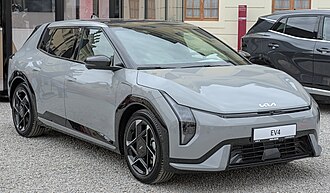
KIA EV4 as a Used Car: What Buyers Should Know
The KIA EV4 is an unusual electric car in a market increasingly dominated by SUVs. Instead of following the familiar formula of giving every new EV a tall body and crossover styling, Kia has developed the EV4 as a low-slung, aerodynamic family car, offered in both five-door hatchback and fastback/sedan-style forms. That makes it particularly interesting as a used car because it combines the advantages of an electric powertrain with a more conventional driving position and body shape. The EV4 is also a relatively new model, meaning that used examples will generally be young, low-mileage cars with plenty of factory warranty remaining rather than high-mileage vehicles with years of history behind them. For buyers considering one, the central questions are therefore less about long-established reliability problems and more about battery choice, real-world range, charging performance, equipment, software and depreciation. Kia offers the EV4 with either a 58.3 kWh Standard Range battery or an 81.4 kWh Long Range battery, both initially paired with a 150 kW front-mounted electric motor producing 283 Nm.
What Is the KIA EV4?
The EV4 occupies a distinctive position in Kia’s electric range. Whereas the EV3 is a compact crossover and the EV6 is a larger, sportier crossover, the EV4 is aimed at customers who want an efficient electric family car without necessarily wanting an SUV. The hatchback measures around 4.43 metres long, while the longer fastback version stretches to approximately 4.73 metres. Both have a 2.82-metre wheelbase and are 1.86 metres wide, giving the EV4 a substantial footprint despite its relatively low roofline. The fastback’s extended body also provides a particularly useful luggage compartment, while the hatchback remains the more compact and potentially easier option for urban driving and parking.
One of the EV4’s defining characteristics is its aerodynamic design. Kia has concentrated heavily on reducing drag, with the company quoting a coefficient of drag as low as 0.23. That is important for an electric car because aerodynamic efficiency becomes increasingly valuable as speed rises. In practice, a low-drag body can help reduce energy consumption during motorway driving and make the larger battery more effective on long journeys. The result is a car that looks quite different from the average electric crossover, but that difference is functional rather than purely cosmetic. For a used buyer who spends a lot of time on faster roads, the EV4’s body shape may actually be one of its biggest advantages.
Battery Options and Range
58.3 kWh Standard Range
The Standard Range EV4 uses a 58.3 kWh lithium-ion battery and a 150 kW permanent-magnet synchronous motor driving the front wheels. Kia’s published European specifications put output at approximately 201 bhp, or 150 kW, with 283 Nm of torque. Official range figures vary according to body style, wheels and market, but Kia quotes roughly 410–430 km for the original projected hatchback and sedan figures, while current market specifications can show higher homologated figures depending on configuration. The important point for a used buyer is that the 58.3 kWh version is not a short-range city car; it is a fully capable family EV whose principal limitation compared with the Long Range model is the additional charging margin available on longer journeys.
For drivers who have reliable home charging and spend most of their time commuting, the Standard Range version could actually be the better-value used purchase. The smaller battery reduces vehicle weight and purchase price, while the motor remains just as powerful as the one in the Long Range model. There is also little reason to carry an expensive 81.4 kWh battery every day if most journeys are only a few dozen kilometres. The decision becomes much more difficult for drivers who regularly travel hundreds of kilometres in a day, where the larger battery can substantially reduce charging stops.
81.4 kWh Long Range
The 81.4 kWh Long Range EV4 is the more ambitious version and is likely to be particularly desirable on the used market. Kia’s official figures have indicated a maximum WLTP range of approximately 625–630 km for the most efficient sedan/fastback configurations, although exact figures depend on body style, wheels and the homologation applicable to the individual market. The hatchback’s official figure is lower than the most efficient fastback because of its body shape and aerodynamics, but it can still provide a very substantial range for a family EV.
The larger battery does not bring a corresponding increase in motor output in the standard front-wheel-drive configuration. That means buyers are paying primarily for range rather than acceleration. This is an important distinction when looking at used advertisements: a Long Range EV4 should not be assumed to be a performance model. Its advantage is endurance. For long-distance drivers, that is arguably more valuable than another few tenths of a second in acceleration because it can make motorway journeys considerably easier to plan.
How Does the KIA EV4 Drive?
The EV4’s 150 kW motor produces brisk performance, with Kia quoting 0–100 km/h in approximately 7.4 seconds for the Standard Range and around 7.7 seconds for the Long Range version. The maximum speed is 170 km/h. As expected from an electric car, acceleration is smooth and immediate, while the single-speed reduction transmission eliminates conventional gear changes. The front-wheel-drive layout also distinguishes the EV4 from some larger E-GMP models that use dual-motor all-wheel-drive configurations. For ordinary road use, however, the EV4 should have more than enough performance for overtaking, joining motorways and maintaining speed on hills.
The suspension layout is reassuringly conventional for a car in this class, with MacPherson struts at the front and a multi-link arrangement at the rear. That combination is intended to provide a balance between ride comfort and handling, and the EV4’s relatively low body should give it a different character from an upright electric SUV. Buyers looking at used examples should nevertheless pay close attention to tyres and wheels. Larger 19-inch wheels can change the ride quality and increase tyre replacement costs, so a cheaper EV4 fitted with smaller wheels may ultimately be the more comfortable and economical car to own.
Charging a Used EV4
DC Fast Charging
The EV4 uses Kia’s 400-volt E-GMP architecture and supports rapid DC charging. Kia quotes approximately 29 minutes for a 10–80% charge with the 58.3 kWh battery and approximately 31 minutes with the 81.4 kWh battery under suitable high-power charging conditions. Current European specifications list peak DC charging capability around 100.5 kW for the Standard Range and up to approximately 127.5 kW for the Long Range. The difference is not enormous in everyday use, but the Long Range model’s larger battery and stronger charging capability make it particularly well suited to long-distance travel.
When buying a used EV4, charging should be part of the inspection rather than something discussed only after the purchase. If possible, connect the car to both an AC charger and a DC rapid charger and confirm that charging begins normally. Inspect the charge port for physical damage and check that the vehicle recognises different charging equipment. A charging problem can be much more inconvenient than a conventional mechanical fault because it can affect the car’s fundamental usefulness, so spending a little extra time on this check is worthwhile.
AC Home Charging
AC charging is naturally slower but remains the most useful form of charging for many owners because the car can be connected overnight. Kia’s UK specification lists approximately 5 hours 20 minutes for a 10–100% charge from a 230V/16A supply with the 58.3 kWh battery and about 7 hours 15 minutes for the 81.4 kWh battery. Some markets and versions can also offer higher-power AC charging equipment, so buyers should check the exact specification of the vehicle rather than assuming every EV4 has identical charging hardware.
For a used buyer, home charging availability should influence which battery is selected. Someone with a driveway and overnight charging can make excellent use of the Standard Range EV4 because the car starts each morning with a full or nearly full battery. Someone who lives in an apartment without private charging may place greater value on the Long Range model because its larger battery reduces the frequency with which public charging is required.
What to Check When Buying a Used EV4
Battery Health and Warranty
The battery is naturally the most important component to investigate. However, because the EV4 is still a young vehicle, an early used example should generally have considerably less battery ageing than an older EV with a decade of use. Buyers should nevertheless ask for the vehicle’s service and charging history, verify that the battery has not suffered any recorded damage and, where possible, obtain a battery-health report. A high-quality inspection can provide reassurance that the advertised range is consistent with the car’s actual condition.
Kia’s Czech-market information states that its high-voltage EV batteries are covered for eight years from first registration or 160,000 km, whichever comes first, and that Kia guarantees at least 70% battery capacity under the applicable warranty terms. This is particularly valuable when buying a relatively young used EV because a substantial part of the battery warranty can remain with the vehicle. Buyers should confirm the exact warranty status, registration date and conditions for the individual car before purchase.
Software and Electronic Equipment
The EV4 is a technology-heavy car, so the used-car inspection should include much more than paintwork and suspension. Check the infotainment screens, digital instruments, reversing camera, parking sensors, climate control, driver-assistance systems, smartphone connectivity and keyless functions. Kia has also designed the EV4 around connected features such as over-the-air software updates, Digital Key and other digital services, meaning software is an important part of the ownership experience.
It is worth asking the seller whether all available software updates have been installed and whether any recalls or technical campaigns have been completed. A car that has received its updates and has a complete service history is generally preferable to an identical example with uncertain electronic history. During the test drive, pay attention to warning messages, unexpected driver-assistance interventions and any glitches in the infotainment system.
Is the EV4 Practical as a Used Family Car?
The answer depends heavily on which body style you choose. The hatchback’s shorter length makes it easier to manoeuvre and park, while its conventional five-door layout should appeal to buyers who want everyday versatility without the size of a large sedan. Kia quotes around 435 litres of luggage capacity for the hatchback in current UK specifications. The fastback is longer and has a larger rear luggage area, with current specifications listing around 490 litres.
The EV4 is therefore more practical than its sleek appearance might initially suggest. The long 2,820 mm wheelbase should provide useful passenger space, while the flat-floor benefits associated with an electric platform help make the cabin feel open. Families should still inspect rear-seat space personally if child seats are involved, because published luggage figures cannot tell you how conveniently a particular pram, bicycle, shopping load or child-seat arrangement will fit.
Running Costs and Maintenance
A used EV4 should generally require less routine mechanical maintenance than a comparable petrol car. There is no engine oil, conventional exhaust system, spark plugs or multi-speed combustion gearbox, while regenerative braking can reduce reliance on the friction brakes. Nevertheless, an electric vehicle is not maintenance-free. Tyres, suspension components, brake components, air-conditioning systems, cabin filters and the high-voltage electrical system still require attention.
Kia’s UK specification currently lists a service interval of 24 months or 20,000 miles, whichever comes first. Maintenance requirements can vary by country and model year, so owners should follow the official schedule applicable to their particular vehicle.
Energy costs will depend on charging location. A driver who charges mostly at home can potentially keep running costs low, while someone dependent on expensive public rapid charging may find the financial advantage over a combustion car less dramatic. The best way to assess the EV4’s economy is therefore to calculate electricity costs using your own annual mileage and the prices you can realistically access.
Which Used KIA EV4 Should You Buy?
For city users and commuters, the 58.3 kWh Standard Range hatchback could be the sweet spot. It has the same 150 kW motor as the Long Range version, provides useful real-world range and should be cheaper to buy second-hand. If the price difference between two otherwise similar cars is substantial, putting the saving toward a home charger or simply keeping it in reserve may make more sense than buying a larger battery that is rarely needed.
For frequent motorway drivers, the 81.4 kWh Long Range is the stronger recommendation. Its substantially greater range gives the driver more flexibility, particularly in winter or when travelling at high speed. The fastback version is particularly interesting because its longer, aerodynamic body is designed to maximise efficiency and its luggage capacity is also generous. Kia’s Czech-market information currently quotes up to 625 km for the EV4 and up to 633 km for the EV4 Fastback with the 81.4 kWh battery, depending on configuration.
Trim level should come after battery and condition in the buying decision. A highly equipped car can be tempting, but battery size, warranty, service history and charging performance are more fundamental to long-term ownership. A modestly equipped Long Range car with an excellent history can therefore be a better used-car purchase than a heavily equipped Standard Range example with less attractive mileage or uncertain provenance.
Final Verdict: Is the KIA EV4 a Good Used Car?
The KIA EV4 has the potential to be an excellent used electric car, particularly for buyers who do not want an SUV. Its low aerodynamic body, spacious wheelbase, efficient electric drivetrain and two useful battery choices give it a broader appeal than its unusual styling might suggest. The Long Range version is particularly impressive on paper, with more than 600 km of maximum WLTP range available in the most efficient configurations, while the Standard Range model provides a less expensive route into the EV4 range.
The biggest caveat is simply the car’s age. Because the EV4 is still a relatively new model, there is not yet a decade of used-car reliability data available. That does not make it a poor choice; rather, it means buyers should focus on the condition and documentation of the specific vehicle. A full service history, remaining battery warranty, healthy high-voltage battery, successful AC and DC charging tests, up-to-date software and clean vehicle history should all be part of the buying checklist.
As a used car, the EV4 is therefore particularly attractive to someone who wants an efficient, modern EV but does not want to follow the SUV trend. The 58.3 kWh version makes the most sense for cost-conscious local and regional driving, while the 81.4 kWh Long Range is the better all-rounder for people who regularly cover longer distances. Provided the used price reflects the car’s age and the individual example passes a thorough inspection, the EV4 could become one of the more interesting second-hand alternatives to the growing number of electric crossovers.
KIA EV4 Technical Specifications
| Specification | EV4 Hatchback 58.3 kWh | EV4 Hatchback 81.4 kWh | EV4 Fastback 81.4 kWh |
|---|---|---|---|
| Battery capacity | 58.3 kWh | 81.4 kWh | 81.4 kWh |
| Battery type | Lithium-ion | Lithium-ion | Lithium-ion |
| Drive | Front-wheel drive | Front-wheel drive | Front-wheel drive |
| Electric motor | PMSM | PMSM | PMSM |
| Maximum power | 150 kW / 201–204 hp | 150 kW / 201–204 hp | 150 kW / 201–204 hp |
| Maximum torque | 283 Nm | 283 Nm | 283 Nm |
| Transmission | Single-speed reduction | Single-speed reduction | Single-speed reduction |
| 0–100 km/h | Approx. 7.4 s | Approx. 7.7 s | Approx. 7.7 s |
| Maximum speed | 170 km/h | 170 km/h | 170 km/h |
| Maximum WLTP range | Approx. 410–456 km* | Up to approx. 625 km* | Up to approx. 633 km* |
| DC charging, 10–80% | Approx. 29 min | Approx. 31 min | Approx. 31 min |
| Peak DC charging power | Approx. 100.5 kW | Approx. 127.5 kW | Approx. 127.5 kW |
| AC charging, 10–100% at 16A | Approx. 5 h 20 min | Approx. 7 h 15 min | Approx. 7 h 15 min |
| Length | 4,430 mm | 4,430–4,450 mm | 4,730 mm |
| Width | 1,860 mm | 1,860 mm | 1,860 mm |
| Height | Approx. 1,485 mm | Approx. 1,485 mm | Approx. 1,480 mm |
| Wheelbase | 2,820 mm | 2,820 mm | 2,820 mm |
| Luggage capacity | Approx. 435 litres | Approx. 435 litres | Approx. 490 litres |
| Maximum braked trailer weight | 500 kg | 1,000 kg | 1,000 kg |
| High-voltage battery warranty | 8 years / 160,000 km, subject to terms | 8 years / 160,000 km, subject to terms | 8 years / 160,000 km, subject to terms |
*Official range varies by body style, wheel size, trim, market and homologation. Kia’s published figures currently give up to 625 km for the EV4 and up to 633 km for the EV4 Fastback with the 81.4 kWh battery. Real-world range will vary with temperature, speed, weather, terrain, load and driving style.
