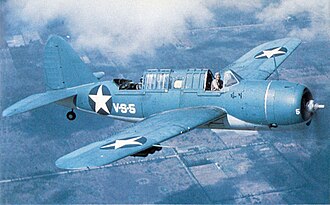
Brewster SB2A Buccaneer: The Forgotten Scout Bomber of the Second World War
The Brewster SB2A Buccaneer is one of the more curious aircraft stories of the Second World War. Conceived as a modern American scout bomber at a time when naval aviation was rapidly moving toward faster, more powerful monoplanes, the Buccaneer looked promising on paper. It had a large internal bomb bay, a powerful 1,700-horsepower radial engine, substantial armament and, in later versions, equipment for carrier operations. Yet the aircraft was plagued by delays, increasing weight, poor handling and production problems, and by the time it was available in meaningful numbers, it had already become unsuitable for the demanding combat environment for which it had been designed. The U.S. Naval Aviation Museum bluntly describes the SB2A as “overweight, underpowered, and lacking maneuverability,” while noting that aircraft supplied to Britain and the Netherlands were ultimately not used in combat.
The Buccaneer’s story is nevertheless worth examining because it illustrates an important reality of wartime aircraft development: a design could be ordered in large numbers, attract international customers and incorporate apparently impressive specifications, yet still fail to become a useful combat aircraft. The SB2A was not simply a case of an obsolete aircraft being overtaken by newer designs. Its problems involved the entire programme, from design changes and manufacturing delays to the aircraft’s growing weight and structural shortcomings. Ultimately, the Buccaneer became a trainer, target tug and maintenance aircraft rather than the frontline scout bomber that its designers and customers had envisioned.
The Origins of the SB2A Buccaneer
Building on Brewster’s earlier experience
The SB2A was developed by the Brewster Aeronautical Corporation, the same company responsible for the F2A Buffalo fighter. Brewster had already gained experience designing naval aircraft, and its earlier XSBA-1 scout bomber provided an important starting point for the new design. In April 1939, the U.S. Navy ordered a prototype of Brewster’s larger Model 340, designated XSB2A-1. The Navy wanted a modern scout bomber capable of carrying a substantially heavier bomb load than earlier aircraft. The new design therefore represented a considerable increase in size and power compared with Brewster’s previous scout-bomber work.
The aircraft was designed around a single powerful radial engine and a conventional mid-wing monoplane configuration. Its internal bomb bay could accommodate up to 1,000 pounds of bombs, while machine guns provided forward and defensive firepower. The original concept also included a gun turret, reflecting the expectation that a two-seat scout bomber might have to defend itself against enemy fighters during reconnaissance or attack missions.
On paper, the SB2A therefore seemed to occupy a useful position between a conventional dive bomber and a reconnaissance aircraft. It could carry a significant internal bomb load while retaining an observer-gunner and substantial defensive armament. The basic design was larger and more powerful than the earlier Brewster SBA/SBN family and appeared to reflect the rapid development of American naval aviation during the late 1930s.
A prototype that arrived too late
The prototype’s development, however, proceeded much more slowly than expected. Although the Navy ordered the aircraft in 1939, the XSB2A-1 did not make its first flight until 17 June 1941. By that point, the international situation had changed dramatically, and foreign governments had already placed substantial orders for the aircraft. Britain had ordered 750 examples, while the Dutch government had ordered 162 for service in the Netherlands East Indies.
The timing was unfortunate. The aircraft had been conceived in the relatively stable technological environment of the late 1930s, but by 1941 combat aviation was evolving at extraordinary speed. Fighters were becoming faster, anti-aircraft defences were improving and dive bombers and attack aircraft were receiving better protection and equipment. Every delay therefore increased the risk that the Buccaneer would enter production already behind the technological curve.
Design and Engineering
A substantial aircraft with a powerful engine
The SB2A was a fairly large aircraft for a single-engine scout bomber. It measured approximately 39 feet 2 inches in length, had a wingspan of about 47 feet, and possessed a wing area of approximately 379 square feet. Power came from a Wright R-2600-series radial engine producing approximately 1,700 horsepower. The combination of a large airframe and powerful engine initially appeared reasonable, particularly given the aircraft’s intended bomb-carrying role.
The aircraft featured a two-person crew consisting of a pilot and an observer-gunner. Its internal bomb bay was an important part of the design because it allowed the aircraft to carry its principal bomb load internally rather than relying entirely on external racks. This arrangement reduced aerodynamic drag and was consistent with the naval scout-bomber concept of the period.
The problem was that the aircraft’s weight increased dramatically during development. Changes to the design included additional armour, self-sealing fuel tanks, modifications to the canopy and tail, and replacement of the planned powered gun turret with a flexible defensive gun arrangement. These changes were understandable from a combat-survivability perspective, but they came at a significant performance cost. Contemporary accounts indicate that the changes added roughly 3,000 pounds to the aircraft compared with the earlier concept.
Weight became the central problem
The SB2A’s fundamental difficulty was the relationship between its weight and available power. Although the R-2600 was a substantial engine, the completed aircraft had become heavy enough that its performance was disappointing. The National Naval Aviation Museum’s assessment is particularly severe, describing the aircraft as overweight and underpowered and criticising its manoeuvrability.
The figures help illustrate the problem. The museum gives an empty weight of approximately 9,924 pounds and a gross weight of approximately 14,289 pounds. Maximum speed was only about 274 mph at 12,000 feet, despite the aircraft’s large engine.
For a scout bomber expected to operate in an increasingly dangerous combat environment, such performance was inadequate. Speed was not merely a matter of convenience. A slow aircraft had greater difficulty avoiding enemy fighters, escaping anti-aircraft fire and reaching its target area safely. Poor manoeuvrability further reduced the aircraft’s ability to defend itself.
Production Problems and International Orders
Britain and the Bermuda
The SB2A attracted considerable foreign interest before its first flight. Britain acquired the aircraft under the Lend-Lease system and gave it the name Bermuda. The British order eventually amounted to 750 aircraft, although only 468 were delivered. The aircraft were evaluated for possible operational use, but the Royal Air Force concluded that the design was unsuitable for combat. Instead, many were converted into target tugs, while others served in training or ground-support roles.
The British experience was particularly revealing because the aircraft was not simply rejected before anyone had a chance to evaluate it. The Bermuda was actually delivered and assessed. The resulting judgement was that its shortcomings were serious enough to prevent it from becoming a useful frontline combat type.
Some aircraft were also passed to the Fleet Air Arm for assessment. These evaluations included consideration of the aircraft as a dive bomber and target tug. Again, however, the Buccaneer failed to establish itself as a practical combat aircraft. Its potential on paper could not overcome the combination of poor performance and an increasingly demanding operational environment.
The Dutch order
The Netherlands had also ordered 162 SB2As for service in the Dutch East Indies. The aircraft were intended to contribute to the defence of Dutch colonial possessions in Southeast Asia, but the rapid Japanese conquest of the region meant that the original plan could not be implemented. After the Netherlands was occupied, the aircraft were taken over by the United States Navy. They became the SB2A-4 variant.
Their eventual American service was far removed from the role originally envisaged. Some were allocated to the U.S. Marine Corps, where they became associated with night-fighter training. The aircraft’s limitations made it unsuitable for frontline operations, but its availability meant that it could still be used as a training platform while more capable aircraft were being developed and supplied.
U.S. Navy Service
SB2A-2 and SB2A-3
The U.S. Navy began receiving production aircraft in 1943. The SB2A-2 represented an early production version, while the SB2A-3 incorporated folding wings and an arresting hook for carrier operations. Approximately 80 SB2A-2s and 60 SB2A-3s were accepted by the Navy.
The addition of folding wings and an arresting hook was logical because the aircraft had originated as a naval scout bomber. Carrier compatibility, however, did not solve its more fundamental shortcomings. The aircraft remained heavy and comparatively sluggish, while structural problems affected its reliability.
The Navy consequently found little use for the Buccaneer as a frontline aircraft. Instead, it was assigned to secondary duties including target towing, training and ground maintenance instruction. Some aircraft were reportedly scrapped without ever entering meaningful operational service. The Naval Aviation Museum notes that the aircraft proved insufficiently rugged and developed stress-related problems, further undermining its usefulness even in training.
A role in Marine night-fighter training
One of the more unusual chapters in the Buccaneer’s career came with the U.S. Marine Corps. The Marines needed aircraft for night-fighter training and used some SB2A-3s for this purpose at Naval Air Station Vero Beach, Florida. Two Marine squadrons were associated with the type.
This was hardly the role envisioned when the aircraft had been ordered, but it demonstrates how obsolete or unsuccessful combat aircraft could still have value during wartime. Training aircraft did not necessarily need to match the performance of the latest frontline fighters. An available two-seat aircraft could provide pilots and aircrew with experience in navigation, formation flying, gunnery and other skills even if the aircraft itself would never be suitable for combat.
The Buccaneer as the A-34 Bermuda
Service with the U.S. Army Air Forces
The British Bermuda was not the only alternative designation associated with the SB2A. The U.S. Army Air Forces received 108 aircraft, designated A-34 Bermuda. Their experience was similarly disappointing. The aircraft was considered unsuitable even for many training purposes and was largely relegated to utility duties, often described as “hacks.” The aircraft were eventually withdrawn from service.
This is significant because it demonstrates how broad the Buccaneer’s failure was. The problem was not confined to one nation’s evaluation standards or one particular operational doctrine. The Royal Air Force, U.S. Navy, U.S. Army Air Forces and Marine Corps all encountered substantial limitations.
By this stage, the SB2A had become a classic example of a wartime aircraft that was technically elaborate but operationally disappointing. Its specifications suggested a capable machine, but actual service experience revealed that performance, reliability and production quality mattered far more than an impressive equipment list.
Why the SB2A Failed
Design compromises accumulated
The Buccaneer’s failure cannot be attributed to a single mistake. Instead, several problems reinforced one another. The aircraft began as a relatively straightforward scout-bomber concept, but requirements for armour, self-sealing fuel tanks, defensive weapons and other equipment increased its weight. At the same time, production and development delays meant that the aircraft did not enter flight testing until 1941.
Once the prototype had flown, there was little opportunity to redesign the entire aircraft. The result was a machine that carried the weight of its accumulated compromises. Its 1,700-horsepower engine was powerful in absolute terms, but it was insufficient to give the completed aircraft the performance expected of a modern wartime combat aircraft.
Brewster’s industrial difficulties
The aircraft’s shortcomings were compounded by problems within Brewster itself. The company experienced labour difficulties, strikes and management problems during the war. The U.S. Navy eventually seized control of Brewster’s operations in 1942, an extraordinary intervention that reflected the seriousness of the company’s production difficulties.
Brewster was also contracted to manufacture the successful Vought F4U Corsair under licence as the F3A. That programme also encountered problems, reinforcing the impression that the company’s wartime production organisation was unable to deliver consistently to the standards required by a rapidly expanding American military.
The distinction between design failure and industrial failure is important. A technically promising aircraft can fail because it is badly manufactured, while an excellent production organisation cannot rescue an airframe whose fundamental performance is inadequate. In the SB2A’s case, both factors contributed to its poor reputation.
Variants of the Buccaneer
XSB2A-1 and SB2A-2
The XSB2A-1 was the single prototype developed from Brewster’s Model 340. After testing and design revisions, the SB2A-2 became the first principal production version. It retained fixed wings and incorporated changes to the armament and defensive arrangement. Approximately 80 SB2A-2s were accepted by the U.S. Navy.
SB2A-3
The SB2A-3 introduced folding wings and an arresting hook, making it suitable for carrier operations. Around 60 were built. The modifications addressed the practical requirements of naval aviation, but they did not transform the aircraft’s fundamental performance.
SB2A-4
The SB2A-4 represented aircraft originally ordered by the Netherlands. Following the collapse of Dutch resistance in Europe and the loss of the Netherlands East Indies, the U.S. Navy took possession of the aircraft. Approximately 162 were completed in this configuration. Some eventually served with the Marine Corps in training roles.
Bermuda
British aircraft were known as the Bermuda, and 468 were ultimately delivered from an original order of 750. Rather than becoming a combat scout bomber, the type found secondary employment, particularly as a target tug.
A Remarkable Aircraft That Never Fought
An operational dead end
Perhaps the most striking fact about the SB2A Buccaneer is that none of the 771 aircraft built achieved a conventional combat career. The U.S. Navy’s historical records list 771 aircraft accepted, with deliveries ending in early 1944. The aircraft was used for training and target-towing work, while some examples were scrapped.
That makes the Buccaneer unusual among aircraft produced in such substantial numbers during the Second World War. Hundreds were manufactured, several countries acquired them, and the aircraft was developed in multiple variants, yet its primary combat mission was never fulfilled.
Its story also highlights how rapidly military aviation changed between 1939 and 1944. An aircraft designed when the scout bomber was still a significant naval category could become irrelevant within only a few years. By the time the SB2A was available, aircraft such as the Douglas SBD Dauntless and Curtiss SB2C Helldiver had established themselves in the U.S. Navy’s combat structure, while faster and more capable attack aircraft were also emerging.
Legacy of the Brewster SB2A Buccaneer
The Brewster SB2A Buccaneer is remembered today primarily as a failure, and the historical record gives good reason for that assessment. It was too heavy, insufficiently manoeuvrable, structurally troublesome and unable to deliver the performance demanded of a wartime combat aircraft. The U.S. Naval Aviation Museum describes it as a “classic failure,” while the U.S. Naval Institute’s historical account records a maximum speed of only about 275 mph for the SB2A-4.
Yet dismissing the aircraft entirely would overlook what makes its history valuable. The SB2A demonstrates the difficulty of designing an aircraft around a changing set of requirements. It also shows the dangers of allowing weight growth to overwhelm the original performance calculations. The Buccaneer began as a promising concept, but every additional requirement reduced the margin available to compensate for the aircraft’s weaknesses.
Its story is therefore less about an inherently foolish design and more about a programme that could not adapt successfully to changing circumstances. Development delays, redesigns, production problems and wartime technological acceleration combined to turn a potentially useful aircraft into an obsolete one before it had a genuine opportunity to prove itself.
Technical Specifications
The following figures represent representative specifications for the SB2A-4 Buccaneer, with minor variations between versions and sources. The U.S. Naval Institute and National Naval Aviation Museum provide somewhat different figures for weight, range and armament, so specifications should be understood as variant-dependent rather than universal.
| Specification | Brewster SB2A-4 Buccaneer |
|---|---|
| Type | Scout bomber / light attack aircraft |
| Manufacturer | Brewster Aeronautical Corporation |
| Country of origin | United States |
| First flight | 17 June 1941 |
| Crew | 2 — pilot and observer/gunner |
| Engine | 1 × Wright R-2600-8 radial engine |
| Engine power | Approximately 1,700 hp |
| Length | 39 ft 2 in (11.94 m) |
| Wingspan | 47 ft (14.33 m) |
| Height | 15 ft 5 in (4.70 m) |
| Wing area | Approximately 379 sq ft (35.2 m²) |
| Maximum speed | Approximately 274–275 mph (441–443 km/h) |
| Cruising speed | Approximately 161 mph (259 km/h) |
| Service ceiling | Approximately 24,900–25,400 ft (7,590–7,740 m) |
| Range | Approximately 1,095–1,750 miles (1,762–2,816 km), depending on load |
| Armament | Various combinations of .50-calibre and .30-calibre machine guns |
| Typical bomb load | Up to 1,000 lb (454 kg) internally |
| Landing gear | Retractable |
| Carrier equipment | Folding wings and arresting hook on SB2A-3 and related naval configurations |
| Total production | 771 aircraft |
| Primary operators | U.S. Navy, U.S. Marine Corps, U.S. Army Air Forces, Royal Air Force |
| British designation | Bermuda |
| Combat record | No confirmed frontline combat service |
Conclusion
The Brewster SB2A Buccaneer stands as one of the clearest examples of how quickly a promising military aircraft could become irrelevant during the Second World War. Ordered in the final years before the conflict, it was intended to provide the U.S. Navy and allied nations with a modern scout bomber capable of carrying a substantial bomb load while retaining reconnaissance and defensive capabilities. Instead, development delays and continuous modifications increased its weight until the aircraft’s 1,700-horsepower engine could no longer provide the performance originally expected.
The aircraft’s international career only reinforces the conclusion. Britain acquired the type as the Bermuda, the Netherlands ordered it for the defence of the Dutch East Indies, and the United States Navy and Marine Corps operated several variants. Yet none considered it suitable for frontline combat. Instead, the Buccaneer became a target tug, trainer, maintenance aircraft and other utility platform. Even the U.S. Navy’s own historical record notes that the aircraft’s later use was largely confined to training and auxiliary duties.
Despite its failure, the SB2A remains an important aircraft to study. It demonstrates that aviation history is not made only by famous winners such as the F4U Corsair, SBD Dauntless or P-51 Mustang. Failed aircraft can be equally revealing because they expose the limitations of contemporary engineering, procurement and industrial organisation. The Buccaneer is a particularly vivid example: a large production run, international orders and apparently impressive specifications could not compensate for fundamental problems in weight, performance, reliability and timing.
In that sense, the Brewster SB2A Buccaneer deserves to be remembered not merely as one of the Second World War’s unsuccessful aircraft, but as a cautionary story about the complexities of military aircraft development. Its short and troubled career shows how a design can be overtaken not by one revolutionary invention, but by the cumulative effect of changing requirements, manufacturing difficulties and an unforgiving technological race.
