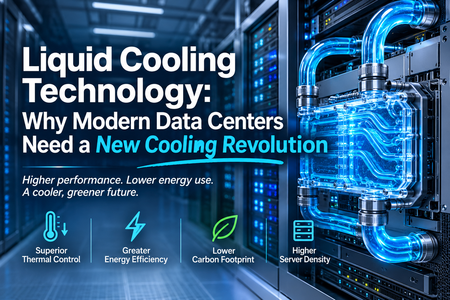
The rapid growth of artificial intelligence (AI), cloud computing, big data, and high-performance computing is transforming the digital world. Behind every AI model, online service, and cloud application is a powerful data center working around the clock to process enormous amounts of information.
However, this digital revolution comes with a significant challenge: heat.
As servers become more powerful and hardware becomes increasingly compact, traditional air-cooling systems are struggling to keep up with rising thermal demands. Data centers must find more efficient ways to maintain safe operating temperatures without dramatically increasing energy consumption and operating costs.
One technology is emerging as a promising solution: liquid cooling.
Liquid cooling is changing how modern data centers manage heat, improve energy efficiency, and prepare for the next generation of computing. But why is this technology becoming so important, and could it eventually replace traditional air cooling?
Let’s explore.
1. Why Traditional Data Center Cooling Is No Longer Enough
For decades, air cooling has been the standard approach to managing temperatures in data centers.
The concept is relatively simple. Air-conditioning systems circulate cold air through server rooms, while fans inside servers move air across processors, memory modules, and other heat-generating components. Hot air is then removed and cooled before being circulated again.
Although this approach has worked well for conventional IT infrastructure, modern computing workloads are creating new challenges.
Today’s AI accelerators, GPUs, and high-performance processors generate significantly more heat than many traditional server components.
Consider the increasing demands of:
-
Artificial intelligence: Training and running large AI models requires enormous computing power.
-
High-performance computing: Scientific simulations and complex calculations place intense workloads on processors.
-
Cloud computing: Growing demand for cloud services requires increasingly powerful server infrastructure.
-
Big data analytics: Processing massive datasets creates sustained hardware workloads.
-
Edge computing: Smaller facilities must deliver substantial computing performance in limited physical spaces.
As equipment becomes more powerful, maintaining optimal temperatures using air alone becomes increasingly difficult.
Traditional cooling systems may require more fans, additional air-conditioning capacity, and greater airflow. This can increase electricity consumption, operating expenses, and infrastructure complexity.
The industry needs a more efficient approach.
2. What Is Liquid Cooling Technology?
Liquid cooling is a thermal management technology that uses a liquid coolant to absorb and transport heat away from electronic components.
The fundamental principle is straightforward: liquids can transfer heat much more effectively than air in many practical cooling applications.
Instead of relying exclusively on cold air circulating through server racks, liquid cooling brings coolant closer to the components generating the most heat.
A typical liquid cooling system consists of several important elements:
-
Cold plates: Specially designed plates attached to processors or GPUs to transfer heat into circulating coolant.
-
Coolant distribution units (CDUs): Equipment responsible for managing coolant circulation, pressure, and temperature.
-
Pumps: Components that move coolant throughout the cooling circuit.
-
Heat exchangers: Devices that transfer heat from one cooling loop to another.
-
Pipes and connectors: Infrastructure that transports coolant between components.
The heated liquid carries thermal energy away from the servers, allowing the system to remove heat more efficiently.
Depending on the design, that heat can then be transferred to a facility water loop, cooling tower, dry cooler, or another heat-rejection system.
3. The Main Types of Liquid Cooling Used in Data Centers
Liquid cooling is not a single technology. Several approaches are available, each offering different advantages depending on the data center’s requirements.
A. Direct-to-Chip Liquid Cooling
Direct-to-chip cooling is one of the most promising approaches for modern high-performance servers.
In this configuration, specially designed cold plates are attached directly to heat-generating components, such as CPUs and GPUs.
Coolant circulates through channels inside the cold plates, absorbing heat before transporting it away from the server.
Key advantages:
-
Efficient cooling for high-performance processors.
-
Better thermal management under demanding workloads.
-
Reduced dependence on traditional server airflow.
-
Potentially higher computing density per rack.
This approach is particularly useful for AI infrastructure and GPU-intensive computing environments.
B. Immersion Cooling
Immersion cooling takes a different approach.
Instead of attaching cooling plates to individual components, entire servers or server boards are submerged in a specially engineered dielectric liquid.
This liquid is electrically non-conductive, meaning it can come into direct contact with electronic components without causing conventional electrical short circuits.
There are two main types:
Single-phase immersion cooling: The coolant absorbs heat while remaining liquid and is circulated through a heat exchanger.
Two-phase immersion cooling: The liquid boils when it absorbs heat, changing into vapor. The vapor then condenses back into liquid, allowing the cooling cycle to continue.
Immersion cooling can provide highly effective thermal management, although it requires specialized equipment, maintenance procedures, and hardware compatibility considerations.
C. Rear-Door Heat Exchangers
Rear-door heat exchangers provide another way to introduce liquid-based cooling into existing data centers.
These systems replace or modify the rear doors of server racks with heat exchangers.
Hot air leaving the servers passes through the heat exchanger, where circulating liquid removes much of its heat before the air returns to the data center.
This approach can be attractive for facilities looking to improve cooling performance without completely redesigning their server infrastructure.
4. Why AI Data Centers Are Driving the Liquid Cooling Revolution
Artificial intelligence is one of the biggest reasons liquid cooling is receiving so much attention.
Modern AI systems rely on powerful GPUs and specialized accelerators capable of performing enormous numbers of calculations simultaneously.
These processors generate substantial heat, particularly during intensive AI training and inference workloads.
As more accelerators are installed within individual racks, the thermal density of data center infrastructure increases.
Traditional air cooling can become difficult or expensive to scale in these environments.
Liquid cooling offers several important advantages:
Higher rack density
Liquid cooling makes it possible to manage heat from densely packed computing equipment more effectively, supporting infrastructure designed for demanding workloads.
Improved thermal stability
Direct cooling helps remove heat close to its source, reducing the risk of localized overheating.
Better performance management
Maintaining appropriate operating temperatures helps hardware operate within its intended thermal limits and reduces the risk of temperature-related performance throttling.
Support for future AI infrastructure
As computing hardware continues to evolve, liquid cooling provides data center operators with another option for accommodating increasingly demanding processors.
The growth of generative AI is therefore accelerating interest in liquid-cooled infrastructure.
5. Energy Efficiency: A Major Advantage of Liquid Cooling
Energy consumption is one of the largest operational challenges facing data center operators.
A significant amount of electricity is used not only to power servers but also to operate cooling infrastructure.
Traditional cooling systems often depend on powerful fans, compressors, chillers, and air-handling equipment.
Liquid cooling can reduce some of these demands by transferring heat more efficiently and potentially reducing the amount of mechanical refrigeration required.
The benefits may include:
-
Lower cooling-related electricity consumption.
-
Reduced reliance on large-scale air-conditioning systems.
-
Opportunities to use free cooling under suitable environmental conditions.
-
Improved overall data center energy efficiency.
-
Potential reductions in operational carbon emissions.
However, actual savings depend on the cooling architecture, climate, facility design, workload, and operating conditions.
It is also important to understand that liquid cooling does not automatically eliminate the need for chillers, pumps, or other cooling equipment.
Its greatest advantage comes from designing the entire thermal management system around efficient heat transfer.
6. Liquid Cooling and Data Center Sustainability
Sustainability is becoming a major priority for data center operators.
As digital infrastructure expands, companies face increasing pressure to reduce energy consumption, manage water resources, and minimize environmental impact.
Liquid cooling can contribute to these goals in several ways.
Reducing energy demand
More efficient heat removal can reduce the electricity required for cooling, depending on the facility configuration.
Supporting heat reuse
One particularly interesting opportunity is waste heat recovery.
Instead of simply releasing thermal energy into the atmosphere, data centers can potentially reuse recovered heat for:
-
District heating networks.
-
Commercial buildings.
-
Industrial processes.
-
Greenhouses.
-
Other nearby heating applications.
The feasibility depends on the temperature of the recovered heat and the availability of suitable infrastructure.
Improving resource utilization
Higher rack densities can allow operators to achieve more computing capacity within a given facility footprint.
This may help reduce the need for additional physical infrastructure as computing demand grows.
Nevertheless, sustainability must be evaluated across the entire system, including coolant production, water consumption, electricity sources, equipment manufacturing, and end-of-life disposal.
7. The Challenges of Implementing Liquid Cooling
Despite its advantages, liquid cooling is not a universal solution that can be introduced without planning.
There are several challenges organizations must consider.
Initial Investment
Liquid cooling systems often require specialized infrastructure, including pumps, CDUs, distribution piping, cold plates, and heat exchangers.
These investments can increase initial deployment costs.
Maintenance and Monitoring
Liquid cooling introduces additional maintenance requirements.
Operators must monitor coolant quality, pressure, temperature, flow rates, and connections.
Leaks, contamination, or improper coolant management can affect system reliability.
Hardware Compatibility
Not every server is designed for liquid cooling.
Organizations may need specialized components or modifications to existing infrastructure.
Operational Expertise
Data center teams must understand both traditional IT infrastructure and liquid-based thermal management systems.
This may require additional training and specialized maintenance procedures.
Retrofitting Existing Facilities
Introducing liquid cooling into an existing data center can be more complicated than implementing it in a newly designed facility.
Space limitations, plumbing requirements, power distribution, and equipment layouts must all be considered.
These challenges demonstrate why successful liquid cooling adoption requires careful engineering and long-term planning.
8. Liquid Cooling vs. Traditional Air Cooling
How do the two approaches compare?
| Feature | Air Cooling | Liquid Cooling |
|---|---|---|
| Heat transfer | Uses circulating air | Uses circulating liquid |
| High-density workloads | Increasingly challenging | Better suited to many high-density designs |
| Infrastructure | Established and familiar | Requires specialized equipment |
| Maintenance | Conventional HVAC and server maintenance | Requires coolant and liquid-system monitoring |
| Energy efficiency | Can become less efficient at high densities | Can reduce cooling energy in suitable designs |
| Initial investment | Often lower | Often higher |
| AI infrastructure | Suitable for some workloads | Particularly attractive for demanding AI systems |
Neither approach is automatically better in every situation.
Air cooling remains practical for many conventional data centers, while liquid cooling becomes increasingly attractive as rack densities and thermal requirements increase.
Hybrid systems combining air and liquid cooling can also offer a practical transition strategy.
9. The Future of Data Center Cooling
The future of data center infrastructure will likely involve a combination of technologies rather than a single universal cooling solution.
Several developments are worth watching.
AI-driven cooling management
Artificial intelligence can help analyze temperature measurements, cooling demand, workload patterns, and equipment performance to optimize cooling operations.
Advanced coolant technologies
New materials and coolant formulations may improve thermal performance, reliability, and environmental characteristics.
More efficient heat exchangers
Advances in heat exchanger design could improve heat recovery and reduce the energy required to maintain operating temperatures.
Modular liquid cooling infrastructure
Pre-engineered cooling modules may simplify deployment and make it easier to expand capacity as computing requirements grow.
Waste heat recovery systems
Future data centers may increasingly become integrated energy resources, supplying recovered heat to surrounding buildings and communities.
As AI and high-performance computing continue to develop, thermal management will become an increasingly important part of data center architecture.
10. Conclusion: The Cooling Revolution Has Already Begun
The growth of AI, cloud computing, and high-performance computing is changing the requirements of modern data centers.
Traditional air cooling remains an important technology, but it faces growing challenges as processors become more powerful and server racks become increasingly dense.
Liquid cooling provides a compelling alternative by bringing heat removal closer to the components that generate it.
From direct-to-chip cooling to immersion systems, these technologies offer new opportunities to improve thermal management, support higher computing densities, and potentially reduce cooling-related energy consumption.
Although implementation costs, maintenance requirements, and infrastructure compatibility remain important considerations, the long-term potential is significant.
Liquid cooling is no longer simply an alternative cooling method. It is becoming a critical part of the infrastructure needed to support the next generation of digital technology.
The data centers of tomorrow will need more than powerful processors and advanced networking. They will need smarter, more efficient ways to manage heat.
And liquid cooling could be one of the technologies that makes that future possible.