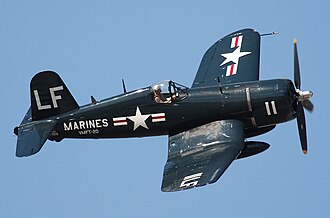
Vought F4U Corsair: The Bent-Wing Legend of the Pacific War
The Vought F4U Corsair is one of the most recognizable and successful fighter aircraft ever produced. With its distinctive inverted-gull wings, enormous three-bladed propeller, powerful radial engine and long fuselage, the Corsair looked unlike any other fighter of the Second World War. More importantly, its appearance reflected a very specific engineering challenge: Vought’s designers wanted to build a carrier-based fighter around the exceptionally powerful Pratt & Whitney R-2800 Double Wasp, an engine that demanded a huge propeller to turn its power into useful thrust. The solution was an inverted-gull wing that allowed the landing gear to remain relatively short while still providing adequate clearance for the propeller. The resulting aircraft became one of the first single-engine fighters to exceed 400 mph and eventually developed into a formidable fighter-bomber that remained in production until 1952. More than 12,500 Corsairs were ultimately built.
The Corsair’s reputation, however, was not established immediately. Its early carrier-handling characteristics were troublesome enough that the U.S. Navy initially kept it away from carrier decks, while U.S. Marine Corps units operated it primarily from land bases in the Pacific. This apparent disadvantage turned into an opportunity: Marine pilots quickly demonstrated that the Corsair’s combination of speed, heavy armament, rugged construction and excellent high-speed performance made it exceptionally effective against Japanese aircraft and ground targets. Later modifications solved many of its carrier-landing problems, allowing the Corsair to return to the role for which it had originally been designed. Its career subsequently extended well beyond the Second World War, including extensive service during the Korean War.
The Origins of the Corsair
Designing around the R-2800 Double Wasp
The story of the F4U began in 1938, when the U.S. Navy sought a new generation of high-performance carrier fighters. Vought engineer Rex Beisel and his team faced a fundamental challenge: the Navy wanted dramatically higher speed while still requiring the aircraft to operate from aircraft carriers. The answer was to build around Pratt & Whitney’s new R-2800 Double Wasp, an eighteen-cylinder radial engine that offered substantially more power than the engines then commonly used in American fighters. Contemporary design work envisaged an engine producing around 1,850 horsepower, with the potential to exceed 2,000 horsepower.
The enormous engine required an equally impressive propeller. The final aircraft used a Hamilton Standard propeller approximately 13 feet 3 inches in diameter. A propeller of that size could not simply be installed on a conventional low-wing fighter without creating serious ground-clearance problems. Longer landing gear would have solved part of the problem, but carrier aircraft required strong, compact landing gear capable of absorbing hard deck landings. Vought therefore adopted the unusual inverted-gull wing. The inner wing sections angled downward from the fuselage before the outer panels angled upward again, allowing the main landing gear to be relatively short while keeping the propeller safely above the ground and deck.
This famous wing was therefore not merely a styling exercise. It was an aerodynamic and structural solution to the problem created by combining a large-diameter propeller with a carrier aircraft. The design also gave the Corsair its unmistakable silhouette, one that has become almost synonymous with American naval aviation during the Pacific War.
The prototype breaks the speed barrier
The prototype, designated XF4U-1, made its first flight on 29 May 1940. Development proceeded rapidly, and by the end of that year the aircraft had demonstrated a maximum speed exceeding 400 mph, making it the first U.S. single-engine fighter to reach that threshold. The achievement was remarkable because the Corsair was not a lightweight experimental racer; it was being developed as a heavily armed, carrier-capable combat aircraft.
The Navy was sufficiently impressed to place a production order. In June 1941, an order for 584 F4U-1s was placed, with deliveries beginning in October 1942. Yet the aircraft’s transition from high-speed prototype to practical carrier fighter exposed a number of problems that had not been fully apparent during the initial flight-testing programme.
A Fighter Built for Speed and Firepower
The distinctive cockpit and fuselage
The production F4U-1 differed significantly from the original prototype. One of the most important changes was moving the cockpit approximately three feet aft to make room for an additional fuselage fuel tank. The change helped provide the range required of a carrier fighter, but it created a serious visibility problem. The pilot sat behind the large engine and long nose, with the aircraft’s wings further obstructing the view during landing approaches.
The Corsair’s long nose was a direct consequence of its powerplant and aerodynamic layout. The R-2800 was a large engine, and the designers wanted to preserve a streamlined fuselage rather than creating a bulky engine installation. The cockpit therefore sat relatively far aft, contributing to the aircraft’s distinctive profile. At high speed this arrangement worked exceptionally well, but at low speed and during carrier approaches it created considerable difficulties.
The early aircraft also suffered from a powerful torque effect and challenging stall characteristics. The landing gear could bounce after touchdown, while the tailhook could fail to engage the arresting wires. These problems were particularly dangerous on an aircraft carrier, where there was little room to recover from an unstable approach. The National Air and Space Museum notes that the early Corsair’s handling difficulties were serious enough that the Navy did not approve it for carrier operations until late in the war.
Six heavy machine guns
The production F4U-1 carried six .50-calibre Browning machine guns, with three installed in each outer wing panel. The arrangement provided the pilot with a formidable concentration of forward-firing firepower. Later Corsair variants could instead carry four 20 mm cannon, offering a different balance between ammunition capacity and projectile destructive power.
The Corsair was not restricted to air-to-air combat. It could carry bombs and rockets and eventually became one of the most important American fighter-bombers of the Pacific. Its combination of speed, heavy armament and substantial weapons load meant that it could escort other aircraft, attack enemy fighters and provide direct support to troops on the ground.
This versatility became increasingly important as the war progressed. The Corsair was not simply a fighter that happened to be capable of carrying bombs. It became a genuine multirole aircraft, able to switch between air superiority and ground-attack missions depending on operational requirements.
The Corsair Enters Combat
Marine aviation in the Solomon Islands
The Corsair entered combat in 1943, initially with U.S. Marine Corps units operating from land bases rather than American carriers. VMF-124 became the first Marine squadron to receive the type in February 1943, and additional Marine squadrons soon followed in the Solomon Islands. The aircraft’s speed and high-altitude performance gave Marine pilots a powerful new tool against Japanese forces.
The Corsair’s performance was especially valuable in the Pacific environment. Japanese fighters such as the Mitsubishi A6M Zero were highly manoeuvrable, but the Corsair offered advantages in speed, diving performance, firepower and ruggedness. American pilots learned to use those strengths rather than attempting to duplicate the close-range turning tactics at which some Japanese fighters excelled.
The aircraft’s combat success helped establish its reputation. The National Naval Aviation Museum records an approximately 11-to-1 kill ratio for the Corsair during the Second World War, while the museum also notes that Corsairs were credited with shooting down 2,140 Japanese aircraft during the Second World War and Korean War.
The Black Sheep and the Pacific legend
Few Corsair units became as famous as VMF-214, commanded by Major Gregory “Pappy” Boyington. Known as the Black Sheep, the squadron became closely associated with the Corsair and with the aggressive Marine fighter operations of the Solomon Islands campaign. The National WWII Museum records that during two six-week tours the squadron claimed 97 Japanese aircraft destroyed and another 103 damaged.
The Black Sheep’s fame has sometimes overshadowed the many other Marine and Navy units that flew the aircraft, but the squadron’s story illustrates why the Corsair became such a potent combat machine. Its pilots could exploit its speed and diving ability to attack enemy aircraft while maintaining the option of disengaging from an unfavourable turning fight.
The Corsair was also remarkably rugged. Its robust construction allowed it to absorb punishment and return to base, an important advantage in the unforgiving environment of Pacific island warfare. The aircraft’s long-range capabilities and ability to carry substantial external stores further increased its usefulness as American forces advanced toward the Japanese home islands.
Solving the Carrier Problem
Why the Navy initially hesitated
The irony of the Corsair’s early career is that it was specifically designed as a carrier-based fighter, yet the first American combat operators were primarily land-based Marines. The aircraft’s speed was impressive, but carrier aviation demanded much more than speed. A carrier fighter needed predictable low-speed handling, excellent visibility during approach, reliable landing gear and a tailhook system capable of catching arresting wires consistently. The early Corsair did not satisfy all of those requirements.
The solution was not to abandon the aircraft but to improve it. Engineers introduced a raised pilot’s seat, modified the canopy, strengthened the landing gear’s oleo struts, added a stall strip and raised the tail post to improve visibility during taxiing. These modifications significantly improved the aircraft’s handling characteristics. By April 1944, the Navy approved the Corsair for carrier operations.
This development illustrates an important feature of successful aircraft programmes: a promising design does not necessarily need to be perfect at the beginning. The Corsair’s fundamental aerodynamic and powerplant concept was sound enough that its weaknesses could be progressively corrected. Once those changes had been implemented, the aircraft could finally fulfil the carrier role for which it had originally been intended.
Production on a Massive Scale
Vought, Goodyear and Brewster
The Corsair became too important for Vought to manufacture alone. As demand increased, production contracts were awarded to Goodyear and Brewster. Goodyear-built aircraft received the designation FG, while Brewster-built Corsairs were designated F3A. This arrangement allowed the United States to increase production without waiting for Vought’s own factories to expand sufficiently.
The production figures are impressive. Vought built 7,829 Corsairs, Goodyear produced 4,006, and Brewster manufactured 735, giving a total of more than 12,500 aircraft. The U.S. Naval Aviation Museum states that production continued from 1942 until 1952, with 12,521 Corsairs built in 18 different models.
This long production run is one of the strongest indicators of the Corsair’s success. Many Second World War aircraft were rapidly replaced as jet technology emerged, but the Corsair remained valuable because its basic design had enough performance and structural strength to accommodate substantial improvements.
The Corsair as a Fighter-Bomber
Rockets and bombs
The Corsair’s importance cannot be measured solely by its air-to-air victories. It became an exceptionally effective fighter-bomber, particularly during the later Pacific campaigns. Later variants could carry bombs and multiple 5-inch High Velocity Aircraft Rockets (HVARs), allowing them to attack fortified positions, ships, vehicles and troop concentrations. Some configurations could carry up to approximately 4,000 pounds of bombs.
This ability made the Corsair particularly valuable to Marine Corps operations. Marine aviation was closely connected to amphibious warfare, where aircraft needed to provide immediate support to troops advancing against strongly defended islands. A fast fighter capable of delivering rockets and bombs could attack targets identified only shortly before the strike and then rapidly leave the target area.
The aircraft’s robust construction was again an advantage. Ground-attack missions exposed pilots to intense anti-aircraft fire, and an aircraft designed primarily for air combat might not survive repeated attacks at low altitude. The Corsair’s durability, engine power and heavy armament made it well suited to this demanding role.
The F4U-4 and the Korean War
More power for a proven design
The F4U-4 represented an important late-war development. It used the Pratt & Whitney R-2800-18W engine, capable of producing up to approximately 2,450 horsepower in the configuration cited by the National WWII Museum. The resulting aircraft could reach roughly 453 mph, making it faster than earlier Corsair versions.
The F4U-4 was the last major Corsair variant to see service during the Second World War. Its increased power and improved cockpit arrangement allowed the basic design to remain competitive even as the first generation of jet fighters appeared.
The aircraft’s career did not end with Japan’s surrender. During the Korean War, Corsairs were employed extensively in the ground-attack role. Their ability to carry heavy weapons loads made them valuable for close air support, interdiction and attacks against enemy infrastructure. The Corsair’s piston-engine performance was no longer sufficient to dominate the skies against jet fighters, but its low-altitude attack capabilities remained highly useful.
The aircraft achieved another remarkable distinction during Korea when a Marine Corsair pilot became the first to shoot down a MiG-15 jet fighter while flying a propeller-driven aircraft, according to the National Naval Aviation Museum.
International Service and Longevity
A fighter that outlived its era
The Corsair’s usefulness extended well beyond American service. Foreign operators received aircraft under various assistance programmes, and the type continued flying in several countries after the United States had moved toward jet-powered combat aircraft. The French Air Force and French naval aviation were among the postwar operators, while Corsairs also remained active in other parts of the world.
Its longevity was partly due to the flexibility of the design. The aircraft could be adapted for different missions, and its powerful engine allowed it to carry substantial weapons. Even after jets had transformed air combat, there remained circumstances in which a rugged piston-engine attack aircraft could be more economical and practical than a sophisticated jet.
The Corsair therefore belongs to a small group of Second World War aircraft whose operational careers continued long enough to bridge two distinct technological eras. It was born in the age of piston-engine aviation but remained useful after jet fighters had become the dominant technology.
The Corsair’s Legacy
More than an iconic silhouette
Today, the inverted-gull wings are probably the first thing people associate with the F4U Corsair. Yet the aircraft’s importance goes far beyond its distinctive appearance. It represented a major step forward in fighter performance, combining an exceptionally powerful engine with sophisticated aerodynamics and heavy armament. Its early speed was extraordinary for a carrier aircraft, and its ability to carry bombs and rockets transformed it into an effective multirole combat platform.
The Corsair’s career also demonstrates the importance of adaptation. The aircraft’s initial carrier problems could have ended its career, but engineers modified the design and pilots developed techniques that allowed it to overcome those weaknesses. What initially looked like a land-based solution became a successful carrier fighter, while its role as a Marine fighter-bomber became one of the defining aspects of its wartime identity.
Its reputation was earned through combat rather than appearance alone. From the Solomon Islands to the later Pacific campaigns and the Korean War, the Corsair repeatedly demonstrated speed, firepower and resilience. Its more than decade-long production run and total output of over 12,500 aircraft are further evidence of the confidence placed in the design.
Technical Specifications
Because the Corsair evolved through numerous variants, exact specifications varied considerably. The following table uses representative figures for the F4U-4, one of the most advanced versions to serve during the Second World War. Earlier F4U-1 and later F4U-5/AU-1/F4U-7 aircraft differed in engine power, weight, armament and performance.
| Specification | Vought F4U-4 Corsair |
|---|---|
| Type | Single-seat carrier fighter / fighter-bomber |
| Manufacturer | Vought-Sikorsky Division; also Goodyear and Brewster |
| Country of origin | United States |
| First prototype flight | 29 May 1940 |
| Crew | 1 |
| Engine | Pratt & Whitney R-2800-18W Double Wasp |
| Maximum power | Up to approximately 2,450 hp |
| Propeller | Hamilton Standard, three-bladed |
| Wingspan | 41 ft (12.50 m) |
| Length | Approximately 34 ft (10.36 m) |
| Wing area | Approximately 314 sq ft (29.2 m²) |
| Empty weight | Approximately 9,205 lb (4,175 kg) |
| Gross weight | Approximately 14,670 lb (6,654 kg) |
| Maximum speed | Approximately 453 mph (729 km/h) |
| Service ceiling | Approximately 41,500 ft (12,650 m) |
| Range | Approximately 900–1,005 miles (1,450–1,620 km), depending on configuration |
| Standard armament | 6 × .50-calibre machine guns |
| Alternative armament | 4 × 20 mm cannon on applicable versions |
| Rocket load | Up to 8 × 5-inch HVAR rockets |
| Bomb load | Up to approximately 4,000 lb in suitable configurations |
| Production period | 1942–1952 |
| Total production | Approximately 12,500+ aircraft |
| Primary wartime operators | U.S. Navy and U.S. Marine Corps |
| Major later conflict | Korean War |
Conclusion
The Vought F4U Corsair was an aircraft born from an ambitious idea: combine the largest practical piston engine of its era with a compact, aerodynamic fighter and achieve unprecedented speed without sacrificing carrier capability. The result was a machine whose distinctive inverted-gull wings became one of the most famous silhouettes in aviation history. But the Corsair’s real significance lies beneath that recognizable outline. It was an exceptionally powerful fighter, a heavily armed interceptor, a rugged ground-attack aircraft and eventually a highly capable carrier aircraft.
Its early difficulties make its eventual success even more remarkable. Poor visibility, difficult low-speed handling, bouncing landing gear and carrier-landing problems prevented the first Corsairs from immediately becoming the naval fighters they were intended to be. Rather than abandoning the design, however, engineers and pilots progressively solved those problems. Marine units meanwhile demonstrated that the aircraft’s enormous speed and power made it an exceptional land-based fighter and fighter-bomber. By 1944, the improved Corsair had finally earned approval for carrier operations.
The aircraft’s wartime record was followed by an unusually long postwar career. More than 12,500 Corsairs were built, production continued until 1952, and the type remained useful during the Korean War. Its ability to carry heavy bomb and rocket loads ensured that it remained valuable even after jet fighters had transformed aerial combat. The Corsair’s combination of performance, ruggedness and versatility made it one of the defining aircraft of American naval aviation.
Ultimately, the F4U Corsair is remembered not simply because it was fast or because it looked extraordinary, but because it successfully adapted to the changing demands of warfare. It began as a high-speed carrier fighter, became a celebrated Marine combat aircraft, evolved into a powerful fighter-bomber and survived into the jet age. Few propeller-driven fighters achieved such a broad and enduring career. The Corsair’s bent wings may have been created to solve a practical engineering problem, but they became the unmistakable symbol of one of the most successful combat aircraft of the Second World War.
.jpg)