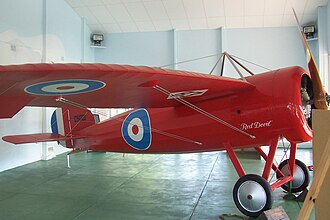
Bristol M.1: The Revolutionary Monoplane Fighter That Britain Nearly Overlooked
The Bristol M.1 was one of the most unconventional British fighter aircraft of the First World War. At a time when the Royal Flying Corps overwhelmingly favoured biplanes, Bristol’s chief designer, Captain Frank Barnwell, produced a streamlined single-seat monoplane that was faster and aerodynamically cleaner than many of its contemporaries. The aircraft’s rounded fuselage, shoulder-mounted wing and distinctive hemispherical spinner gave it a remarkably modern appearance, while its relatively small 110-horsepower rotary engine was sufficient to propel the production M.1C to approximately 130 mph (209 km/h). The Bristol M.1 was therefore an aircraft whose performance seemed to point toward the future of fighter design. Yet institutional suspicion of monoplanes, concerns about its landing characteristics and changing wartime requirements prevented it from becoming the major Western Front fighter that its designers had hoped to create. Only a limited number were built, and most served in training units or distant theatres rather than on the principal fighting front in France.
The M.1 is particularly interesting because its story does not fit the conventional narrative of technological progress during the First World War. It was not an unsuccessful aircraft because it was inherently slow, weak or poorly armed. On the contrary, its principal attraction was speed. Its problem was that British military aviation authorities were reluctant to embrace a monoplane fighter, despite the aircraft’s promising performance. The M.1 therefore became a fascinating example of the difference between what an aircraft could achieve technically and what an institution was willing to accept operationally. Its relatively brief frontline career, unusual design and later life in racing and civilian aviation have ensured that the Bristol M.1 remains one of the most intriguing aircraft of the Great War.
The Origins of the Bristol M.1
A new answer to the fighter problem
The Bristol M.1 emerged during a period of intense experimentation in fighter aircraft design. By 1916, aerial combat had evolved dramatically from the reconnaissance missions that had characterised the opening years of the war. Aircraft were now expected to intercept enemy scouts, protect reconnaissance formations and attack opposing aircraft, creating a demand for fighters that combined speed, manoeuvrability and effective armament.
Captain Frank Sowter Barnwell, Bristol’s chief designer, believed that one way to achieve higher performance was to reduce aerodynamic drag. The conventional biplane arrangement provided excellent structural strength and relatively compact wings, but the second wing inevitably introduced additional drag. A clean monoplane configuration could potentially achieve significantly higher speed from the same engine power. The Bristol design therefore adopted a single shoulder-mounted wing and a carefully streamlined fuselage.
Barnwell’s approach was particularly ambitious because the aircraft was not designed around an exceptionally powerful engine. Instead, aerodynamic efficiency was expected to compensate for the relatively modest output of the 110-horsepower Le Rhône rotary. The prototype consequently demonstrated how much performance could be obtained simply by reducing drag and refining the shape of the airframe.
The result was an aircraft that looked strikingly different from many contemporary British fighters. Rather than the open, skeletal appearance of aircraft such as the early Sopwith scouts, the M.1 had a smooth fuselage and a compact, almost streamlined appearance. Its large spinner further reduced drag around the engine installation and gave the aircraft its characteristic pointed nose.
The M.1 Prototype
First flight and impressive performance
The first prototype, designated M.1A, was completed in 1916 and flew for the first time on 14 July 1916. It was powered by a 110-horsepower Clerget rotary engine and incorporated many of the aerodynamic ideas that Barnwell had developed from earlier Bristol aircraft. According to the RAF Museum, the aircraft displayed a “sparkling performance and manoeuvrability,” while other historical sources record a prototype speed of approximately 132 mph during trials.
For a fighter powered by only 110 horsepower, this was remarkable. The aircraft’s low-drag configuration allowed it to exploit its engine power efficiently, giving it a speed advantage over many contemporary aircraft. The RAF Museum notes that its performance was in many respects superior to that of considerably later British fighters such as the SE5 and Sopwith Snipe, although comparisons between aircraft with different operational roles and configurations should naturally be treated with some caution.
The prototype’s success encouraged further development. Four M.1B aircraft were constructed, with different engines tested during the programme, including versions of the Clerget and Admiralty Rotary. The armament arrangement was also revised as Bristol and the military authorities investigated how best to turn the fast monoplane into a practical operational fighter.
The evolution into the M.1C
The definitive production aircraft became the M.1C. It was powered by the 110-horsepower Le Rhône 9J rotary engine and featured a centrally mounted synchronized Vickers machine gun, allowing the pilot to fire forward through the propeller arc. This was a major practical advantage because it concentrated the weapon directly along the aircraft’s line of sight and simplified aiming during combat.
The M.1C also retained the aerodynamic philosophy of the prototype. Its fuselage was carefully streamlined, while the shoulder-mounted wing and reduced frontal area helped minimise drag. The aircraft’s large spinner was another distinctive feature. It was not merely decorative: its streamlined form helped smooth the airflow around the rotary engine installation.
The production version was ordered in significant numbers by the standards of the time, with 125 M.1Cs constructed. Some sources give a total Bristol M.1 family production figure of approximately 130 aircraft when prototypes and other versions are included, while the RAF Museum and other historical references emphasise the 125-aircraft M.1C production order.
A Monoplane in a Biplane World
The problem of institutional prejudice
The most important reason the M.1 failed to become a major British fighter was not its speed. It was the widespread suspicion of monoplanes within British military aviation.
The Royal Flying Corps had developed a strong preference for biplanes, partly because of their structural characteristics and partly because of unfortunate experiences with early monoplanes. The RAF Museum specifically identifies institutional distrust of monoplanes as a major factor in the limited procurement of the M.1C.
This prejudice was not entirely irrational when viewed in the context of early aviation. Aircraft construction was still developing rapidly, and military planners had experienced structural failures with some early designs. The biplane configuration offered considerable structural strength with relatively lightweight materials, and it had become the established formula for military aircraft.
However, by 1916 the monoplane was capable of being built safely and effectively. The M.1 demonstrated that a carefully designed monoplane could offer an extraordinary speed advantage. Its experience therefore reveals a recurring theme in military technology: established designs can remain dominant even after an alternative technology demonstrates clear advantages.
Landing speed and pilot visibility
The M.1 also had genuine operational disadvantages. Its landing speed was around 49 mph, relatively high by the standards of the day. The RAF Museum records that its high landing speed was one reason it was considered unsuitable for the small airfields used on the Western Front.
The aircraft’s downward visibility was another concern. The broad wing roots and monoplane layout could obstruct the pilot’s view below the aircraft. Modifications included clear-view panels around the wing roots in earlier development aircraft, but the basic visibility issue remained a consideration.
These characteristics mattered considerably in First World War aviation. Pilots often operated from improvised grass airfields that could be short, uneven or muddy. A fighter that required a faster landing approach could present greater risks during takeoff and landing. The M.1’s high landing speed therefore gave military authorities a practical reason for caution even if its airborne performance was impressive.
The controversy was ultimately about more than speed. The M.1 demonstrated that a fighter could be exceptionally fast yet still fail to satisfy the complete set of requirements demanded by a frontline military aircraft.
Armament and Combat Potential
The Vickers machine gun
The production M.1C was armed with a single .303-inch Vickers machine gun mounted above the nose and synchronized to fire through the propeller. Although one machine gun may appear modest compared with later wartime fighters carrying multiple weapons, it was a standard arrangement for many single-seat scouts of the period. The centralized mounting offered an accurate line of fire and avoided the complications associated with wing-mounted guns.
The aircraft’s real advantage was its combination of speed and manoeuvrability. A fighter did not necessarily need an enormous number of guns if it could choose when and where to engage an opponent. The M.1’s performance theoretically allowed its pilot to dictate the geometry of an engagement, approach quickly, fire and then disengage.
That capability was particularly important against reconnaissance aircraft and slower enemy machines. The M.1’s speed made it an attractive interceptor, and its streamlined design meant that the relatively small engine could produce performance that appeared exceptional for its era.
Operational Service
The M.1 and the Western Front
Despite its impressive performance, the Bristol M.1 was never deployed operationally to France. Instead, most examples were assigned to training establishments in Britain or sent to other theatres. The RAF Museum records that only five squadrons were partly equipped with the type for operational use.
This is one of the great “what if” stories of First World War aviation. Had the M.1 been deployed to the Western Front in significant numbers, its speed could potentially have made it a valuable interceptor. However, its actual combat contribution was much more limited.
The decision not to use the aircraft extensively in France meant that the M.1 never had the opportunity to demonstrate whether its theoretical advantages could translate into a decisive operational advantage. Its reputation was therefore shaped largely by testing and by the successes of small numbers in other theatres.
Macedonia and the Middle East
The M.1C did see operational service in the Middle East and Macedonia, where the aircraft was employed by units including No. 72 Squadron and No. 150 Squadron. The RAF Museum notes that small numbers were deployed to Palestine, where they were reasonably effective in deterring Turkish reconnaissance aircraft, while the aircraft also saw useful service on the Macedonian front.
These deployments demonstrated that the M.1 was not simply a failed experiment. In environments where its speed could be exploited and where the limitations associated with Western Front airfields were less significant, it could perform useful combat work.
The aircraft also acquired an impressive association with Captain Frederick Dudley Travers, who scored five of his nine confirmed victories while flying the M.1. This combat record is significant because it provides tangible evidence that the aircraft could be an effective fighting machine when used operationally.
The M.1 was particularly suited to intercepting enemy reconnaissance aircraft. Its high speed gave it the ability to close rapidly with slower targets, while its compact size and manoeuvrability made it a useful platform for aerial combat.
The Bristol M.1 in Chile
An unexpected international chapter
One of the most interesting aspects of the M.1’s history occurred after examples were supplied to Chile. Six M.1Cs were delivered to the Chilean Air Force in 1917, giving the type an international career beyond British service.
The Chilean aircraft later became associated with a remarkable aviation achievement. On 12 December 1918, Lieutenant Dagoberto Godoy used a Bristol M.1C to make the first aerial crossing of the Andes. The aircraft’s speed and ability to operate at altitude made it a suitable machine for such a demanding undertaking.
This episode illustrates how the M.1’s strengths could become particularly valuable outside the circumstances for which it had originally been designed. A fighter that had been considered too demanding for certain Western Front airfields could become an important high-performance aircraft in another environment.
The Andes crossing also helped give the M.1 a place in aviation history beyond its relatively small wartime combat record. It became associated not only with the First World War but also with the early development of long-distance and high-altitude aviation in South America.
The M.1 After the First World War
From fighter to racing aircraft
The M.1 did not disappear immediately after the war. A number of surviving aircraft found new lives in civilian aviation, and at least one became particularly famous in Australia.
Captain Harry Butler operated a Bristol M.1C that became known as the Red Devil. The aircraft was used for demonstrations, racing and early commercial aviation activities. In August 1919, Butler flew it from Adelaide to Minlaton, carrying mail, in what became an important milestone in South Australian aviation history.
Another surviving M.1C was later modified by Australian aviator Captain Horrie Miller and became known as Puck. It was fitted with a de Havilland Gipsy engine and took part in aerial races, winning the Adelaide Aerial Derby in 1931 and 1932.
The aircraft’s postwar racing career is an important reminder of just how advanced its aerodynamic design had been. Long after the M.1’s military career had ended, its clean shape and low drag remained valuable for speed competitions.
Surviving Bristol M.1 Aircraft
Museum examples and replicas
The Bristol M.1 is rare today, but its unusual historical importance has encouraged preservation and reproduction. The RAF Museum possesses a reproduction M.1C, serial C4994, constructed by Don Cashmore using original manufacturer’s drawings. The aircraft first flew in 1987 before entering the museum’s collection. It was subsequently fitted with a 110-horsepower Le Rhône rotary engine to reproduce the appearance and configuration of an original M.1C.
The Shuttleworth Collection also operates a reproduction M.1C. Built by the Northern Aeroplane Workshops, it was delivered to the collection in 1997 and made its first flight in 2000. The aircraft is powered by a 110-horsepower Le Rhône 9J and carries the registration G-BWJM.
An original M.1C also survives in Australia. The aircraft associated with Harry Butler was preserved at the Harry Butler Memorial in Minlaton, South Australia, where it represents one of the most tangible surviving links to the M.1’s remarkable postwar career.
Why the Bristol M.1 Matters
A glimpse of the future
The greatest importance of the Bristol M.1 lies in what it represented. In 1916, it demonstrated that a streamlined monoplane could provide exceptional fighter performance with comparatively modest engine power. Its 130-mph capability was impressive for an aircraft of its time, and its aerodynamic philosophy anticipated the increasingly clean and powerful fighter designs that would dominate later generations.
Yet the M.1 also demonstrates that technological merit alone does not determine whether an aircraft succeeds. Military organisations operate within established assumptions about safety, tactics, logistics and training. The M.1 challenged some of those assumptions, and the resistance it encountered limited its potential.
The aircraft’s story is therefore particularly valuable because it reveals the tension between innovation and institutional conservatism. The M.1 was not perfect: its landing speed and visibility presented real challenges, and its single machine gun was not especially powerful by the standards that would emerge later in the war. But it was an innovative, fast and manoeuvrable fighter that deserved a more substantial operational opportunity than it received.
A pioneer of British monoplane fighters
The RAF Museum describes the M.1C as the first British monoplane of the First World War and notes that the RAF would not see another monoplane fighter until the Hawker Hurricane appeared in the late 1930s.
That long gap is striking. British fighter development remained strongly associated with biplanes throughout the interwar years, even as monoplane designs became increasingly dominant elsewhere. The M.1 therefore stands as an intriguing early example of a design direction that Britain would eventually embrace on a much larger scale.
The M.1 did not directly lead to the Hurricane or other later fighters, but its existence demonstrated that the monoplane concept was already viable in British service decades before the RAF fully committed to it. In that respect, the Bristol M.1 can be viewed as an early glimpse of the future of fighter aviation.
Technical Specifications
The following figures refer primarily to the production Bristol M.1C equipped with its standard 110-horsepower Le Rhône 9J rotary engine. Published specifications vary slightly depending on the source and whether empty or loaded weights are quoted, so the figures below should be regarded as representative.
| Specification | Bristol M.1C |
|---|---|
| Type | Single-seat fighter monoplane |
| Country of origin | United Kingdom |
| Manufacturer | British and Colonial Aeroplane Company (Bristol) |
| Designer | Captain Frank S. Barnwell |
| First flight | 14 July 1916 |
| Crew | 1 |
| Engine | 1 × Le Rhône 9J rotary |
| Engine power | 110 hp (82 kW) |
| Configuration | Shoulder-wing monoplane |
| Wingspan | 30 ft 9 in (9.37 m) |
| Length | 20 ft 5 in (6.24 m) |
| Height | Approximately 7 ft 9 in (2.37 m) |
| Wing area | Approximately 145 sq ft (13.5–13.6 m²) |
| Empty weight | Approximately 850–900 lb (385–409 kg) |
| Loaded weight | Approximately 1,300–1,348 lb (589–611 kg) |
| Maximum speed | Approximately 130 mph (209 km/h) |
| Landing speed | Approximately 49 mph (79 km/h) |
| Service ceiling | Approximately 20,000 ft (6,096 m) |
| Endurance | Approximately 1 hour 45 minutes |
| Armament | 1 × .303 in (7.7 mm) synchronized Vickers machine gun |
| Production | 125 M.1Cs; approximately 130 M.1 family aircraft including other versions |
| Primary wartime users | Royal Flying Corps / Royal Air Force |
| Foreign operator | Chilean Air Force |
| Operational theatres | Macedonia, Palestine and Middle East |
| Western Front service | Not deployed operationally in France |
Conclusion
The Bristol M.1 occupies a fascinating position in the history of First World War aviation. It was fast, streamlined and technologically unconventional, yet it emerged at a time when the British military establishment remained deeply committed to the biplane. Its 110-horsepower engine could propel the M.1C to around 130 mph, a remarkable performance for 1917, and its clean monoplane configuration demonstrated the enormous potential of reducing aerodynamic drag.
The aircraft’s limited operational career should therefore not be mistaken for proof that it was a poor fighter. Its small deployments to Macedonia and Palestine produced useful results, and individual pilots achieved combat success with it. Its speed made it particularly valuable for intercepting enemy reconnaissance aircraft, while its manoeuvrability gave it additional combat potential. The aircraft’s most famous international achievement came after the war, when a Chilean M.1C was used by Lieutenant Dagoberto Godoy to cross the Andes for the first time by air.
Perhaps the most enduring lesson of the Bristol M.1 is that innovation can arrive before an organisation is ready to embrace it. The M.1 appeared at a moment when military aviation was still learning what a fighter should look like, and its designers correctly recognised the advantages of a clean monoplane. But concerns about landing speed, pilot visibility and the perceived risks of monoplane construction restricted its use.
Today, the M.1 is remembered as one of the most distinctive British aircraft of the First World War and as an early demonstration of the potential of monoplane fighter design. Its streamlined fuselage, enormous spinner and single wing foreshadowed the increasingly aerodynamic aircraft that would eventually dominate the skies. Although only a small number were built and its wartime career was frustratingly limited, the Bristol M.1 remains an aircraft whose historical significance is considerably greater than its production numbers suggest.
