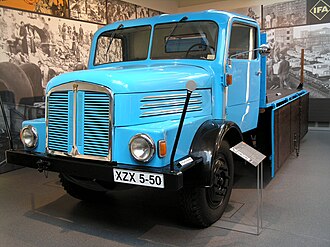
Horch H3A: The First Major Truck of Postwar East Germany
The Horch H3A occupies a special place in the history of German commercial vehicles because it was much more than simply another postwar truck. Developed and manufactured at the Horch works in Zwickau, the H3A became one of the earliest major truck designs produced in the Soviet occupation zone and subsequently the German Democratic Republic (GDR). It was a three-ton-class vehicle designed at a time when East Germany desperately needed modern commercial transport, yet its automotive industry was still recovering from the destruction, dismantling and material shortages that followed the Second World War. The H3A therefore combined ambitious engineering with the practical realities of an economy rebuilding almost from scratch. Presented at the Leipzig Spring Fair in 1949 and entering series production around 1950, it remained an important part of East German road transport through the 1950s. Contemporary and historical sources generally identify production of approximately 30,000 H3A vehicles, making it a foundational model for the developing East German truck industry.
The H3A was also significant because it represented a transition between two very different eras. Its predecessor, the short-lived H3, relied heavily on components and engineering concepts inherited from the prewar and wartime German automotive industry. The H3A, by contrast, was designed as a new generation of truck and introduced the EM 4-20 four-cylinder diesel engine, a 6.0-litre powerplant developed around the need for economical and durable commercial transportation. The truck used a conventional front-engine, rear-wheel-drive arrangement, a ladder frame, leaf-sprung solid axles and a five-speed manual gearbox. Although modest by today’s standards, the H3A was a serious working vehicle in its time, capable of carrying three tonnes initially and, from 1953, up to 3.5 tonnes in certain configurations.
The Historical Background of the Horch H3A
From the H3 to a New East German Truck
The history of the H3A begins with the difficult circumstances of postwar Germany. The Horch plant at Zwickau had been an important automotive manufacturer before the war, but after 1945 the industrial landscape was radically transformed. The Soviet occupation authorities took control of factories and industrial assets, while the newly emerging East German economy faced severe shortages of machinery, raw materials and components. The automotive industry nevertheless had an urgent responsibility: railways alone could not provide all the transportation required for reconstruction, agriculture, mining and industrial production.
The first postwar Horch truck was the H3, produced between 1947 and 1949. It was a three-ton truck, but much of its construction was effectively a transitional solution. The H3 relied on engineering and components associated with earlier German designs, including a Maybach petrol engine. Only around 852 examples were produced, illustrating its limited and temporary role. The H3 was therefore never intended to be the ultimate postwar medium truck. Instead, engineers at Zwickau were already working toward a completely new vehicle.
The result was the H3A. Its appearance at the 1949 Leipzig Spring Fair represented an important milestone because it showed that East German industry was attempting to move beyond simply assembling inherited components. The new vehicle was developed around a modern diesel engine and a chassis intended specifically for commercial operation. However, presenting a truck and producing it in meaningful quantities were two very different challenges. Industrial shortages delayed the transition to full production, and series manufacturing developed gradually before becoming established.
Production in Zwickau and Werdau
The main manufacturing base was the Horch works in Zwickau, although H3A production and related vehicle construction also involved the Werdau industrial complex. The truck was ultimately produced in a range of forms, including standard platform trucks, tipper trucks, tractors and specialized vehicles. This flexibility was crucial because the GDR required transport equipment for many different sectors of its economy.
Production figures show just how important the H3A became. A specialist historical source lists approximately 30,306 examples built during the model’s production period, while the truck remained in production through the 1950s before being superseded by newer IFA designs.
The Design of the H3A
A Conventional but Purposeful Layout
The H3A was not an experimental or radically unconventional truck. Instead, its engineers concentrated on producing a reliable and practical medium-duty vehicle using technologies that could realistically be manufactured and maintained in the postwar East German industrial environment. It used a front-mounted engine, rear-wheel drive and a conventional ladder frame, with rigid axles suspended by leaf springs.
This arrangement had several advantages. A ladder frame provided a strong foundation for different body types, while leaf springs were inexpensive, durable and relatively straightforward to repair. The rigid rear axle was particularly appropriate for a commercial vehicle expected to carry heavy loads repeatedly. The truck’s dual rear tires helped distribute the payload and provided additional traction and load-bearing capability.
The H3A had a wheelbase of approximately 3,250 mm, a length of roughly 6.17 metres and a width of approximately 2.39 metres. Its proportions gave it a substantial road presence without placing it in the heavy-truck class occupied by vehicles such as the larger H6.
The Characteristic Long-Bonnet Cab
Visually, the H3A is immediately recognizable by its long-bonnet configuration. This separated it from some later East German trucks that adopted more compact cab designs. The bonnet housed the diesel engine, while the driver and passenger sat behind it in a relatively conventional truck cab.
The styling was functional rather than decorative. The front grille, rounded fenders and large bonnet reflected the design language of early postwar commercial vehicles while retaining a strong connection to traditional Horch engineering. Early examples carried the distinctive Horch emblem, while later vehicles were increasingly associated with the IFA identity as the East German industrial structure developed. A surviving H3A displayed by the South Bohemian Motorcycle Museum, for example, illustrates the combination of the crowned Horch “H” and IFA branding seen during the transition.
The long bonnet also made mechanical access relatively straightforward. Unlike a cab-over-engine truck, the driver did not need to tilt the entire cab to reach the engine. For an early postwar vehicle operating in workshops with limited resources, this was a practical advantage.
The EM 4-20 Diesel Engine
Six Litres and Four Cylinders
The most important mechanical feature of the H3A was its EM 4-20 diesel engine. This water-cooled, four-cylinder, four-stroke diesel displaced approximately 6,024 cm³ and produced around 80 PS at 2,000 rpm. Its maximum torque was approximately 31 mkp, or roughly 304 Nm.
The engine was part of the East German Einheitsmotor, or standardized engine, development program. This was particularly significant because the Soviet occupation zone faced a shortage of suitable modern diesel engines and the industrial infrastructure needed to produce them. Historical accounts note that engineers drew upon prewar German engine-development work, including designs associated with the former Vomag organization, and developed a family of swirl-chamber diesel engines suitable for postwar truck production.
The choice of diesel power was logical. Commercial trucks spend much of their working life under load, and diesel engines offer advantages in fuel efficiency and low-speed pulling power compared with petrol engines. The H3A’s engine was not designed to produce impressive high-speed performance. Instead, its substantial displacement and relatively low operating speed emphasized durability and torque.
A Significant Improvement Over the H3
The transition from the petrol-powered H3 to the diesel H3A was more than a simple engine replacement. It represented a change in philosophy. The H3 had used a 4.2-litre six-cylinder Maybach petrol engine producing around 100 PS, whereas the H3A used a larger-displacement four-cylinder diesel with less peak horsepower but much stronger emphasis on economical commercial operation.
For a three-ton truck, 80 PS might appear modest today, but the H3A operated in an era when roads, payloads and traffic speeds were completely different. Its published maximum speed was around 60 km/h, which was adequate for the working conditions of the period.
The engine’s relatively low speed also suited the truck’s role. A commercial vehicle did not need to accelerate rapidly; it needed to maintain steady progress while loaded and climb gradients without excessive strain. The diesel’s torque characteristics were therefore arguably more important than its headline horsepower figure.
Transmission and Chassis
Five-Speed Manual Gearbox
Power from the EM 4-20 was transferred through a five-speed manual transmission with reverse gear. The gearbox was unsynchronized, meaning the driver had to use appropriate technique when changing gears, particularly during downshifts.
An unsynchronized gearbox required more skill than a modern transmission. Drivers had to coordinate engine speed and road speed carefully, and double-declutching could be necessary for smooth shifts. However, the mechanical simplicity of such a transmission was considered an advantage in a working vehicle of the period.
The five-speed arrangement also provided a useful spread of ratios. Lower gears allowed the H3A to get a loaded vehicle moving from rest, while the highest gear permitted economical cruising at the truck’s relatively modest maximum speed.
Leaf Springs and Solid Axles
The H3A’s suspension was based on leaf springs and rigid axles, a conventional solution for medium and heavy trucks. The front axle was a rigid steering axle, while the rear axle was driven and fitted with dual wheels. The arrangement emphasized durability and load carrying rather than passenger comfort.
Leaf springs are particularly well suited to commercial vehicles because they can support substantial loads while also serving as locating members for the axle. They are mechanically simple and can withstand considerable abuse. The compromise is ride quality: an unloaded truck with stiff leaf springs can feel harsh over uneven roads.
For operators of the H3A, however, reliability and carrying ability were more important than comfort. The truck was fundamentally a working tool.
The H3A as a Three-Tonne Truck
Payload and Practical Capacity
The H3A was initially classified as a three-tonne truck, placing it between smaller light-duty vehicles and the much larger heavy trucks used for major industrial transport. Historical specifications show a payload of 3,000 kg, with the permitted load later increasing to approximately 3,500 kg from July 1953.
This capacity made the H3A suitable for a wide range of jobs. A standard platform body could carry agricultural produce, machinery, building materials or industrial goods. A tipper body could transport bulk materials, while specialist equipment could transform the same chassis into a tanker, fire engine or service vehicle.
This adaptability was extremely important for the GDR economy. Rather than maintaining separate vehicle designs for every application, a common truck chassis could support many different body types.
Towing and Tractor Versions
The H3A was not limited to carrying cargo. A tractor version was introduced in 1951, and the chassis could also be configured for towing. Historical documentation indicates that H3A-based tractor units were used with tanker combinations and that the truck’s towing equipment could support substantial trailer loads.
This extended the usefulness of the H3A considerably. A truck could be configured as a conventional rigid vehicle for local deliveries or transformed into a tractor for heavier combinations. The underlying diesel engine and five-speed transmission provided the mechanical foundation for both roles.
The existence of these variants also illustrates how seriously East German industry approached standardization. The H3A was not merely a single truck model; it was a platform around which a family of commercial vehicles could be constructed.
Specialist Versions of the Horch H3A
Tippers, Fire Engines and Tankers
One of the most interesting aspects of the H3A’s career was the variety of bodies mounted on its chassis. Contemporary commercial-vehicle descriptions identify configurations including drop-sided trucks, tippers, fire engines, tankers, telephone-repair vehicles, enclosed refuse collectors and goods vans.
This diversity demonstrates the vehicle’s importance to everyday infrastructure. A truck might be found delivering goods during the day, while another H3A chassis served as a fire engine or municipal utility vehicle. The mechanical platform was sufficiently adaptable to accommodate very different superstructures.
Fire-service versions are particularly interesting today because they are among the best-preserved surviving examples. Their specialized bodies and equipment provide a direct reminder that the H3A was not merely a cargo hauler but an important part of the public-service vehicle fleet.
The H3B Bus Connection
The H3A chassis also contributed to passenger transport. Approximately 180 H3A chassis were used in the construction of IFA H3B buses during 1952 and 1953, illustrating how the truck platform could be adapted beyond conventional freight work. (Wikipedia)
The H3B relationship is significant because buses required a different combination of packaging, weight distribution and passenger accommodation. Nevertheless, the proven H3A mechanical foundation could serve as a starting point.
This was a common approach in postwar commercial-vehicle engineering: develop a robust chassis and then adapt it to multiple applications. In a resource-constrained economy, maximizing the usefulness of existing components was economically sensible.
The H3A and the East German Economy
A Truck for Reconstruction
The H3A should be understood in the context of postwar reconstruction. East Germany needed vehicles to transport raw materials, agricultural goods, industrial products and construction equipment. Railways were important, but road transport offered flexibility that trains could not provide.
The H3A therefore became part of the physical infrastructure of the emerging GDR. Its three-ton payload was enough for local and regional freight work, while its diesel engine made it suitable for sustained commercial use.
Production was nevertheless constrained by shortages. Historical records from the early 1950s describe difficulties obtaining materials such as sheet metal and front axles, and production targets could be difficult to achieve. A 1953 CIA report, for example, described the H3A as a major component of East German medium-truck production and noted that significant numbers were being ordered for the country’s emerging military and paramilitary organizations.
Military and State Service
Although the H3A was fundamentally a civilian commercial truck, it also found significant use in state organizations and the armed forces. The 1953 CIA report notes that a substantial share of military orders involved the H3A during 1952 and 1953. (
Its suitability for this role was straightforward. Military logistics require trucks that can carry supplies, personnel and equipment using established roads, while also being simple enough to maintain under difficult circumstances. The H3A’s conventional construction and diesel engine made it a practical choice.
Its rear-wheel-drive configuration meant it was not an extreme off-road truck like later specialized military 4×4 vehicles, but for road-based logistical transportation it offered useful capacity and reasonable durability.
The H3A’s Place in Horch History
From Horch to IFA
The name Horch has a much older history than the H3A. Before the Second World War, Horch was associated with high-quality passenger cars and formed part of Auto Union. After the war, however, the Zwickau plant became part of the state-owned East German industrial system.
The H3A thus represents a fascinating moment when the famous Horch name survived but its role had fundamentally changed. Instead of luxury automobiles, the Zwickau factory was now producing practical trucks required for national reconstruction.
As the East German automotive industry became increasingly organized under IFA, the branding on vehicles evolved as well. The H3A could therefore carry both historical Horch associations and the newer IFA identity. This transition is visible on surviving examples and reflects the broader political and industrial transformation taking place around them.
From H3A to IFA S4000
The H3A’s successor was the IFA S4000, representing another stage in the development of East German commercial vehicles. The H3A had established the basic medium-duty truck concept, but by the latter part of the 1950s the industry needed greater capacity, improved performance and updated engineering.
The H3A’s long production career nevertheless proved that the basic concept was sound. It had successfully established a domestic diesel-powered medium truck at a time when East German industrial production was still recovering from the consequences of war.
Driving the Horch H3A
A Very Different Experience From a Modern Truck
Driving an H3A today would be an experience very different from operating a modern commercial vehicle. The unsynchronized five-speed gearbox demands mechanical sympathy and driver involvement, while the large steering wheel, manual controls and basic cab insulation reflect a period when truck driving was physically demanding work.
The 80-horsepower diesel would not provide rapid acceleration, and a top speed around 60 km/h means that modern highways would not be its natural environment. Yet that misses the point of the vehicle. The H3A was designed for steady, dependable work rather than speed.
Its low-revving diesel and robust chassis would have been well suited to the roads of the early 1950s, when traffic volumes were much lower and journey times were measured differently. The important question was not how quickly the truck could travel empty, but whether it could deliver a full load reliably.
Mechanical Simplicity as an Advantage
The H3A’s mechanical simplicity is one of its most appealing characteristics for modern collectors. There are no electronic control units, complex emissions systems or computer-controlled transmissions. Its systems can be understood through traditional mechanical principles.
That simplicity was essential when the truck was new. Maintenance facilities varied considerably in quality and availability, especially outside major industrial centers. A vehicle that could be diagnosed and repaired using conventional tools had a significant advantage.
It also meant that the truck could continue working for years after its official production life had ended. Commercial vehicles often remain valuable long after manufacturers stop building them, provided replacement parts and mechanical knowledge remain available.
Technical Specifications of the Horch H3A
The following figures summarize the commonly documented specifications of the standard H3A. Some dimensions and payload figures vary between production years, body configurations and sources. In particular, the payload increased from three tonnes to approximately 3.5 tonnes during production.
| Specification | Horch H3A |
|---|---|
| Manufacturer | VEB Horch Kraftfahrzeug- und Motorenwerke Zwickau |
| Country | East Germany / GDR |
| Production | Approx. 1950–1957/1958 |
| Prototype/presentation | 1949 |
| Vehicle class | Medium-duty truck |
| Standard payload | 3,000 kg |
| Later payload | Approx. 3,500 kg from 1953 |
| Layout | Front engine, rear-wheel drive |
| Engine | IFA EM 4-20 diesel |
| Engine configuration | 4-cylinder, inline |
| Displacement | 6,024 cm³ |
| Cooling | Water-cooled |
| Fuel system | Indirect/swirl-chamber diesel injection |
| Maximum power | 80 PS at 2,000 rpm |
| Maximum torque | Approx. 31 mkp / 304 Nm |
| Transmission | 5-speed manual |
| Synchronization | Unsynchronized |
| Reverse gears | 1 |
| Suspension | Leaf springs, rigid axles |
| Brakes | Hydraulic drum brakes |
| Rear wheels | Dual tires |
| Tire size | 7.50–20 |
| Wheelbase | 3,250 mm |
| Length | Approx. 6,173–6,194 mm |
| Width | Approx. 2,370–2,386 mm |
| Height | Approx. 2,250 mm |
| Empty weight | Approx. 3,300–3,580 kg |
| Maximum speed | Approx. 60 km/h |
| Drive axle | Rear |
| Main body styles | Platform, tipper, tanker, specialist bodies |
| Other configurations | Tractor, fire engine, bus chassis |
| Approx. production | 30,000+ |
The numbers reveal an interesting balance. The H3A was not particularly powerful, but its six-litre diesel engine delivered the kind of low-speed torque appropriate for a three-ton commercial truck. Its five-speed gearbox allowed the available power to be used effectively, while the conventional frame and leaf-spring suspension provided a strong foundation for different bodies.
The Legacy of the Horch H3A
More Than an Old Truck
The importance of the H3A extends beyond its technical specifications. It represents the beginning of a distinct East German commercial-vehicle tradition. The truck demonstrated that the newly reorganized automotive industry could develop and manufacture a modern diesel-powered vehicle despite severe postwar limitations.
Its success also provided the industrial experience needed for later IFA trucks. Engineers, production workers and suppliers gained experience with diesel engines, heavy chassis construction, commercial bodywork and large-scale truck production.
The H3A consequently belongs to the foundation of the GDR’s automotive industry. Later trucks may have been more powerful or sophisticated, but the H3A helped establish the industrial capabilities on which they depended.
A Collector’s Vehicle Today
Surviving H3A trucks are now valuable historical artifacts. Their rarity, distinctive styling and importance in East German industrial history make them especially interesting to collectors and museums. Restored examples can often be found in transportation collections, military-vehicle displays and specialist automotive museums.
The August Horch Museum in Zwickau is particularly relevant to the story because the H3A is closely tied to the city’s automotive heritage. The surviving vehicles preserve not only the appearance of the truck but also the story of an industry rebuilding itself under extraordinary circumstances.
For enthusiasts, the H3A offers an appealing combination of engineering simplicity and historical significance. It is old enough to represent a completely different era of truck design, yet sophisticated enough to demonstrate the transition toward modern diesel commercial vehicles.
Conclusion
The Horch H3A was one of the defining trucks of early East German industrial history. Introduced at the 1949 Leipzig Spring Fair and entering series production around 1950, it was created to meet an urgent need for dependable commercial transportation at a time when the country’s industrial infrastructure was still recovering from the Second World War. Its conventional chassis, three-ton payload and six-litre four-cylinder diesel engine gave East German industry a practical medium-duty truck that could be adapted to a remarkably wide range of applications.
Its EM 4-20 diesel engine was perhaps its most important technical contribution. Producing around 80 PS from 6.0 litres, it was not intended to deliver speed but dependable pulling power and improved operating economy. The five-speed manual gearbox, leaf-sprung axles and robust ladder frame complemented this philosophy. The H3A was a machine built around steady, sustained work rather than performance in the modern sense.
The truck’s versatility was equally important. Platform trucks, tippers, tankers, fire engines, refuse vehicles, repair vans, tractors and even bus-related applications all emerged from the basic H3A platform. Historical sources document around 30,306 vehicles produced, while the model served civilian, industrial and state organizations throughout its career.
Perhaps the most fascinating aspect of the H3A is the period in which it was created. The truck represented the transformation of the Zwickau Horch works from a prewar automotive manufacturer into a key component of the East German state-owned vehicle industry. The famous Horch name remained attached to a vehicle that was no longer a luxury automobile but a rugged tool for rebuilding roads, factories, farms and public infrastructure.
In that respect, the H3A deserves recognition not merely as a historic truck but as an industrial landmark. It helped establish East Germany’s postwar commercial-vehicle production, introduced a domestically developed diesel powerplant into an important truck class and created the foundation for later IFA vehicles. Its modest 60 km/h top speed and three-ton payload may seem unremarkable today, but in the early 1950s the H3A was exactly what its economy needed: a practical, durable and adaptable workhorse.
The Horch H3A ultimately tells the story of a country rebuilding its transportation system one truck at a time. Its long bonnet, diesel engine and unmistakable Horch grille are reminders of a period when mechanical simplicity mattered enormously and a successful truck was judged by one basic question: could it carry the load and keep working? For the H3A, the answer was clearly yes.
