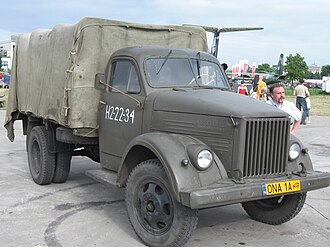
GAZ-51: The Legendary Soviet Workhorse That Built a Nation
The GAZ-51 is one of the most recognizable trucks in the history of Soviet automotive engineering and one of the most successful medium-duty commercial vehicles ever produced in the USSR. Designed in the years immediately before the Second World War, substantially redesigned during the conflict, and finally introduced into series production in 1946, the GAZ-51 became the backbone of civilian freight transportation across the Soviet Union. Its combination of a simple six-cylinder petrol engine, conventional 4×2 drivetrain, approximately 2.5-tonne payload and rugged chassis made it suitable for almost every sector of the postwar economy. Production continued in various forms until 1975, and the GAZ factory records more than 3.48 million GAZ-51 trucks built during the model’s exceptionally long career.
What made the GAZ-51 remarkable was not technological sophistication in the modern sense. Instead, its success came from the careful balance of durability, ease of repair, useful payload and relatively uncomplicated mechanical construction. The truck could operate on paved roads, gravel tracks and agricultural routes, while its standardized chassis provided a foundation for numerous specialized versions. It became familiar not only in the Soviet Union but also in other countries where Soviet vehicles were exported or produced under license. The Polish Lublin 51, for example, was based on the GAZ-51 and was manufactured at the FSC plant in Lublin beginning in 1951.
The Origins of the GAZ-51
Development Before the Second World War
The story of the GAZ-51 begins before the outbreak of the Second World War. The Gorky Automobile Plant had already established itself as one of the most important Soviet automobile manufacturers through models such as the GAZ-AA and GAZ-MM. By the late 1930s, however, these earlier trucks were becoming outdated. Soviet engineers wanted a modern medium-duty vehicle capable of carrying a larger payload while offering better road performance, improved reliability and greater standardization with other GAZ products.
Development work on the new truck began in the second half of the 1930s, and experimental vehicles appeared before the war. One of the key ideas was to create a truck with a payload of approximately 2.5 tonnes, positioned between the lighter GAZ vehicles and heavier Soviet trucks. Early prototypes were designated GAZ-11-51 and incorporated the six-cylinder engine derived from the GAZ-11 passenger-car power unit. A Czech museum account of the model’s development notes that prototypes had already been built and tested in 1939 before the project was interrupted by the war.
The war changed the development program dramatically. Soviet industrial capacity was redirected toward military production, and the GAZ plant became heavily involved in producing vehicles and other military equipment. The new truck could not immediately enter normal civilian production. Instead, engineers continued refining the concept during the conflict, incorporating lessons from military vehicle production and adapting the design to the realities of postwar Soviet manufacturing.
From Prototype to Production
After the war, the project was substantially revised. The resulting GAZ-51 was introduced into series production on 6 January 1946, according to the official GAZ historical archive. The model remained in production for decades, with the modernized GAZ-51A becoming the principal version from the mid-1950s.
This long production run is important because it explains why the name GAZ-51 covers vehicles that can differ noticeably in detail. Early postwar trucks had different body and cab arrangements from later examples, while mechanical and equipment changes were introduced throughout production. The 1955 modernization was particularly significant, after which the truck was generally identified as the GAZ-51A.
The GAZ-51 was also an immediate industrial success. In 1947, the engineering team responsible for the truck received the Stalin Prize for its design and development, while in 1948 the millionth GAZ vehicle produced by the factory was a GAZ-51. These milestones demonstrate how quickly the model became central to Soviet automobile manufacturing.
A Simple but Highly Effective Design
The Six-Cylinder Petrol Engine
The GAZ-51 was powered by a 3.485-litre six-cylinder petrol engine producing approximately 70 horsepower at 2,800 rpm. The engine represented further development of the GAZ-11 design and used a relatively low-compression configuration appropriate for the fuel available at the time. Historical specifications give a displacement of 3,485 cm³ and 70 hp at 2,800 rpm.
A 70-horsepower engine might appear extremely modest today, particularly for a truck capable of carrying 2.5 tonnes, but the GAZ-51 was engineered around low-speed pulling ability rather than rapid acceleration. The truck was expected to work continuously and reliably, often on poor roads, and the engine was designed with that mission in mind. Its six-cylinder configuration provided smoother operation than a comparable four-cylinder unit, while the long-stroke architecture produced useful torque at relatively low engine speeds.
The engine’s maximum torque is listed at approximately 201 Nm at 1,500 rpm, which illustrates the truck’s intended operating character. Drivers did not need to rev the engine aggressively to make progress. Instead, the truck delivered its useful pulling force in the lower part of the rev range, where it could work steadily under load.
The Four-Speed Manual Transmission
Power was transmitted through a four-speed manual gearbox driving the rear axle. The gearbox was deliberately uncomplicated and, in period specifications, lacked synchronizers. This meant that changing gears required considerably more mechanical involvement from the driver than is normal in a modern truck.
The lack of synchronization was not necessarily a major disadvantage for the period. Commercial drivers were trained to operate manual gearboxes correctly, and techniques such as double-clutching were part of normal driving practice. The simple gearbox also had the advantage of being mechanically straightforward and relatively easy to repair.
The GAZ-51’s rear-wheel-drive layout was similarly conventional. The front axle handled steering while the rear axle transmitted engine power to the road. For normal road freight, agricultural transportation and municipal work, this arrangement provided a sensible compromise between cost, mechanical simplicity and useful traction.
Chassis, Suspension and Payload
Built Around a 2.5-Tonne Payload
One of the defining characteristics of the GAZ-51 was its 2.5-tonne payload rating. This represented a substantial improvement over the earlier GAZ-AA, whose 1.5-tonne capacity had become increasingly inadequate for the growing demands of the Soviet economy. Contemporary Soviet automotive documentation identifies the GAZ-51 as the most numerous of the major postwar Soviet trucks in its class.
The increase in payload was particularly important during postwar reconstruction. Factories needed raw materials, cities required construction supplies, farms needed equipment and consumer goods had to be distributed across enormous distances. A truck that could carry two and a half tonnes offered a useful middle ground: large enough to perform meaningful commercial work but compact enough to operate on secondary roads.
The truck’s curb weight was approximately 2,710 kg, giving it a substantial but manageable relationship between empty mass and payload. Some catalogues list variations depending on configuration and production period, so individual surviving vehicles can differ.
Suspension Designed for Difficult Roads
The GAZ-51’s suspension was conventional but carefully engineered for the conditions in which Soviet trucks were expected to work. The front axle used leaf springs with hydraulic shock absorbers, while the rear axle was suspended by longitudinal leaf springs. The chassis was designed to tolerate substantial loads and repeated operation on uneven surfaces.
The truck’s approximately 245 mm of ground clearance was particularly useful outside urban environments. This allowed the GAZ-51 to negotiate rutted dirt roads and rough tracks without placing the lowest mechanical components dangerously close to the ground.
The combination of leaf-spring suspension, high clearance and relatively simple axles made the truck well suited to agricultural and industrial work. It was not an all-wheel-drive vehicle—the GAZ-63 fulfilled that role—but the rear-wheel-drive GAZ-51 could nevertheless operate effectively on a wide variety of roads when properly loaded.
Dimensions and Road Performance
A Compact Medium-Duty Truck
The standard GAZ-51 measured approximately 5,525 mm in length, 2,200 mm in width and 2,130 mm in height, with a wheelbase of approximately 3,300 mm. These dimensions placed the truck in a useful middle ground between smaller delivery vehicles and large highway trucks.
Its relatively compact footprint was an advantage in towns and industrial areas. The driver could maneuver the truck through narrow streets and loading yards more easily than a larger heavy-duty vehicle, while the 2.5-tonne payload provided enough capacity for a wide range of commercial work.
The maximum speed was approximately 70 km/h, although this figure should be interpreted in the context of the vehicle’s era. Soviet road networks were far less developed than modern highway systems, and much of the truck’s work involved regional routes where average speeds were substantially lower.
Fuel Consumption
The GAZ-51 was not economical by contemporary standards, largely because of its petrol engine and relatively low-efficiency drivetrain. Historical sources give operational fuel consumption in the region of 26–27 litres per 100 km.
This was an accepted compromise. The truck’s engine could operate on the fuels available to Soviet operators, and the priority was reliable transportation rather than minimizing fuel consumption. Later GAZ-51 variants were also developed for alternative gaseous fuels, reflecting Soviet efforts to reduce dependence on conventional petrol and make use of locally available fuel resources. Catalogued versions included gas/petrol configurations producing around the same nominal 70 hp.
The GAZ-51A Modernization
A Major Mid-1950s Update
In 1955, GAZ introduced the substantially modernized GAZ-51A. The original GAZ-51 had already established itself as an extremely successful truck, so the objective was not to replace the concept but to improve it.
One important improvement involved the cargo platform. Historical documentation notes that the internal platform dimensions were increased during the transition to the GAZ-51A, producing a more practical cargo area and allowing different configurations of side boards.
The modernization also introduced numerous smaller improvements to the truck’s mechanical and electrical systems. Over time, these changes made the GAZ-51A more convenient to manufacture and maintain while preserving the basic architecture that had made the original truck so successful.
The result was a truck that could remain competitive for another two decades. Rather than being replaced after a conventional model cycle, the GAZ-51 evolved gradually, allowing GAZ to keep production efficient while meeting changing operational requirements.
The GAZ-51 Around the World
Production Outside the Soviet Union
The influence of the GAZ-51 extended well beyond Soviet territory. One of the best-known foreign versions was the Lublin 51, manufactured in Poland by Fabryka Samochodów Ciężarowych in Lublin. Production began in 1951, and the Polish factory produced 17,479 examples through June 1959.
The Lublin version retained the essential characteristics of the Soviet design, including the 2.5-tonne payload, 4×2 layout and six-cylinder petrol engine. It was offered in several body configurations, including cargo vehicles and specialized enclosed versions such as sanitary and workshop bodies.
The Polish experience also demonstrates both the strengths and limitations of the design. The truck was robust and versatile, but its petrol engine consumed substantial quantities of fuel. As newer and more economical European trucks became available, vehicles such as the Lublin 51 faced increasing competition from models offering larger payloads or better fuel economy.
Specialized Versions of the GAZ-51
More Than Just a Flatbed Truck
Although the standard flatbed GAZ-51 became the most familiar version, the chassis was adapted for numerous specialized purposes. Its relatively straightforward frame and mechanical components made it an excellent foundation for vehicles with enclosed bodies, tanks, workshops, buses and municipal equipment.
Agricultural operators used GAZ-51-based vehicles to transport crops, feed and equipment, while industrial organizations used them for deliveries and mobile service work. Specialized bodies could be installed without fundamentally changing the truck’s underlying architecture.
There were also versions intended for passenger and cargo transport, including vehicles that combined a cab with an enlarged body for personnel. The GAZ-51’s versatility was one of the reasons it remained in production for so long: operators did not need an entirely different vehicle for every task.
Gas-Fueled Variants
The Soviet Union also experimented extensively with gaseous fuels. GAZ-51 variants were offered with engines adapted for gas, and some versions could operate using a gas/petrol fuel system. Catalogued specifications include 70-horsepower gas/petrol versions and a specialized GAZ-51 configuration producing approximately 76 hp on gas.
These vehicles were especially useful where gaseous fuel infrastructure was available. Although the technology imposed its own limitations, it demonstrated how the basic GAZ-51 platform could be adapted to changing fuel requirements without requiring an entirely new truck.
The GAZ-51 in Agriculture and Industry
A Truck for the Reconstruction Era
The GAZ-51 became inseparable from the economic reconstruction of the Soviet Union after 1945. Its production coincided with an enormous demand for transportation. Cities were rebuilding, factories were expanding and agricultural production required the movement of goods over increasingly large distances.
Because the truck was neither too large nor too small, it could be deployed almost anywhere. A single GAZ-51 might spend one part of its working life carrying construction materials and another transporting agricultural produce. The same basic truck could be found at factories, collective farms, municipal departments and state organizations.
This ubiquity contributed to its cultural significance. For several generations of Soviet citizens, the sight and sound of a GAZ-51 was simply part of everyday life. It was not an exotic specialist machine but a familiar piece of infrastructure.
Reliability as a Design Philosophy
The truck’s long service life also demonstrates the importance of designing for maintainability. A GAZ-51 could be repaired using relatively conventional mechanical tools and did not depend on sophisticated electronic systems or diagnostic equipment. This was essential in remote agricultural areas and smaller towns where access to specialized repair facilities was limited.
Its mechanical simplicity also made the truck attractive to operators who valued durability over comfort. The driving environment was basic by modern standards, but the vehicle was built around the idea that it should continue working even when conditions were far from ideal.
The Legacy of the GAZ-51
More Than Three Million Trucks
The production figures alone explain why the GAZ-51 became legendary. GAZ’s official history records 3,481,033 GAZ-51 trucks built over the model’s production life, with production beginning in 1946 and continuing until 1975.
Few commercial vehicles achieve such a production volume. The number reflects not only Soviet domestic demand but also the vehicle’s adaptability, long production life and international influence. The GAZ-51 became one of the defining trucks of the postwar Soviet period in much the same way that the GAZ-AA had symbolized an earlier era of industrialization.
Its enormous production run also meant that spare parts, maintenance knowledge and specialist bodies became widely available. This created a positive cycle: because many trucks were already operating, it made sense to continue producing parts and equipment, which in turn made it economical to keep older trucks in service.
A Bridge Between Generations
The GAZ-51 can also be seen as a bridge between prewar Soviet truck design and the increasingly specialized commercial vehicles of the later twentieth century. It retained the conventional bonneted layout and mechanical simplicity of earlier trucks but introduced a significantly more capable payload and a modernized powertrain.
The later GAZ-51A extended this philosophy, allowing the truck to remain relevant through the 1960s and into the 1970s. Meanwhile, related vehicles such as the four-wheel-drive GAZ-63 addressed applications where the standard GAZ-51’s 4×2 layout was insufficient.
Technical Specifications of the GAZ-51
The following table summarizes commonly cited specifications for the standard GAZ-51. Because the model remained in production for decades and received numerous modifications, exact dimensions, engine details and payload figures can vary by production period and body style. The figures below represent the principal specifications of the conventional 4×2 truck.
| Specification | GAZ-51 |
|---|---|
| Manufacturer | Gorky Automobile Plant (GAZ) |
| Country of origin | Soviet Union |
| Production | 1946–1975 |
| Modernized version | GAZ-51A, from 1955 |
| Vehicle type | Medium-duty truck |
| Drive configuration | 4×2 |
| Engine | GAZ-11 / GAZ-51 family |
| Engine type | Inline 6-cylinder petrol |
| Displacement | 3,485 cm³ |
| Valve arrangement | Side-valve |
| Maximum power | 70 hp (approx. 51 kW) |
| Rated engine speed | 2,800 rpm |
| Maximum torque | Approx. 201 Nm |
| Peak torque speed | Approx. 1,500 rpm |
| Transmission | 4-speed manual |
| Synchronizers | None on period gearbox |
| Payload | Approx. 2,500 kg |
| Curb weight | Approx. 2,710 kg |
| Maximum speed | Approx. 70 km/h |
| Wheelbase | 3,300 mm |
| Length | Approx. 5,525 mm |
| Width | Approx. 2,200 mm |
| Height | Approx. 2,130 mm |
| Ground clearance | Approx. 245 mm |
| Tyres | 7.50-20 |
| Fuel tank | Approx. 105 litres |
| Typical fuel consumption | Approx. 26–27 l/100 km |
| Main drivetrain | Front engine, rear-wheel drive |
| Primary applications | Freight, agriculture, construction, municipal work |
| Major related model | GAZ-63 |
| Foreign licensed derivative | Lublin 51 |
| Total production | 3,481,033 |
Conclusion
The GAZ-51 deserves its reputation as one of the great workhorses of Soviet automotive history. Its success was not based on spectacular performance or advanced technology but on a carefully judged combination of useful payload, robust construction, straightforward maintenance and adaptability. With its 3.5-litre six-cylinder petrol engine, four-speed manual gearbox and 2.5-tonne payload, it was ideally suited to the transportation requirements of a country rebuilding its infrastructure and expanding its industrial and agricultural production after the Second World War.
Its story began before the war, when Soviet engineers were already working on a new generation of medium-duty trucks. The conflict interrupted the program, but the project returned after 1945 in a substantially revised form. Once production began in January 1946, the GAZ-51 quickly became central to the Soviet commercial-vehicle industry. The truck’s engineering team received major recognition, and by 1948 a GAZ-51 had become the millionth vehicle produced by the Gorky plant.
The introduction of the GAZ-51A in 1955 ensured that the concept could survive into a new era. Improvements to the cargo platform and other systems allowed the truck to remain useful as transport requirements changed. Production ultimately continued until 1975, with more than 3.48 million examples produced. (museum.gaz.ru)
Its influence was also international. The Polish Lublin 51 demonstrated that the design could be manufactured outside the Soviet Union and adapted to local requirements, while numerous specialized bodies showed how flexible the chassis could be.
For today’s enthusiasts, the GAZ-51 represents much more than an old Soviet truck. It is a mechanical snapshot of an important period in twentieth-century history, when dependable road transportation was essential to industrialization, agricultural modernization and reconstruction. Its modest 70-horsepower engine, high ground clearance and 2.5-tonne payload may seem unremarkable by modern standards, but together they created a vehicle that could work almost anywhere and remain in service for decades.
The GAZ-51’s greatest achievement was therefore not speed, luxury or technical innovation. It was dependability on a massive scale. Millions of examples carried food, machinery, construction materials, agricultural products and countless other loads across the Soviet Union and beyond. Few trucks have been so closely associated with the everyday movement of an entire economy, and that is why the GAZ-51 remains one of the most important and recognizable trucks of the postwar era.
